The main difference in .357 Magnum velocity across different barrel lengths is that longer barrels allow more complete powder burn, resulting in higher muzzle velocity and energy. This cartridge was designed in the 1930s with large case capacity and relatively slow-burning powders. As a result, barrel length plays a more significant role in determining the final ballistic performance of the .357 Magnum than it does for almost any other common handgun caliber.
In this comprehensive guide, we will analyze exactly how much velocity is gained or lost depending on your barrel length. We will compare velocity, muzzle energy, powder burn efficiency, recoil, muzzle blast, accuracy, trajectory, and practical applications across a variety of setups. Using real chronograph data, we will definitively show which barrel length is best for concealed carry, home defense, hunting, and range use.
357 Magnum Velocity by Barrel Length Comparison Table
To understand the real-world impact of barrel length, we must look at actual chronograph testing. The data below is sourced from the independent testing database Ballistics By The Inch (BBTI), which recorded average velocities across incrementally chopped barrels.
Here is a side-by-side comparison of two standard factory loads: the Federal 125-grain JHP and the Federal 158-grain JHP.
| Barrel Length | Bullet Weight | Ammunition Brand | Average Velocity (fps) | Muzzle Energy (ft-lbs) | Velocity Gain (fps) | % Velocity Increase | Best Use |
| 2 inch | 125 gr | Federal JHP | 949 fps | 250 ft-lbs | Baseline | Baseline | Deep Concealment |
| 3 inch | 125 gr | Federal JHP | 1,255 fps | 437 ft-lbs | +306 fps | +32.2% | Concealed Carry |
| 4 inch | 125 gr | Federal JHP | 1,511 fps | 634 ft-lbs | +256 fps | +20.4% | Duty / Home Defense |
| 5 inch | 125 gr | Federal JHP | 1,571 fps | 685 ft-lbs | +60 fps | +3.9% | Open Carry / Range |
| 6 inch | 125 gr | Federal JHP | 1,702 fps | 804 ft-lbs | +131 fps | +8.3% | Target / Hunting |
| 8 inch | 125 gr | Federal JHP | 1,817 fps | 916 ft-lbs | +115 fps | +6.7% | Max Velocity / Hunting |
| 2 inch | 158 gr | Federal JHP | 858 fps | 258 ft-lbs | Baseline | Baseline | Backwoods Backup |
| 3 inch | 158 gr | Federal JHP | 1,102 fps | 426 ft-lbs | +244 fps | +28.4% | Trail Carry |
| 4 inch | 158 gr | Federal JHP | 1,293 fps | 586 ft-lbs | +191 fps | +17.3% | General Purpose |
| 5 inch | 158 gr | Federal JHP | 1,373 fps | 661 ft-lbs | +80 fps | +6.1% | General Purpose |
| 6 inch | 158 gr | Federal JHP | 1,465 fps | 753 ft-lbs | +92 fps | +6.7% | Hunting |
| 8 inch | 158 gr | Federal JHP | 1,570 fps | 865 ft-lbs | +105 fps | +7.1% | Hunting |
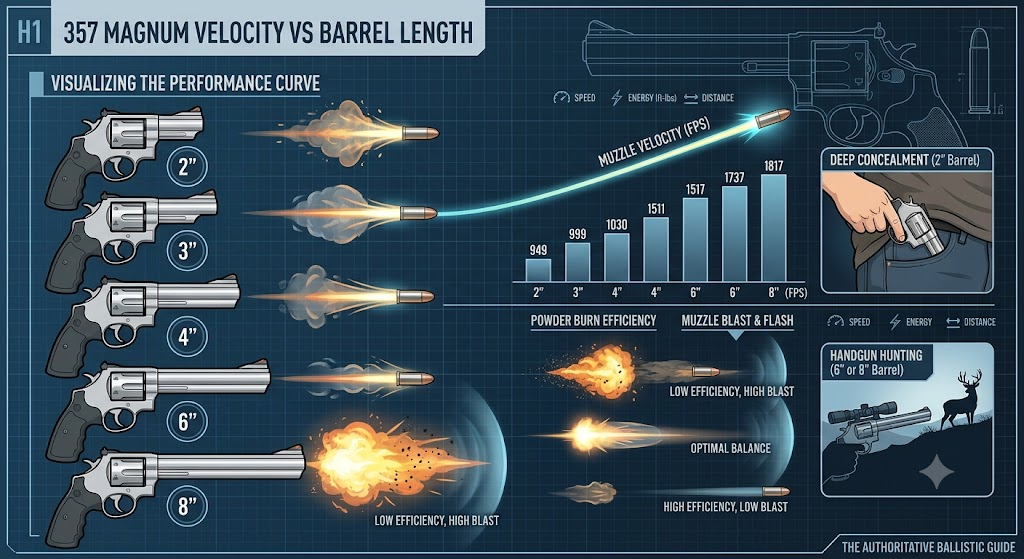
Analyzing these actual numbers reveals several critical realities about the .357 Magnum. Moving from a 2-inch snub nose to a 3-inch barrel yields a massive performance leap: the 125-grain load gains 306 fps (a 32% increase), and energy nearly doubles from 250 ft-lbs to 437 ft-lbs.
The data also proves that the .357 Magnum continues to gain significant velocity all the way up to 8 inches. While some calibers (like 9mm) plateau around 4 to 5 inches, the .357 Magnum 125-grain load pushes from 1,511 fps in a 4-inch barrel to a blistering 1,817 fps in an 8-inch barrel. This completely changes the terminal ballistics and effective range of the cartridge.
How Barrel Length Affects Velocity
Velocity is generated by the rapidly expanding gases produced when gunpowder ignites. As long as the pressure of the expanding gas behind the bullet is greater than the friction of the bullet traveling down the bore, the bullet will continue to accelerate.
Because the .357 Magnum has a relatively large case capacity compared to standard semi-automatic handgun cartridges, ammunition manufacturers typically load it with slower-burning magnum powders (such as H110 or W296). Slower-burning powders require a longer runway (barrel length) to achieve a complete burn.
When you fire a .357 Magnum from a 2-inch barrel, the bullet exits the muzzle before all the powder has had a chance to combust. The unburnt powder is ejected into the air, creating a massive fireball, but contributing nothing to the bullet’s speed. In contrast, a 6-inch or 8-inch barrel traps those expanding gases for a longer duration, converting more of that chemical energy into kinetic energy.
357 Magnum Powder Burn Efficiency
Powder burn efficiency refers to the percentage of the powder charge that actually ignites and pushes the bullet before it exits the muzzle.
In a 2-inch barrel, powder burn efficiency is remarkably poor for magnum loads. The bullet is in the bore for mere milliseconds. When the bullet clears the muzzle, high-pressure gas rushes out behind it, creating the notorious .357 Magnum muzzle blast.
By the time you step up to a 4-inch barrel, the powder has significantly more time to burn. While not 100% efficient, it captures the critical peak pressure curve of standard magnum powders, resulting in the ~1,300 to 1,500 fps velocities most shooters associate with the cartridge. By 6 and 8 inches, burn efficiency peaks for most factory loads, delivering maximum transfer of energy from the cartridge case to the projectile.
Velocity Gain Per Inch of Barrel
A common myth is that you gain exactly 50 fps per inch of barrel added. The BBTI data proves this is entirely false. Velocity gain is a curve, not a straight line, and the most dramatic gains occur at the shortest lengths.
Looking at the Federal 125-grain JHP:
- 2 to 3 inches: +306 fps (massive spike as minimum pressure thresholds are reached).
- 3 to 4 inches: +256 fps (still an incredibly steep climb).
- 4 to 5 inches: +60 fps (diminishing returns begin as the pressure curve flattens).
- 5 to 6 inches: +131 fps (varies slightly depending on barrel harmonics and powder).
- 6 to 8 inches: +115 fps (an average of +57.5 fps per inch).
This shows that the first 4 inches of barrel are critical for the .357 Magnum. You lose staggering amounts of velocity if you drop below 3 inches, but once you hit the 4-inch mark, you have captured the vast majority of the cartridge’s potential.
Muzzle Energy Comparison
Velocity is only half the equation; muzzle energy (measured in foot-pounds) dictates the sheer kinetic force the bullet carries. Because velocity is squared in the kinetic energy formula, small increases in speed result in massive increases in energy.
Let’s look at the Federal 158-grain JHP:
- 2-inch barrel: 258 ft-lbs of energy. (This is barely on par with a standard pressure 9mm).
- 4-inch barrel: 586 ft-lbs of energy. (Over double the energy of the 2-inch barrel).
- 8-inch barrel: 865 ft-lbs of energy. (Approaching modern rifle energies).
If you are carrying a .357 Magnum for defense against large animals (like bears), a 2-inch barrel robs the bullet of the energy required to crush through heavy bone and dense muscle. A 4-inch barrel provides the required ~600 ft-lbs to achieve deep penetration, making it the minimum recommended length for woods carry.
Trajectory Comparison
Trajectory is the flight path of the bullet. Because gravity acts on all bullets equally, a faster bullet will reach the target in less time, meaning it has less time to drop.
From a 2-inch barrel, the .357 Magnum has a rainbow-like trajectory past 50 yards because the bullet is traveling relatively slowly (under 1,000 fps with heavy loads).
From a 6-inch or 8-inch barrel, a 125-grain bullet exiting at 1,700+ fps shoots remarkably flat. If zeroed at 50 yards with a 6-inch barrel, a standard 125-grain load will drop only about 2 to 3 inches at 100 yards, making it highly effective for medium-range target shooting and hunting.
Bullet Drop Comparison
Let’s quantify the bullet drop using average ballistic coefficients for a 158-grain projectile fired from a short barrel vs a long barrel:
- Short Barrel (2-inch, ~900 fps): At 100 yards, the bullet will experience over 10 inches of drop, requiring significant holdover.
- Long Barrel (6-inch, ~1,450 fps): At 100 yards, the bullet will drop approximately 4 to 5 inches. At 50 yards, drop is negligible.
A longer barrel directly translates to less bullet drop, increasing your hit probability on small targets at extended ranges.
Recoil Comparison
Sir Isaac Newton’s Third Law of Motion dictates that for every action, there is an equal and opposite reaction. As bullet velocity goes up, recoil goes up. However, barrel length heavily impacts the felt recoil.
- Weight: Longer barrels are heavier. A 6-inch steel-framed revolver weighs significantly more than a 2-inch snub nose. This physical mass absorbs a tremendous amount of recoil energy.
- Velocity: While the bullet is moving faster out of a 6-inch barrel (which increases total recoil force), the heavy gun tames the snap.
- The Snub Nose Penalty: Firing a full-power .357 Magnum from a 2-inch, lightweight revolver is notoriously punishing. Even though the bullet is slower (generating less total kinetic energy), the lack of gun weight means all that force is driven directly into the shooter’s palm.
For sheer shooting comfort, a 4-inch or 6-inch barrel is vastly superior to a 2-inch barrel.
Muzzle Blast Comparison
Muzzle blast is the concussive pressure wave generated when the hot, expanding gases exit the muzzle.
Because the .357 Magnum uses slow-burning powder, a 2-inch or 3-inch barrel will uncork those gases while they are still at extreme pressures. This creates a concussive shockwave that shooters feel in their sinuses and chest.
In a 6-inch or 8-inch barrel, the internal volume of the barrel allows the gases to expand and cool slightly before exiting the muzzle. The result is a more manageable muzzle blast. While still authoritative, a longer barrel significantly reduces the concussive slap to the shooter’s face.
Flash Comparison
Muzzle flash is directly tied to unburnt powder igniting when it meets the oxygen in the atmosphere outside the barrel.
- 2-inch & 3-inch Barrels: Produce blinding, beachball-sized fireballs. In a low-light self-defense scenario, firing a snub-nose .357 Magnum can temporarily degrade your natural night vision.
- 4-inch Barrels: Produce noticeable flash, but ammunition utilizing flash-suppressed powders (common in premium defensive loads) can mitigate this substantially.
- 6-inch & 8-inch Barrels: Muzzle flash is drastically reduced. Almost all of the powder has burned inside the bore, resulting in a much smaller visual signature.
Noise Comparison
The .357 Magnum is a phenomenally loud cartridge, often registering at over 160 decibels (dB), which can cause instant, permanent hearing damage.
A shorter barrel puts the muzzle closer to the shooter’s ears and releases gases at a higher pressure, making it perceptibly louder and sharper. A 2-inch snub nose indoors is deafening. While an 8-inch barrel is still far above the threshold for hearing damage, the sheer distance of the muzzle from the shooter’s ear, combined with lower exit pressures, makes it slightly less punishing on the firing line.
Accuracy Comparison
A barrel’s length does not mechanically make the gun more intrinsically accurate (a 2-inch barrel locked in a machine rest can shoot exceptionally tight groups). However, barrel length profoundly impacts practical accuracy—the ability of a human being to shoot the gun well.
- Sight Radius: The distance between the front and rear sight. A 6-inch barrel has a long sight radius, meaning tiny misalignments are easy to see and correct. A 2-inch barrel has a sight radius of just a few inches; a millimeter of misalignment translates to missing a target completely at 15 yards.
- Velocity Consistency: Longer barrels often yield lower standard deviations in velocity, leading to tighter vertical groupings on target.
Effective Range Comparison
Based on velocity, energy, and practical sight radius, the effective range of the .357 Magnum scales directly with barrel length:
- 2-inch Barrel: 0 to 15 yards. (Velocity loss inhibits reliable hollow-point expansion at distance).
- 3-inch Barrel: 0 to 25 yards.
- 4-inch Barrel: 0 to 50 yards. (Maintains sufficient velocity for expansion and energy transfer).
- 6-inch Barrel: 0 to 75 yards.
- 8-inch Barrel: 0 to 100+ yards. (Excellent velocity retention for hunting applications).
2-inch Barrel
The 2-inch snub-nose revolver is heavily compromised by the .357 Magnum cartridge, but remains immensely popular due to its size.
- Typical Velocity: 850 – 1,000 fps (158gr).
- Typical Energy: 250 – 350 ft-lbs.
- Advantages: Ultimate concealability. Lightweight. Easy to draw from concealment or a pocket.
- Disadvantages: Massive velocity loss. Punishing recoil. Extreme muzzle blast and flash. Poor sight radius. Hollow points may fail to expand due to low velocity.
- Best Applications: Deep concealed carry, backup gun.
Expert Note: When using a 2-inch barrel, many experts recommend carrying .38 Special +P instead, as you avoid the magnum blast and recoil while achieving nearly identical terminal performance from the short tube.
3-inch Barrel
The 3-inch barrel is considered by many revolver aficionados to be the “Goldilocks” length for a dedicated carry gun.
- Typical Velocity: 1,100 – 1,250 fps (158gr).
- Typical Energy: 400 – 450 ft-lbs.
- Advantages: Massive velocity jump over the 2-inch barrel (often gaining 200+ fps). Full-length ejector rod for faster reloads. Still highly concealable.
- Disadvantages: Harder to pocket carry than a 2-inch. Still produces significant blast.
- Best Applications: Inside-the-waistband (IWB) concealed carry, trail gun.
4-inch Barrel
The 4-inch barrel is the universal standard for police duty, home defense, and general purpose use. It allows the .357 Magnum to truly act like a magnum.
- Typical Velocity: 1,250 – 1,500 fps (depending on bullet weight).
- Typical Energy: 550 – 650 ft-lbs.
- Advantages: Excellent balance on the belt. Recoil is manageable in a medium-frame gun (like the S&W 686). Achieves full, reliable hollow-point expansion.
- Disadvantages: Difficult to conceal without a dedicated cover garment.
- Best Applications: Duty carry, home defense, general woods carry.
6-inch Barrel
The 6-inch barrel maximizes the ballistic potential of standard factory ammunition without becoming completely unwieldy.
- Typical Velocity: 1,400 – 1,700 fps.
- Typical Energy: 700 – 800 ft-lbs.
- Advantages: Flattens trajectory. Long sight radius for precision accuracy. Gun weight tames recoil. Extracts maximum terminal performance.
- Disadvantages: Too long for comfortable daily carry. Slow to draw from a holster. Heavy.
- Best Applications: Target shooting, handgun hunting (deer, hogs), bear defense.
8-inch Barrel
The 8-inch (and 8.375-inch) barrel is a specialized tool. It blurs the line between a handgun and a carbine in terms of ballistics.
- Typical Velocity: 1,500 – 1,850 fps.
- Typical Energy:800 – 950 ft-lbs.
- Advantages: Pushes 125-grain bullets past 1,800 fps. Exceptional accuracy. Almost zero muzzle flash.
- Disadvantages: Front-heavy and fatiguing to hold unsupported. Requires a specialized chest holster to carry practically in the field.
- Best Applications: Dedicated handgun hunting, metallic silhouette competition.
Real World Applications
Hunting Performance
For hunting medium game like whitetail deer or feral hogs, velocity and energy are paramount for ensuring a humane harvest. A 6-inch or 8-inch barrel is ideal. The increased velocity guarantees the bullet has enough kinetic energy (ideally over 600 ft-lbs at the target) to achieve deep penetration and expansion through bone and thick hide. A 4-inch barrel is acceptable at close ranges (under 50 yards), but shorter barrels should never be used for primary hunting.
Self Defense Performance
For self-defense, reliable bullet expansion is the primary goal. Because most modern JHP bullets are calibrated to expand reliably at velocities between 1,100 and 1,300 fps, a 3-inch or 4-inch barrel is the absolute sweet spot. A 2-inch barrel risks under-penetration or failure to expand, while a 6-inch barrel is too slow to draw in a close-quarters reactive scenario.
Home Defense Performance
Concealability does not matter in a nightstand gun, but maneuverability does. The 4-inch barrel is the undisputed king of home defense revolvers. It provides the full kinetic energy of the .357 Magnum to stop a threat, features a full-length ejector rod for clearing spent casings, and is short enough to navigate hallways safely.
Concealed Carry Performance
Carrying a firearm all day requires compromise. While the 2-inch snub nose is easiest to hide, the ballistic penalty is simply too high for many experts. The 3-inch barrel offers the best of both worlds: it conceals easily inside the waistband but retains enough velocity (averaging 1,250 fps with 125gr loads) to ensure the magnum round performs as intended.
Target Shooting Performance
Punching paper or ringing steel at the range is all about sight radius and mitigating fatigue. A 6-inch barrel offers a brilliant sight picture and enough forward weight to make shooting full-house magnum loads comfortable for long afternoon sessions.
Pros and Cons
2-inch Barrel
- Pros: Highly concealable, lightweight, easy pocket carry.
- Cons: Severe velocity loss, punishing recoil, blinding muzzle flash, short sight radius.
3-inch Barrel
- Pros: Massive velocity gain over 2-inch, full-length ejector rod, excellent balance of power and size.
- Cons: Harder to pocket carry, still has noticeable blast.
4-inch Barrel
- Pros: The industry standard, perfect balance, optimal terminal ballistics, manageable recoil.
- Cons: Requires an outside-the-waistband (OWB) holster or sturdy IWB setup to carry comfortably.
6-inch Barrel
- Pros: Maximum practical velocity for factory ammo, great accuracy, very tame recoil.
- Cons: Heavy, difficult to carry daily, slow to draw.
8-inch Barrel
- Pros: Carbine-like ballistics, lowest recoil, flat trajectory.
- Cons: Extremely front-heavy, specialized use only, difficult to holster.
Final Verdict
Based on the chronological velocity data and ballistic energy yields, here are the definitive recommendations:
- Best for Concealed Carry: The 3-inch barrel. It captures the vital velocity spike required for the .357 Magnum to expand reliably, while remaining easy to hide.
- Best for Home Defense: The 4-inch barrel. It delivers 100% of the terminal performance required to stop a threat without the unwieldy length of a target gun.
- Best for Hunting: The 6-inch barrel. It provides the perfect blend of high velocity (pushing 158gr bullets past 1,450 fps) and a sight radius long enough to make ethical shots at 50 to 75 yards.
- Best Overall Balance: The 4-inch barrel. If you can only own one .357 Magnum, a 4-inch medium-frame revolver will comfortably handle target shooting, home defense, and woods carry.
- Maximum Velocity: The 8-inch barrel. For the ballistic purist looking to extract over 1,800 fps from light bullets, the 8-inch tube is unparalleled.
FAQ
Does a longer barrel always increase .357 Magnum velocity?
Yes, up to a point. From 2 inches all the way to 18-inch rifles, the .357 Magnum consistently gains velocity. In handguns, velocity peaks smoothly around 8 to 10 inches depending on the powder used.
How much velocity does a .357 Magnum lose in a 2-inch barrel?
Compared to a standard 4-inch barrel, a 2-inch barrel will generally lose between 300 to 450 feet per second, completely castrating the round’s kinetic energy.
What is the best barrel length for .357 Magnum?
The 4-inch barrel is universally considered the best all-around length, offering optimal ballistic performance, balance, and manageable recoil.
Is a 4-inch revolver enough for hunting?
Yes, a 4-inch revolver is sufficient for hunting medium game like deer at close ranges (under 50 yards) using heavy 158-grain or 180-grain hard cast bullets.
Does an 8-inch barrel increase accuracy?
Mechanically, an 8-inch barrel is not intrinsically more accurate than a 4-inch barrel. However, it increases practical accuracy by giving the shooter a longer sight radius and taming recoil.
Does barrel length affect recoil?
Yes. A longer, heavier barrel absorbs more of the recoil force, reducing the felt “snap” in the shooter’s hands. Shorter barrels result in harsher, sharper recoil.
Does barrel length affect penetration?
Directly. Shorter barrels produce lower velocities. If a bullet is traveling too slowly, it lacks the kinetic energy required to push through heavy bone and dense tissue.
Does barrel length affect muzzle flash?
Yes. Shorter barrels expel unburnt powder into the air, creating large fireballs. Longer barrels allow the powder to burn inside the bore, significantly reducing muzzle flash.
Which barrel length has the best balance of power and portability?
The 3-inch barrel. It offers a massive leap in velocity over a 2-inch snub nose while remaining comfortable for inside-the-waistband concealed carry.
Is a snub nose .357 Magnum still effective?
It is effective as a close-range defensive tool, but a 2-inch .357 Magnum performs ballistically closer to a 9mm or hot .38 Special, accompanied by vastly more noise and recoil.