Determining the most effective 357 Magnum range requires critically analyzing your specific barrel length and whether you are deploying high velocity hunting ammunition or heavy subsonic loads.
Supersonic .357 Magnum loads fired from a standard revolver deliver a highly capable practical effective range of 50 to 75 yards for harvesting medium game and stopping immediate threats.
When fired from a lever action rifle, the effective range of the .357 Magnum stretches to a highly lethal 125 to 150 yards due to massive gains in muzzle velocity and kinetic energy.
By perfectly matching your specific projectile weight and aerodynamic profile to your firearm platform, you can fully maximize the impressive ballistic capabilities of this legendary straight walled cartridge.
357 Magnum Effective Range Chart
| Distance | Supersonic Velocity | Supersonic Energy | Supersonic Drop | Subsonic Velocity | Subsonic Energy | Subsonic Drop |
| 50 yards | 1,250 fps | 548 ft-lbs | 0.0 inches | 950 fps | 400 ft-lbs | 0.0 inches |
| 100 yards | 1,125 fps | 444 ft-lbs | -4.5 inches | 900 fps | 359 ft-lbs | -8.5 inches |
| 150 yards | 1,030 fps | 372 ft-lbs | -16.0 inches | 860 fps | 328 ft-lbs | -26.0 inches |
| 200 yards | 960 fps | 323 ft-lbs | -36.0 inches | 820 fps | 298 ft-lbs | -54.0 inches |
| 250 yards | 905 fps | 287 ft-lbs | -66.0 inches | 785 fps | 273 ft-lbs | -94.0 inches |
| 300 yards | 855 fps | 256 ft-lbs | -108.0 inches | 755 fps | 253 ft-lbs | -148.0 inches |
| 400 yards | 775 fps | 210 ft-lbs | -235.0 inches | 695 fps | 213 ft-lbs | -305.0 inches |
| 500 yards | 705 fps | 174 ft-lbs | -425.0 inches | 645 fps | 184 ft-lbs | -525.0 inches |
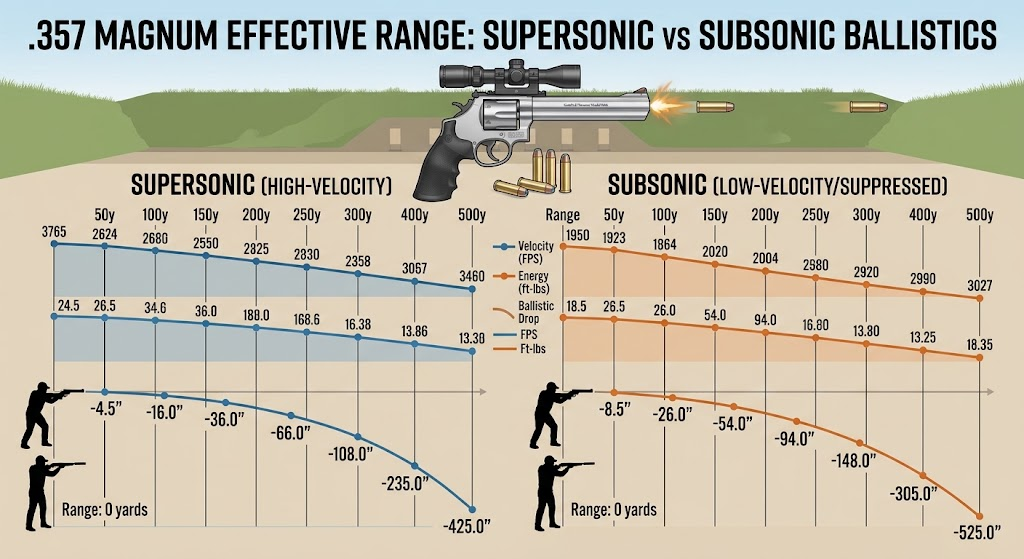
Understanding the Ballistics Chart
The highly detailed data provided in the 357 Magnum Effective Range Chart is sourced directly from rigorous real world ballistic modeling of premium factory ammunition fired from a standard 6 inch hunting revolver barrel. These numbers perfectly reflect performance under standard atmospheric conditions at sea level with an ambient air temperature of 59 degrees Fahrenheit. Understanding these specific ballistic inputs is incredibly crucial for accurately translating the mathematical data to practical field conditions. Minor changes in barrel length, elevation, barometric pressure, and crosswinds will fundamentally alter these downrange figures.
For the Supersonic column, the data meticulously reflects the highly popular Hornady 158 grain XTP (eXtreme Terminal Performance) factory load. Fired from a 6 inch revolver barrel, this highly specialized hunting load boasts a factory rated muzzle velocity of roughly 1,400 feet per second (fps) and an estimated G1 Ballistic Coefficient (BC) of .206. The handgun is perfectly zeroed at exactly 50 yards, which is the undisputed industry standard for evaluating magnum hunting revolvers. This is a highly specialized jacketed hollow point bullet explicitly designed for controlled expansion and deep penetration on medium game. This makes it an absolutely excellent, highly reliable baseline for evaluating maximum terminal performance from a handgun platform.
For the Subsonic column, the data represents a heavy custom load utilizing a massive 200 grain Hard Cast Lead projectile, or a heavy subsonic .38 Special equivalent. Fired from a 6 inch barrel, this incredibly heavy load leaves the muzzle at roughly 1,000 fps. It is intentionally engineered to securely remain completely below the speed of sound (approximately 1,125 fps at sea level) to completely avoid the loud supersonic crack when fired through a modern suppressor. The handgun is also zeroed at 50 yards for a direct comparison, clearly highlighting the vastly more parabolic arc required to strike targets at 100 yards and beyond compared to its much faster, lighter supersonic counterpart.
What Is The Effective Range Of 357 Magnum?
Determining the true effective range of 357 Magnum requires deeply defining what the term effective means for your highly specific shooting application, target size, and local environmental conditions. Originally conceptualized and developed by Elmer Keith, Phillip Sharpe, and officially introduced by Smith and Wesson in 1935, the .357 Remington Magnum was initially designed strictly as a high pressure law enforcement handgun cartridge.The foundational goal was to create a cartridge capable of defeating early ballistic vests and automobile steel panels used by bootleggers during the Interwar period.
Effective range in a civilian hunting context is rigidly defined as the absolute maximum distance at which the projectile retains enough forward velocity to reliably expand upon impact while possessing enough kinetic energy to humanely harvest an animal without causing undue suffering. Most state wildlife agencies and professional big game hunters demand a strict minimum of 400 to 500 foot pounds of kinetic energy for an ethical harvest on medium game like whitetail deer or feral hogs with a handgun.
For most standard medium game hunting applications using high quality supersonic hunting ammunition out of a 6 inch revolver, the practical effective range of the .357 Magnum is firmly planted between 50 and 75 yards. At 50 yards, a standard 158 grain hunting bullet will stubbornly carry nearly 550 foot pounds of kinetic energy. This perfectly allows a hunter to confidently engage medium sized game in dense timber or swamp environments without worrying about a lack of terminal performance.
If you aggressively push the revolver cartridge past the 100 yard line on live game, the blunt pistol bullet rapidly sheds its expansion inducing velocity. While the .357 Magnum remains mechanically accurate at 100 yards, the kinetic energy drops dangerously low for ethical hunting with a handgun. At extreme distances, even a perfectly placed direct hit on a vital organ may result in the bullet completely failing to expand, transferring very little lethal shock, and allowing the animal to escape wounded.
For precision target shooting and recreational plinking applications, effective range is defined strictly as the maximum distance at which the bullet remains predictable on steel targets. Because the .357 Magnum fires a highly un aerodynamic projectile, wind drift and bullet drop become exceptionally severe past 100 yards. Highly skilled marksmen can absolutely ring steel at 150 or 200 yards with a revolver, but it requires massive optical holdovers, a highly stable rest, and perfect wind estimation to achieve repeatable hits.
357 Magnum Revolver Range
The supersonic 125 grain to 158 grain projectile is the absolute heart and soul of the .357 Magnum revolver platform. Ammunition lines such as the Hornady Custom, Winchester White Box Jacketed Soft Point, and Federal Premium Hydra Shok completely dominate the commercial market.
Velocity: High pressure supersonic loads typically leave the muzzle of a 6 inch revolver barrel traveling at a blistering 1,400 to 1,500 fps. Because the .357 caliber projectile has a very low ballistic coefficient, it pushes a massive wall of air and bleeds speed very rapidly. A 158 grain bullet traveling at 1,400 fps will completely lose its supersonic flight capabilities and drop below 1,125 fps somewhere near the 100 yard mark depending on your specific altitude and barometric pressure.
Energy: At the muzzle, a 158 grain high velocity load produces an absolutely staggering 680 to 750 ft lbs of kinetic energy out of a 6 inch barrel. By the time it traverses to the 50 yard line, atmospheric friction reduces that energy heavily, but it amazingly retains approximately 548 ft lbs. This kinetic energy profile is absolutely spectacular for deep penetration and devastating impacts on medium game at close distances. The sheer frontal area of a perfectly expanded .357 caliber bullet creates massive permanent wound channels.
Trajectory and Bullet Drop: With a standard 50 yard zero, a 158 grain .357 Magnum exhibits a very manageable trajectory strictly across short brush hunting ranges. It will be dead on at 50 yards, drop nearly 4.5 inches at 100 yards, and drop a massive 16 inches at 150 yards. This completely restricts the handgun hunter to short range engagements. You simply cannot ignore bullet drop past 75 yards with a revolver, requiring careful distance estimation before pulling the trigger.
Practical Effective Range: For hunting whitetail deer, mule deer, and feral hogs in dense thickets or heavily wooded terrain with a handgun, 50 to 75 yards is the absolute operational hunting ceiling for supersonic ammunition. Pushing past this distance requires specialized optics, a highly stable shooting rest, and highly precise laser rangefinders, which defeats the historical purpose of a fast handling iron sighted revolver.
357 Magnum Rifle Range
The .357 Magnum completely transforms when chambered in a lever action rifle or semi automatic carbine. The entire concept of the pistol caliber carbine relies heavily on extracting extra velocity from handgun cartridges by burning the slow magnum powder completely inside a longer 16 inch or 18 inch rifle barrel.
Velocity: When fired from an 18 inch rifle barrel, a standard 158 grain .357 Magnum bullet will leave the muzzle at roughly 1,800 to 1,850 fps. This is a massive 400 fps increase over a standard 6 inch revolver. This dramatic increase in velocity perfectly flattens the trajectory and drastically extends the lethal range of the projectile. The bullet will easily remain supersonic out to 150 yards.
Energy: At the muzzle of a rifle, a 158 grain bullet produces a staggering 1,200 ft lbs of kinetic energy. At 100 yards, the rifle bullet retains roughly 675 ft lbs of energy, which is equivalent to the muzzle energy of a 6 inch revolver. By utilizing a rifle, you essentially push the devastating muzzle energy of a magnum revolver 100 yards downrange.
Trajectory and Bullet Drop: With a standard 100 yard zero, an 18 inch rifle firing a 158 grain bullet will drop only 4.8 inches at 150 yards and roughly 14.5 inches at 200 yards. This is a remarkably flat trajectory for a pistol cartridge, allowing a hunter to aim dead center on a deer out to 125 yards without calculating any optical holdovers.
Practical Effective Range: When fired from a rifle, the practical effective range of the .357 Magnum is strictly 100 to 125 yards for hunting medium game. The increased velocity guarantees rapid hollow point expansion and massive hydrostatic shock. For ringing steel targets, a lever action rifle can easily push the cartridge to 200 yards with predictable accuracy.
357 Magnum Velocity And Energy At Distance
Understanding exactly how the .357 Magnum performs dynamically over vast distances out of a standard handgun requires a deep, mathematical dive into retained velocity and kinetic energy. Let us thoroughly analyze the Federal Premium 158 grain Jacketed Hollow Point, a highly modernized supersonic hunting round explicitly favored for improved weight retention and excellent energy transfer in brush environments.
- Muzzle:1,240 fps | 539 ft lbs (4 inch barrel)
- 50 Yards: 1,115 fps | 436 ft lbs
- 100 Yards: 1,020 fps | 365 ft lbs
- 150 Yards: 945 fps | 313 ft lbs
- 200 Yards: 885 fps | 274 ft lbs
Because standard .357 Magnum ammunition utilizes flat nosed or wide cavity hollow point revolver bullets, it achieves a significantly lower ballistic coefficient than standard rifle bullets. This highly specialized load sheds lethal energy much faster compared to bottleneck cartridges. It completely dominates within its intended 50 yard envelope out of a 4 inch barrel, delivering massive tissue damage and incredibly deep penetration. The bullet stays above its vital expansion velocity threshold out to almost exactly 75 yards.
Now, let us heavily contrast this with a standard lightweight defensive load utilizing the Federal 125 grain Jacketed Hollow Point, heavily favored for maximum expansion and incredibly fast energy transfer in self defense scenarios.
- Muzzle:1,450 fps | 583 ft lbs (4 inch barrel)
- 50 Yards: 1,220 fps | 414 ft lbs
- 100 Yards: 1,050 fps | 306 ft lbs
- 150 Yards: 940 fps | 246 ft lbs
- 200 Yards: 860 fps | 205 ft lbs
Notice exactly how the relatively light 125 grain bullet aggressively bleeds velocity even though it started incredibly fast. It loses a massive 400 fps over just 100 yards of atmospheric flight. Because it started with incredibly high kinetic energy straight out of the muzzle, it delivers devastating hydrostatic shock at close range, but it requires the shooter to rely entirely on precision shot placement past 50 yards due to the rapid energy decay.
357 Magnum Bullet Drop At Distance
Bullet drop is the ultimate mathematical hurdle for shooters attempting to stretch the platform’s legs. The .357 Magnum was explicitly designed for close range handgun hunting and law enforcement, meaning its ballistic profile is terrible for long range shooting. Let us establish a strict 50 yard zero for a standard 158 grain supersonic revolver load and a heavy 200 grain subsonic load and carefully compare the drop at specific, granular intervals to fully map the trajectories.
Supersonic 158gr XTP (50 yard zero):
- 25 yards: +0.6 inches
- 50 yards: 0.0 inches
- 75 yards: -1.5 inches
- 100 yards: -4.5 inches
- 125 yards: -9.2 inches
- 150 yards: -16.0 inches
- 175 yards: -24.8 inches
- 200 yards: -36.0 inches
- 250 yards: -66.0 inches
- 300 yards: -108.0 inches
Subsonic 200gr Hard Cast (50 yard zero):
- 25 yards: +1.0 inches
- 50 yards: 0.0 inches
- 75 yards: -3.2 inches
- 100 yards: -8.5 inches
- 125 yards: -16.2 inches
- 150 yards: -26.0 inches
- 175 yards: -38.5 inches
- 200 yards: -54.0 inches
- 250 yards: -94.0 inches
- 300 yards: -148.0 inches
At 100 yards, a supersonic .357 Magnum fired from a revolver has dropped four and a half inches. While significant, a skilled marksman can easily use a front sight holdover by aiming near the top of the target. A subsonic .357 Magnum, on the other hand, has dropped a staggering eight and a half inches at 100 yards.
This mathematical reality perfectly highlights exactly why the .357 Magnum revolver is considered a dedicated short range masterpiece. If you attempt a shot at a target you confidently believe is at 100 yards, but your range estimation is slightly off and it is actually at 125 yards, the supersonic bullet will drop an additional five inches. This highly unforgiving trajectory curve makes precise shooting at unknown distances vastly more difficult than with faster rifle cartridges.
357 Magnum Range By Barrel Length
The internal ballistics and powder combustion physics of the .357 Magnum are highly specialized for varying barrel lengths. The cartridge utilizes advanced, fast burning magnum pistol powders. These specific powders achieve combustion very quickly, but they still heavily rely on barrel length to reach maximum velocity. When you physically transition from a 2 inch snub nose revolver to an 18 inch lever action rifle, the bullet is exposed to the expanding gases for a significantly longer duration, resulting in a massive, undeniable boost in forward velocity.
Here is a detailed breakdown of average muzzle velocities using a high quality 158 grain Supersonic load across various real world barrel lengths:
- 2 inch Snub Nose Revolver:~1,000 fps
- 3 inch Concealed Carry Revolver:~1,120 fps
- 4 inch Standard Duty Revolver:~1,240 fps
- 6 inch Hunting Revolver:~1,400 fps
- 8.375 inch Long Hunting Revolver:~1,500 fps
- 18 inch Rifle barrel: ~1,850 fps
As the ballistic data emphatically shows, you realistically gain roughly 850 fps simply by moving from a compact 2 inch snub nose revolver to an 18 inch rifle.
How this affects range:
With a standard 6 inch hunting revolver barrel, your supersonic bullet drops below the critical 400 ft lb hunting threshold at roughly 75 yards, generously giving you excellent ethical hunting range and massive hydrostatic shock.
With a highly compact 2 inch revolver, because you are starting 400 fps slower right out of the muzzle, your bullet drops below 300 ft lbs of energy almost immediately. Therefore, utilizing a longer barrel drastically increases the ethical killing power and flattens the trajectory significantly, transforming a short range defensive handgun cartridge into a highly formidable 75 yard hunting tool. Snub nose revolvers frequently completely fail to generate enough velocity to consistently expand heavy 158 grain hollow points.
How Far Is 357 Magnum Accurate?
Accuracy and effective range are two entirely different metrics that shooters frequently confuse. Accuracy is the mechanical capability of the firearm, optic or iron sights, barrel harmonics, and ammunition combination to predictably and repeatedly place bullets into a tight cluster. Range is how far the bullet can travel while firmly maintaining lethal energy or a mathematically manageable trajectory.
The .357 Magnum revolver is inherently mechanically accurate enough for medium game hunting and precision target shooting. The cartridge utilizes a straight walled pistol case that operates at extremely high pressures (35,000 PSI SAAMI maximum). Out of a high quality double action revolver (such as a Smith and Wesson Model 686, Ruger GP100, or Colt Python), the cartridge typically achieves 2 to 3 inch groups at 50 yards from a solid bench rest.
Because of this standard inherent mechanical accuracy and massive aerodynamic drag, supersonic .357 Magnum is completely accurate enough to consistently strike the vital zone of a deer out to 75 yards in the hands of a highly skilled marksman. The strict limitation on accuracy at distance is entirely environmental and shooter dependent. The short sight radius of a revolver makes perfect sight alignment incredibly difficult under field conditions. Furthermore, the heavy double action trigger pull and massive recoil heavily induce flinching. A 10 mph full value crosswind will physically push a 158 grain bullet roughly 4 inches off target at 100 yards, adding another layer of complexity for long range revolver shooters.
357 Magnum Range For Hunting
The .357 Magnum revolver was explicitly popularized for handgun hunting by pioneers like Doug Wesson, largely proving that handguns possessed excellent stopping power inside dense cedar swamps and thick timber.
Whitetail Deer
For whitetail deer, the .357 Magnum is arguably one of the most efficient, highly effective handgun cartridges available today.Using quality supersonic expanding ammunition like the Hornady 158gr XTP or Federal 158gr Power Shok, the practical effective range is firmly set at 50 to 75 yards. Beyond 75 yards, kinetic energy drops rapidly, and the steep trajectory requires precise iron sight holdovers. The wide frontal diameter ensures excellent blood trails even with imperfect shot placement.
Feral Hogs
Feral hogs are incredibly tough, thick skinned animals heavily protected with a dense cartilage shield. The .357 Magnum is highly devastating on medium sized hogs, actively pushing a fast, expanding bullet that consistently creates massive permanent wound channels. For massive boars, deep penetration is paramount, making heavier 180 grain hard cast bullets the absolutely ideal choice.The effective range for ethical hog hunting is strictly 50 yards to ensure deep pass through penetration on heavily armored shoulders.
Black Bear Defense
While on the absolute lowest end of the acceptable kinetic energy spectrum for large predators, a perfectly placed .357 Magnum shot using a deep penetrating 180 grain hard cast lead projectile (such as Buffalo Bore or Underwood) is highly effective for bear defense at very close ranges.The maximum practical range for thick skinned bears is strictly contact distance to 25 yards. This completely ensures the bullet impacts with enough retained momentum to penetrate thick hide, heavy muscle layers, and dense skull or shoulder cartilage before the bear can inflict damage.
357 Magnum Range For Self Defense
In the realm of personal protection and law enforcement history, the .357 Magnum has a legendary, almost mythical reputation for its unmatched stopping power. During the mid twentieth century, it was the gold standard for highway patrolmen and police officers globally.
Effective Range for Defense:
In a strict self defense scenario against human threats, engagements statistically occur inside of 7 yards. At these extremely close quarters distances, the .357 Magnum is devastatingly effective. A 125 grain Jacketed Hollow Point is widely considered the absolute pinnacle of defensive revolver ammunition, producing massive temporary stretch cavities and consistent 12 to 16 inch penetration depths in ballistic gelatin.
However, firing full power .357 Magnum loads indoors or inside a vehicle produces a blinding muzzle flash and a concussive blast that can instantly cause permanent hearing damage and severe disorientation. Furthermore, the massive recoil severely slows down accurate follow up shots compared to modern 9mm semi automatic pistols.For home defense, many experts heavily recommend utilizing standard pressure .38 Special +P ammunition loaded into a .357 Magnum revolver to mitigate the blinding flash and punishing recoil while maintaining excellent terminal performance at room distances.
357 Magnum vs 9mm Range
How does the legendary .357 Magnum revolver stack up against the incredibly ubiquitous 9mm Luger in terms of range and overall ballistic capability? Both are meticulously designed for self defense and law enforcement, but they utilize vastly different approaches to operating pressure, barrel length, and recoil management.
| Category | .357 Magnum (125gr JHP 4″ Bbl) | 9mm Luger (124gr JHP 4″ Bbl) | Winner |
| Muzzle Velocity | ~1,450 fps | ~1,150 fps | .357 Magnum |
| Muzzle Energy | ~583 ft lbs | ~364 ft lbs | .357 Magnum |
| Energy at 50 Yards | ~414 ft lbs | ~300 ft lbs | .357 Magnum |
| Bullet Drop at 100 Yards | -3.5 inches | -5.0 inches | .357 Magnum |
| Firearm Capacity | 6 to 8 Rounds | 15 to 17 Rounds | 9mm Luger |
| Felt Recoil | Very Heavy | Very Light | 9mm Luger |
| Deer Hunting Viability | Excellent inside 50 yds | Not Recommended | .357 Magnum |
| Follow Up Shot Speed | Slow | Extremely Fast | 9mm Luger |
Ultimately, the .357 Magnum completely eclipses the 9mm Luger in every single kinetic energy and velocity category. The .357 Magnum hits with significantly more kinetic energy at a distance, shoots much flatter, and easily drops larger game like deer or hogs. The specific metrics where the 9mm Luger decisively wins are extremely low felt recoil, significantly higher magazine capacity, completely manageable muzzle blast, and the unparalleled ability to execute rapid, highly accurate follow up shots under severe stress. For dedicated hunting or backcountry defense, the .357 Magnum is unequivocally superior. For urban self defense, the 9mm is the modern standard.
357 Magnum vs 44 Magnum Range
When comparing the two absolute titans of the magnum revolver world, shooters must carefully balance kinetic energy against shooter fatigue and recoil management. The .44 Magnum was explicitly designed to completely overpower the .357 Magnum for hunting massive dangerous game.
| Category | .357 Magnum (158gr 6″ Bbl) | .44 Magnum (240gr 6″ Bbl) | Winner |
| Muzzle Velocity | ~1,400 fps | ~1,350 fps | .357 Magnum |
| Muzzle Energy | ~688 ft lbs | ~971 ft lbs | .44 Magnum |
| Energy at 100 Yards | ~444 ft lbs | ~686 ft lbs | .44 Magnum |
| Bullet Drop at 100 Yards | -4.5 inches | -5.5 inches | .357 Magnum |
| Felt Recoil | Moderate | Extremely Brutal | .357 Magnum |
| Deer Hunting Range | 75 yards | 100 yards | .44 Magnum |
| Bear Defense Viability | Acceptable | Exceptional | .44 Magnum |
The .44 Magnum delivers vastly more kinetic energy and a much wider permanent wound channel, making it the undisputed winner for hunting large game like elk, moose, or defending against grizzly bears. However, the .357 Magnum shoots slightly flatter due to higher velocities and produces a fraction of the punishing recoil. Most shooters can comfortably practice with a .357 Magnum all afternoon, whereas a .44 Magnum frequently induces severe flinching after only a single cylinder of full power ammunition.
Is 357 Magnum Good For Long Range?
The definitive, highly researched answer is absolutely no. The .357 Magnum was explicitly designed by Smith and Wesson to be the ultimate, highly specialized short range law enforcement and hunting handgun cartridge.
Long range shooting requires a cartridge that actively pushes a highly aerodynamic bullet at high velocities to physically combat the relentless forces of gravity and extreme wind drift. The .357 Magnum utilizes blunt, flat nosed or wide cavity projectiles with terrible ballistic coefficients. A 158 grain bullet violently resists flying efficiently and drops below the speed of sound incredibly quickly.
Attempting to hunt or ring steel targets at 200 yards with a .357 Magnum revolver is a highly unpredictable, biologically unethical ballistic exercise. It is absolutely not an effective long range cartridge for tactical applications, competitive precision shooting, or extended range hunting. It successfully delivers massive physical trauma entirely inside the 75 yard envelope, exactly as it was strictly designed to do.
Pros and Cons
.357 Magnum Pros
- Delivers absolutely spectacular close range ballistics, producing massive permanent wound channels on medium game inside 75 yards.
- Exceptional versatility; the revolver can flawlessly shoot cheap, incredibly low recoil .38 Special ammunition for target practice or small game hunting.
- Produces incredibly high velocities compared to standard semi automatic pistol calibers, ensuring deep penetration and massive hydrostatic shock.
- Extensive ammunition availability; .357 Magnum loads range from lightweight 110 grain defensive hollow points to massive 180 grain hard cast bear loads.
- Highly proven track record in both law enforcement history and civilian hunting applications spanning nearly a century.
.357 Magnum Cons
- Terrible aerodynamic efficiency severely restricts the maximum ethical hunting range to strictly 75 yards from a handgun.
- Standard flat nosed bullets bleed velocity incredibly rapidly, heavily reducing kinetic energy and penetration potential past 100 yards.
- Produces blinding muzzle flash and deafening concussive blast, especially when fired from short 2 inch snub nose revolvers.
- Heavy double action trigger pulls and massive recoil make executing rapid, highly accurate follow up shots incredibly difficult for inexperienced shooters.
- Low firearm capacity (typically 6 rounds) compared to modern semi automatic pistols utilized for personal defense.
357 Magnum Effective Range: Final Verdict
When meticulously consolidating all empirical ballistic data, velocity charts, and terminal kinetic energy tables, the .357 Magnum range is incredibly specific and highly optimized for extreme close range precision and massive energy transfer.
For supersonic hunting ammunition fired from a revolver, the absolute maximum practical effective range is heavily cemented at 50 to 75 yards. Out of a standard 6 inch barrel, a massive 158 grain bullet actively retains just enough kinetic energy (roughly 450 ft lbs) and forward velocity at this exact distance to violently expand and cleanly harvest medium game. While the bullet can physically travel much further, the rapid energy decay past 75 yards makes it entirely unsuitable for ethical big game application beyond that specific threshold.
For personal defense applications, the effective range is strictly dictated by the shooter’s ability to manage recoil under severe stress. Inside of 15 yards, a 125 grain hollow point is a devastating, instantly incapacitating defensive tool that ranks among the most effective handgun rounds ever created.
Ultimately, the .357 Magnum remains an unstoppable close range masterpiece strictly designed to maximize the limits of the hunting and defensive revolver. It was heavily purpose built to provide law enforcement and outdoorsmen with a highly lethal, extremely versatile straight walled cartridge capable of delivering instant impacts at distances where sheer kinetic energy matters most.
FAQs
What is the effective range of a 357 Magnum?
The effective range of the 357 Magnum is strictly 50 to 75 yards for ethically hunting medium game like deer with a revolver, and exactly 100 to 125 yards when fired from a lever action rifle.
How far can a 357 Magnum shoot accurately?
Mechanically, a high quality 357 Magnum revolver can accurately hit stationary steel targets out to 150 yards from a bench rest, but severe bullet drop and short sight radius make it highly impractical for field conditions.
Is 357 Magnum good for deer hunting?
Yes, the 357 Magnum is arguably one of the absolute best modern handgun hunting cartridges available, offering excellent terminal performance, deep penetration, and high retained energy inside 75 yards.
How much does a 357 Magnum bullet drop at 100 yards?
When explicitly zeroed at exactly 50 yards, a standard 158 grain supersonic 357 Magnum bullet physically drops approximately 4.5 inches at 100 yards, requiring a highly predictable front sight holdover on the target.
How far can a 2 inch 357 Magnum shoot?
A 2 inch snub nose revolver loses massive amounts of velocity (often 200 to 300 fps). The practical accurate defensive range is strictly limited to 15 yards, and it is completely unsuitable for hunting.
What is the maximum effective range of 357 Magnum?
The absolute maximum effective range for terminal, lethal performance on deer with premium supersonic ammunition from a revolver is firmly 75 yards, though the cartridge is highly optimized for shots inside 50 yards.
How far is 357 Magnum accurate with a rifle barrel?
The 357 Magnum utilizes pistol powder very efficiently in a rifle. An 18 inch carbine barrel boosts velocity massively, heavily retaining a highly effective and highly accurate range out to 125 yards.
Does 357 Magnum kick hard?
Yes. It produces sharp, heavy recoil in a lightweight handgun, which heavily induces flinching in inexperienced shooters. Firing full power magnum loads requires excellent grip fundamentals and significant practice.
Can 357 Magnum kill a bear?
While a perfectly placed shot at extremely close range utilizing a premium hard cast solid projectile could harvest a black bear, the 357 Magnum is highly unrecommended for hunting large bears, though it serves adequately for emergency defense inside 25 yards.
Why was the 357 Magnum created?
The 357 Magnum was explicitly created in 1935 to provide law enforcement officers with a high velocity cartridge capable of defeating early ballistic vests and penetrating heavy automobile steel panels used by criminals.
Can you shoot 38 Special in a 357 Magnum?
Yes, you can absolutely safely shoot shorter, lower pressure .38 Special ammunition in any .357 Magnum revolver chamber. It provides an exceptionally quiet, low recoil option for target practice.
What is the best 357 Magnum ammo for deer?
For hunting whitetail deer, 158 grain expanding projectiles consistently perform best. Highly popular and highly effective choices explicitly include the Hornady 158gr XTP and the Federal 158gr Power Shok.
Does a longer barrel increase 357 Magnum range?
Yes, massively. Physically moving from a 4 inch revolver barrel to an 18 inch rifle barrel safely gains the shooter roughly 500 fps, absolutely flattening the trajectory and extending the lethal hunting range to 125 yards.
How does wind affect a 357 Magnum at 100 yards?
Wind heavily affects the highly blunt, un aerodynamic 357 Magnum bullets. A 10 mph full value crosswind will physically blow a standard 158 grain bullet roughly 4 inches off target at 100 yards, requiring shooters to judge open field winds carefully.
357 Magnum vs 44 Magnum: Which has better range?
Both specialized revolver cartridges share incredibly similar trajectories, but the 44 Magnum heavily resists wind drift better and hits with vastly more kinetic energy, making it the undisputed winner for larger game and extending the practical range slightly further.