Determining the most effective .22 LR range requires analyzing your intended application, barrel length, and whether you are utilizing high-velocity or standard-velocity match ammunition. The .22 Long Rifle delivers a highly practical effective range of 50 to 75 yards for small game hunting and ethical pest control. For target shooting and precision rimfire competitions, high-quality .22 LR ammunition can accurately engage steel targets out to 200 or even 300 yards in capable hands. By thoroughly understanding the drastic bullet drop and wind deflection of this venerable rimfire cartridge, shooters can maximize its impressive ballistic capabilities.
.22 LR Range Chart
| Distance | High Velocity FPS | High Velocity Energy | High Velocity Drop | Standard Velocity FPS | Standard Velocity Energy | Standard Drop |
| 25 yards | 1,145 fps | 105 ft-lbs | -0.1 inches | 1,005 fps | 90 ft-lbs | +0.2 inches |
| 50 yards | 1,050 fps | 88 ft-lbs | 0.0 inches | 950 fps | 80 ft-lbs | 0.0 inches |
| 75 yards | 975 fps | 76 ft-lbs | -1.8 inches | 900 fps | 72 ft-lbs | -2.4 inches |
| 100 yards | 915 fps | 67 ft-lbs | -5.5 inches | 855 fps | 65 ft-lbs | -7.5 inches |
| 150 yards | 825 fps | 54 ft-lbs | -18.5 inches | 780 fps | 54 ft-lbs | -23.5 inches |
| 200 yards | 750 fps | 45 ft-lbs | -40.0 inches | 715 fps | 45 ft-lbs | -48.0 inches |
| 250 yards | 685 fps | 38 ft-lbs | -71.5 inches | 655 fps | 38 ft-lbs | -84.0 inches |
| 300 yards | 630 fps | 32 ft-lbs | -115.0 inches | 600 fps | 32 ft-lbs | -132.0 inches |
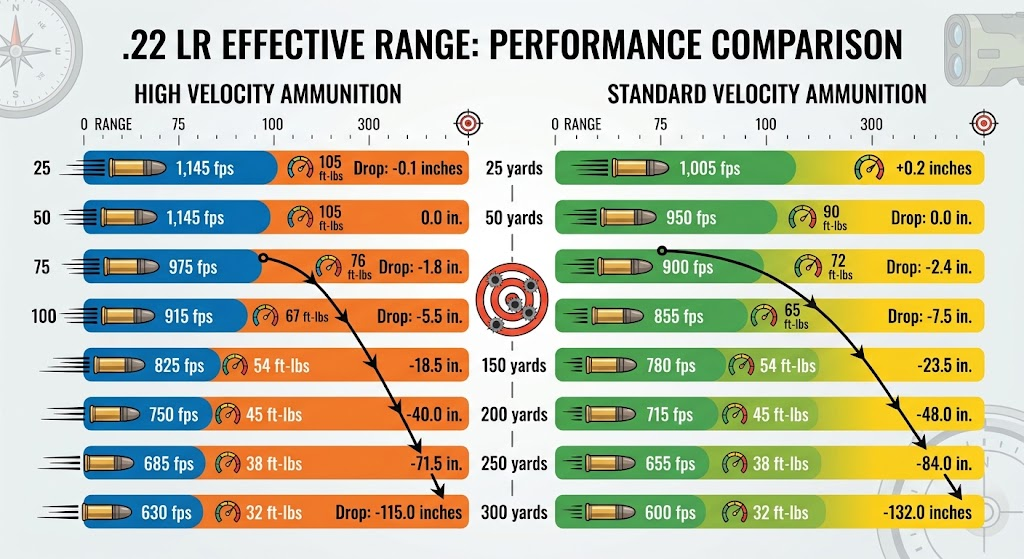
Understanding the Ballistics Chart
The data provided in the .22 LR Range Chart is sourced from real-world ballistic modeling of two industry-standard factory loads fired from a 16-inch barrel. Because the .22 Long Rifle uses a heel-based bullet with a notoriously poor ballistic coefficient, changes in atmospheric conditions will heavily alter these figures, but they serve as a highly accurate baseline.
For the High Velocity column, the data reflects the CCI Mini-Mag 36-grain Copper Plated Hollow Point (CPHP). Fired from a 16-inch barrel, this load has a factory-rated muzzle velocity of 1,260 feet per second (fps) and a G1 Ballistic Coefficient (BC) of .125. The rifle is zeroed at exactly 50 yards, which is the industry standard for .22 LR optics.
For the Standard Velocity column, the data represents the CCI Standard Velocity 40-grain Lead Round Nose (LRN) load, heavily favored by target shooters. Fired from a 16-inch barrel, this heavier match-style load leaves the muzzle at roughly 1,070 fps, intentionally keeping it below the speed of sound (approximately 1,125 fps) to avoid transonic destabilization. This bullet features a G1 BC of .120. The rifle is also zeroed at 50 yards, highlighting the slightly more parabolic arc required to meet the 50-yard crosshair.
What Is The Effective Range Of .22 LR?
Determining the effective range of the .22 Long Rifle requires deeply defining what “effective” means for your specific application. Developed in 1887, the .22 LR is the most common and widely fired cartridge on the planet, but its rimfire ignition system and lightweight projectiles mean it operates under a strict set of aerodynamic limitations.
Effective range in a civilian hunting context is the maximum distance at which the tiny 36-grain to 40-grain projectile retains enough kinetic energy and velocity to reliably penetrate soft tissue and humanely harvest an animal without causing undue suffering. For small game like squirrels and rabbits, a minimum of 15 to 20 foot-pounds of energy is required.
For target and competition shooting, effective range is the maximum distance at which the shooter can reliably predict the bullet’s aggressive drop and wind deflection to strike paper or steel targets. Because the .22 LR bullet is so light, it acts like a badminton shuttlecock in the wind, making long-range precision an extreme mathematical challenge.
For standard hunting applications, the practical effective range of the .22 LR is 50 to 75 yards. At this distance, a high-velocity hollow point maintains enough speed to expand upon impact, transferring its energy immediately into the vital organs of small game. Pushing past 75 yards on living targets introduces severe wind drift issues, risking unethical, non-fatal hits.
For target shooting, the effective range stretches vastly further. In the modern era of NRL22 and Rimfire Precision Rifle Series (PRS) competitions, skilled marksmen using heavy-barreled bolt-action rifles and standard-velocity match ammunition routinely push the .22 LR out to 200 and 300 yards. At 300 yards, the bullet has dropped over 10 feet and carries very little energy, but the mechanical accuracy of the cartridge remains intact if the shooter can perfectly calculate the environmental variables.
.22 LR High-Velocity Range
High-velocity .22 LR ammunition is the go-to choice for the vast majority of casual plinkers and small-game hunters. A standard high-velocity load, such as the Remington Golden Bullet or CCI Mini-Mag, utilizes a lighter bullet (typically 36 to 38 grains) pushed to supersonic speeds out of the muzzle.
Velocity: High-velocity loads typically leave the muzzle between 1,200 and 1,300 fps. However, because the tiny .22-caliber projectile has an incredibly low ballistic coefficient (usually around .120), it bleeds speed faster than almost any centerfire rifle cartridge. A 1,260 fps bullet will drop below the speed of sound (transonic transition) at roughly 40 to 50 yards depending on altitude. When a bullet transitions from supersonic to subsonic, the sound barrier shockwave collapses over the projectile, causing a slight “wobble” that degrades accuracy.
Energy: At the muzzle, a 36-grain high-velocity load produces roughly 127 ft-lbs of energy. By the time it reaches 50 yards, atmospheric friction reduces that energy to around 88 ft-lbs. By 100 yards, it retains 67 ft-lbs. This is more than enough to ethically harvest small game, but expansion of hollow-point designs generally ceases past 75 yards as velocities drop below 950 fps.
Trajectory and Bullet Drop: With a standard 50-yard zero, a high-velocity 36-grain .22 LR exhibits a surprisingly flat trajectory inside of 75 yards. It will rise a fraction of an inch at 25 yards, be dead-on at 50 yards, drop nearly 2 inches at 75 yards, and drop 5.5 inches at 100 yards.
Practical Effective Range: For hunting squirrels, raccoons, and rabbits, 75 yards is the operational ceiling for high-velocity ammunition. While the energy is sufficient out to 100 yards, the transonic wobble that occurs around the 45-yard mark often opens up group sizes just enough to make 100-yard headshots on small game incredibly risky.
.22 LR Standard Velocity Range
Standard-velocity (or subsonic) .22 LR is where the cartridge achieves its legendary precision. Competitive shooters avoid high-velocity ammunition entirely because of the transonic transition wobble mentioned above. By intentionally keeping the projectile below the speed of sound from the moment it leaves the muzzle, the bullet’s flight path remains perfectly stable all the way to the target.
Velocity: A standard-velocity match load, such as Eley Tenex, Eley Match, or SK Standard Plus, pushes a heavy 40-grain solid lead bullet at roughly 1,050 to 1,070 fps. Because it never breaks the sound barrier, it never has to cross back through it. At 100 yards, it is still traveling at 855 fps. At 200 yards, it is moving at 715 fps.
Energy: The heavier 40-grain mass of the bullet slightly compensates for the lack of initial speed. At the muzzle, a 40-grain standard-velocity bullet generates roughly 102 ft-lbs of energy. At 50 yards, it retains 80 ft-lbs. Because standard velocity ammunition almost exclusively utilizes solid Lead Round Nose (LRN) profiles rather than hollow points, it does not expand. It relies on deep penetration to achieve lethality, though it is primarily designed for punching paper and ringing steel.
Trajectory and Bullet Drop: The trajectory of standard-velocity .22 LR is a steep parabola compared to centerfire rifles, acting much like a miniature mortar. With a 50-yard zero, a 40-grain standard-velocity bullet will drop 2.4 inches at 75 yards, 7.5 inches at 100 yards, 23.5 inches at 150 yards, and 48 inches at 200 yards.
Practical Effective Range: For precision target shooting, standard-velocity .22 LR is effective out to 300 yards in the hands of an expert. Because the bullet flight is highly stabilized without transonic disruption, it maintains extreme mechanical accuracy at distance. If the shooter can dial the required 130+ inches of elevation and correctly read the wind, standard-velocity ammo will hit 10-inch steel plates at 300 yards with staggering consistency.
.22 LR Velocity And Energy At Distance
Understanding how the .22 Long Rifle performs dynamically over distance requires analyzing its abysmal ballistic coefficient. Bullets with high BCs slip through the air; the .22 LR bullet acts like a parachute, shedding velocity and kinetic energy at an alarming rate. Let’s look at the CCI Stinger 32-grain, an ultra-high-velocity varmint round fired from a 16-inch barrel (BC .084).
• Muzzle: 1,640 fps | 191 ft-lbs
• 50 Yards: 1,235 fps | 108 ft-lbs
• 100 Yards: 990 fps | 70 ft-lbs
• 150 Yards: 845 fps | 51 ft-lbs
• 200 Yards: 740 fps | 39 ft-lbs
Despite starting out at a blistering 1,640 fps (almost centerfire pistol speeds), the ultra-light 32-grain bullet and its blunt profile cause it to lose over 400 fps in just the first 50 yards. By 100 yards, it has already dropped to subsonic speeds, shedding over 120 foot-pounds of energy. This highlights why hyper-velocity .22 LR rounds are spectacular for explosive impacts on pests at 25 yards, but terrible for long-range energy retention.
Now, let’s contrast this with a premium standard-velocity target load: the Lapua Center-X 40-grain LRN (BC .172).
• Muzzle: 1,073 fps | 102 ft-lbs
• 50 Yards: 965 fps | 82 ft-lbs
• 100 Yards: 880 fps | 68 ft-lbs
• 150 Yards: 810 fps | 58 ft-lbs
• 200 Yards: 745 fps | 49 ft-lbs
Notice how the better aerodynamic profile and heavier weight of the Lapua Center-X prevents rapid velocity loss. It only loses roughly 100 fps in the first 50 yards. By 200 yards, the “slow” Lapua load is actually traveling faster and carries more kinetic energy than the “hyper-velocity” CCI Stinger. This proves mathematically that heavy, standard-velocity bullets provide vastly superior downrange performance past 100 yards.
.22 LR Bullet Drop At Distance
Bullet drop is the ultimate mathematical hurdle for .22 LR shooters attempting to stretch the cartridge’s legs. Let’s establish a strict 50-yard zero for a standard 40-grain target load and compare the drop at specific intervals out to 300 yards.
Lapua Center-X 40gr LRN (50-yard zero):
• 25 yards: +0.2″
• 50 yards: 0.0″
• 75 yards: -2.3″
• 100 yards: -7.1″
• 125 yards: -14.2″
• 150 yards: -23.5″
• 200 yards: -48.2″
• 250 yards: -84.5″
• 300 yards: -133.0″
At 100 yards, a standard-velocity .22 LR has dropped over 7 inches. By 200 yards, it has dropped 4 feet. By 300 yards, it has dropped over 11 feet.
To overcome this, shooters engaging targets past 150 yards must use precision rifle scopes mounted on canted rails (usually 20 MOA or 30 MOA bases). A standard rifle scope mounted flat to the receiver often lacks the internal elevation travel to dial 133 inches of drop. The steep parabolic trajectory means range estimation is critical; misjudging a 200-yard target by merely 10 yards (thinking it is 210 yards) will result in an additional 7 inches of drop, completely missing a standard target plate.
.22 LR Range By Barrel Length
The internal ballistics of the .22 Long Rifle are unique. Because the cartridge utilizes a microscopic amount of very fast-burning powder, the entire powder charge is completely combusted within the first 12 to 16 inches of barrel length. Unlike centerfire cartridges (like the 5.56 NATO) that gain velocity with every inch of barrel out to 24 inches, the .22 LR actually begins to slow down if the barrel is too long, as the friction of the rifling overtakes the expanding gases.
Here is a breakdown of average muzzle velocities using a high-quality 36-grain High-Velocity load across various real-world barrel lengths:
• 4-inch pistol barrel: ~1,010 fps
• 10-inch SBR/Pistol barrel: ~1,180 fps
• 16-inch rifle barrel: ~1,260 fps
• 20-inch rifle barrel: ~1,245 fps
As the ballistic data shows, maximum velocity is achieved right around the 14 to 16-inch mark.
How this affects range:
With a 16-inch rifle barrel, your bullet maintains its maximum lethal range out to 75-100 yards.
With a 4-inch pistol barrel (such as a Ruger Mark IV or Glock 44), you are starting roughly 250 fps slower right out of the muzzle. This severely limits the practical hunting range of a .22 LR handgun to roughly 25 to 30 yards before the bullet loses the necessary velocity to expand and dispatch game ethically. Interestingly, because short pistol barrels naturally keep high-velocity bulk ammunition below the speed of sound, they are exceptionally accurate at close range, avoiding the transonic wobble entirely.
How Far Is .22 LR Accurate?
Accuracy is the mechanical capability of the rifle, barrel harmonics, and ammunition combination to place bullets predictably into a tight cluster. Range is how far the bullet can travel while maintaining lethality or predictability.
The .22 LR is inherently highly accurate, provided the shooter utilizes premium ammunition. High-velocity bulk ammunition is notoriously inconsistent, often producing 2-inch or 3-inch groups at 50 yards due to mass-manufacturing variances in rim primer compound and projectile weight.
However, out of a high-end bolt-action rifle (such as a Vudoo Gun Works, CZ 457, or Tikka T1x) paired with match-grade standard-velocity ammunition (like Eley Tenex or Lapua Midas+), the cartridge easily achieves 0.5 MOA (Half Minute of Angle) to 1 MOA accuracy. This means the rifle will shoot roughly 0.25-inch to 0.5-inch groups at 50 yards consistently.
Because of this supreme inherent mechanical accuracy, standard-velocity .22 LR is accurate enough to consistently strike a golf ball at 100 yards and ring 10-inch steel plates at 300 yards. The limitation on accuracy at distance is entirely environmental. The tiny 40-grain bullet is highly susceptible to wind deflection. A mild 10 mph full-value crosswind will push a .22 LR bullet roughly 5 inches off target at 100 yards, and nearly 24 inches off target at 200 yards.
.22 LR Range For Hunting
The .22 LR is universally recognized as the greatest small-game hunting cartridge in history, responsible for harvesting millions of squirrels, rabbits, and game birds. However, its low kinetic energy requires strict discipline from the hunter.
Squirrels and Rabbits
For thin-skinned small game, the .22 LR is perfect. Using quality high-velocity hollow points or flat-nose subsonic loads, the practical effective range is firmly set at 50 to 75 yards. Beyond 75 yards, kinetic energy drops near the 60 ft-lb mark, and the risk of poor expansion increases. Shot placement is critical; headshots are heavily preferred to preserve edible meat, requiring precise optics and a stable shooting rest.
Raccoons, Groundhogs, and Opossums
These are substantially tougher, thicker-skinned animals. While the .22 LR can lethally harvest a groundhog, the hunter must limit their range strictly to 50 yards. Pushing past 50 yards on tough mid-sized pests drastically increases the chance of the bullet failing to penetrate vital organs, resulting in the animal escaping into a burrow to die slowly. Hyper-velocity loads (like CCI Stingers) are heavily recommended for this application.
Coyotes and Foxes
While a perfectly placed .22 LR shot can technically kill a coyote, it is widely considered an unethical caliber for predators. The tiny 40-grain projectile lacks the hydrostatic shock, weight, and penetration depth required to immediately drop a 35-pound coyote, often resulting in agonizing wounds. If a shooter must use a .22 LR for predator control in emergency livestock situations, the maximum ethical range is 25 yards with strict head placement. For serious predator hunting, a centerfire cartridge like a .223 Remington or a magnum rimfire like a .22 WMR is required.
.22 LR Range With A Suppressor
Shooting .22 LR suppressed is a masterclass in acoustic dampening. Due to the tiny powder charge, a suppressed .22 LR bolt-action rifle firing standard-velocity (subsonic) ammunition is the quietest firearm available, often registering around 112 to 115 decibels—quieter than a BB gun or the mechanical click of the rifle’s firing pin.
Adding a suppressor slightly alters the internal and external ballistic equation. When firing standard ammunition through a modern suppressor, the silencer’s internal baffles provide “free bore,” capturing escaping gases and boosting muzzle velocity by a marginal 10 to 20 fps. This very slightly flattens the trajectory but does not alter the terminal range.
The suppressor fundamentally changes the tactical and pest-control utility of the cartridge. Fired from a 16-inch barrel through a high-quality rimfire suppressor, standard-velocity .22 LR produces virtually zero acoustic signature. This allows a farmer or hunter to eliminate multiple pests (such as rats or starlings) in an enclosed barn without startling the remaining group. The lack of acoustic signature means the effective range is dictated entirely by bullet drop, keeping the practical pest-control engagement envelope locked tightly between 0 and 75 yards.
.22 LR vs .17 HMR Range
How does the century-old .22 Long Rifle stack up against the highly modernized .17 Hornady Magnum Rimfire (HMR) in terms of range and capability? They are entirely different tools designed for different distances. The .17 HMR relies on a microscopic, highly aerodynamic 17-grain polymer-tipped bullet traveling at blistering speeds (2,550 fps) to cause explosive fragmentation and hydrostatic shock.
| Category | .22 Long Rifle | .17 HMR | Winner |
| Short-Range Trajectory (Sub 50 yds) | Flat out to 50 yds | Laser-flat | Tie |
| Long-Range Trajectory (150 yds) | Drastic mortar-arc drop | Flat, drops only 2-3 inches | .17 HMR |
| Wind Drift | High susceptibility | Highly resistant due to speed | .17 HMR |
| Velocity | ~1,260 fps | ~2,550 fps | .17 HMR |
| Energy at 100 yards | ~65 ft-lbs | ~135 ft-lbs | .17 HMR |
| Meat Preservation | Excellent, small entry/exit | Destructive, ruins meat | .22 LR |
| Ammunition Cost | Incredibly cheap | Moderately expensive | .22 LR |
| Suppressor Use | Dead quiet (subsonic loads) | Supersonic crack always present | .22 LR |
| Effective Hunting Range | 75 yards | 150-200 yards | .17 HMR |
Ultimately, the choice comes down to intended range and application. If your pest control engagements stretch past 75 yards and you need to drop a groundhog at 150 yards across a pasture, the flat-shooting .17 HMR is vastly superior. If you are hunting squirrels at 35 yards, want to preserve the meat for the table, or want to shoot suppressed without ear protection, the .22 LR completely dominates the .17 HMR.
Is .22 LR Good For Long Range?
In a hunting or defensive context, absolutely not. However, in the context of precision target shooting, the .22 LR is currently experiencing a golden age as a surrogate long-range trainer.
Shooting a .22 LR at 300 yards perfectly simulates the exact mathematical challenges of shooting a .308 Winchester at 1,000 yards. The shooter must account for severe bullet drop, extreme wind drift, spin drift, and barometric pressure. Because .22 LR ammunition is inexpensive and recoil is non-existent, shooters use it to practice dialing optics, reading wind mirage, and building stable shooting positions without the massive cost or barrel wear associated with large centerfire calibers.
While ringing steel gongs at 300 yards with a .22 LR requires incredible skill, specialized optics with high internal elevation, and canted scope bases, it is an incredibly effective and rewarding long-range target cartridge when paired with premium match-grade standard-velocity ammunition.
Pros and Cons
.22 LR Pros
• Unmatched ammunition affordability, allowing shooters to practice constantly for pennies per round.
• Virtually zero recoil, making it the premier caliber for teaching new shooters and children fundamental marksmanship.
• Extremely low acoustic signature, scaling down to near-silent when paired with a suppressor and standard-velocity ammunition.
• Excellent terminal ballistics on small game within 75 yards with minimal meat destruction.
• Exceptional barrel life; a .22 LR barrel can easily shoot 50,000 to 100,000 rounds before accuracy degrades, whereas a centerfire rifle barrel degrades after 3,000 rounds.
.22 LR Cons
• Poor terminal energy makes it highly unethical for medium or large game, limiting its use strictly to small pests and varmints.
• The heel-based bullet design results in a terrible ballistic coefficient, leading to aggressive bullet drop and extreme wind drift past 100 yards.
• Rimfire ignition is inherently less reliable than centerfire primers, resulting in occasional “duds” (failure to fire) with bulk-grade ammunition.
• High-velocity loads transition to subsonic speeds around 45 yards, creating a destabilizing transonic wobble that degrades long-range accuracy.
.22 LR Effective Range: Final Verdict
When consolidating empirical ballistic data, velocity charts, and terminal kinetic energy thresholds, the .22 LR effective range is highly defined by the cartridge’s unique physical limitations.
For hunting small game, the absolute maximum practical effective range is heavily cemented at 75 yards. Inside of this envelope, a high-velocity 36-grain hollow point retains enough kinetic energy (roughly 75 ft-lbs) to expand properly and instantly dispatch a squirrel, rabbit, or small pest. Pushing past this distance introduces the risk of the bullet failing to expand, severe wind drift causing poor shot placement, and unethical wounding.
For pest control on tougher varmints (like groundhogs or raccoons), the effective range must be restricted strictly to 50 yards to guarantee deep penetration into vital organs.
For precision target shooting, the practical effective range stretches vastly to 200 and even 300 yards. Utilizing heavy, standard-velocity match ammunition (40-grain) eliminates the transonic wobble, stabilizing the bullet’s flight path. While the bullet will drop over 11 feet at 300 yards, a shooter utilizing a canted scope base and precise wind holds can accurately and repeatedly ring steel targets, making the .22 LR an exceptional long-range training tool.
Ultimately, the .22 Long Rifle remains the king of the sub-75-yard envelope. It was purpose-built over a century ago to be affordable, quiet, and lethal on small game at close range, a role it still perfects today.
FAQs
What is the effective range of a .22 LR?
The effective range of a .22 LR is 50 to 75 yards for hunting small game and up to 200-300 yards for precision target shooting on steel plates using match-grade ammunition.
How far can a .22 LR shoot accurately?
Mechanically, a high-quality bolt-action .22 LR rifle paired with match-grade ammunition can accurately hit an 8-inch target at 300 yards. However, extreme wind drift and bullet drop make practical field accuracy difficult past 100 yards for inexperienced shooters.
How much does a .22 bullet drop at 100 yards?
When zeroed at 50 yards, a standard high-velocity .22 LR bullet drops approximately 5.5 inches at 100 yards. A slower standard-velocity target bullet will drop roughly 7.5 inches at 100 yards.
How far is a .22 LR lethal on a human?
While completely unsuitable and unrecommended for self-defense, a .22 LR bullet can travel over a mile (roughly 2,000 yards) when fired at a 30-degree angle and retains enough kinetic energy to be potentially lethal at several hundred yards. Always practice absolute firearm safety.
Can a .22 LR kill a deer?
While a perfectly placed .22 LR shot to the brain can theoretically kill a deer, it is highly unethical, completely illegal in almost all hunting jurisdictions, and overwhelmingly likely to result in a wounded, suffering animal.
What is the maximum range of a .22 rifle?
The maximum ballistic range (the total distance the bullet can travel before hitting the ground when fired at an upward arc) is approximately 1.5 miles. However, its targeted effective range is under 300 yards.
Is standard velocity or high velocity better for .22 LR range?
High velocity is better for hunting inside of 75 yards because it provides necessary hollow-point expansion. Standard velocity is far better for target shooting past 50 yards because it never breaks the sound barrier, avoiding the accuracy-degrading transonic wobble.
How far can you shoot a .22 LR pistol accurately?
Due to the shorter sight radius and drastic velocity loss from a 4-inch barrel, the practical accurate hunting range of a .22 LR pistol is roughly 25 to 30 yards.
What is the zero distance for a .22 LR?
The industry standard zero distance for a .22 LR rifle is 50 yards. This provides a relatively flat trajectory that keeps the bullet within an inch of the crosshairs from 15 yards out to roughly 60 yards.
Can you shoot 200 yards with a .22 LR?
Yes, shooting 200 yards with a .22 LR is entirely possible and highly popular in rimfire competitions. It requires dialing roughly 40 to 48 inches of elevation into your optic to compensate for the massive bullet drop.
Does a longer barrel increase .22 LR range?
No. The .22 LR powder burns completely within the first 16 inches. Barrels longer than 18 to 20 inches actually begin to slow the bullet down due to the friction of the rifling inside the barrel.
How does wind affect a .22 LR at 100 yards?
Wind affects the tiny, lightweight 40-grain .22 LR bullet severely. A 10 mph crosswind will blow a standard .22 LR bullet roughly 4.5 to 5 inches off target at 100 yards, requiring the shooter to hold into the wind.
What is the best .22 LR ammo for long range?
The best ammunition for long-range precision is heavy, standard-velocity match ammo (subsonic). Brands like Eley Tenex, Eley Match, Lapua Center-X, and SK Standard Plus provide the necessary consistency to hit targets at 200 and 300 yards without transonic destabilization.