The 357 Magnum is a standardized rimmed centerfire revolver cartridge featuring a maximum case length of 1.290 inches (33.00 mm) and a maximum overall cartridge length of 1.590 inches (40.00 mm). Based on official SAAMI and C.I.P. standards, the straight-walled case features a 0.440 inch rim diameter, a 0.379 inch base diameter, and a continuous 0.379 inch neck diameter without a shoulder. Published specifications can vary slightly depending on whether they represent maximum material conditions, nominal dimensions, or specific manufacturer tolerances across different standardization bodies.
357 Magnum Case Dimensions
| Case Dimension | Inches | Millimeters | Specification Type | Source | Notes |
| Case Length | 1.290 | 33.00 | Maximum | SAAMI / C.I.P. | Standard trim to length is 1.280 in. |
| Rim Diameter | 0.440 | 11.20 | Maximum | SAAMI / C.I.P. | Dictates revolver cylinder spacing. |
| Rim Thickness | 0.060 | 1.50 | Maximum | SAAMI / C.I.P. | Controls cylinder headspacing. |
| Base Diameter | 0.379 | 9.60 | Maximum | SAAMI / C.I.P. | Measured just above the rim. |
| Shoulder Diameter | N/A | N/A | N/A | SAAMI | Straight-walled case. |
| Neck Diameter | 0.379 | 9.60 | Maximum | SAAMI / C.I.P. | Outside case neck diameter. |
| Neck Length | N/A | N/A | N/A | SAAMI | Straight-walled case. |
| Shoulder Angle | N/A | N/A | N/A | SAAMI | Straight-walled case. |
| Overall Cartridge Length | 1.590 | 40.00 | Maximum | SAAMI / C.I.P. | Fits standard revolver cylinders. |
| Case Capacity | ~26.2 | 1.70 cm³ | Nominal (H2O) | Industry Std. | Varies by brass manufacturer. |
| Maximum Pressure | 35,000 | 240.00 MPa | Max Average | SAAMI (Piezo) | C.I.P. specifies 44,000 psi (300 MPa). |
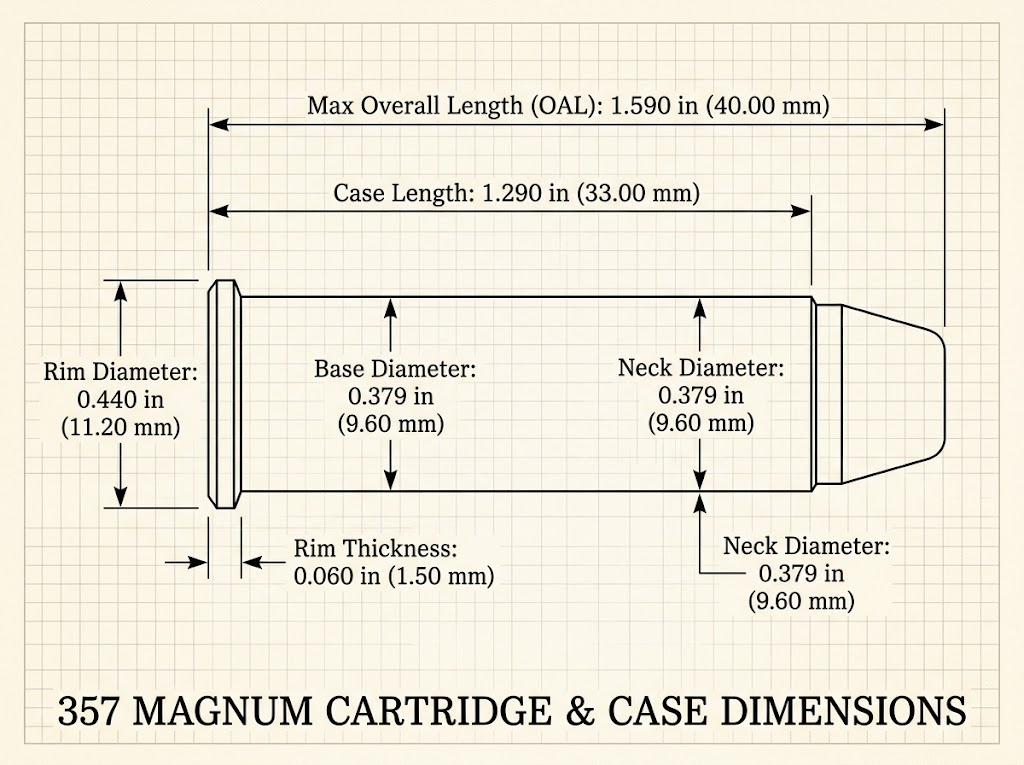
Understanding The .357 Magnum Case Dimensions
To understand how the .357 Magnum interacts with a revolver cylinder and lever-action rifle chamber, you must analyze its discrete geometric components. Because it is a straight-walled cartridge, its geometry serves a different engineering purpose than bottleneck rifle cases.
- Case Length: Measured from the base of the rim to the case mouth. This dimension dictates the space available for powder and determines where the cartridge mouth crimps into the bullet.
- Rim Diameter and Thickness: The prominent rim prevents the cartridge from slipping forward through the revolver cylinder chamber. The thickness determines exactly how the cartridge headspaces against the cylinder face.
- Base Diameter: This is the width of the main cartridge body just ahead of the rim. Because there is no shoulder taper, the base diameter establishes the primary dimension for the rest of the case.
- Shoulder Diameter and Geometry: The .357 Magnum does not have a shoulder. It is a cylindrical, straight-walled design.
- Neck Diameter and Length: Without a shoulder step, the case maintains a continuous 0.379 inch diameter from the base directly to the case mouth. The case relies on heavy bullet tension and a rolled crimp at the mouth rather than a dedicated neck segment.
- Overall Cartridge Length (OAL): The measurement from the case base to the tip of the seated bullet. It dictates whether the bullet will fit inside the revolver cylinder without protruding and binding the cylinder rotation.
- Case Capacity: The internal volume of the case, generally expressed in grains of water (gr H2O). This dictates the maximum powder charge the cartridge can safely hold to generate magnum pressures.
.357 Magnum Case Dimensions In Inches And Millimeters
Official standardization bodies use different base measurement systems. SAAMI specifications rely heavily on inches, whereas European C.I.P. standards utilize metric parameters.
| Dimension | Measurement (Inches) | Measurement (Millimeters) |
| Maximum Case Length | 1.290 in | 33.00 mm |
| Maximum Rim Diameter | 0.440 in | 11.20 mm |
| Maximum Base Diameter | 0.379 in | 9.60 mm |
| Maximum Neck Diameter | 0.379 in | 9.60 mm |
| Maximum Overall Length | 1.590 in | 40.00 mm |
.357 Magnum Case Length
The published maximum case length for the .357 Magnum is 1.290 inches (33.00 mm). Consistent case length is highly critical for straight-walled revolver cartridges.
Unlike bottleneck rifle cases that use a taper crimp, the .357 Magnum relies on a heavy “roll crimp” applied at the case mouth. The brass is mechanically rolled into a groove (cannelure) on the bullet to prevent the bullet from migrating forward under heavy recoil. If the case length is inconsistent, the roll crimp will be applied unevenly, leading to inconsistent powder ignition and fluctuating pressures. Most handloaders trim their .357 Magnum cases uniformly to a nominal 1.280 inches to ensure a perfect crimp on every round.
.357 Magnum Base And Rim Dimensions
The .357 Magnum utilizes a classic rimmed design. The base diameter measures 0.379 inches, while the rim flares outward to a diameter of 0.440 inches.
The primary function of the rim is headspacing. The 0.060 inch rim thickness physically stops the cartridge against the rear face of the revolver cylinder, ensuring the primer is perfectly aligned with the firing pin. In lever-action rifles chambered for .357 Magnum, the 0.440 inch rim also provides the gripping surface for the rifle’s extractor claw to pull the fired casing out of the chamber.
.357 Magnum Shoulder And Neck Dimensions
Because the .357 Magnum is a straight-walled cartridge, it possesses absolutely zero shoulder diameter, shoulder angle, or distinct neck length.
The case body simply extends forward from the 0.379 inch base, retaining that exact 0.379 inch maximum external diameter all the way to the case mouth. The internal dimension of the case mouth measures slightly under the 0.357 inch bullet diameter, providing friction (neck tension) to hold the bullet securely in alignment before the heavy roll crimp is applied.
.357 Magnum Case Capacity
Case capacity heavily influences internal ballistics and powder selection. The nominal, industry accepted capacity for the .357 Magnum is 26.2 grains of water (H2O), or roughly 1.70 cubic centimeters.
This generous capacity is what allows the cartridge to safely contain large charges of slow burning magnum pistol powders like H110 or W296. However, actual case capacity will fluctuate slightly between brass manufacturers depending on how thick they draw the brass web near the case head.
.357 Magnum Case Dimensions vs .38 Special
The .357 Magnum was developed directly from the .38 Special cartridge in 1934 by Elmer Keith and Smith & Wesson.
| Dimension | .357 Magnum | .38 Special | Source |
| Case Length | 1.290 in | 1.155 in | SAAMI |
| Rim Diameter | 0.440 in | 0.440 in | SAAMI |
| Base Diameter | 0.379 in | 0.379 in | SAAMI |
| Neck Diameter | 0.379 in | 0.379 in | SAAMI |
| Overall Length | 1.590 in | 1.550 in | SAAMI |
| Case Capacity | ~26.2 gr H2O | ~23.4 gr H2O | Standard Data |
| Max Pressure | 35,000 psi | 17,000 psi | SAAMI |
The physical case diameters (base, rim, and neck) are absolutely identical between the two cartridges. The only dimensional difference is the case length. Designers intentionally lengthened the .357 Magnum case by 0.135 inches (1.290 inches compared to the .38 Special’s 1.155 inches). This dimensional safety feature physically prevents a high-pressure 35,000 psi .357 Magnum cartridge from fully seating into a vintage revolver cylinder cut for the low-pressure 17,000 psi .38 Special. A modern .357 Magnum revolver, however, can safely chamber and fire the shorter .38 Special cartridge.
.357 Magnum Case Dimensions vs Similar Cartridges
The .357 Magnum belongs to a family of 0.357 caliber handgun cartridges that span a wide variety of case shapes and lengths.
| Cartridge | Case Length | Base Diameter | Case Type | Overall Length |
| .357 Magnum | 1.290 in | 0.379 in | Rimmed Straight | 1.590 in |
| .38 Special | 1.155 in | 0.379 in | Rimmed Straight | 1.550 in |
| .357 Maximum | 1.605 in | 0.379 in | Rimmed Straight | 1.990 in |
| .357 SIG | 0.865 in | 0.424 in | Rimless Bottleneck | 1.140 in |
.357 Magnum vs .357 Maximum Case Dimensions
Following the exact same design philosophy used to create the .357 Magnum from the .38 Special, Remington later created the .357 Maximum by lengthening the .357 Magnum case.The .357 Maximum features the exact same 0.379 inch base diameter and 0.440 inch rim, but uses a massively elongated 1.605 inch case length. This prevents the ultra high pressure .357 Maximum from chambering in standard .357 Magnum revolvers.
.357 Magnum vs .357 SIG Case Dimensions
Despite sharing a similar caliber designation, the .357 SIG shares absolutely no case dimensions with the .357 Magnum.
The .357 Magnum is a long, rimmed, straight-walled case designed for revolvers.The .357 SIG is a short, rimless, bottlenecked case designed specifically for semi-automatic pistols.Based on a necked-down 10mm Auto parent case, the .357 SIG features a much wider 0.424 inch base diameter, a 0.865 inch case length, and a distinct case shoulder.
.357 Magnum Chamber And Case Dimensions
A revolver cylinder chamber must be fractionally larger than the cartridge it accepts. The relationship between .357 Magnum case dimensions and chamber dimensions centers entirely on the rim.
Because there is no shoulder, headspace for the .357 Magnum is measured from the rear face of the cylinder to the recoil shield. The 0.060 inch rim thickness slots perfectly into this gap. Inside the cylinder, the chamber wall remains straight until it reaches a step called the “chamber throat,” which restricts the diameter down to match the 0.357 inch bullet, preventing the brass casing from moving any further forward.
.357 Magnum Case Forming And Resizing
Because the .357 Magnum and .38 Special share identical base and neck diameters, a handloader using a standard tungsten carbide sizing die can resize either case interchangeably.
Furthermore, if .38 Special brass is unavailable, a reloader can mechanically trim a 1.290 inch .357 Magnum case down to the 1.155 inch specification of the .38 Special. This permanently converts the brass into a .38 Special casing, making it safe to load using standard .38 Special reloading data.
.357 Magnum Manufacturer Specifications vs Actual Measurements
There is a documented difference between absolute standards (SAAMI/C.I.P.) and the dimensions of a physical cartridge sitting on a reloading bench.
SAAMI lists maximum material conditions. Ammunition manufacturers intentionally produce brass slightly smaller than these maximums (often around 0.376 inches at the base instead of the 0.379 inch maximum) to guarantee their cartridges will extract cleanly from dirty or tightly machined revolver cylinders. Tolerance stacking between a minimum specification cartridge and a maximum specification chamber is completely safe due to the solid headspacing provided by the thick rim.
Common Questions
What are the .357 Magnum case dimensions?
The key maximum case dimensions for the .357 Magnum include a 1.290 inch case length, a 0.440 inch rim diameter, a 0.379 inch base diameter, and a continuous 0.379 inch case mouth (neck) diameter.
What is the .357 Magnum case length?
The maximum SAAMI and C.I.P. case length for the .357 Magnum is 1.290 inches (33.00 mm). The standard trim to length for reloading is typically 1.280 inches.
What is the .357 Magnum rim diameter?
The .357 Magnum rim diameter is 0.440 inches (11.20 mm max).
What is the .357 Magnum base diameter?
The base diameter of the .357 Magnum, measured just above the rim, is 0.379 inches (9.60 mm max).
What is the .357 Magnum shoulder diameter?
The .357 Magnum is a straight-walled cartridge and does not possess a shoulder. The case maintains a uniform 0.379 inch diameter from the base to the mouth.
What is the .357 Magnum neck diameter?
Because the case is straight-walled, the maximum outside diameter at the case mouth (neck) remains 0.379 inches (9.60 mm).
What is the .357 Magnum case capacity?
The nominal case capacity of the .357 Magnum is 26.2 grains of water (H2O), or 1.70 cubic centimeters.
What is the .357 Magnum overall length?
The maximum overall cartridge length (OAL) for the .357 Magnum is 1.590 inches (40.00 mm) under SAAMI specifications.
How does .357 Magnum compare with .38 Special case dimensions?
The .357 Magnum and .38 Special share the exact same 0.379 inch base diameter and 0.440 inch rim diameter. The only dimensional difference is the case length. The .357 Magnum case is lengthened to 1.290 inches compared to the .38 Special’s 1.155 inches.
Are .357 Magnum and .38 Special case dimensions the same?
They are identical in width but differ in length. The extra 0.135 inches of case length on the .357 Magnum acts as a physical safety barrier, preventing the high pressure Magnum round from fitting into a firearm chambered for the lower pressure .38 Special.
What is the .357 Magnum maximum pressure?
The SAAMI maximum average pressure (MAP) for the .357 Magnum is 35,000 psi (piezo method). Under European C.I.P. testing methods, the maximum pressure is rated slightly higher at 44,000 psi (300 MPa).