The main pros of the 338 ARC are its massive subsonic energy delivery, exceptional suppressor performance, and compatibility with standard AR-15 receivers, while the main cons are its steep trajectory, short effective range, and requirement for specialized magazines and bolts. Developed by Hornady to surpass the popular 300 Blackout, this cartridge launches incredibly heavy bullets, such as the 307-grain Sub-X, to maximize kinetic energy at subsonic speeds.While it consistently delivers devastating terminal performance on medium game within close ranges, its heavy projectiles drop rapidly beyond 150 yards.Because it utilizes a necked-up 6.5 Grendel case, it requires a dedicated Type II bolt face and specific magazines to feed reliably, but it offers shooters true big-bore stopping power without stepping up to a heavy AR-10 platform.
Table of Contents [Click to open]
338 ARC Pros And Cons
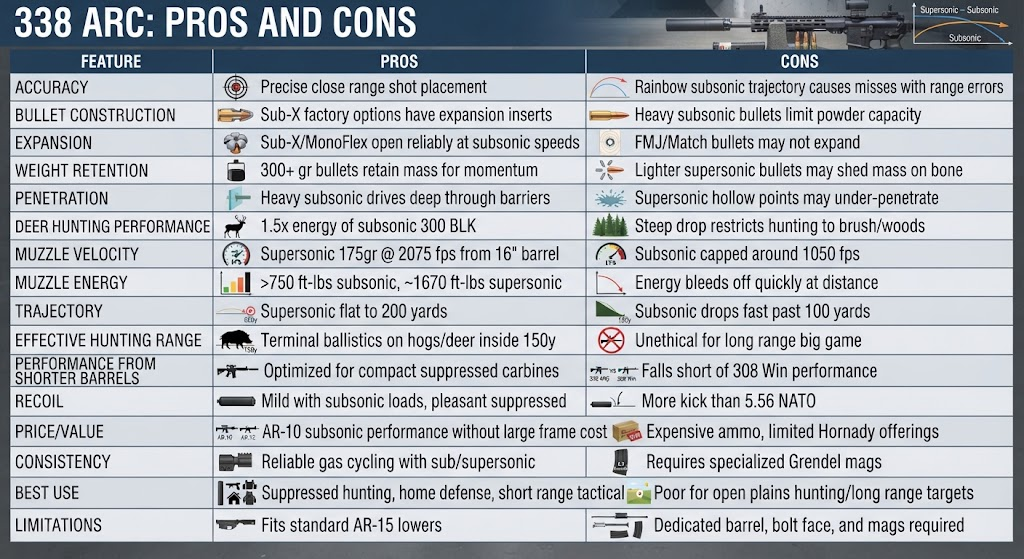
| Feature | Pros | Cons |
| Accuracy | Consistently precise at close ranges, allowing for exact shot placement on game. | The rainbow-like subsonic trajectory means minor range estimation errors result in total misses. |
| Bullet construction | Factory options like the 307-grain Sub-X feature specialized inserts to force expansion at low speeds. | Heavy subsonic bullets take up massive case volume, limiting the available powder capacity. |
| Expansion | Sub-X and MonoFlex bullets open reliably even at velocities below the speed of sound. | Standard match or full metal jacket bullets will simply punch clean holes without expanding. |
| Weight retention | Heavy 300-plus grain bullets retain nearly all their mass upon impact for maximum momentum. | Lighter supersonic bullets may shed weight if striking heavy bone at point-blank range. |
| Penetration | The massive mass of the subsonic loads drives deep through thick muscle and bone. | Supersonic hollow points can occasionally under-penetrate if they expand too violently on the surface. |
| Deer hunting performance | Hits with absolute authority, delivering roughly 1.5 times the energy of a subsonic 300 Blackout. | The steep bullet drop restricts ethical hunting to heavy brush or tight wooded environments. |
| Muzzle velocity | Supersonic 175-grain loads reach roughly 2,075 fps from a 16-inch barrel. | Subsonic loads are intentionally capped around 1,050 fps, severely limiting downrange speed. |
| Muzzle energy | Generates over 750 ft-lbs with subsonic loads and roughly 1,670 ft-lbs with supersonic loads. | Energy bleeds off quickly with supersonic loads compared to dedicated long range cartridges. |
| Trajectory | Supersonic loads shoot flat enough for a 200-yard zero without severe holdovers. | Subsonic loads drop like a rock past 100 yards, requiring extensive dope charting. |
| Effective hunting range | Outstanding terminal ballistics on hogs and deer inside 150 yards. | Rapid velocity and energy loss make it unethical for long range big game hunting. |
| Performance from shorter barrels | Specifically optimized for short barrels, making it the ultimate compact suppressed carbine cartridge. | Even from a 16-inch barrel, supersonic loads fall short of traditional 308 Winchester performance. |
| Recoil | Exceptionally mild in subsonic loads, making it very pleasant to shoot suppressed. | Supersonic loads produce noticeably more kick than a standard 5.56 NATO. |
| Price/value | Provides AR-10 subsonic terminal performance without the cost of building a large frame rifle. | Factory ammunition is expensive and currently limited primarily to Hornady offerings. |
| Consistency | Engineered for reliable gas system cycling with both subsonic and supersonic loads. | Requires high quality magazines designed for the Grendel case family to feed reliably. |
| Best use | Suppressed hunting, home defense, and short range tactical applications. | A poor choice for open plains hunting or precision long range target shooting. |
| Limitations | Fits standard AR-15 lowers, allowing shooters to easily swap uppers for close quarters work. | Requires a dedicated barrel, a 0.136-inch depth bolt face, and proprietary magazines. |
Accuracy
The 338 ARC is inherently accurate at the close distances it was designed for. Built around modern cartridge geometries, it cycles consistently and shoots tight groups inside 100 yards. However, practical accuracy at a distance is extremely difficult with the subsonic loads. Because the heavy bullets travel so slowly, they drop aggressively. A minor miscalculation in range estimation past 100 yards can easily result in shooting completely underneath your target.
Bullet Construction And Expansion
Hornady launched this cartridge with a heavy emphasis on proper projectile design. The flagship subsonic load utilizes a massive 307-grain Sub-X (Subsonic eXpanding) bullet. This projectile features a polymer insert in a hollow cavity, ensuring that the bullet mushrooms and transfers energy reliably even at velocities below 1,100 feet per second. For supersonic applications, Hornady offers a 170-grain MonoFlex, a 175-grain Match, and a 215-grain FTX.
Penetration And Weight Retention
When running the 307-grain subsonic load, penetration is exceptional. Because the bullet is so heavy and dense, it carries massive momentum into the target.It retains its weight very well, driving deep through the vitals of deer and feral hogs. The supersonic loads, being much lighter, rely on speed for their energy transfer and will penetrate similarly to a heavy 300 Blackout supersonic round.
Deer Hunting Performance
The 338 ARC is a devastating cartridge for hunting medium game in heavy cover. The massive frontal area of the .338 caliber bullet creates wide wound channels, and the extreme energy of the heavy projectiles drops deer and hogs rapidly. It is essentially a purpose-built brush gun cartridge for the modern AR-15 era. Hunters simply need to respect the cartridge’s limitations and avoid taking shots across open agricultural fields.
Velocity And Energy
Velocity and energy depend entirely on which load you select. Hornady rates the 307-grain Sub-X subsonic load at roughly 1,050 feet per second, generating about 752 foot-pounds of muzzle energy.This is approximately 1.5 times the energy of a standard 220-grain subsonic 300 Blackout load, making it a massive upgrade. For shooters wanting more speed, supersonic loads like the 175-grain HP Match reach roughly 2,075 feet per second from a 16-inch barrel.
Trajectory And Range
The effective range of the 338 ARC is strictly limited. The 175-grain supersonic loads can be effectively utilized out to roughly 200 yards before bullet drop and energy loss become problematic. The 307-grain subsonic loads are best treated as 100 to 150-yard options. Beyond 150 yards, the subsonic trajectory plunges so steeply that executing an ethical shot on a live animal becomes highly unpredictable.
Recoil
Shooting the 307-grain subsonic load suppressed is an incredibly pleasant experience. The recoil impulse is a slow, gentle push rather than a sharp snap, making it easy to keep the sights on target for follow-up shots. The supersonic loads do produce a bit more recoil due to the higher velocities, but because the cartridge is fired from a gas-operated AR-15, the buffer system soaks up enough energy to make it completely manageable for shooters of all sizes.
Price And Value
The value proposition of the 338 ARC lies in its platform. Previously, if a shooter wanted to fire a massive 300-plus grain subsonic bullet, they had to step up to an AR-10 platform chambered in 8.6 Blackout, which is heavy, bulky, and expensive. The 338 ARC allows shooters to achieve hard-hitting subsonic performance using standard AR-15 lower receivers, providing significant cost savings on the rifle build itself.
Main Drawbacks
The most significant disadvantages of the 338 ARC are its steep trajectory and reliance on proprietary parts. You cannot use standard 5.56 NATO magazines or bolts.You must use a dedicated Type II Grendel bolt with a 0.136-inch face depth and magazines designed specifically for the wider 6.5 Grendel case family. Furthermore, because it is a specialized cartridge, factory ammunition is expensive and can be difficult to source locally.
Final Verdict
Is 338 ARC good?
Yes, it is a phenomenal and highly specialized cartridge for shooters who prioritize suppressed performance and close-range stopping power.
This caliber is best suited for feral hog eradication, dense woods deer hunting, and tactical home defense. It completely outclasses the subsonic capabilities of the 300 Blackout by delivering significantly more mass and energy into the target.
However, hunters who frequently shoot past 200 yards or shooters who do not plan on owning a suppressor would be much better served by a flatter-shooting cartridge like the 6mm ARC or standard 6.5 Grendel.
Frequently Asked Questions (FAQs)
1. What is the parent case of the 338 ARC?
The 338 ARC is based on the 6.5 Grendel cartridge case, which has had its neck expanded to accept .338 caliber projectiles.
2. Can I use standard AR-15 magazines for the 338 ARC?
No. Because the cartridge case is wider than a 5.56 NATO, you must use magazines designed for the 6.5 Grendel or specific 338 ARC magazines to ensure reliable feeding.
3. Does the 338 ARC fit in a standard AR-15?
Yes. It uses the standard AR-15 maximum overall length of 2.260 inches, meaning it fits perfectly inside standard AR-15 upper and lower receivers.
4. What bolt face is required for this cartridge?
It requires a Type II 6.5 Grendel bolt face, which features a 0.136-inch bolt face depth.
5. How much more energy does it have than a subsonic 300 Blackout?
The 307-grain 338 ARC subsonic load delivers roughly 1.5 times the muzzle energy of a standard 220-grain 300 Blackout subsonic load.
6. What is the ideal barrel twist rate for the 338 ARC?
The recommended and standardized twist rate is 1:8, which is fast enough to properly stabilize the massive 307-grain subsonic bullets in flight.
7. Can I shoot supersonic ammunition out of a 338 ARC?
Yes. Hornady offers several supersonic loads, including a 170-grain MonoFlex, a 175-grain HP Match, and a 215-grain FTX, giving the cartridge dual-purpose capabilities.
8. Is it legal for deer hunting?
Yes, it is highly effective and legal for deer hunting in states where AR-15s and centerfire rifle cartridges are permitted. It excels at close ranges in thick brush.
9. Do I need a specialized suppressor for the 338 ARC?
Because it shoots a .338 caliber bullet, you cannot use a standard .30 caliber (7.62mm) suppressor. You must use a suppressor rated for at least .36 caliber or 9mm to provide the necessary bore clearance.
10. What is the maximum effective range of the 338 ARC?
For the heavy subsonic loads, the practical hunting limit is roughly 100 to 150 yards due to rapid bullet drop. The lighter supersonic loads extend that practical range out to about 200 yards.