A 308 Subsonic Ballistics Chart is a highly specialized reference table that details the unique trajectory, velocity, and kinetic energy of .308 Winchester ammunition loaded specifically to remain below the speed of sound. By reviewing this chart, you can visualize exactly how your heavy, slow-moving bullet will behave from the moment it leaves your suppressed rifle until it reaches its target. This critical data allows you to accurately predict the massive, mortar-like bullet drop, understand the severe limitations of your kinetic energy, and ensure ethical performance when utilizing these incredibly quiet rounds in the field.
Shooters, pest control specialists, and tactical enthusiasts use a 308 Subsonic Ballistics Chart to unlock the absolute quietest potential of the .308 Winchester platform. When paired with a quality sound suppressor, a subsonic .308 load produces nothing more than the mechanical click of the firing pin and a dull thump, completely eliminating the deafening supersonic crack of standard rifle ammunition. However, this stealth comes at a massive ballistic cost. By intentionally limiting the muzzle velocity to roughly 1,050 feet per second, the .308 Winchester goes from a 1,000-yard big-game powerhouse to a cartridge that perfectly mimics the trajectory and kinetic energy of a heavy .45 ACP pistol. In this comprehensive guide, you will learn how to analyze subsonic ballistics data, understand why specialized expanding bullets are absolutely mandatory for hunting, determine the ideal zero distance, and see exactly how to navigate the steep learning curve of subsonic rifle shooting.
308 Subsonic Ballistics Drop Chart
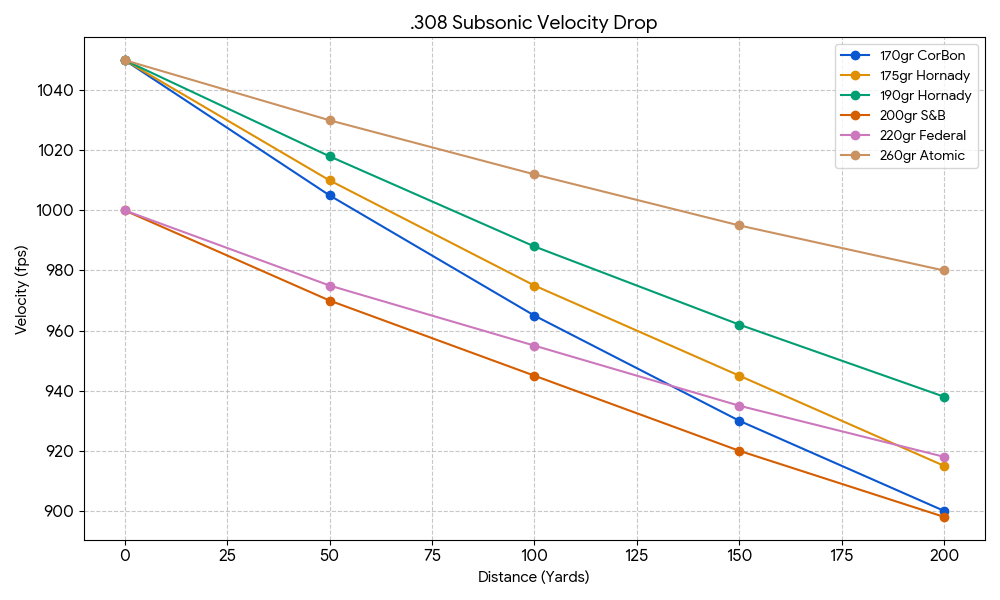
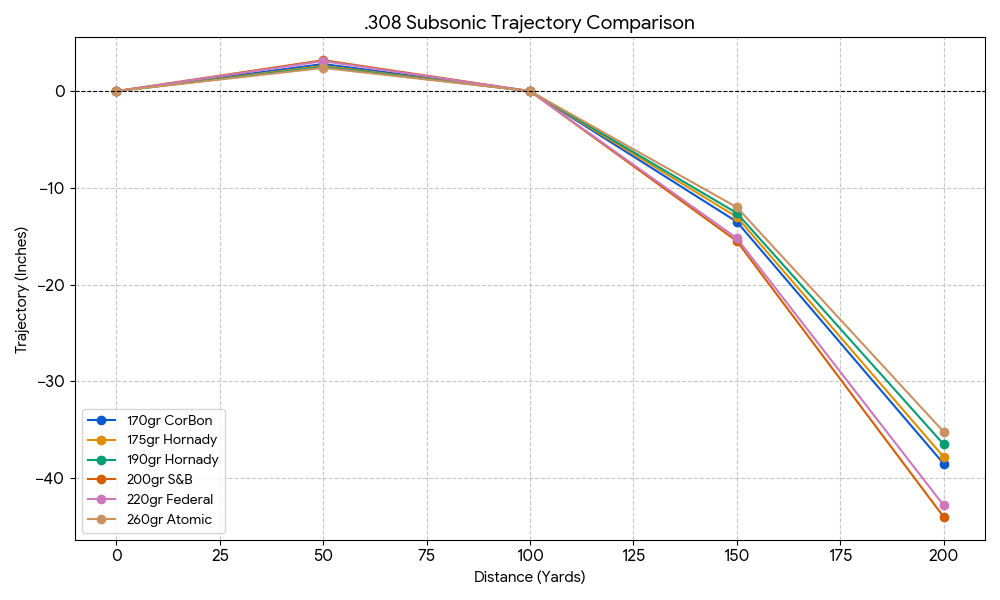
Below is a detailed ballistics table featuring popular factory-loaded subsonic ammunition available for the .308 Winchester today. The data assumes a 100-yard zero under standard sea-level atmospheric conditions. Because subsonic rifle bullets experience dramatic, lobbing trajectories, the data is restricted to 200 yards, which is generally considered the absolute maximum practical range for this ammunition type.
| Bullet Weight | Bullet Type | Manufacturer | Muzzle Velocity | Velocity At 50 Yards | Velocity At 100 Yards | Velocity At 150 Yards | Velocity At 200 Yards | Muzzle Energy | Energy At 50 Yards | Energy At 100 Yards | Energy At 150 Yards | Energy At 200 Yards | Trajectory At 50 Yards | Trajectory At 100 Yards | Trajectory At 150 Yards | Trajectory At 200 Yards | Ballistic Coefficient |
|---|---|---|---|---|---|---|---|---|---|---|---|---|---|---|---|---|---|
| 170 Grain | Subsonic Expanding | CorBon | 1050 fps | 1005 fps | 965 fps | 930 fps | 900 fps | 416 ft lbs | 381 ft lbs | 351 ft lbs | 326 ft lbs | 306 ft lbs | +2.8 inches | 0 inches | -13.5 inches | -38.5 inches | 0.315 |
| 175 Grain | Sub-X | Hornady | 1050 fps | 1010 fps | 975 fps | 945 fps | 915 fps | 428 ft lbs | 396 ft lbs | 369 ft lbs | 347 ft lbs | 325 ft lbs | +2.6 inches | 0 inches | -13.0 inches | -37.8 inches | 0.330 |
| 190 Grain | Sub-X | Hornady | 1050 fps | 1018 fps | 988 fps | 962 fps | 938 fps | 465 ft lbs | 437 ft lbs | 412 ft lbs | 390 ft lbs | 371 ft lbs | +2.5 inches | 0 inches | -12.6 inches | -36.5 inches | 0.437 |
| 200 Grain | FMJ Subsonic | Sellier & Bellot | 1000 fps | 970 fps | 945 fps | 920 fps | 898 fps | 444 ft lbs | 418 ft lbs | 396 ft lbs | 376 ft lbs | 358 ft lbs | +3.2 inches | 0 inches | -15.5 inches | -44.0 inches | 0.450 |
| 220 Grain | MatchKing | Federal Premium | 1000 fps | 975 fps | 955 fps | 935 fps | 918 fps | 488 ft lbs | 464 ft lbs | 445 ft lbs | 427 ft lbs | 411 ft lbs | +3.1 inches | 0 inches | -15.2 inches | -42.8 inches | 0.629 |
| 260 Grain | Soft Point Subsonic | Atomic Ammo | 1050 fps | 1030 fps | 1012 fps | 995 fps | 980 fps | 636 ft lbs | 612 ft lbs | 591 ft lbs | 571 ft lbs | 554 ft lbs | +2.4 inches | 0 inches | -12.0 inches | -35.2 inches | 0.500 |
Understanding The Chart
A subsonic ballistics chart looks entirely different from a standard high-velocity rifle chart. Because you are severely limiting the most important metric (speed), understanding the remaining data columns is absolutely critical for field success.
Muzzle Velocity (The Speed of Sound Limit)
Muzzle velocity is the exact speed at which the bullet exits the barrel. The speed of sound at sea level at 68°F (20°C) is roughly 1,125 fps. To ensure the bullet never breaks the sound barrier and creates a loud “crack,” ammunition manufacturers intentionally load subsonic .308 rounds to a muzzle velocity of 1,000 to 1,050 fps. This speed is carefully regulated to provide maximum momentum while remaining safely below the supersonic threshold, even in varying atmospheric conditions.
Retained Velocity
Retained velocity measures the speed of the projectile downrange. Because subsonic bullets start out so incredibly slow, air resistance has a surprisingly minimal effect on them. Heavy, high-BC bullets like the 220-grain MatchKing lose very little speed in flight, often arriving at 200 yards traveling nearly as fast as they were at the muzzle. However, they are still moving too slowly to rely on standard rifle-bullet expansion.
Kinetic Energy
Kinetic energy is the amount of destructive physical force the bullet carries, measured in foot-pounds (ft-lbs). This is the absolute biggest limitation of subsonic rifle ammunition. A standard supersonic 150-grain .308 Winchester generates over 2,600 ft-lbs of energy. A 200-grain subsonic .308 generates only 450 ft-lbs of energy. Shooting a subsonic .308 is ballistically identical to shooting a .45 ACP pistol. You no longer have the massive hydrostatic shock of a rifle; you are entirely reliant on heavy bullet mass and deep tissue penetration.
Trajectory
Trajectory indicates the physical path the bullet takes through the air. Because the bullet is traveling so slowly, gravity has a massive amount of time to pull it toward the earth. The trajectory of a subsonic .308 is highly arched, resembling a mortar round. If you zero your rifle at 100 yards, the bullet will typically drop between 35 and 45 inches by the time it reaches 200 yards. Precise laser rangefinding is absolutely mandatory for any shot past 75 yards.
The “Subsonic Expansion” Problem
The single most critical factor for hunting with a subsonic .308 Winchester is bullet construction.
Standard hunting bullets (like a Core-Lokt, SST, or AccuBond) are engineered with thick copper jackets designed to peel open upon impact at velocities exceeding 1,800 fps. If you fire a standard rifle bullet at subsonic speeds (1,000 fps) into an animal, it will not expand. It will act exactly like a solid Full Metal Jacket (FMJ), punching a tiny, non-lethal .30-caliber hole straight through the target, resulting in wounded and lost game.
If you intend to hunt with a subsonic .308, you absolutely must use specialized ammunition designed to expand at pistol velocities.
- Hornady Sub-X: Features a specialized flat-profile, heavily serrated jacket with a polymer insert designed to expand reliably at speeds as low as 900 fps.
- Maker Rex / Solid Copper: Boutique manufacturers machine deep cuts into solid copper bullets, allowing them to peel open into massive, sharp petals at very low speeds.
Effective Hunting Range
Because the subsonic .308 operates with the energy of a handgun, its ethical hunting range is incredibly short.
Small Game and Pest Control
For raccoons, opossums, and foxes, the subsonic .308 is highly effective out to 100 yards. The heavy bullet mass anchors small pests instantly, and when paired with a suppressor, it allows for discreet pest control near populated agricultural areas without disturbing livestock.
Coyotes and Feral Hogs
For medium predators and feral hogs, the effective ethical range is restricted to 75 yards or less, and shot placement is critical. Because you lack the explosive hydrostatic shock of a supersonic rifle, you must place the bullet perfectly in the heart/lung vitals or the central nervous system (brain/spine).
Whitetail Deer
Hunting whitetail deer with a subsonic .308 is highly controversial and generally restricted to 50 yards or less. You must treat the hunt exactly like bowhunting. You cannot take quartering or angled shots. You must wait for a perfect, close-range broadside presentation and ensure you are using a dedicated subsonic expanding bullet like the Hornady Sub-X.
Factors That Affect Subsonic Ballistics
Subsonic loads are highly sensitive to internal and environmental variables.
Barrel Twist Rate Stability
The heaviest subsonic bullets (200-grain to 220-grain) are incredibly long. To stabilize a long, heavy bullet traveling very slowly, your rifle barrel requires a very fast twist rate.
- A standard 1-in-10″ twist .308 barrel will generally stabilize bullets up to 190 or 200 grains at subsonic speeds.
- If you attempt to shoot massive 220-grain or 240-grain subsonic bullets out of a standard 1-in-10″ or 1-in-12″ barrel, the bullets may fail to stabilize, causing them to tumble end-over-end in flight (keyholing). Warning: A tumbling bullet will strike the internal baffles of your expensive suppressor, causing catastrophic damage.
Altitude and Temperature (Breaking the Barrier)
The speed of sound is not a static number; it changes based on air temperature.
- At 80°F, the speed of sound is roughly 1,138 fps.
- At 20°F, the speed of sound drops to roughly 1,074 fps. If your ammunition leaves the muzzle at 1,080 fps, it will be whisper-quiet during a warm summer range session, but it might break the sound barrier and produce a loud supersonic “crack” during a freezing winter hunt.
Best Zero Distance
Choosing a zero distance for a subsonic rifle requires understanding the steep trajectory curve.
50-Yard Zero
A 50-yard zero is the absolute most practical baseline for a dedicated subsonic hunting rifle. It keeps the bullet’s arcing trajectory very close to your line of sight for typical close-range, thick-brush hunting distances. With a 50-yard zero, the bullet will typically drop about 4 to 6 inches at 100 yards, which is an easy and predictable holdover.
100-Yard Zero
If you are shooting steel targets on a range, a 100-yard zero provides a clean mathematical baseline for understanding the massive drop that occurs at 150 and 200 yards. However, if zeroed at 100 yards, the bullet will strike roughly 2.5 to 3 inches high at 50 yards, which can cause you to shoot over the back of a small animal at close range.
Conclusion
Understanding a 308 Subsonic Ballistics Chart requires a complete shift in mindset. You are no longer calculating the performance of a high-powered, flat-shooting rifle; you are mastering the heavy, arching trajectory of a suppressed, pistol-energy powerhouse. By carefully selecting specialized expanding bullets, understanding the strict limitations of your kinetic energy, and mastering the steep trajectory curve inside 100 yards, you can utilize the subsonic .308 Winchester as an incredibly stealthy, highly effective tool for close-range pest control and discreet woodland hunting.