The .308 Winchester is highly suitable for deer hunting and remains widely used for harvesting whitetail, mule deer, and other big game. Cartridge performance in the field depends heavily on bullet construction, bullet weight, shot placement, the specific firearm, and environmental hunting conditions. Reputable ammunition manufacturers and established hunting authorities consistently list the .308 Winchester among the most reliable cartridges for deer and similar big game species.
308 for Deer Hunting
| Factor | .308 Winchester for Deer Hunting |
| Cartridge | .308 Winchester |
| Bullet Diameter | .308 inches |
| Common Hunting Bullet Weights | 150 grain, 165 grain, 168 grain, 180 grain |
| Typical Hunting Bullet Types | Soft point, polymer tipped, bonded, copper alloy |
| Muzzle Velocity | 2,600 to 2,820 fps (depending on bullet weight and load) |
| Muzzle Energy | 2,600 to 2,750 ft-lbs (typical factory hunting loads) |
| Effective Hunting Range | Varies by load and shooter ability (often 300 to 400 yards) |
| Recoil | Moderate (approximately 15 to 18 ft-lbs in a standard weight rifle) |
| Deer Size | Suitable for all deer species |
| Suitable Hunting Environments | Brush, timber, open fields, elevated stands |
| Main Advantages | Wide ammunition availability, manageable recoil, excellent bullet selection |
| Main Limitations | Heavier recoil than smaller calibers, more bullet drop at extended ranges than magnum cartridges |
308 for Deer Hunting: .308 Winchester is a well-established deer hunting cartridge, offering a combination of bullet selection, energy, accuracy, and manageable recoil for typical deer hunting conditions.
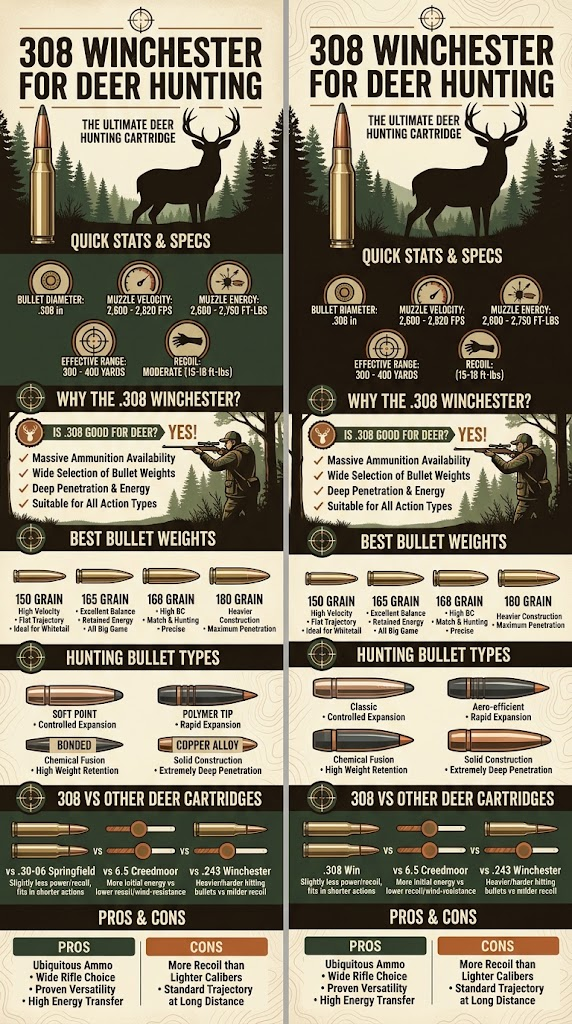
Is 308 Good for Deer Hunting?
Yes, the .308 Winchester is highly effective and widely considered good for deer hunting. It is commonly used because it strikes a proven balance between power, recoil, and accuracy.
The .308 inch bullet diameter allows for a vast array of bullet weight options, ranging from light 125 grain loads to heavy 180 grain bullets, giving hunters flexibility for different game sizes. Factory ammunition availability for the .308 Winchester is among the best in the world. Hunters have access to numerous controlled-expansion hunting bullets designed to deliver deep penetration and reliable expansion on deer.
The trajectory of the .308 Winchester is flat enough for the vast majority of practical hunting distances. It maintains excellent energy retention downrange, ensuring bullets perform reliably upon impact. Recoil is generally manageable for most adult shooters, reducing flinching and promoting accurate shot placement. Rifle availability is exceptional, with nearly every major firearm manufacturer offering bolt-action, lever-action, and semi-automatic rifles chambered in .308 Winchester. This versatility makes it a premier choice for 308 deer hunting. Hornady identifies the .308 Winchester as part of its heavyweight hunting cartridge class and discusses properly constructed bullets as ideal for deer-sized game.
Best 308 Bullet Weight for Deer Hunting
| Bullet Weight | Common Application | General Characteristics |
| 150 grain | Deer hunting | Flat trajectory, high velocity, rapid expansion on medium game |
| 165 grain | Deer and general big game | Excellent balance of velocity, sectional density, and retained energy |
| 168 grain | Hunting and target applications | Often features high ballistic coefficients, suitable for medium to large game |
| 175 grain | Larger game/general hunting | Heavier construction, retains velocity well at longer distances |
| 180 grain | Heavier hunting applications | Deep penetration, maximum energy transfer on heavy-boned animals |
Bullet weight alone does not determine terminal performance. Bullet construction and the intended game are also important factors. A fast-expanding 150 grain bullet might be ideal for whitetail deer, while a solidly constructed 165 grain or 180 grain bonded bullet might be chosen for larger mule deer or mixed big game hunts. Hunters should rely on manufacturer specifications for actual ammunition examples to select the appropriate load.
Best 308 Bullet Type for Deer Hunting
The best 308 bullet for deer depends on the hunting environment and the desired terminal performance. Hunting bullets designed for deer typically prioritize reliable expansion and sufficient penetration to reach vital organs.
Soft point bullets feature an exposed lead core at the tip, initiating expansion upon impact. Polymer-tipped expanding bullets use a plastic insert in the nose to initiate rapid expansion while improving aerodynamic efficiency. Bonded bullets feature a lead core chemically fused to the copper jacket, preventing core separation and ensuring high weight retention. Monolithic copper-alloy expanding bullets contain no lead and are machined to expand into petals while retaining nearly 100 percent of their weight for deep penetration.
Remington describes controlled expansion, penetration, and weight retention as important characteristics for big-game ammunition.
| Bullet Type | Expansion | Penetration | Typical Hunting Use | Main Consideration |
| Soft Point | Rapid to moderate | Moderate to deep | General deer hunting, shorter ranges | Traditional performance, affordable, reliable |
| Polymer Tip | Rapid | Moderate | Open country deer hunting, longer ranges | High ballistic coefficient, aerodynamic |
| Bonded | Controlled | Deep | Large deer, heavy bone, mixed big game | High weight retention, prevents core separation |
| Copper Alloy Expanding | Controlled | Very deep | Deep penetration requirements, lead-free zones | Excellent weight retention, requires sufficient velocity to expand |
308 Deer Hunting Ballistics
The following table displays representative .308 Winchester hunting loads using verified manufacturer data based on a standard 24 inch test barrel.
| Bullet Weight | Bullet Type | Manufacturer | Muzzle Velocity | Muzzle Energy | 100 yd Velocity | 200 yd Velocity | 300 yd Velocity |
| 150 grain | InterLock SP | Hornady | 2,820 fps | 2,649 ft-lbs | 2,536 fps | 2,268 fps | 2,016 fps |
| 165 grain | Nosler Ballistic Tip | Federal | 2,700 fps | 2,671 ft-lbs | 2,510 fps | 2,328 fps | 2,155 fps |
| 180 grain | Power-Point SP | Winchester | 2,620 fps | 2,743 ft-lbs | 2,374 fps | 2,142 fps | 1,922 fps |
308 Effective Range for Deer Hunting
The effective range of a .308 for deer cannot be defined by a single universal number. It must be evaluated in terms of practical hunting conditions. Trajectory dictates how much the bullet drops over distance, requiring the hunter to know holdovers at extended ranges. Remaining velocity is critical because hunting bullets require a minimum impact speed (often between 1,800 and 2,000 fps) to ensure proper bullet expansion.
Remaining energy must be sufficient to ensure a clean harvest, with many hunting authorities recommending a minimum of 1,000 ft-lbs of energy at the impact distance for deer. Wind drift becomes a significant variable as distance increases, demanding advanced shooter accuracy and environmental reading skills. Ultimately, ethical shot placement is the limiting factor. Depending on environmental conditions, individual ammunition characteristics, and shooter skill, the practical effective range of a 308 deer cartridge is typically between 300 and 400 yards when using standard hunting loads in a typical rifle barrel.
308 vs 30 06 for Deer Hunting
| Factor | .308 Winchester | .30-06 Springfield |
| Bullet Diameter | .308 inches | .308 inches |
| Typical Hunting Bullet Weights | 150 to 180 grains | 150 to 220 grains |
| Case Length | 2.015 inches | 2.494 inches |
| Overall Cartridge Length | 2.810 inches | 3.340 inches |
| Typical Velocity | 2,600 to 2,820 fps | 2,700 to 2,950 fps |
| Typical Energy | 2,600 to 2,750 ft-lbs | 2,800 to 3,000 ft-lbs |
| Recoil | Moderate | Moderate to heavy |
| Rifle Size | Short action | Long action |
| Ammunition Availability | Excellent | Excellent |
| Deer Hunting Use | Excellent for all deer | Excellent for all deer, handles heavier game better |
The .308 Winchester and .30-06 Springfield share the same bullet diameter and many of the same bullet weights. The documented differences stem from case capacity. The larger .30-06 case allows for more powder, generating higher velocity and energy, particularly with heavier bullets (180 grains and above). The .308 Winchester fits in a short action rifle, saving a small amount of weight and bolt travel, while generating slightly less recoil. Both are exceptionally proven for deer hunting.
308 vs 270 for Deer Hunting
The .308 Winchester uses a .308 inch bullet diameter, while the .270 Winchester uses a smaller .277 inch diameter. Typical bullet weights for the .308 range from 150 to 180 grains, whereas the .270 usually fires lighter 130 to 150 grain bullets.
Because it pushes lighter bullets with a large powder charge, the .270 Winchester produces higher muzzle velocity and a noticeably flatter trajectory than the .308 Winchester. However, the .308 Winchester delivers comparable energy at standard hunting distances and offers heavier bullet options. Recoil is relatively similar between the two, though individual rifle weight plays a large role. Both cartridges enjoy massive ammunition availability and are widely considered top tier for all deer hunting applications.
308 vs 243 for Deer Hunting
The .308 Winchester and .243 Winchester are closely related, as the .243 is simply a .308 case necked down to hold a smaller bullet. The .308 uses a .308 inch diameter bullet, while the .243 uses a .243 (6mm) inch diameter bullet. Typical bullet weights for the .243 range from 85 to 100 grains for hunting, substantially lighter than the 150 to 180 grain bullets standard in the .308.
The .243 Winchester provides much higher velocity and a flatter trajectory, alongside significantly lower recoil. The published ballistic data shows the .308 carries much more retained energy and momentum due to its heavier bullets. While the .243 is highly praised for low recoil deer hunting suitability, the .308 offers greater penetration potential on large-bodied deer or quartering shot angles.
308 vs 6.5 Creedmoor for Deer Hunting
| Factor | .308 Winchester | 6.5 Creedmoor |
| Bullet Diameter | .308 inches | .264 inches (6.5mm) |
| Common Hunting Bullet Weights | 150 to 180 grains | 120 to 143 grains |
| Muzzle Velocity | 2,600 to 2,820 fps | 2,700 to 2,850 fps |
| Muzzle Energy | 2,600 to 2,750 ft-lbs | 2,200 to 2,400 ft-lbs |
| Ballistic Coefficient | Moderate to high | Very high |
| Recoil | Moderate (approx. 15 to 18 ft-lbs) | Mild (approx. 11 to 13 ft-lbs) |
| Trajectory | Standard | Very flat |
| Deer Hunting Applications | Excellent for all deer species | Excellent for all deer species |
| Ammunition Availability | Excellent | Excellent |
The .308 Winchester pushes heavier bullets and delivers higher muzzle energy, making it a formidable choice for large deer at short to medium ranges. The 6.5 Creedmoor utilizes highly aerodynamic bullets with high ballistic coefficients, allowing it to retain velocity better and resist wind drift at extended ranges, while generating less recoil. Comparable factory hunting loads show both cartridges are highly effective for deer.
308 for Whitetail Deer
The use of .308 Winchester for whitetail deer is incredibly common across North America. Typical whitetail deer vary in size from 100 to 250 pounds depending on the region. Common hunting distances range from dense 30 yard woods setups to 250 yard field edges.
Bullet selection should reflect these environments; 150 grain soft point or polymer tipped bullets are highly popular for rapid expansion on thin skinned whitetails. Proper shot placement remains vital. The terrain often dictates rifle weight, and the .308 chambering in short action rifles allows hunters to carry lightweight, maneuverable firearms through thick brush or up into tree stands. The moderate recoil of a 308 deer rifle ensures that hunters can practice comfortably and shoot accurately without developing a flinch. The cartridge choice does not replace proper shot placement and hunting ethics, but the .308 provides ample power for whitetail.
308 for Mule Deer
Mule deer hunting presents different considerations. Mule deer are generally heavier and have a larger skeletal structure than whitetails. The terrain in western states often dictates that shooting distances can differ from typical whitetail hunting, with shots frequently spanning open canyons or vast sagebrush flats.
Because of these longer ranges, bullet selection and trajectory matter significantly. Hunters pursuing mule deer with a .308 Winchester often select 165 grain or 168 grain polymer tipped or bonded bullets. These bullets retain velocity well over distance and offer the deep penetration required for larger animals. Current manufacturer data indicates that a 165 grain aerodynamic bullet fired from a .308 Winchester retains sufficient energy (over 1,000 ft-lbs) to ethically harvest a mule deer past 300 yards under appropriate conditions.
308 for Deer Hunting Pros and Cons
Pros
- Wide ammunition selection with options for almost any hunting scenario
- Large selection of hunting bullets ranging from 125 to 180 grains
- Established big-game cartridge with decades of proven field performance
- Good versatility for game ranging from small deer to elk
- Broad rifle availability in almost every action type and budget
- Highly suitable for deer-sized game without requiring magnum length actions
Cons
- More recoil than some lighter deer cartridges like the .243 Winchester or 6.5 Creedmoor
- Heavier ammunition than some alternatives, adding slight weight to a hunting pack
- Trajectory can vary significantly by load and is not as flat as magnum calibers
- Terminal performance depends heavily on correct bullet construction and shot placement
308 Deer Hunting Ammo
| Ammunition | Bullet Weight | Bullet Type | Advertised Muzzle Velocity | Advertised Muzzle Energy | Intended Use |
| Hornady American Whitetail | 150 grain | InterLock SP | 2,820 fps | 2,649 ft-lbs | Whitetail and general deer |
| Federal Non-Typical | 150 grain | Soft Point | 2,820 fps | 2,648 ft-lbs | Whitetail deer hunting |
| Remington Core-Lokt | 165 grain | Pointed Soft Point | 2,700 fps | 2,671 ft-lbs | General big game |
| Winchester Deer Season XP | 150 grain | Extreme Point (Polymer) | 2,820 fps | 2,648 ft-lbs | Deer specific hunting |
| Nosler Ballistic Tip | 165 grain | Polymer Tip | 2,800 fps | 2,872 ft-lbs | Deer and medium game |
308 Deer Hunting Rifle Considerations
Hunters evaluating a 308 deer rifle look at several distinct firearm characteristics. Barrel length heavily influences muzzle velocity; 22 to 24 inch barrels maximize velocity, while 16 to 20 inch barrels are prized for maneuverability in dense woods. Rifle weight is a balancing act. A lightweight rifle is easier to carry over steep terrain but transmits more recoil to the shoulder.
Optic selection typically ranges from low power variables (like 2-7x or 3-9x) for brush hunting to higher magnifications (like 4-16x) for open country. Stock design and materials (wood vs synthetic) impact weather resistance and overall rifle size. Magazine capacity in bolt action hunting rifles usually ranges from 3 to 5 rounds, which is plentiful for typical hunting situations. Proper recoil management is achieved through well designed recoil pads and proper rifle fit.
308 Deer Hunting FAQs
Is 308 good for deer hunting?
Yes, .308 Winchester is highly regarded and commonly used for all types of deer hunting due to its accuracy, manageable recoil, and excellent terminal ballistics.
Is 308 overkill for deer?
No, it is not overkill. With properly constructed 150 grain to 165 grain hunting bullets, it provides ethical, clean harvests without excessive meat damage.
What is the best 308 bullet weight for deer?
The 150 grain and 165 grain bullet weights are most commonly recommended for deer, offering an optimal balance of velocity, flat trajectory, and energy transfer.
Is 150 grain 308 good for deer?
Yes, 150 grain .308 bullets are excellent for deer, particularly thin skinned whitetails, as they provide high velocity and reliable expansion.
Is 165 grain 308 good for deer?
Yes, 165 grain bullets are outstanding for deer and are often favored for their high ballistic coefficients and deep penetration on larger mule deer.
Is 180 grain 308 good for deer?
While 180 grain bullets will certainly harvest deer, they are generally heavier than necessary and are better suited for larger game like elk or moose.
How far can you ethically hunt deer with a 308?
For an average skilled shooter with standard hunting ammunition, the ethical range is generally within 300 to 400 yards, provided the bullet retains enough velocity to expand.
What is the effective range of a 308 for deer hunting?
The effective range is typically up to 400 yards, depending heavily on the specific load, remaining bullet energy, and the hunter’s marksmanship skills.
Is 308 better than 30 06 for deer?
Neither is universally better. The .308 Winchester offers slightly less recoil and fits in a short action rifle, while the .30-06 offers slightly more velocity and energy for longer shots.
Is 308 better than 270 for deer?
They are comparable. The .270 Winchester shoots lighter bullets flatter, while the .308 Winchester throws heavier bullets with a wider selection of bullet weights.
Is 308 better than 6.5 Creedmoor for deer?
Both are excellent. The .308 Winchester provides higher initial energy and heavier bullets, while the 6.5 Creedmoor offers a flatter trajectory and less wind drift at longer ranges.
Is 308 good for whitetail deer?
Yes, it is one of the most popular and proven cartridges for whitetail deer hunting across North America.
Is 308 good for mule deer?
Yes, the .308 Winchester is highly effective for mule deer, especially when paired with aerodynamic 165 grain bullets for open country environments.
What type of 308 bullet is best for deer?
Soft point and polymer tipped expanding bullets are generally considered the best 308 bullet for deer, as they are designed specifically to expand rapidly and transfer maximum energy into the animal.