A 308 25 Yard Zero Chart is a ballistic reference table that displays the exact bullet trajectory and point of impact at various distances when a rifle chambered in 308 Winchester is perfectly sighted in at twenty five yards. This specific zeroing method creates an intersecting line of sight and bullet path at close range before the bullet begins its upward arc. Hunters and precision shooters use this chart to understand exactly where their shots will land at fifty, one hundred, two hundred, and even five hundred yards without needing to guess. By referencing these verified ballistic values, shooters can confidently execute accurate shots across practical hunting and target engagements.
308 25 Yard Zero Chart
| Manufacturer | Load Name | Bullet Weight | Bullet Type | Ballistic Coefficient | Muzzle Velocity | 25 Yard Impact | 50 Yard Impact | 100 Yard Impact | 200 Yard Impact | 300 Yard Impact | 400 Yard Impact | 500 Yard Impact | Maximum Point Blank Range |
| Hornady | Superformance | 150 Grain | SST | 0.415 | 3000 FPS | 0.0 Inches | 0.8 Inches High | 2.1 Inches High | 1.5 Inches High | 4.5 Inches Low | 16.2 Inches Low | 35.8 Inches Low | 295 Yards |
| Federal Premium | Gold Medal | 175 Grain | Sierra MatchKing | 0.505 | 2600 FPS | 0.0 Inches | 1.2 Inches High | 2.8 Inches High | 1.8 Inches High | 5.5 Inches Low | 19.8 Inches Low | 41.5 Inches Low | 265 Yards |
| PMC | Bronze | 147 Grain | FMJ | 0.398 | 2780 FPS | 0.0 Inches | 1.0 Inches High | 2.5 Inches High | 1.6 Inches High | 5.8 Inches Low | 20.5 Inches Low | 43.5 Inches Low | 275 Yards |
| Barnes | VOR TX | 168 Grain | TTSX | 0.470 | 2700 FPS | 0.0 Inches | 1.1 Inches High | 2.6 Inches High | 1.7 Inches High | 5.2 Inches Low | 18.5 Inches Low | 40.0 Inches Low | 270 Yards |
| Nosler | Trophy Grade | 165 Grain | AccuBond | 0.475 | 2800 FPS | 0.0 Inches | 1.0 Inches High | 2.4 Inches High | 1.6 Inches High | 4.8 Inches Low | 17.0 Inches Low | 36.5 Inches Low | 280 Yards |
| Winchester | Deer Season XP | 150 Grain | Extreme Point | 0.392 | 2820 FPS | 0.0 Inches | 1.0 Inches High | 2.5 Inches High | 1.5 Inches High | 5.5 Inches Low | 19.5 Inches Low | 42.0 Inches Low | 278 Yards |
| Remington | Core Lokt | 150 Grain | Soft Point | 0.314 | 2820 FPS | 0.0 Inches | 1.0 Inches High | 2.5 Inches High | 1.4 Inches High | 6.5 Inches Low | 24.0 Inches Low | 52.0 Inches Low | 270 Yards |
| Speer | Gold Dot | 150 Grain | Soft Point | 0.433 | 2820 FPS | 0.0 Inches | 1.0 Inches High | 2.5 Inches High | 1.5 Inches High | 5.2 Inches Low | 18.2 Inches Low | 39.5 Inches Low | 278 Yards |
| Norma | Whitetail | 150 Grain | Soft Point | 0.274 | 2820 FPS | 0.0 Inches | 1.0 Inches High | 2.6 Inches High | 1.2 Inches High | 7.5 Inches Low | 27.5 Inches Low | 60.5 Inches Low | 265 Yards |
| Hornady | Precision Hunter | 178 Grain | ELD X | 0.552 | 2600 FPS | 0.0 Inches | 1.2 Inches High | 2.7 Inches High | 1.8 Inches High | 5.2 Inches Low | 18.5 Inches Low | 38.5 Inches Low | 268 Yards |
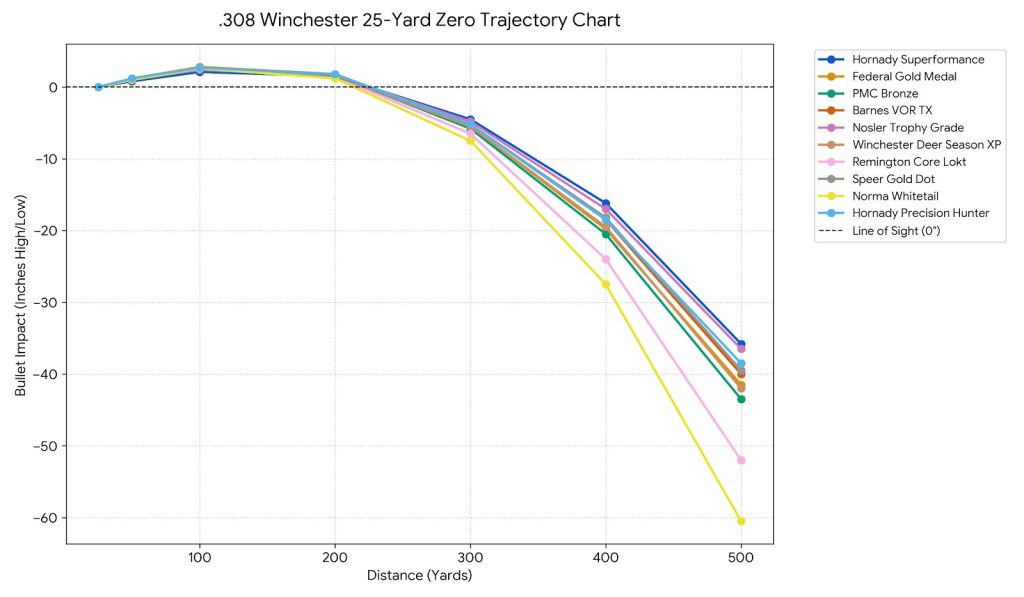
Shooters should use this table by finding their specific factory ammunition and noting the vertical impact deviations at various distances. The data allows marksmen to understand exactly how much holdover or holdunder is required when a target appears at distances other than the twenty five yard zeroing mark.
Understanding The 308 25 Yard Zero Chart
Point Of Impact Analysis
The chart reveals that every listed factory load climbs above the line of sight immediately after the twenty five yard zero mark. At fifty yards, we see the Hornady Superformance impacting only zero point eight inches high, while the Federal Premium Gold Medal impacts one point two inches high.
This initial climb peaks around the one hundred yard mark for all loads listed in our 308 zero chart. The Federal Premium Gold Medal peaks at two point eight inches high, whereas the Hornady Superformance reaches only two point one inches high.
By two hundred yards, gravity begins pulling the bullets back toward the original line of sight. The Norma Whitetail drops to just one point two inches high at two hundred yards.
At three hundred yards, every single load in the table impacts below the line of sight. The drop varies significantly, from four point five inches low with Hornady Superformance to seven point five inches low with Norma Whitetail.
Beyond three hundred yards, the point of impact diverges drastically based on the bullet weight and ballistic coefficient. The Remington Core Lokt drops a massive fifty two inches at five hundred yards, while the Nosler Trophy Grade drops only thirty six point five inches.
Trajectory Analysis
Trajectory curves are dictated largely by muzzle velocity and how efficiently a bullet cuts through the air. The Hornady Superformance load demonstrates the flattest overall trajectory in the table.
Because the Hornady Superformance travels at three thousand feet per second, its bullet drop at four hundred yards is only sixteen point two inches. Compare this to the slower PMC Bronze load which drops twenty point five inches at the exact same distance.
The Remington Core Lokt shows a steep trajectory degradation at extended ranges due to its low zero point three one four ballistic coefficient. Despite starting at a respectable two thousand eight hundred and twenty feet per second, it drops twenty four inches at four hundred yards.
Practical holdover with a twenty five yard sight in requires aiming slightly low for targets between fifty and two hundred yards. For example, when shooting the Winchester Deer Season XP at one hundred yards, the shooter must aim two point five inches below the desired point of impact.
When stretching out to three hundred yards, holdovers become necessary for every listed option. A shooter using the Barnes VOR TX would need to aim approximately five point two inches above their target to secure a precise hit.
Velocity Analysis
Muzzle velocity is a critical component that drives the trajectory values shown in the table. The Hornady Superformance is the clear speed leader at three thousand feet per second.
This high velocity is directly responsible for the Superformance load having the longest maximum point blank range at two hundred and ninety five yards. Higher velocity means the bullet spends less time in the air, giving gravity less time to alter its path.
Conversely, the Federal Premium Gold Medal and the Hornady Precision Hunter both leave the muzzle at a slower two thousand six hundred feet per second. This slower speed causes a steeper initial climb to two point eight and two point seven inches high at one hundred yards, respectively.
While slower velocities lead to steeper initial trajectories, high ballistic coefficients can retain speed over longer distances. The Hornady Precision Hunter load starts slow but its impressive zero point five five two ballistic coefficient keeps its five hundred yard drop to just thirty eight point five inches.
The standard two thousand eight hundred and twenty feet per second velocity is common among one hundred and fifty grain hunting loads like Winchester Deer Season XP and Remington Core Lokt. This velocity provides a balanced trajectory that keeps the one hundred yard impact consistently around two point five inches high.
Best Factory Loads Based On The Chart
For hunting whitetail deer, the Winchester Deer Season XP is an exceptional choice based on the data. It offers a forgiving maximum point blank range of two hundred and seventy eight yards and requires only a five point five inch holdover at three hundred yards.
When pursuing larger game like elk, the Nosler Trophy Grade one hundred and sixty five grain AccuBond stands out. It retains excellent energy while maintaining a flat trajectory, dropping only four point eight inches at three hundred yards.
For dedicated target shooting, the Federal Premium Gold Medal one hundred and seventy five grain Sierra MatchKing is unmatched. Although it drops forty one point five inches at five hundred yards, its consistent trajectory and high ballistic coefficient make it incredibly predictable.
If long range shooting is the primary goal, the Hornady Precision Hunter takes the lead. Its massive zero point five five two ballistic coefficient ensures it resists wind deflection while dropping only eighteen point five inches at four hundred yards.
For general purpose hunting, the Barnes VOR TX offers incredible versatility. The trajectory peaks at only two point six inches high at one hundred yards and the solid copper bullet provides excellent terminal performance.
Key Takeaways From The Chart
The flattest trajectory in the entire 308 bullet drop chart belongs to the Hornady Superformance one hundred and fifty grain SST. It drops the least amount of any listed load at every distance beyond two hundred yards.
The fastest load is also the Hornady Superformance, clocking in at a blistering three thousand feet per second. This speed advantage translates directly to its superior maximum point blank range.
The load with the least drop at three hundred yards is the Hornady Superformance at four point five inches low. The Nosler Trophy Grade follows very closely behind at four point eight inches low.
The best hunting load for diverse environments is the Nosler Trophy Grade AccuBond. It bridges the gap between high velocity and high ballistic coefficient perfectly.
The best overall factory load for consistent, predictable performance is the Hornady Precision Hunter. It balances a heavy bullet weight with stellar aerodynamic properties for consistent 308 point of impact downrange.
How A 25 Yard Zero Affects Trajectory
50 Yards
When zeroed at twenty five yards, the barrel is angled slightly upward relative to the optic. This means that at fifty yards, the bullet is still traveling upward on its initial flight path.
Looking at the PMC Bronze load, the bullet impacts exactly one inch high at fifty yards. Shooters must remember to hold their crosshairs slightly below the intended target at this distance.
100 Yards
One hundred yards is typically the peak altitude of the bullet trajectory for most standard velocity loads. The bullet is at its highest point above the line of sight before gravity begins to pull it noticeably downward.
For example, the Speer Gold Dot load impacts two point five inches high at one hundred yards. If you aim dead center on a small target at this distance, you risk shooting completely over it.
200 Yards
At two hundred yards, the bullet is on its downward descent and is approaching the line of sight once again. The trajectory is flattening out as it prepares to drop below the zero plane.
The Winchester Deer Season XP impacts one point five inches high at two hundred yards. This makes it an incredibly lethal point and shoot distance for medium game without requiring complex calculations.
300 Yards
By the time the bullet reaches three hundred yards, it has crossed back through the line of sight and is now dropping rapidly. Every single load requires a holdover to strike the center of the target.
The Remington Core Lokt drops six point five inches low at this range. A shooter must consciously aim into the upper third of a deer sized target to secure a vital hit.
Beyond 300 Yards
Past three hundred yards, aerodynamic drag takes a massive toll on bullet velocity. The trajectory curve becomes extremely steep, making precise distance measurement mandatory for accurate hits.
The Norma Whitetail drops a staggering sixty point five inches low at five hundred yards. Attempting shots at this distance with a twenty five yard sight in requires advanced optics with dedicated drop compensation reticles or adjustable turrets.
Common 308 Bullet Weights
125 Grain
One hundred and twenty five grain bullets are among the lightest practical projectiles available for this caliber. They are designed for maximum velocity and minimal recoil.
With a twenty five yard zero, these light bullets shoot exceptionally flat out to two hundred yards due to velocities frequently exceeding three thousand feet per second. However, they shed velocity quickly and suffer significant wind drift at longer ranges.
The main advantage is the very mild recoil pulse and explosive terminal performance on small pests. The disadvantage is their terrible performance in windy conditions.
These lightweight projectiles are best applied to predator hunting and varmint control. They are generally not recommended for large game due to a lack of penetration depth.
147 Grain
The one hundred and forty seven grain bullet is the standard military ball weight for the seven point six two NATO cartridge. It is widely available and extremely affordable for volume shooting.
The PMC Bronze load in our chart demonstrates that this weight produces a reliable trajectory, rising two point five inches high at one hundred yards. The velocity normally hovers around two thousand seven hundred and eighty feet per second.
The primary advantage of this bullet weight is cost effectiveness for practice and plinking. The disadvantage is that full metal jacket designs are inappropriate for hunting.
This weight is the absolute best application for high volume target practice, tactical training, and breaking in a new rifle barrel. It allows shooters to build proficiency without spending a fortune on premium ammunition.
150 Grain
One hundred and fifty grain bullets are considered the classic standard for hunting medium sized game. They offer the perfect balance of speed and striking energy.
As seen with the Winchester Deer Season XP, these bullets generally impact two point five inches high at one hundred yards. Velocities usually sit comfortably at two thousand eight hundred and twenty feet per second.
Their advantage lies in their versatility and the massive variety of factory loads available on the market. A minor disadvantage is that they lack the ballistic coefficients needed for extreme long range precision.
The absolute best application for this bullet weight is hunting whitetail deer and feral hogs at moderate ranges. They provide rapid expansion and massive energy transfer inside two hundred and fifty yards.
155 Grain
One hundred and fifty five grain bullets were initially popularized by international Palma shooting competitions. They are designed to stay supersonic all the way out to one thousand yards.
With a short range sight in, these bullets share a trajectory very similar to the one hundred and fifty grain variants but retain their speed slightly better. Typical muzzle velocities are around two thousand eight hundred feet per second.
The major advantage is exceptional aerodynamic efficiency for a relatively light bullet. There are virtually no disadvantages when used for their intended purpose.
These specialized projectiles are best suited for competitive target shooting and long range precision rifle matches. They are favored by marksmen who need maximum velocity with high ballistic coefficients.
165 Grain
One hundred and sixty five grain bullets represent the perfect middle ground between the fast one hundred and fifty grain and the heavy one hundred and eighty grain options. Many experts consider this the optimal weight for the caliber.
The Nosler Trophy Grade load shows this weight rising two point four inches at one hundred yards before dropping four point eight inches at three hundred yards. Velocities generally run at two thousand eight hundred feet per second.
The primary advantage is outstanding terminal ballistics on larger game without sacrificing a flat trajectory. The disadvantage is a slightly sharper recoil pulse than lighter options.
This bullet weight is the ultimate application for mixed bag hunting where you might encounter both deer and elk on the same trip. It is the true jack of all trades projectile.
168 Grain
The one hundred and sixty eight grain bullet is deeply rooted in law enforcement and military sniper history. It is world renowned for its inherent accuracy.
The Barnes VOR TX load in our 308 trajectory chart pushes this weight to two thousand seven hundred feet per second. It peaks at two point six inches high at one hundred yards.
Its biggest advantage is match winning precision and consistency across various rifle platforms. The traditional disadvantage was that older match designs became unstable past eight hundred yards, though modern designs have largely fixed this.
This is the best bullet weight for tactical precision shooting, law enforcement applications, and medium to large game hunting when using premium hunting variants. It offers incredible confidence when making critical shots.
175 Grain
One hundred and seventy five grain bullets were specifically designed to fix the long range instability issues of older one hundred and sixty eight grain designs. They are the heavy hitters of the precision shooting world.
The Federal Premium Gold Medal load clearly shows this weight traveling at two thousand six hundred feet per second. It impacts two point eight inches high at one hundred yards and drops forty one point five inches at five hundred yards.
The advantage is spectacular stability and wind resistance at extreme distances. The disadvantage is a looping, rainbow like trajectory at closer ranges due to the slower muzzle velocity.
This weight is the gold standard application for military snipers and extreme long range steel plate shooting. It ensures the bullet remains completely stable during transonic flight.
178 Grain
One hundred and seventy eight grain bullets are a modern evolution designed to push ballistic coefficients to their absolute maximum within the confines of the cartridge case. They are incredibly sleek and aerodynamic.
The Hornady Precision Hunter utilizes this weight to achieve a staggering zero point five five two ballistic coefficient. It travels at two thousand six hundred feet per second and drops eighteen point five inches at four hundred yards.
The main advantage is superior energy retention and minimal wind drift at extended hunting ranges. The disadvantage is a noticeably heavier recoil impulse compared to standard loads.
This modern bullet weight is best applied to open country hunting where shots frequently exceed three hundred yards. It is highly favored by western hunters pursuing game across vast canyons.
180 Grain
One hundred and eighty grain bullets are the heaviest projectiles commonly loaded by commercial ammunition factories for this caliber. They are built strictly for deep penetration.
Because of their mass, they generally leave the muzzle at a sluggish two thousand five hundred feet per second. This results in a trajectory that arcs nearly three inches high at one hundred yards and drops very rapidly past two hundred and fifty yards.
The advantage is unstoppable momentum and bone crushing penetration on heavy game. The distinct disadvantage is a very steep trajectory curve that makes ranging errors extremely costly.
These heavy bullets are best applied to hunting large, tough game like moose or large bears at close distances. They are meant for deep woods environments where shots rarely exceed one hundred and fifty yards.
Is A 25 Yard Zero Good For A 308?
A twenty five yard sight in is a highly effective and practical choice for many shooters using this caliber. It provides a generous maximum point blank range that simplifies aiming for hunters.
Looking at the Winchester Deer Season XP in the table, a twenty five yard sight in allows the shooter to hold dead center on a deer sized target from point blank range all the way out to two hundred and seventy eight yards. The bullet will never rise or fall more than a few inches from the line of sight during that entire flight path.
The primary disadvantage is that the bullet impacts roughly two to three inches high at exactly one hundred yards. If a shooter is attempting to hit a very small target like a groundhog at that specific distance, they must remember to aim noticeably low.
This zeroing distance is especially beneficial for shooters utilizing iron sights or low power variable optics on tactical rifles. It ensures rapid, combat effective hits on man sized silhouettes without the need to dial elevation turrets or consult complex data cards in the field.
25 Yard Zero Vs 100 Yard Zero Vs 200 Yard Zero
| Feature | 25 Yard Zero | 100 Yard Zero | 200 Yard Zero |
| Point Of Impact At 100 Yards | Approx 2.5 Inches High | Exactly 0.0 Inches | Approx 1.8 Inches High |
| Trajectory Arc | Rises to 100 yds, falls through 200 yds | Starts dropping immediately past 100 yds | Rises to 100 yds, zero at 200 yds |
| Maximum Point Blank Range | Very Long (Approx 270 Yards) | Very Short (Approx 120 Yards) | Long (Approx 240 Yards) |
| Ease Of Zeroing | Very Easy (Short range visibility) | Moderate (Requires standard range) | Difficult (Requires long range) |
| Long Range Performance | Requires hold under then hold over | Requires massive holdovers immediately | Requires minimal holdover to 300 yards |
For general purpose hunting in diverse environments, the twenty five yard sight in is often considered superior due to its maximum point blank range. It allows hunters to completely ignore ballistic charts when a deer steps out at one hundred and fifty yards.
For dedicated benchrest target shooting, a one hundred yard sight in is universally preferred. Target shooters want the bullet to strike exactly where the crosshairs rest without having to calculate a two point five inch offset for a high impact.
For open plains hunting where shots are consistently long, a two hundred yard sight in is extremely popular. It provides a slightly flatter trajectory curve than the twenty five yard method while keeping the mid range rise to a manageable one point eight inches.
Ultimately, the choice depends heavily on the optic being used. Shooters with complex tree reticles often prefer a one hundred yard sight in so their drop marks align perfectly, while hunters with simple duplex reticles benefit massively from the point blank capabilities of the short range sight in.
Frequently Asked Questions
What is a 308 25 yard zero?
It is a sighting method where the rifle optic is adjusted so the bullet impacts exactly exactly at the point of aim at twenty five yards. Because the barrel is angled slightly upward relative to the scope, the bullet will cross the line of sight, continue upward, and then drop back down at longer distances.
Does sighting in at 25 yards mean I am also zeroed at 200 yards?
It is a very common misconception that these distances share the exact same point of impact. While the bullet does return downward near the two hundred yard mark, our chart shows that most factory loads like the Speer Gold Dot still impact roughly one point five inches high at two hundred yards.
Why is my rifle shooting high at 100 yards?
If you zeroed your rifle at twenty five yards, the bullet is still on its upward trajectory path when it reaches the one hundred yard marker. Depending on your muzzle velocity, it is completely normal for the bullet to impact anywhere from two to three inches high at this distance.
Is a 25 yard sight in good for hunting deer?
Yes, it is an exceptionally good strategy for hunting whitetail deer. It creates a maximum point blank range of nearly two hundred and eighty yards, meaning you can aim directly at the center of the deer vital zone at any practical distance without adjusting your aim.
How much will a 150 grain bullet drop at 300 yards?
Based on our verified 308 bullet drop chart, a standard one hundred and fifty grain load like the Remington Core Lokt will drop roughly six point five inches below the line of sight at three hundred yards. Faster loads like the Hornady Superformance will drop slightly less at four point five inches.
Should I zero my hunting rifle at 25 or 100 yards?
If you hunt in dense woods where visibility is limited, a one hundred yard sight in provides exact precision for tight shots. If you hunt in mixed terrain where a deer could appear at fifty or two hundred and fifty yards, the shorter sight in offers a much more forgiving trajectory.
What is Maximum Point Blank Range?
Maximum point blank range is the furthest distance a shooter can hit a target of a specific size without needing to hold the crosshairs above or below the center point. With a twenty five yard sight in, this distance is heavily maximized, allowing hunters to point and shoot out to nearly three hundred yards.
Can I zero my scope at 25 yards at an indoor range?
Yes, indoor ranges are perfect for this exact sighting method. Because environmental factors like wind do not affect the bullet at such a short distance, you can establish a perfectly precise mechanical zero before confirming it at an outdoor facility.
How do I use the 308 trajectory chart in the field?
You should print or memorize the data specific to your chosen factory ammunition. When you range a target in the field, simply check the chart to see exactly how many inches high or low the bullet will strike, and adjust your aiming point accordingly.
Which load drops the least at 500 yards?
According to the chart data, the Hornady Superformance one hundred and fifty grain SST has the least amount of drop at five hundred yards, measuring thirty five point eight inches low. The Nosler Trophy Grade is the second best performer, dropping thirty six point five inches low.