The typical .300 WSM recoil energy ranges from 25 to 30 foot-pounds when fired from a standard 8-pound hunting rifle. For example, a 150-grain load generates roughly 25 foot-pounds of free recoil, while a heavy 200-grain load pushes closer to 29 foot-pounds. This 300 wsm recoil energy variance depends entirely on the bullet weight, the powder charge, the muzzle velocity, and the physical weight of the firearm. Firing this cartridge from a lightweight 6.5-pound mountain rifle will significantly increase the felt recoil energy to over 35 foot-pounds. While it offers genuine magnum performance, the short and highly efficient powder column generates noticeably less recoil than the older traditional .300 Winchester Magnum.
.300 WSM Recoil Energy
| Ammunition / Load (8 lb Rifle) | Bullet Weight | Muzzle Velocity | Recoil Energy |
| Winchester Deer Season XP | 150 grain | 3,260 fps | 25.8 ft-lbs |
| Browning BXS Solid Copper | 155 grain | 3,250 fps | 26.2 ft-lbs |
| Hornady Outfitter CX | 165 grain | 3,120 fps | 26.7 ft-lbs |
| Federal Premium Nosler Partition | 180 grain | 2,960 fps | 27.9 ft-lbs |
| Winchester Expedition Big Game | 190 grain | 2,870 fps | 28.5 ft-lbs |
| Barnes Precision Match | 200 grain | 2,820 fps | 29.2 ft-lbs |
| Hornady Precision Hunter ELD-X | 200 grain | 2,820 fps | 29.2 ft-lbs |
| Federal Premium Terminal Ascent | 215 grain | 2,750 fps | 30.1 ft-lbs |
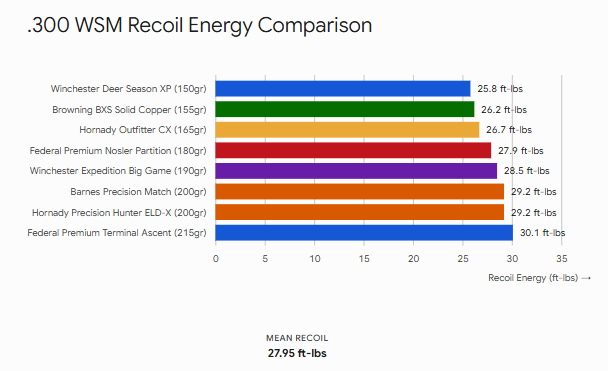
Explaining The 300 WSM Recoil Energy Chart
Based on the real world ballistic data above, assuming a standardized 8-pound rifle, we can identify several key performance baselines:
- Lowest Tested Recoil Energy: The Winchester Deer Season XP 150-grain yields 25.8 ft-lbs. Because it utilizes a lighter bullet, it generates the least amount of rearward physical force despite traveling at blistering speeds.
- Highest Tested Recoil Energy: The Federal Premium Terminal Ascent 215-grain load generates 30.1 ft-lbs. Pushing an ultra-heavy bullet at magnum velocities requires maximum powder charges, resulting in the heaviest recoil impulse.
- Typical Range: The standard .300 WSM energy baseline falls between 26 and 29 ft-lbs. This is where most traditional 165-grain and 180-grain hunting ammunition operates.
- How Bullet Weight Affects Recoil: Heavy bullets consistently increase recoil. Pushing a massive 200-grain bullet out of the barrel requires more physical force than pushing a 150-grain bullet, which translates directly to a harder impact on the shooter’s shoulder.
- How Rifle Weight Affects Energy: All numbers in the chart assume an 8-pound rifle. If you shoot these exact same loads out of a lighter rifle, the recoil energy will spike drastically because there is less physical mass to absorb the backward momentum.
Importantly, free recoil energy is strictly a physics measurement of the rearward force generated by the cartridge. It is not a measurement of felt recoil, which can be mitigated by soft recoil pads, muzzle brakes, and the specific stock design of the rifle.
What Is The Recoil Energy Of .300 WSM?
The recoil energy of .300 WSM ammunition generally sits around 27 to 28 foot-pounds for standard pressure 180-grain loads fired from a standard 8-pound hunting rifle. However, depending on the specific hunting application, ranging from lightweight 150-grain deer loads up to ultra-heavy 215-grain elk and moose cartridges, the .300 WSM recoil spectrum spans from roughly 25 ft-lbs up to 30 ft-lbs in standard rifles.
.300 WSM Recoil Energy By Bullet Weight
Because manufacturers load the .300 WSM across several bullet weights specifically designed for different sizes of game, recoil energy shifts predictably depending on the projectile selected. The table below uses specific factory load examples to illustrate how recoil scales with bullet weight.
| Bullet Weight | Example Velocity | Recoil Energy (8 lb Rifle) |
| 150 grain (Winchester XP) | 3,260 fps | 25.8 ft-lbs |
| 165 grain (Hornady CX) | 3,120 fps | 26.7 ft-lbs |
| 180 grain (Federal Partition) | 2,960 fps | 27.9 ft-lbs |
| 200 grain (Hornady ELD-X) | 2,820 fps | 29.2 ft-lbs |
| 215 grain (Federal Ascent) | 2,750 fps | 30.1 ft-lbs |
Note: These figures represent specific factory loads calculated in an 8-pound rifle. Not every load of the same bullet weight produces the exact same recoil due to variations in powder types.
.300 WSM 150 Grain Recoil Energy
The 150-grain bullet is the most popular lightweight option for hunting whitetail deer and antelope. Because the bullet is relatively light for a magnum caliber, it produces the softest recoil in the lineup. A standard .300 WSM 150 grain recoil energy typically measures just under 26 ft-lbs. This makes it highly manageable for most adult shooters while still delivering exceptional flat-shooting velocity.
.300 WSM 180 Grain Recoil Energy
The 180-grain bullet is the historic and undisputed standard for .30 caliber magnum hunting cartridges, perfectly suited for elk and large game. Moving at a robust 2,960 fps out of a rifle barrel, a standard .300 WSM 180 grain recoil energy typically measures exactly 27.9 ft-lbs in an 8-pound rifle. This represents a stout, sharp recoil impulse that commands respect from the shooter, but remains controllable with proper shooting mechanics.
.300 WSM Recoil Energy By Rifle Weight
A cartridge’s advertised free recoil energy changes completely the moment you change the physical weight of the firearm. The .300 WSM is frequently chambered in ultra-lightweight mountain rifles designed for backcountry carry, which drastically alters the recoil experience.
Using standard 180-grain hunting ammunition traveling at 2,960 fps, here is how .300 WSM recoil energy changes across common rifle weights:
- 6.0 lbs (e.g., Ultra-light titanium mountain rifles): 36.9 ft-lbs
- 7.0 lbs (e.g., Lightweight synthetic hunting rifles): 31.7 ft-lbs
- 8.0 lbs (e.g., Standard wood or heavy synthetic rifles): 27.9 ft-lbs
- 9.0 lbs (e.g., Heavy barrel target or chassis rifles): 24.6 ft-lbs
- 10.0 lbs (e.g., Precision long range bench rifles): 22.1 ft-lbs
Because rifle weight acts as a physical dampener, heavier rifles absorb more of the backward acceleration. Taking an 8-pound rifle and shaving two pounds off the weight will punish the shooter with nearly 10 additional foot-pounds of recoil energy.
.300 WSM Velocity And Recoil Energy
To understand how .300 WSM velocity and recoil energy are related, it is important to conceptually understand recoil physics. Free recoil energy is calculated using the total physical weight of the firearm, the weight of the powder charge, the weight of the bullet, and the muzzle velocity.
Because velocity plays an exponential mathematical role in kinetic physics calculations, increasing the speed of the bullet will sharply increase the backward force felt by the shooter. Furthermore, the massive powder charge inside a magnum cartridge turns into superheated gas that exits the muzzle at roughly 4,700 fps. This escaping gas acts like a rocket engine pushing backward against the rifle, which contributes heavily to the total recoil energy.
.300 WSM Recoil Energy vs .300 Win Mag and .308 Winchester
How does the .300 WSM recoil compare to the standard .308 Winchester and the legendary full length .300 Winchester Magnum? The table below compares identical 165-grain and 180-grain bullet weights fired from standard 8-pound rifles.
| Cartridge | Rifle Weight | Bullet Weight | Recoil Energy |
| .308 Winchester | 8.0 lbs | 165 grain | 17.0 ft-lbs |
| .300 WSM | 8.0 lbs | 180 grain | 27.9 ft-lbs |
| .300 Win Mag | 8.0 lbs | 180 grain | 31.0 ft-lbs |
The .300 WSM produces roughly 60 percent more recoil than the standard .308 Winchester, marking a significant step up in power that novice shooters will immediately notice.
However, the .300 WSM shines when compared to the older .300 Winchester Magnum. Both cartridges fire a 180-grain bullet at nearly identical speeds, but the .300 WSM generates roughly 3 foot-pounds less recoil. This happens because the short, fat .300 WSM cartridge case is highly efficient and requires roughly 10 grains less powder to achieve the exact same velocity. Less burning powder means less rocket effect at the muzzle, resulting in a softer recoil impulse.
What Recoil Energy Actually Tells You
Free recoil energy is a useful comparative metric for evaluating different cartridges on paper, but it has severe limitations when analyzing actual shooter comfort in the field.
- Free Recoil vs. Felt Recoil: Free recoil is raw physics. Felt recoil is how the shooter actually perceives that physical force. A rifle with 30 foot-pounds of free recoil might feel comfortable if it has an excellent recoil pad and a stock that fits the shooter perfectly.
- Muzzle Brakes: Adding a quality muzzle brake will instantly reduce the free recoil energy by 30 to 50 percent by redirecting the high speed powder gases sideways rather than letting them push the rifle backward.
- Shooter Stance: A shooter firing from a standing position can allow their body to rock backward, absorbing heavy recoil easily. Firing that exact same rifle from a prone position forces the shoulder to absorb the entire 28 foot-pounds of energy instantly, making it feel much more violent.
.300 WSM Recoil Energy Pros
- Generates measurably less recoil than traditional magnum cartridges like the .300 Win Mag while delivering identical ballistic performance.
- The highly efficient powder column reduces the total powder charge needed, which lowers the overall recoil impulse.
- Recoil is highly manageable for most adult shooters when fired from standard 8-pound to 9-pound hunting rifles.
.300 WSM Recoil Energy Limitations
- Produces significantly more recoil than standard non-magnum calibers like the .308 Winchester, which can easily induce flinching.
- Extremely punishing when fired from ultra-lightweight 6-pound mountain rifles commonly used for backcountry hunting.
- Requires excellent shooting fundamentals, a high quality recoil pad, or a muzzle brake to shoot comfortably during long range practice sessions.
.300 WSM Recoil Energy: Final Answer
The .300 WSM produces a typical recoil energy range of 25 to 30 foot-pounds when standard ammunition is fired from an 8-pound hunting rifle.
Common 150-grain deer loads reliably yield roughly 25 to 26 ft-lbs of recoil. Traditional 180-grain elk hunting loads predictably produce 27 to 28 ft-lbs. Heavy 200-grain and 215-grain long range loads will generate 29 to 30 ft-lbs. The highest recoil numbers are experienced when the cartridge is fired from lightweight backcountry mountain rifles, which can push the recoil energy well past 36 ft-lbs.
Ultimately, there is no single universal .300 WSM recoil energy number. The final output depends entirely on the bullet weight selected, the powder charge used by the manufacturer, and exactly how heavy your specific rifle is.
FAQs
How much recoil energy does a .300 WSM have?
Standard .300 WSM rifle loads typically generate between 25 and 30 foot-pounds of free recoil energy when fired from a standard 8-pound hunting rifle.
What is the recoil energy of a 180 grain .300 WSM?
A standard 180-grain .300 WSM load traveling at roughly 2,960 fps produces approximately 27.9 foot-pounds of recoil energy out of an 8-pound rifle.
How much recoil does a 150 grain .300 WSM have?
Lightweight 150-grain loads produce roughly 25.8 ft-lbs of recoil energy, making them the softest shooting option available for the caliber.
Does rifle weight affect .300 WSM recoil energy?
Yes, drastically. Firing a .300 WSM from a lightweight 6-pound mountain rifle will result in nearly 37 foot-pounds of recoil, compared to roughly 28 foot-pounds generated from a standard 8-pound rifle.
How does .300 WSM recoil compare with .308 Winchester?
The .300 WSM produces roughly 60 percent more raw recoil energy than a standard .308 Winchester. While a .308 Winchester generally sits around 16 to 17 ft-lbs, the .300 WSM comfortably operates above 26 ft-lbs.
How does .300 WSM recoil compare with .300 Win Mag?
The .300 WSM produces slightly less recoil than the .300 Winchester Magnum. Because the .300 WSM uses roughly 10 grains less powder to achieve identical velocities, it generates about 3 foot-pounds less free recoil.
Is .300 WSM recoil manageable for hunting?
Yes. While it is a true magnum cartridge with stout recoil, it is entirely manageable for adult shooters using standard weight rifles or rifles equipped with a muzzle brake.
Will a muzzle brake reduce .300 WSM recoil energy?
Yes. A high quality muzzle brake can reduce the free recoil energy of a .300 WSM by up to 50 percent, dropping the felt recoil down to levels similar to a mild .243 Winchester.
How is .300 WSM recoil energy calculated?
It is calculated conceptually using a physics equation that combines the physical weight of the rifle, the weight of the bullet, the weight of the powder charge, and the muzzle velocity. Because velocity has an exponential mathematical effect in this calculation, speed plays a massive role in generating high foot-pounds of recoil force.