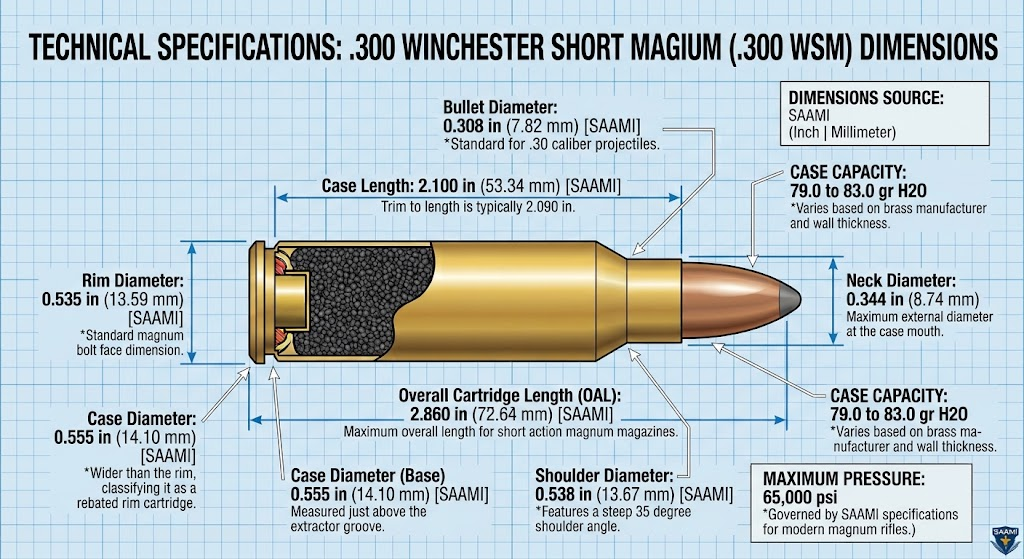
The 300 Winchester Short Magnum (300 WSM) is a beltless, short action centerfire rifle cartridge featuring a standard maximum bullet diameter of 0.308 inches (7.82 mm). The maximum case length is 2.100 inches (53.34 mm), and the maximum overall cartridge length is restricted to 2.860 inches (72.64 mm) to ensure compatibility with short action rifle magazines. The case utilizes a rebated rim diameter of 0.535 inches (13.59 mm) and a wider base diameter of 0.555 inches (14.10 mm). Ammunition for this caliber is most commonly found in 150 grain, 165 grain, and 180 grain bullet weights. Exact dimensions and operating pressures can vary slightly depending on manufacturing tolerances and whether you reference American SAAMI specifications or European C.I.P. standards.
Table of Contents [Click to open]
300 WSM Dimensions
| Dimension | Specification | Source | Notes |
|---|---|---|---|
| Bullet Diameter | 0.308 in (7.82 mm) | SAAMI | Standard for .30 caliber projectiles. |
| Case Length | 2.100 in (53.34 mm) | SAAMI | Maximum case length; trim to length is typically 2.090 in. |
| Overall Cartridge Length | 2.860 in (72.64 mm) | SAAMI | Maximum overall length for short action magnum magazines. |
| Rim Diameter | 0.535 in (13.59 mm) | SAAMI | Standard magnum bolt face dimension. |
| Case Diameter (Base) | 0.555 in (14.10 mm) | SAAMI | Measured just above the extractor groove. |
| Shoulder Diameter | 0.538 in (13.67 mm) | SAAMI | Features a steep 35 degree shoulder angle. |
| Neck Diameter | 0.344 in (8.74 mm) | SAAMI | Maximum external diameter at the case mouth. |
| Base Diameter | 0.555 in (14.10 mm) | SAAMI | Wider than the rim, classifying it as a rebated rim cartridge. |
| Case Capacity | 79.0 to 83.0 gr H2O | Industry Standard | Varies based on the brass manufacturer and wall thickness. |
| Maximum Pressure | 65,000 psi | SAAMI | Governed by SAAMI specifications for modern magnum rifles. |
Understanding The 300 WSM Dimensions
- Bullet Diameter: The measurement across the widest point of the bullet. For the 300 WSM, this is specified as 0.308 inches. This standard dimension gives shooters access to a massive global inventory of highly advanced target and hunting projectiles.
- Case Length: The length of the empty brass cylinder from the base to the case mouth, maxing out at 2.100 inches. This short length is the defining characteristic of the cartridge, allowing it to cycle in lighter, faster rifle actions.
- Overall Cartridge Length (OAL): The total length of the fully assembled round from the base to the tip of the bullet, strictly capped at 2.860 inches. This dimension dictates that the 300 WSM is a true short action cartridge, fitting into magazines designed around the 308 Winchester profile.
- Rim Diameter: The diameter of the flange at the very bottom of the case measuring 0.535 inches. This matches the standard magnum bolt face used by older cartridges like the 7mm Remington Magnum and 300 Winchester Magnum.
- Case Diameter: The width of the cartridge body at the base. At 0.555 inches, the base is physically wider than the 0.535 inch rim. This creates a rebated rim design and completely eliminates the need for a traditional brass belt.
- Shoulder Diameter: The width of the case where it begins to angle inward toward the neck (0.538 inches). The 300 WSM utilizes a very steep 35 degree shoulder to maximize internal powder capacity within its short case limits.
- Case Capacity: Measured in grains of water (gr H2O), this represents the internal volume of the empty case. Averaging roughly 79 to 83 grains of water, this short and fat powder column provides highly efficient, consistent powder ignition.
- Maximum Pressure: The peak internal pressure generated when the cartridge is fired. Standard SAAMI limits set this at an intense 65,000 psi.
300 WSM Cartridge Dimensions In Inches And Millimeters
For engineers, reloaders, and international shooters, below are the primary 300 WSM measurements converted accurately between imperial and metric systems.
| Dimension | Inches (SAAMI Max) | Millimeters (Equivalent) |
|---|---|---|
| Bullet Diameter | 0.308 in | 7.82 mm |
| Case Length | 2.100 in | 53.34 mm |
| Overall Length | 2.860 in | 72.64 mm |
| Rim Diameter | 0.535 in | 13.59 mm |
| Base Diameter | 0.555 in | 14.10 mm |
| Shoulder Diameter | 0.538 in | 13.67 mm |
| Neck Diameter | 0.344 in | 8.74 mm |
300 WSM Case Dimensions
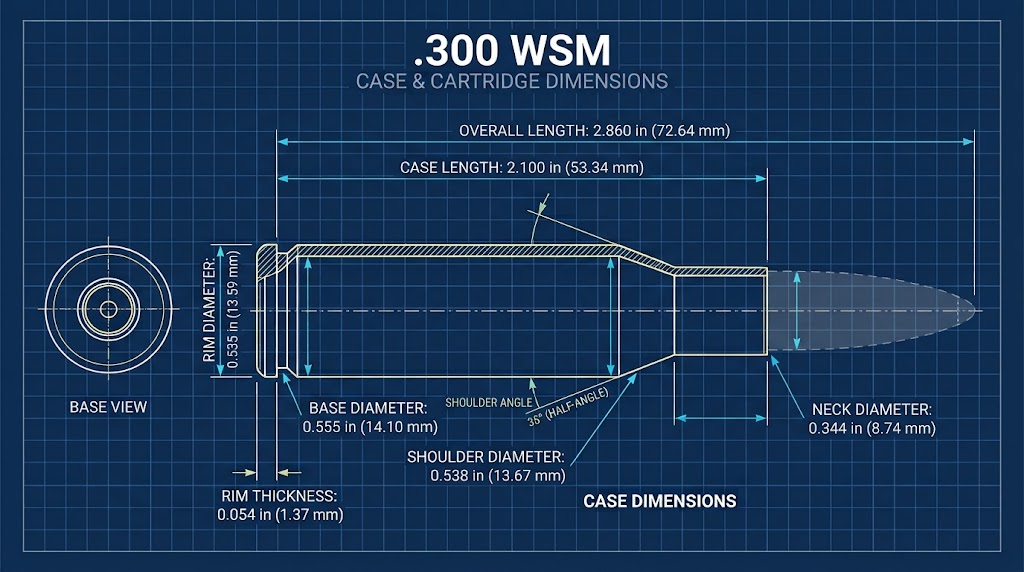
| Case Dimension | Inches | Millimeters | Specification Type | Source | Notes |
| Case Length | 2.100 | 53.34 | Maximum | SAAMI | Standard trim to length is 2.090 in. |
| Rim Diameter | 0.535 | 13.59 | Maximum | SAAMI | Rebated rim design. |
| Rim Thickness | 0.054 | 1.37 | Maximum | SAAMI | Controls bolt face engagement. |
| Base Diameter | 0.555 | 14.10 | Maximum | SAAMI | Measured just above the extractor groove. |
| Shoulder Diameter | 0.538 | 13.67 | Maximum | SAAMI | Body to shoulder intersection. |
| Neck Diameter | 0.344 | 8.74 | Maximum | SAAMI | Outside case neck diameter. |
| Shoulder Angle | 35° | N/A | Half Angle | SAAMI | Steep shoulder promotes powder burn efficiency. |
| Overall Length | 2.860 | 72.64 | Maximum | SAAMI | Allows feeding from short action magazines. |
| Case Capacity | ~80.0 | 5.18 cm³ | Nominal (H2O) | Industry Std. | Varies by brass manufacturer and wall thickness. |
| Max Pressure | 65,000 | 448.16 MPa | Max Average | SAAMI (Piezo) | C.I.P. specifies 63,817 psi (440 MPa). |
300 WSM Bullet Diameter
The standardized maximum bullet diameter for the 300 WSM is 0.308 inches (7.82 mm). This specific bore diameter gives shooters access to everything from lightweight 110 grain varmint bullets to heavy 220 grain match projectiles.
The standard 300 WSM barrel features a groove diameter of 0.308 inches and a bore or land diameter of 0.300 inches. Firing a 0.308 inch bullet down a 0.300 inch bore diameter forces the copper jacket to engrave tightly into the rifling. Factory rifles chambered in 300 WSM typically utilize a 1:10 twist rate, which perfectly stabilizes the 150 grain to 180 grain bullets most commonly used for big game hunting.
300 WSM Overall Length
The SAAMI maximum overall cartridge length (OAL) for the 300 WSM is 2.860 inches (72.64 mm). This maximum overall length is a defining dimensional characteristic of the cartridge, classifying it as a short action caliber.
The 2.860 inch restriction allows the cartridge to be used in mountain rifles that are significantly shorter and lighter than standard magnum rifles. However, this strict length limitation creates a dimensional challenge for reloaders. If a shooter attempts to use extremely long, high ballistic coefficient target bullets weighing 200 grains or more, the bullets must be seated very deeply into the brass case to fit inside the magazine. Seating long bullets deeply intrudes into the powder column, displacing gunpowder and reducing the velocity potential of the cartridge.
300 WSM Chamber And Cartridge Dimensions
The relationship between the 300 WSM cartridge and the firearm chamber is engineered for extreme precision. Unlike older belted magnums that headspace inconsistently on a brass belt, the 300 WSM headspaces entirely on its 35 degree shoulder.
This means the angled portion of the brass casing physically stops against a matching machined angle inside the barrel chamber. This provides a precise, solid stopping point that aligns the bullet perfectly concentric to the bore. The tight tolerance between the chamber shoulder and the cartridge shoulder is largely responsible for the reputation the 300 WSM has earned as a highly accurate target and hunting round.
300 WSM Dimensions vs Similar Cartridges
To understand the 300 WSM size profile, it is helpful to compare it against other popular 30 caliber rifle cartridges.
| Cartridge | Bullet Diameter | Case Length | Overall Length | Base Diameter | Maximum Pressure | Source |
|---|---|---|---|---|---|---|
| 300 WSM | 0.308 in | 2.100 in | 2.860 in | 0.555 in | 65,000 psi | SAAMI |
| 300 Win Mag | 0.308 in | 2.620 in | 3.340 in | 0.513 in | 64,000 psi | SAAMI |
| 308 Winchester | 0.308 in | 2.015 in | 2.810 in | 0.470 in | 62,000 psi | SAAMI |
| 300 PRC | 0.308 in | 2.580 in | 3.700 in | 0.532 in | 65,000 psi | SAAMI |
| 7mm WSM | 0.284 in | 2.100 in | 2.860 in | 0.555 in | 65,000 psi | SAAMI |
300 WSM vs 300 Winchester Magnum Dimensions
The 300 WSM was introduced in 2001 to replicate the legendary ballistic performance of the 300 Winchester Magnum inside a much smaller package. While they share identical ballistics with 180 grain bullets, their cases are fundamentally different.
- Action Size and Length: The 300 Win Mag uses a longer 2.620 inch case and requires a long action receiver to accommodate its 3.340 inch OAL. The 300 WSM uses a 2.100 inch case and cycles in a lighter short action receiver with a 2.860 inch OAL.
- Case Width and Shape: The 300 WSM features a fat 0.555 inch base and a steep 35 degree shoulder. The 300 Win Mag has a narrower 0.513 inch body and a shallow 25 degree shoulder.
- Headspacing: The 300 Win Mag utilizes a traditional brass belt near the base for headspacing. The modern 300 WSM is completely beltless and headspaces perfectly on its shoulder.
300 WSM SAAMI vs C.I.P. Dimensions
Cartridge dimensions and safe pressure limits are governed by SAAMI in the United States and C.I.P. in Europe.
Winchester submitted the 300 WSM to SAAMI for standardization upon its release. SAAMI lists the maximum average pressure for the 300 WSM at 65,000 psi, measured via conformal piezoelectric transducers. C.I.P. also adopted the cartridge and lists the maximum pressure at 440 MPa, which translates to approximately 63,817 psi. While they measure pressure using slightly different methodologies, the physical dimensional specifications remain absolutely identical to ensure global compatibility. Ammunition manufactured to SAAMI specifications is considered safe in any properly chambered rifle worldwide.
300 WSM Bullet Weight And Dimensions
The 300 WSM was optimized entirely around standard hunting weights in the 30 caliber spectrum. Common factory bullet weights include:
- 150 grain: A shorter projectile that leaves massive case capacity for heavy powder charges, resulting in velocities exceeding 3,250 feet per second for flat shooting on medium game.
- 165 grain: Often considered the perfect dimensional balance for the 300 WSM. These bullets fit comfortably within the 2.860 inch overall length limit without excessively intruding into the powder space.
- 180 grain: The traditional heavy hunting standard. These longer bullets take up more space inside the brass case but provide excellent sectional density for deep penetration on elk and moose.
Bullet weight does not alter the external brass case dimensions. However, because heavier bullets are physically longer, the manufacturer must carefully manage bullet seating depth. Seating bullets heavier than 200 grains in the 300 WSM often requires pushing the base of the bullet deep past the case neck and into the powder column, which is why long action magnums are preferred for ultra heavy projectiles.
Why 300 WSM Dimensions Matter
Understanding the specific 300 WSM measurements is essential for several practical reasons.
- Rifle Weight: The 2.860 inch overall length allows shooters to utilize short action rifles. Short actions use less steel, resulting in mountain hunting rifles that are significantly lighter to carry over rough terrain.
- Bolt Throw: A short action requires less rearward bolt travel to eject a spent case and chamber a new round, allowing for slightly faster follow up shots compared to a long action magnum.
- Reloading Consistency: Because the case headspaces precisely on the 35 degree shoulder without a belt, reloaders can easily bump the shoulder back a mere 0.002 inches during resizing. This exact dimensional control creates incredibly accurate ammunition and extends the lifespan of the brass.
Manufacturer Specifications vs Independent Measurements
If you use precision calipers to measure factory 300 WSM ammunition from companies like Winchester, Federal, or Hornady, the numbers will rarely match the SAAMI maximum specifications exactly.
SAAMI publishes maximum allowable dimensions to ensure absolute safety and interoperability across all firearm brands. Ammunition manufacturers purposefully produce their cases slightly smaller than these maximums. For example, the maximum case length is 2.100 inches, but measuring a factory cartridge might reveal a case length of 2.088 inches. This built in negative tolerance margin guarantees that the wide magnum ammunition will chamber smoothly in the field without jamming in tight match grade chambers.
Common Questions
What are the dimensions of the 300 WSM?
The key maximum dimensions are a bullet diameter of 0.308 inches, a case length of 2.100 inches, and an overall cartridge length of 2.860 inches.
What is the 300 WSM case length?
The maximum SAAMI case length is 2.100 inches (53.34 mm).
What is the 300 WSM overall length?
The maximum overall length (OAL) is 2.860 inches (72.64 mm), fitting perfectly into standard short action magazines.
What is the 300 WSM bullet diameter?
The SAAMI maximum bullet diameter is 0.308 inches.
What is the 300 WSM rim diameter?
The rim diameter measures 0.535 inches, matching the standard magnum bolt face used by older cartridges.
What is the 300 WSM case diameter?
The case diameter at the base is 0.555 inches, which is wider than the rim, making it a rebated rim cartridge.
What is the 300 WSM case capacity?
The 300 WSM holds approximately 79.0 to 83.0 grains of water depending on the exact thickness of the specific brass casing.
What is the maximum pressure for the 300 WSM?
The SAAMI maximum average pressure is strictly capped at 65,000 psi.
How do 300 WSM and 300 Win Mag dimensions compare?
They share the same bullet diameter of 0.308 inches, but the 300 WSM utilizes a much shorter 2.100 inch case compared to 2.620 inches. The 300 WSM also eliminates the brass belt and features a wider body with a steep 35 degree shoulder.
Does the 300 WSM use a standard magnum bolt face?
Yes. Despite having a wider body, the 300 WSM uses a rebated 0.535 inch rim, allowing it to function on standard magnum bolt faces.