When comparing the .300 Blackout and the 5.56x45mm NATO, shooters often focus heavily on velocity, effective range, and terminal ballistics. However, recoil impulse is a critical factor that directly influences follow up shot speed, shooter fatigue, and overall rifle control. The main difference in their recoil comes down to how they generate energy; the 5.56 relies on extreme velocity with a lightweight bullet, while the .300 Blackout relies on a much heavier bullet traveling at slower speeds.
Whether you are setting up a home defense rifle, a suppressed short barreled rifle, or a general purpose carbine, understanding how these two popular cartridges compare in the recoil department is essential.
300 Blackout vs. 556 Recoil: Which Caliber Kicks Harder?
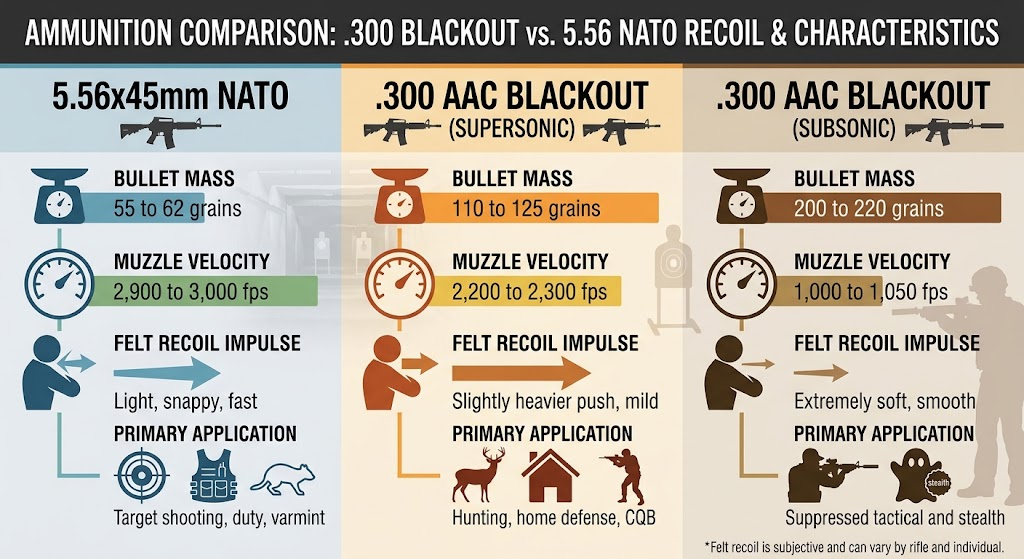
| Feature | 5.56x45mm NATO | .300 AAC Blackout (Supersonic) | .300 AAC Blackout (Subsonic) |
| Bullet Mass | 55 to 62 grains | 110 to 125 grains | 200 to 220 grains |
| Muzzle Velocity | 2,900 to 3,000 fps | 2,200 to 2,300 fps | 1,000 to 1,050 fps |
| Felt Recoil Impulse | Light, snappy, fast | Slightly heavier push, mild | Extremely soft, smooth |
| Primary Application | Target shooting, duty, varmint | Hunting, home defense, CQB | Suppressed tactical and stealth |
Bullet Mass
The weight of the projectile plays a massive role in how much a rifle kicks. The 5.56 NATO fires a relatively lightweight bullet, typically between 55 and 62 grains. On the other hand, the .300 Blackout relies on bullet mass to deliver energy. Supersonic .300 Blackout loads use heavier projectiles ranging from 110 to 125 grains, while subsonic loads can weigh up to 220 grains. Because of this added mass, the .300 Blackout creates a different energy transfer upon firing, which alters how the recoil feels against your shoulder.
Muzzle Velocity
Recoil is governed by physics, specifically the mass and velocity of both the bullet and the expanding propellant gases. The 5.56 NATO generates its energy through high velocity, pushing lightweight bullets at speeds around 2,900 to 3,000 feet per second out of a standard barrel. The .300 Blackout operates at lower speeds. Its supersonic loads travel at moderate velocities of 2,200 to 2,300 feet per second. The extreme speed of the 5.56 creates a sharp recoil impulse, while the slower .300 Blackout velocity contributes to a different recoil profile.
Felt Recoil Impulse
When firing standard supersonic loads side by side, both calibers produce very similar and highly manageable recoil. The 5.56 NATO recoil is sharp, fast, and snappy. The impulse is very light, making it exceptionally easy for shooters to manage during rapid fire. The .300 Blackout supersonic recoil feels slightly heavier and broader than the 5.56, but it remains exceptionally mild. Because the bullet is heavier, the recoil feels more like a deliberate push rather than a sharp crack, but it rarely causes heavy muzzle rise.
Primary Application and Suppressed Use
One of the main reasons shooters adopt the .300 Blackout is its ability to fire heavy subsonic ammunition suppressed. These rounds operate below the speed of sound, which completely changes the recoil dynamics. Because the projectile is moving slower and is powered by fast burning powders, the recoil is extremely gentle. The subsonic recoil feels comparable to a 9mm carbine, offering a soft, smooth, and exceptionally easy to control shooting experience that is perfect for stealth and tactical applications. Meanwhile, the fast and flat 5.56 NATO remains the top choice for duty use and target shooting where recoil is already minimal.
Frequently Asked Questions
Does the 300 Blackout kick more than a 5.56?
When firing standard supersonic loads, the .300 Blackout has a slightly heavier recoil impulse than the 5.56 NATO. However, the difference is minimal, and both are considered very light recoiling calibers that are easy for anyone to control.
Is 300 Blackout subsonic recoil lighter than 5.56?
Yes, subsonic .300 Blackout rounds produce significantly less felt recoil than standard 5.56 NATO rounds. The heavy bullet moving at much slower speeds creates a very soft and smooth recoil profile.
Do I need a different buffer weight to manage 300 Blackout recoil?
Often, a standard carbine buffer works perfectly for both calibers. However, if you are shooting subsonic .300 Blackout suppressed, you might need to experiment with different buffer weights or an adjustable gas block to ensure reliable cycling and a perfectly tuned recoil impulse.