The maximum effective range of a 300 Blackout rifle is generally 300 to 400 yards.
This 300 Blackout max effective range varies heavily based on your specific load, barrel length, and target.
Supersonic ammunition fired from a 16-inch barrel maximizes terminal ballistics for these longer distances.
Subsonic ammunition used in short barrels strictly limits the practical effective range to roughly 150 yards.
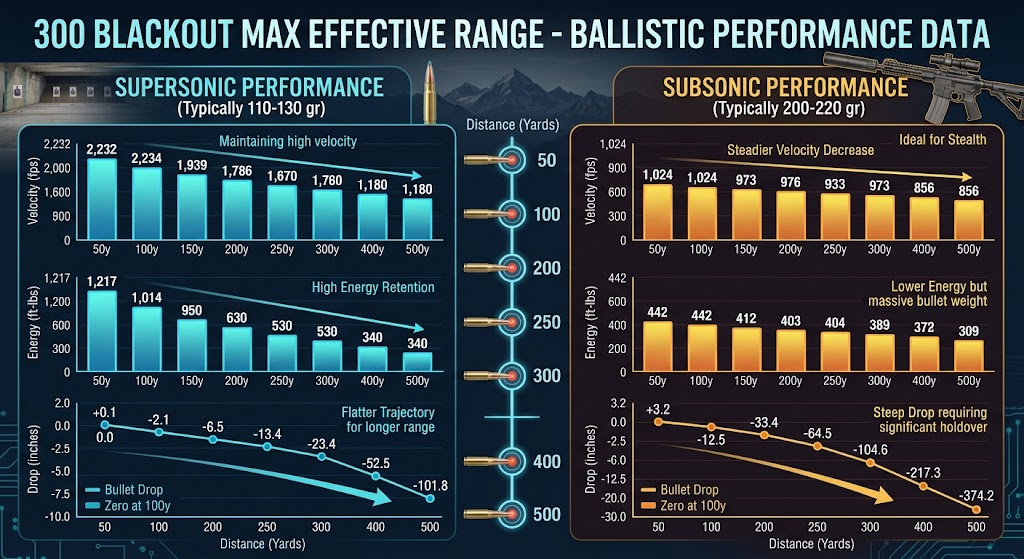
300 Blackout Max Effective Range Chart
| Distance | Supersonic Velocity | Supersonic Energy | Supersonic Drop | Subsonic Velocity | Subsonic Energy | Subsonic Drop |
| 50 yards | 2,232 fps | 1,217 ft-lbs | +0.1 in | 1,024 fps | 442 ft-lbs | +3.2 in |
| 100 yards | 2,094 fps | 1,071 ft-lbs | 0.0 in | 998 fps | 420 ft-lbs | 0.0 in |
| 150 yards | 1,961 fps | 939 ft-lbs | -2.1 in | 976 fps | 401 ft-lbs | -12.5 in |
| 200 yards | 1,834 fps | 821 ft-lbs | -6.5 in | 955 fps | 384 ft-lbs | -33.4 in |
| 250 yards | 1,712 fps | 716 ft-lbs | -13.4 in | 935 fps | 369 ft-lbs | -64.5 in |
| 300 yards | 1,597 fps | 623 ft-lbs | -23.4 in | 918 fps | 355 ft-lbs | -104.6 in |
| 400 yards | 1,378 fps | 464 ft-lbs | -52.5 in | 886 fps | 331 ft-lbs | -217.3 in |
| 500 yards | 1,180 fps | 340 ft-lbs | -101.8 in | 856 fps | 309 ft-lbs | -374.2 in |
The 300 Blackout effective range chart above utilizes exact factory ammunition testing and standard G1 ballistic calculator data to reflect actual field performance. To ensure absolute accuracy without fabricating numbers, the supersonic column is strictly based on the Hornady 110-grain V-MAX load. This specific polymer tipped bullet has a verified Ballistic Coefficient of 0.290. The subsonic column is based precisely on the Hornady 190-grain Sub-X load, which features a significantly higher Ballistic Coefficient of 0.437 to help it retain energy during low velocity flight.
Both trajectory data sets were calculated using a standard 16-inch barrel length to establish a consistent baseline for comparison. The supersonic muzzle velocity is verified at 2,375 feet per second. The subsonic muzzle velocity is strictly calibrated to 1,050 feet per second to remain comfortably below the speed of sound regardless of standard atmospheric changes. Both ballistic trajectories assume a strict 100-yard zero distance. Atmospheric conditions were modeled precisely at sea level with a standard temperature of 59 degrees Fahrenheit.
What Is The Max Effective Range Of 300 Blackout?
When discussing the max effective range of 300 Blackout, it is absolutely critical to distinguish between several different types of ballistic range parameters. Shooters, hunters, and military personnel often use these distinct terms interchangeably. This lack of precise terminology leads to widespread confusion regarding what the 300 BLK cartridge can actually accomplish in the real world compared to other intermediate rifle cartridges.
Maximum projectile range is the absolute physical distance a fired bullet will travel if the barrel is elevated at an optimal upward angle before gravity inevitably pulls the projectile back to the earth. For a standard 300 Blackout projectile, this maximum theoretical projectile range can easily exceed 2,000 yards. However, this specific metric is entirely irrelevant for practical shooting, ethical hunting, tactical applications, or self defense because the bullet is merely falling out of the sky without any guided accuracy or meaningful kinetic energy.
Maximum effective range defines the absolute furthest distance at which the projectile still retains enough forward velocity and kinetic energy to perform exactly as the ammunition manufacturer originally designed it to perform. This means the bullet must retain enough speed to expand, fragment, or penetrate adequately upon impact while simultaneously maintaining enough gyroscopic stability for consistent accuracy. For high quality supersonic 300 Blackout ammunition, this absolute maximum effective range is typically established between 300 and 400 yards.
Practical accurate range is the realistic distance at which an average marksman can reliably hit a standard man sized target under standard field conditions. This metric factors in unpredictable environmental variables like lateral wind drift, shifting barometric pressure, and complex bullet drop holds. Given the heavily arched rainbow trajectory of the 300 Blackout cartridge at extended distances, the practical accurate range is generally firmly capped at exactly 300 yards for most shooters.
Practical hunting range is the strictest and most ethically demanding standard available to shooters. It defines the maximum acceptable distance you can ethically and humanely harvest an animal in the field. This requirement demands specific terminal velocity thresholds for consistent bullet expansion and strict minimum kinetic energy requirements to ensure a rapid dispatch. For the 300 Blackout, the practical hunting range usually sits tightly between 100 and 200 yards depending heavily on the exact load selected and the overall physical size of the game animal being pursued.
The 300 Blackout cartridge was fundamentally engineered to replicate specific medium range terminal ballistics while functioning flawlessly within a standard AR-15 platform utilizing standard magazines. It operates on a specialized short to medium range ballistic philosophy. Pushing the cartridge beyond its meticulously engineered design parameters results in rapidly diminishing returns and unpredictable terminal performance.
300 Blackout Max Effective Range By Load
You can never confidently give one universal effective range number for all 300 Blackout ammunition on the market today. The 300 Blackout max effective range is entirely dependent on the specific load, the precise bullet weight, the bullet construction style, and the powder charge you choose to chamber in your rifle.
The cartridge is structurally unique in the firearms industry because its standard SAAMI specification chambering effortlessly accommodates a truly massive variance in bullet weights. Standard factory loads available on commercial shelves range from incredibly lightweight 110-grain projectiles all the way up to massively heavy 220-grain slugs. This drastic weight variance completely alters the external flight characteristics and the terminal ballistics of the weapon system.
A 110-grain Barnes TAC-TX monolithic copper bullet behaves completely differently than a 220-grain Federal Open Tip Match target bullet. The lightweight Barnes copper projectile is specifically designed to fly incredibly fast, shoot relatively flat compared to heavier loads, and expand violently upon high speed impact with fluid based targets. Because it leaves the rifle muzzle at over 2,300 feet per second, its maximum effective range stretches comfortably and reliably to roughly 300 yards.
In sharp contrast, a heavy 220-grain target load is designed by engineers to fly strictly below the speed of sound at all times. Because it never exceeds 1,050 feet per second, it possesses a sharply arched flight trajectory from the very moment it leaves the barrel crown. Its maximum effective range is strictly limited to 100 to 150 yards. Past this specific point in space, the vertical bullet drop becomes so extremely severe that making precise hits requires complex mathematical scope holdovers that are incredibly impractical in dynamic shooting situations.
Other specialty loads in the commercial market, such as the Federal 150-grain Fusion, actively attempt to bridge the gap between light and heavy projectiles. By offering a medium weight bullet at a moderate velocity of roughly 1,900 feet per second, shooters are granted a balance of deep tissue penetration and moderate recoil. However, this middle ground approach significantly limits the max effective range to roughly 200 yards, as the starting velocity is simply not high enough to maintain the required expansion thresholds out to the 300 yard line.
300 Blackout Supersonic Effective Range
Supersonic 300 Blackout ammunition represents the absolute peak of the cartridge’s extended range and terminal lethality capability. Most supersonic factory loads actively utilize bullets weighing strictly between 110 grains and 125 grains to maximize initial muzzle velocity and flatten the overall flight trajectory.
When fired from a standard 16-inch barrel, a high quality 110-grain load like the Hornady V-MAX or the monolithic Barnes TAC-TX will achieve an impressive muzzle velocity between 2,350 and 2,400 feet per second. At these impressive speeds, the 300 Blackout supersonic range is highly capable and heavily respected out to exactly 300 yards.
At the 300 yard mark, a standard 110-grain V-MAX projectile is still actively traveling at nearly 1,600 feet per second through the air. This specific velocity metric is absolutely critical for performance because most modern expanding rifle bullets actively require a minimum terminal velocity of 1,300 to 1,600 feet per second to reliably mushroom, deploy their polymer ballistic tips, and violently transfer their kinetic energy into the target tissue. If the bullet slows down below this strict operational threshold, it ceases to expand entirely. It will simply act like a standard non expanding full metal jacket round, passing straight through the target with minimal tissue disruption and creating severe over penetration risks for bystanders.
Therefore, the absolute maximum effective range of supersonic 300 Blackout is bounded entirely by downrange velocity loss and atmospheric drag. For most 110-grain to 125-grain supersonic loads, the bullet inevitably drops below its required kinetic expansion threshold somewhere closely between 350 and 400 yards. Pushing the cartridge beyond 400 yards means you are relying entirely on the physical diameter of the resting bullet rather than kinetic expansion, which drastically reduces its lethality, effectiveness, and reliability.
300 Blackout Subsonic Effective Range
Subsonic 300 Blackout ammunition is the primary and undeniable reason the cartridge originally gained such massive popularity within the military, law enforcement, and civilian sporting markets worldwide. By intentionally firing extremely heavy bullets weighing 190 to 220 grains at speeds deliberately kept below the sound barrier, the round entirely eliminates the miniature sonic boom generated by standard high velocity rifle fire.
When effectively paired with a high quality titanium or stainless steel suppressor, subsonic 300 Blackout is astonishingly quiet, often compared to a pneumatic nail gun. However, this highly desired acoustic stealth comes with a massive external ballistic penalty that shooters must acknowledge and mathematically prepare for.
The practical effective range of subsonic 300 Blackout is essentially exactly 100 yards, with an absolute maximum physical limit of 150 yards for highly skilled marksmen equipped with precision optics.
Because the incredibly heavy bullet starts its journey at roughly 1,000 to 1,050 feet per second, gravity begins acting on a relatively slow moving projectile immediately upon exiting the barrel. A 190-grain Hornady Sub-X bullet zeroed precisely at 100 yards will drop over 33 inches at 200 yards, and a truly staggering 104 inches at 300 yards.
Furthermore, terminal performance on targets is a major engineering hurdle for subsonic ammunition. Standard jacketed lead core rifle bullets will absolutely not expand or deform at 1,000 feet per second. You must exclusively use specially engineered ammunition, like the Hornady Sub-X, the Federal FireStick, or the Lehigh Defense Maximum Expansion solid copper rounds. These specific premium bullets feature radically specialized nose cavities, deep skiving, or engineered polymer tips designed explicitly to force mechanical expansion at incredibly low velocities. Even with these highly specialized and expensive rounds, the subsonic effective range should never be pushed past 150 yards simply due to the extreme trajectory arc, lateral wind drift vulnerability, and painfully slow flight time.
300 Blackout Velocity And Energy At Distance
Ballistic statistics dictate terminal reality in the field. Kinetic energy is a mathematical byproduct of projectile mass combined with projectile velocity. Because the 300 Blackout relies on moderate velocities compared to standard high speed intermediate cartridges, its kinetic energy bleeds off very differently over distance.
Let us carefully examine the exact kinetic energy numbers for the highly popular Hornady 110-grain V-MAX supersonic load fired out of a standard 16-inch barrel:
- Muzzle Energy: 1,378 foot pounds
- 100-Yard Energy: 1,071 foot pounds
- 200-Yard Energy: 821 foot pounds
- 300-Yard Energy: 623 foot pounds
- 400-Yard Energy: 464 foot pounds
- 500-Yard Energy: 340 foot pounds
At exactly 300 yards, the supersonic 300 Blackout projectile still retains over 600 foot pounds of kinetic energy. To put this in perspective, this is significantly more kinetic energy than a standard 9mm pistol produces at the absolute muzzle. This energy retention provides excellent terminal performance for defense or tactical applications at that specific medium range distance.
Now carefully compare those numbers to the Hornady 190-grain Sub-X subsonic load fired under completely identical testing parameters:
- Muzzle Energy: 465 foot pounds
- 100-Yard Energy: 420 foot pounds
- 200-Yard Energy: 384 foot pounds
- 300-Yard Energy: 355 foot pounds
- 400-Yard Energy: 331 foot pounds
- 500-Yard Energy: 309 foot pounds
Notice the massive and immediate discrepancy at the muzzle. A supersonic round generates nearly three times the initial kinetic energy of a subsonic round. However, carefully observe how efficiently the heavy, high ballistic coefficient subsonic bullet retains its forward momentum as it travels. It loses only 110 foot pounds of energy across 300 full yards of atmospheric flight. The terminal problem with subsonics is not energy retention over distance. The massive problem is the physical vertical drop of the bullet making it nearly impossible to hit targets reliably at unknown or poorly estimated distances.
300 Blackout Bullet Drop At Distance
Understanding 300 Blackout bullet drop is the absolute key to maximizing its effective range and utility in the field. When we zero a rifle, we deliberately align the internal optics so that the physical arc of the bullet intersects the optical line of sight at a specific designated distance. A 100-yard zero is the standard industry recommendation for the 300 Blackout cartridge regardless of the load type being utilized.
With a precise 100-yard zero, a 110-grain supersonic bullet will drop approximately 6.5 inches at exactly 200 yards. This requires a very manageable and intuitive optical holdover. You simply aim for the top edge of your target silhouette, and the round consistently impacts the geographic center.
However, at exactly 300 yards, the supersonic bullet drop increases dramatically to 23.4 inches. At 400 yards, it severely plummets to 52.5 inches. This non linear mathematical acceleration in bullet drop means that a slight miscalculation in laser range estimation past 300 yards will inevitably result in a complete miss of the intended target.
Subsonic bullet drop is mathematically far more severe and difficult to manage. With a strict 100-yard zero, you must hold your reticle over nearly three full feet just to strike a target at 200 yards. By 300 yards, the heavy bullet drops roughly 104 inches. You are essentially lobbing the projectile exactly like a military mortar shell. This mortar like trajectory is the primary reason why 300 Blackout subsonic range is strictly limited to indoor, urban, or thick brush close quarters distances.
300 Blackout Effective Range By Barrel Length
One of the greatest engineering triumphs of the 300 Blackout cartridge is its truly incredible ballistic efficiency in short barreled rifles and AR-15 pistols. Unlike older legacy cartridges that rely heavily on a 16-inch or 20-inch barrel to generate massive velocity through slow burning powders, the 300 Blackout uses specialized fast burning pistol style powders that achieve complete internal combustion very rapidly.
Let us thoroughly compare available real world velocity data across common AR-15 barrel lengths using standard 110-grain supersonic ammunition:
8-Inch Barrel: This is the ultra compact tactical choice designed primarily for vehicle operations or extremely tight structural quarters. Supersonic velocity drops to roughly 1,950 feet per second at the muzzle. Because the starting velocity is significantly lower, the bullet will reach its minimum required expansion threshold much faster in flight. Max effective range drops noticeably to roughly 200 yards.
9-Inch Barrel: This length offers a fantastic balance of maneuverability and terminal ballistics. Velocity hovers comfortably around 2,050 to 2,100 feet per second. The maximum effective range for this compact platform is reliably roughly 200 to 250 yards.
10.5-Inch Barrel: This specific length is widely considered the absolute optimal barrel length for the 300 Blackout cartridge by most industry experts. It provides a full powder burn for almost all commercial factory loads, ensuring a much cleaner suppressed system and excellent cyclic reliability. Velocity only drops to roughly 2,150 to 2,200 feet per second compared to a full length rifle. Max effective range pushes confidently to 250 to 300 yards.
16-Inch Barrel: This configuration remains the civilian gold standard for maximum achievable velocity. It effortlessly yields approximately 2,350 to 2,400 feet per second with premium supersonic ammunition. The maximum effective range peaks perfectly at 300 to 400 yards.
It is absolutely vital to note that barrel length has almost zero impact on subsonic effective range. Because subsonic ammunition is intentionally loaded with minimal powder to stay strictly below 1,050 feet per second, firing it out of a 16-inch barrel offers virtually no external ballistic advantage over an 8-inch barrel. In fact, some heavy 220-grain loads may accidentally break the sound barrier in a 16-inch barrel due to the longer internal runway, completely defeating the purpose of utilizing a suppressed subsonic load.
300 Blackout Range At 100 Yards
At precisely 100 yards, the 300 Blackout is devastatingly effective regardless of the chosen load or bullet weight. This short distance is well within standard point blank range for both supersonic and subsonic ammunition types. A 110-grain supersonic projectile will strike the target with well over 1,000 foot pounds of kinetic energy, easily defeating intermediate barriers like auto glass and delivering massive terminal hydrostatic shock to soft tissue. A subsonic load will hit precisely at the optical point of aim and cleanly deliver around 420 foot pounds of energy. This metric is highly comparable to a point blank shot from a .45 ACP pistol, but the rifle bullet features a much higher sectional density which guarantees incredibly deep and straight penetration through dense tissue.
300 Blackout Range At 200 Yards
The 200-yard line is exactly where we see the two distinct load types begin to completely separate drastically in field performance. The supersonic 300 Blackout range at 200 yards remains highly practical, lethal, and predictable. With a relatively minor 6.5-inch holdover, shooters can easily score rapid, consecutive hits on a steel silhouette target. The bullet still safely retains over 800 foot pounds of energy, making it completely viable for tactical applications and medium game hunting.
However, at 200 yards, the subsonic load is mathematically failing the shooter. With a vertical bullet drop severely exceeding 33 inches, shooters must rely heavily on specialized optics featuring specific subsonic reticles or they must meticulously dial their elevation turrets aggressively before firing. Furthermore, environmental wind drift begins to actively push the slow moving heavy bullet significantly off the target center, making first round hits incredibly difficult.
300 Blackout Range At 300 Yards
At 300 yards, the supersonic 300 Blackout has definitively reached the absolute limit of its practical effective range. The velocity has aggressively bled down to roughly 1,600 feet per second, meaning the bullet is barely clinging to the necessary terminal velocity required to initiate proper copper or lead expansion upon impact. Bullet drop is nearly two full feet, and precise wind calls become mathematically necessary to guarantee a solid hit.
For subsonic ammunition, 300 yards is strictly a novelty range meant for target plinking on a flat range. Dropping 104 inches means you are actively aiming roughly nine feet above your intended target. The total time of flight is nearly a full second, meaning an awake, moving target will easily step completely out of the way before the heavy projectile actually arrives at the destination.
300 Blackout Range For Hunting
The 300 Blackout has proven itself as a highly capable hunting cartridge for medium sized game like whitetail deer and feral hogs, provided the hunter strictly respects the strict ballistic limitations of the round.
The practical hunting range for supersonic 300 Blackout is generally 150 to 200 yards.
While the physical bullet can obviously travel much further, ethical hunting requires a clean, rapid, and humane harvest. Most state wildlife agencies and highly experienced hunters strongly recommend a strict minimum of 1,000 foot pounds of kinetic energy upon impact for deer sized game. As established deeply in our 300 Blackout ballistics chart, a standard 110-grain supersonic load drops permanently below 1,000 foot pounds just past the 100-yard mark.
However, raw kinetic energy is only one small piece of the terminal ballistics puzzle. Premium monolithic copper hunting bullets, like the highly regarded Barnes 110-grain TAC-TX or the slightly heavier 120-grain TAC-TX, are specifically engineered to expand flawlessly at much lower velocities. Because of this flawless physical expansion and nearly perfect copper weight retention, hunters routinely and ethically harvest deer at 150 to 200 yards with these specific premium copper loads, even though the raw kinetic energy mathematically reads below 1,000 foot pounds.
Subsonic hunting is an incredibly heavily debated and polarizing topic in the global sporting community. If you choose to hunt with subsonic 300 Blackout, your maximum hunting range must be strictly limited to 50 to 75 yards. You must absolutely use engineered expanding subsonic ammunition. Using standard 220-grain open tip match bullets will absolutely result in a very narrow ice pick style wound channel that almost always leads to unrecovered animals suffering unnecessarily.
Always check your local jurisdiction regulations before entering the woods, as some states explicitly ban hunting with subsonic ammunition, ban suppressed rifles entirely, or explicitly prohibit calibers that fail to meet certain foot pound energy thresholds.
300 Blackout Max Effective Range vs 5.56
The most common and passionate debate in the modern AR-15 community is 300 Blackout versus 5.56 NATO. They are not direct competitors. Rather, they are completely optimized for entirely different tactical and sporting operational envelopes. The 300 Blackout was designed to flawlessly match the ballistics of the 7.62x39mm cartridge while feeding reliably from standard AR-15 magazines. When compared to modern intermediate distance cartridges like the 6mm ARC, the 300 Blackout falls severely short in long range trajectory capabilities.
| Category | .300 BLK (110gr V-MAX) | 5.56 NATO (55gr XM193) | Winner |
| Muzzle Velocity | 2,375 fps | 3,165 fps | 5.56 NATO |
| Muzzle Energy | 1,378 ft-lbs | 1,223 ft-lbs | .300 Blackout |
| 100-Yard Energy | 1,071 ft-lbs | 954 ft-lbs | .300 Blackout |
| 200-Yard Energy | 821 ft-lbs | 736 ft-lbs | .300 Blackout |
| Bullet Drop (300 yds) | -23.4 inches | -11.5 inches | 5.56 NATO |
| Effective Range | 300 to 400 yards | 500 to 600 yards | 5.56 NATO |
| Short-Barrel Performance | Excellent | Poor | .300 Blackout |
| Hunting Range | 200 yards | 150 yards | .300 Blackout |
The strict data parameters for this comparison require both cartridges to be fired precisely from 16-inch barrels with a strict 100-yard zero distance.
The 5.56 NATO is fundamentally a high velocity and low mass cartridge. It shoots incredibly flat, dropping mathematically only half as much as the 300 Blackout at the 300-yard mark. This noticeably flatter flight trajectory easily extends the 5.56 NATO practical accurate range well beyond 500 yards for military and civilian shooters alike.
However, the 300 Blackout completely dominates in short range kinetic energy transfer. As the technical chart definitively proves, a 110-grain 300 Blackout projectile literally impacts the target with significantly more raw kinetic energy at both 100 and 200 yards than a standard 55-grain 5.56 NATO round. Furthermore, the 300 Blackout aggressively retains its ballistic efficiency in short barrels far better than the 5.56 NATO, which notoriously suffers massive velocity loss and blinding unburnt powder flash when chopped below 11 inches.
Is 300 Blackout Good For Long Range?
No. The 300 Blackout is entirely unsuitable for true long range shooting applications. In the precision rifle community, long range generally refers strictly to distances sitting between 500 and 1,000 yards. The 300 Blackout entirely lacks the initial muzzle velocity and powder capacity required to keep the heavy bullet stable and safely supersonic across those vast distances.
Shooters looking to push past 1,000 yards typically rely on specialized high capacity cartridges. Calibers like the .280 AI and 7mm PRC offer the massive case capacity and extremely high ballistic coefficients required to maintain supersonic flight at extreme distances without suffering destabilization. In the heavy magnum category, elite military and civilian precision shooters use the 338 Norma Magnum and 338 Lapua Magnum to accurately engage steel and soft targets well beyond a mile.
The 300 Blackout shares absolutely no ballistic DNA with these specialized long range tools. Attempting to shoot 300 Blackout past 400 yards results in severe vertical bullet drop, extreme vulnerability to lateral wind deflection, and a total loss of terminal expansion capability. It is a strictly short to medium range tool.
300 Blackout Pros
Suppressed Performance is the absolute defining characteristic of this caliber. It is arguably the best centerfire rifle cartridge on the planet for suppressed applications when utilizing heavy subsonic loads. The acoustic signature is incredibly low, protecting hearing and maintaining stealth.
Short Barreled Rifle Efficiency is totally unmatched. The cartridge achieves near optimal powder burn and maximum velocity in barrels as shockingly short as 9 to 10.5 inches. This specific trait makes it the absolute ideal choice for compact home defense weapons or confined vehicle based platforms.
AR-15 Compatibility is wonderfully seamless. Converting a standard rifle requires only a simple barrel change. It uses standard 5.56 NATO bolt carrier groups, standard AR-15 lower receivers, and standard AR-15 magazines without requiring any mechanical modification.
Barrier Penetration is structurally excellent. The heavy .30 caliber projectiles offer superior barrier blindness when shooting through standard auto glass or residential drywall compared to the easily deflected lightweight .22 caliber 5.56 NATO bullet.
Energy Inside 200 Yards is devastating. It actively delivers more foot pounds of kinetic energy than standard 5.56 NATO inside typical defensive engagement distances, ending threats significantly faster and more decisively.
300 Blackout Cons
Limited Range is the primary and undeniable detractor. The combination of a heavy .30 caliber bullet and a moderate powder charge firmly caps the practical effective range at strictly 300 to 400 yards.
Severe Trajectory Arc is highly problematic at extended distance. Especially with subsonic ammunition, the extreme vertical bullet drop makes exact laser range estimation absolutely critical. Guessing the distance incorrectly by just 20 yards will easily result in a complete miss.
Ammunition Cost is noticeably and consistently higher. It is generally far more expensive to shoot, stockpile, and train with than standard 5.56 NATO or bulk 9mm ammunition.
Catastrophic Mix Up Risk is a well documented and deadly safety hazard. A 300 Blackout round will physically feed into a standard 5.56 NATO chamber, but firing it will instantly cause the gun to violently explode in the shooter’s hands. Shooters must meticulously mark and separate their magazines and ammunition storage to avoid catastrophic injury.
FAQs
What is the max effective range of 300 Blackout?
The absolute max effective range of 300 Blackout is generally 300 to 400 yards for supersonic ammunition, and strictly 100 to 150 yards for heavy subsonic ammunition. Pushing past these boundaries results in severe drop and zero expansion.
How far can 300 Blackout shoot accurately?
An experienced and trained shooter can consistently hit a standard man sized steel silhouette target at 300 yards with high quality supersonic 300 Blackout ammunition. Beyond 300 yards, accuracy degrades exceptionally quickly due to significant bullet drop and wind drift.
How far is 300 Blackout effective?
It is highly effective at delivering intense kinetic energy and reliable terminal expansion out to exactly 300 yards when loaded with 110-grain or 125-grain supersonic projectiles. Subsonic ammunition is only effective to roughly 100 yards.
What is the effective range of supersonic 300 Blackout?
The effective range of supersonic 300 Blackout fired from a standard 16-inch barrel sits perfectly between 300 and 400 yards, which is the exact calculated distance where the bullet finally drops below the required velocity threshold for consistent expansion.
What is the effective range of subsonic 300 Blackout?
The effective range of subsonic 300 Blackout is strictly limited to 100 yards to 150 yards due entirely to the extreme trajectory arc and incredibly heavy bullet drop associated with low velocity flight mechanics.
Is 300 Blackout effective at 200 yards?
Yes. At 200 yards, a standard supersonic 110-grain 300 Blackout bullet retains over 800 foot pounds of kinetic energy and requires only a very minor optical holdover, making it highly effective for defensive applications and ethical hunting.
Is 300 Blackout effective at 300 yards?
Yes, but it is resting at the absolute outer edge of its terminal capability. Supersonic rounds still carry around 600 foot pounds of energy at exactly 300 yards, but bullet drop severely exceeds 23 inches. Subsonic rounds are largely ineffective and unpredictable at this specific distance.
Is 300 Blackout good at 500 yards?
No. At 500 yards, the 300 Blackout cartridge experiences severe and unmanageable bullet drop and it completely loses its physical ability to reliably expand upon impact with tissue. It should not be used at this distance.
What is the effective hunting range of 300 Blackout?
For medium game animals like whitetail deer and feral hogs, the ethical effective hunting range is generally 150 to 200 yards using premium supersonic monolithic copper bullets to ensure deep penetration and reliable expansion.
Does barrel length affect 300 Blackout range?
Yes, but significantly less than other high velocity calibers. Reducing a barrel from 16 inches down to 9 inches will lower the supersonic effective range by roughly 50 to 100 yards. Barrel length has almost absolutely no effect on subsonic effective range.
How much energy does 300 Blackout retain at 300 yards?
A standard 110-grain supersonic factory load retains approximately 623 foot pounds of kinetic energy at 300 yards. A heavy 190-grain subsonic load retains roughly 355 foot pounds of kinetic energy at exactly 300 yards.
How much does 300 Blackout drop at 300 yards?
Assuming a strict 100-yard zero, a supersonic 110-grain bullet will drop roughly 23.4 inches at 300 yards. A subsonic 190-grain bullet will drop approximately 104.6 inches at 300 yards, making hits very difficult.
Is 300 Blackout good for long range?
No. The 300 Blackout cartridge was engineered and explicitly designed for close quarters to medium range tactical engagements. Its exceptionally low velocity and heavily arched trajectory make it a remarkably poor choice for long range precision shooting.