The .300 Blackout, standardized by SAAMI as the 300 BLK, is a bottlenecked centerfire rifle cartridge featuring a maximum bullet diameter of .308 inches (7.82 mm).The maximum case length is 1.368 inches (34.75 mm), and the maximum overall cartridge length is restricted to 2.260 inches (57.40 mm) to ensure compatibility with standard AR-15 magazines.The case utilizes a rim diameter of .378 inches (9.60 mm) and a base diameter of .376 inches (9.55 mm), sharing its case head dimensions with the .223 Remington.Ammunition for this caliber is commonly available in both supersonic weights like 110 or 125 grains, and subsonic weights like 220 grains. Exact dimensions can vary slightly depending on manufacturing tolerances and the specific bullet profile used.
.300 Blackout Dimensions
| Dimension | Specification | Source | Notes |
| Bullet Diameter | .308 in (7.82 mm) | SAAMI | Standard for .30 caliber projectiles. |
| Case Length | 1.368 in (34.75 mm) | SAAMI | Maximum case length; trim-to length is typically 1.358 in. |
| Overall Cartridge Length | 2.260 in (57.40 mm) | SAAMI | Maximum overall length for standard AR-15 style magazines. |
| Rim Diameter | .378 in (9.60 mm) | SAAMI | Shares the exact same rim size as the .223 Remington. |
| Case Diameter (Base) | .376 in (9.55 mm) | SAAMI | Measured just above the extractor groove. |
| Shoulder Diameter | .361 in (9.17 mm) | SAAMI | Features a 23 degree shoulder angle. |
| Neck Diameter | .334 in (8.48 mm) | SAAMI | Maximum external diameter at the case mouth (typically measures .332 in). |
| Case Capacity | 25.1 to 26.5 gr H2O | Industry Standard | Varies slightly based on the brass manufacturer. |
| Maximum Pressure | 55,000 psi | SAAMI | Governed by SAAMI specifications for AR-15 platforms. |
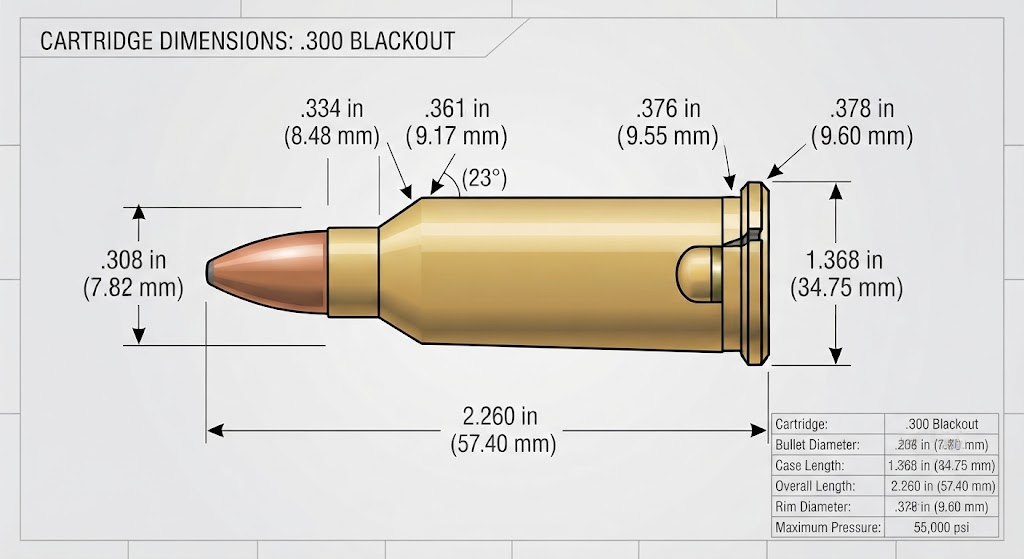
Understanding The .300 Blackout Dimensions
- Bullet Diameter: The measurement across the widest point of the bullet. For the .300 Blackout, this is specified as .308 inches. This dimension ensures the projectile seals properly within the barrel’s rifling to trap expanding gases and generate velocity.
- Case Length: The length of the empty brass cylinder from the base to the case mouth, maxing out at 1.368 inches. This short case leaves plenty of room in the magazine for long, heavy subsonic bullets.
- Overall Cartridge Length (OAL): The total length of the fully assembled round from the base to the tip of the bullet, strictly capped at 2.260 inches. OAL directly influences whether a cartridge will fit into a magazine and feed properly through the firearm’s action.
- Rim Diameter: The diameter of the flange at the very bottom of the case (.378 inches). The firearm’s extractor hooks onto this rim to pull the spent casing out of the chamber. Because it matches the 5.56 NATO, the .300 Blackout uses a standard AR-15 bolt.
- Case Diameter: The width of the cartridge body at the base. At .376 inches, it matches the .223 Remington base, allowing it to function reliably in standard magazines.
- Case Capacity: Measured in grains of water (gr H2O), this represents the internal volume of the empty case. Averaging 25.1 to 26.5 grains of water, it dictates how much gunpowder the case can safely hold.
- Maximum Pressure: The peak internal pressure generated when the cartridge is fired. Standard SAAMI limits set this at 55,000 psi to ensure the firearm does not suffer catastrophic failure.
.300 Blackout Cartridge Dimensions In Inches And Millimeters
For engineers, reloaders, and international shooters, below are the primary .300 Blackout measurements converted accurately between imperial and metric systems.
| Dimension | Inches (SAAMI Max) | Millimeters (Equivalent) |
| Bullet Diameter | .308 in | 7.82 mm |
| Case Length | 1.368 in | 34.75 mm |
| Overall Length | 2.260 in | 57.40 mm |
| Rim Diameter | .378 in | 9.60 mm |
| Base Diameter | .376 in | 9.55 mm |
| Neck Diameter | .334 in | 8.48 mm |
.300 Blackout Case Dimensions
The .300 Blackout is defined by a rimless, bottlenecked case derived directly from the .223 Remington. The official maximum case length is 1.368 inches (34.75 mm), with a nominal trim-to length for reloaders sitting at 1.358 inches.The base diameter measures .376 inches, and the rim diameter is slightly larger at .378 inches.
Because the case is significantly shorter than its .223 Remington parent case (which is 1.760 inches long), the internal case capacity is reduced to roughly 25.1 to 26.5 grains of water. This smaller capacity is optimized for fast burning pistol and magnum powders, which allow the cartridge to achieve full ballistic potential in short barrels.
.300 Blackout Bullet Diameter
The standardized maximum bullet diameter for the .300 Blackout is .308 inches (7.82 mm). This is a massive advantage for reloaders and ammunition manufacturers because .308 caliber bullets are among the most common and widely developed projectiles in the world, shared with cartridges like the .308 Winchester and .30-06 Springfield.
The standard .300 Blackout barrel features a groove diameter of .308 inches and a bore (land) diameter of .300 inches. Firing a .308 inch bullet down a .308 inch groove diameter forces the bullet to engrave into the rifling tightly, creating the spin necessary to stabilize both lightweight supersonic and heavyweight subsonic projectiles.
.300 Blackout Overall Length
The SAAMI maximum overall cartridge length (OAL) for the .300 Blackout is 2.260 inches (57.40 mm). This number is a hard limit designed to guarantee that the cartridge will fit perfectly inside standard AR-15 magazines without modifying the firearm.
However, typical factory cartridge length varies drastically based on the bullet profile and intended velocity. A 110 grain supersonic load might measure closer to 2.050 inches because the bullet is physically short. In contrast, heavy 220 grain subsonic bullets are exceptionally long, pushing the assembled cartridge to the absolute 2.260 inch maximum OAL just to fit the projectile safely into the short case.
.300 Blackout Chamber And Cartridge Dimensions
The relationship between the .300 Blackout cartridge and the firearm’s chamber is critical for reliable functionality. The .300 Blackout cartridge headspaces on its 23 degree shoulder.
This means the angled portion of the brass casing physically stops against a matching machined angle inside the barrel’s chamber. Proper case length and shoulder setback are mandatory. If the brass is formed incorrectly or stretched beyond 1.368 inches, the cartridge will not allow the AR-15 bolt to rotate and lock into battery. Furthermore, the feed geometry relies on the ogive of the bullet clearing the internal ribs of standard 5.56 NATO magazines.
.300 Blackout Dimensions vs Similar Cartridges
To understand the .300 Blackout’s size profile, it is helpful to compare it against other popular intermediate rifle cartridges.
| Cartridge | Bullet Diameter | Case Length | Overall Length | Base Diameter | Maximum Pressure | Source |
| .300 Blackout | .308 in | 1.368 in | 2.260 in | .376 in | 55,000 psi | SAAMI |
| 5.56x45mm NATO | .224 in | 1.760 in | 2.260 in | .376 in | 62,366 psi | NATO |
| 7.62x39mm | .312 in | 1.524 in | 2.200 in | .443 in | 45,010 psi | SAAMI |
| .308 Winchester | .308 in | 2.015 in | 2.810 in | .470 in | 62,000 psi | SAAMI |
| .350 Legend | .357 in | 1.710 in | 2.260 in | .390 in | 55,000 psi | SAAMI |
.300 Blackout vs .223 Remington Dimensions
The .300 Blackout was explicitly designed around the dimensions of the .223 Remington (and 5.56 NATO) to share as many parts as possible.
- Shared Dimensions:Both cartridges share an identical .376 inch base diameter and a .378 inch rim diameter. Both are restricted to a 2.260 inch maximum overall length to fit AR-15 magazines.
- Differences:The .300 Blackout case is much shorter (1.368 inches vs 1.760 inches) and has a wider neck to accept a .308 inch bullet instead of a .224 inch bullet.
- Safety Warning: Because the case dimensions are so similar, it is physically possible to chamber a .300 Blackout round in a .223 Remington / 5.56 NATO rifle. Firing a .308 caliber bullet down a .224 caliber barrel will result in a catastrophic, explosive firearm failure.
.300 Blackout SAAMI vs C.I.P. Dimensions
Cartridge dimensions and safe pressure limits are governed by SAAMI in the United States and C.I.P. in Europe.
The dimensional specifications for the cartridge are functionally identical between the two governing bodies to ensure global compatibility. C.I.P. officially recognizes the cartridge as the “300 AAC Blackout,” while SAAMI abbreviates it to “300 BLK”. Ammunition manufactured to either specification is safe to fire in correctly chambered rifles worldwide.
.300 Blackout Bullet Weight And Dimensions
The .300 Blackout is uniquely versatile, loaded heavily in two completely different bullet weight categories that change how the cartridge is dimensionally assembled:
- Supersonic (110 to 150 grain): These shorter, lighter bullets fly faster than the speed of sound. They do not require extreme seating depths, leaving maximum case capacity for the gunpowder required to push them to high velocities.
- Subsonic (190 to 220 grain): These massive, long bullets are designed to stay below the speed of sound, making them exceptionally quiet when suppressed. To maintain the 2.260 inch overall length restriction, these long bullets must be seated very deeply into the brass case, significantly reducing the available powder capacity.
Bullet weight does not alter the external brass case dimensions, but the manufacturer must carefully manage bullet seating depth to ensure safe pressures.
Why .300 Blackout Dimensions Matter
Understanding the specific .300 BLK measurements is essential for several practical reasons:
- Parts Compatibility:Knowing that the rim diameter (.378 inches) and overall length (2.260 inches) match the 5.56 NATO allows shooters to use the exact same magazines, standard bolt carrier groups, and lower receivers for both calibers. Only the barrel needs to be changed.
- Reloading Efficiency: Because the case base is identical to the .223 Remington, handloaders can physically cut down abundant .223 brass and resize it to form .300 Blackout cases.
- Safety: Memorizing the differences between the .223 Remington and .300 Blackout is critical to prevent loading the wrong ammunition into the wrong chamber.
Manufacturer Specifications vs Independent Measurements
If you use calipers to measure factory .300 Blackout ammunition from companies like Hornady or Barnes, the numbers will rarely match the SAAMI maximum specifications exactly.
SAAMI publishes maximum allowable dimensions to ensure absolute safety. Ammunition manufacturers purposefully produce their cases slightly smaller than these maximums. For example, the maximum case length is 1.368 inches, but measuring a factory cartridge might reveal a case length of 1.355 inches. This built in tolerance margin guarantees that the ammunition will chamber reliably even if the rifle is fouled from carbon buildup, which is especially common when shooting subsonic ammunition with a suppressor.
Common Questions
What are the dimensions of the .300 Blackout?
The key maximum dimensions are a bullet diameter of .308 inches, a case length of 1.368 inches, and an overall cartridge length of 2.260 inches.
What is the .300 Blackout case length?
The maximum SAAMI case length is 1.368 inches (34.75 mm).
What is the .300 Blackout overall length?
The maximum overall length (OAL) is 2.260 inches (57.40 mm), designed to fit standard AR-15 magazines.
What is the .300 Blackout bullet diameter?
The standard bullet diameter is .308 inches (7.82 mm).
What is the .300 Blackout rim diameter?
The rim diameter measures .378 inches, identical to the .223 Remington and 5.56 NATO.
What is the .300 Blackout case capacity?
The .300 Blackout holds approximately 25.1 to 26.5 grains of water, depending on the thickness of the specific brass casing.
What is the maximum pressure for the .300 Blackout?
The SAAMI maximum average pressure is strictly capped at 55,000 psi.
How do .300 Blackout and 5.56 NATO dimensions compare?
They share the same base diameter (.376 in), rim diameter (.378 in), and maximum overall length (2.260 in), but the .300 Blackout uses a much shorter case (1.368 in) and a larger .308 inch bullet.
Does the .300 Blackout use the same bolt as a 5.56 NATO?
Yes. Because they share the exact same rim diameter and base dimensions, the .300 Blackout uses a standard 5.56 NATO bolt carrier group.