The main .300 Blackout ammo types include Superonic Supressed, Supersonic Hunting, Subsonic Hollow Point, Subsonic Solid Copper, and Full Metal Jacket (FMJ) training ammunition. Supersonic loads are engineered for high velocity and traditional rifle performance out to 300 yards, while heavy subsonic loads are optimized for suppressed shooting and close-quarters terminal ballistic performance. FMJ range ammunition is widely available for affordable practice. Because the .300 AAC Blackout was designed to fire standard .30-caliber projectiles from standard AR-15 magazines while using 5.56 NATO bolt faces, civilian shooters have uninhibited commercial access to all of these diverse variations.
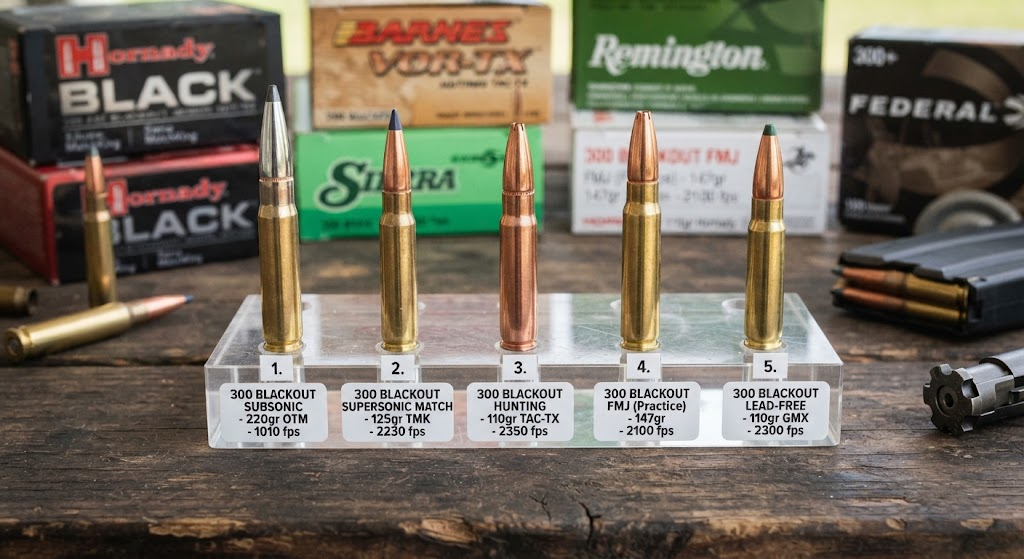
Table of Contents [Click to open]
300 Blackout Ammo Types
The .300 AAC Blackout (7.62×35mm) cartridge is uniquely engineered to operate in two completely distinct performance envelopes within the same rifle platform: high-velocity supersonic loads and ultra-quiet heavy subsonic loads. For military operators, the round provides suppressed short-barreled rifle capability that matches 9mm sound signatures while retaining intermediate-barrier penetration. For civilian shooters, the cartridge bridges the gap between home defense and suppressive versatility, allowing hunters to easily transition from supersonic deer loads to subsonic barrier-penetrating rounds simply by swapping magazines.
Below is a comprehensive comparison of the core .300 Blackout ammunition types based on published manufacturer data:
| Ammo Type | Velocity Tier | Typical Bullet/Projectile | Main Purpose | Typical Weight | Key Characteristic |
| Supersonic FMJ | Supersonic (~2,200 fps) | Full Metal Jacket | Range training / plinking | 110 to 147 gr | Inexpensive practice ammunition |
| Supersonic Hunting | Supersonic (~2,350 fps) | Polymer-tipped expanding | Medium game hunting | 110 to 125 gr | Designed to expand rapidly at high velocities |
| Subsonic Hollow Point | Subsonic (<1,050 fps) | Expanding hollow point | Suppressed home defense | 190 to 220 gr | Expands at low speeds without a sonic crack |
| Subsonic Solid | Subsonic (<1,050 fps) | Machined solid copper | Suppressed barrier penetration / hunting | 194 to 220 gr | Deep linear penetration and massive weight retention |
| Subsonic FMJ | Subsonic (<1,050 fps) | Heavy Lead Core FMJ | Quiet range practice | 200 to 220 gr | Low noise and recoil for suppressed training |
300 Blackout Supersonic FMJ Ammo
.300 Blackout supersonic FMJ (Full Metal Jacket) ammo is the most common and cost-effective tier for high-volume range training. Standard loads, such as the 147-grain FMJ or lighter 125-grain loads, typically leave a 16-inch barrel at roughly 1,900 to 2,200 feet per second (fps). This ammunition mimics the general point of impact of standard hunting loads, allowing shooters to zero their optics affordably before switching to specialized defensive or hunting rounds. It features a traditional copper jacket over a lead core and is manufactured in bulk by companies like Winchester, Federal, and Magtech.
300 Blackout Supersonic Hunting Ammo
.300 Blackout supersonic hunting ammo is specifically engineered to maximize the terminal ballistics of the cartridge on medium-sized game like white-tailed deer and hogs within 150 yards. Because the .300 Blackout case has limited powder capacity compared to larger .30-caliber rounds like the .308 Winchester, manufacturers use lightweight, highly frangible bullets to ensure reliable expansion at lower impact velocities. A prime example is the Hornady 110-grain V-MAX or Barnes 110-grain TAC-TX, which exit the muzzle at approximately 2,350 fps and shed energy rapidly upon impact.
300 Blackout Subsonic Hollow Point Ammo
.300 Blackout subsonic hollow point ammo is tailored specifically for suppressed home defense and tactical applications. These rounds utilize massive projectiles, typically weighing between 190 and 220 grains, and use fast-burning powder to keep muzzle velocities safely below the speed of sound (around 1,000 fps). Because standard hollow point bullets usually fail to expand at speeds under 1,100 fps, specialized subsonic rounds like the Hornady 190-grain Sub-X feature deep hollow cavities with flex-tips or score-lines designed to initiate violent expansion even at low impact velocities.
300 Blackout Subsonic Solid Copper Ammo
.300 Blackout subsonic solid copper ammo relies on CNC-machined monmetal bullets (such as the Lehigh Defense or Barnes solid lines) weighing between 194 and 220 grains. Instead of relying on traditional mushroom expansion, these specialized projectiles feature fluted or cutting nose profiles designed to carve massive permanent wound cavities through hydraulic displacement while maintaining straight-line penetration through heavy bone and intermediate barriers. This makes them widely considered the gold standard for suppressed hunting and tactical deployment.
300 Blackout Subsonic FMJ Ammo
.300 Blackout subsonic FMJ ammo is intended strictly for quiet range practice when shooting with a firearm suppressor. Weighing 200 to 220 grains, these heavy lead-core bullets travel silently at roughly 1,000 fps. They produce minimal recoil and eliminate the sonic crack entirely, providing a pleasant, hearing-safe indoor or outdoor training experience. However, because they are full metal jacket bullets, they do not expand on impact and are poorly suited for hunting or self-defense.
300 Blackout Ammo Types Compared
Different .300 Blackout ammo types explained by their optimal application:
- Home Defense (Suppressed): 190-grain expanding subsonic hollow points or machined copper solids provide maximum terminal performance without causing permanent hearing damage in enclosed spaces.
- Medium Game Hunting: 110-grain to 125-grain supersonic polymer-tipped expanding rounds are ideal for clean harvests on deer and hogs within 150 yards.
- Volume Range Training: 147-grain supersonic FMJ ammunition offers the cheapest way to zero optics and practice standard AR-15 drills.
- Suppressed Plinking: 220-grain subsonic FMJ ammunition delivers quiet, low-recoil target shooting when paired with a silencer.
- Barrier Penetration: Solid copper subsonic or bonded supersonic loads provide reliable structural penetration through glass, sheet metal, and heavy bone.
How To Choose 300 Blackout Ammo
Choosing the correct .300 Blackout ammunition types depends heavily on whether you are using a firearm suppressor and your primary intended target. If you are shooting an unsuppressed short-barreled rifle (SBR) for hunting, select 110-grain supersonic expanding ammunition to maximize velocity and energy transfer before the bullet drops below its expansion threshold. If you run your rifle suppressed for home defense, opt for heavy subsonic expanding rounds to mitigate blast concussion and flash while ensuring terminal performance. Always verify that your rifle’s gas system is properly adjusted or that you are using a reliable buffer weight, as switching between heavy subsonics and light supersonics can occasionally cause cycling issues in poorly tuned rifles.
Pros And Cons Of Different 300 Blackout Ammo Types
Supersonic FMJ
- Pros: Inexpensive, widely available in bulk, ideal for general range practice and zeroing.
- Cons: Zero expansion limits its utility for ethical hunting or defensive use.
Supersonic Hunting Loads
- Pros: Flatter trajectory and higher energy transfer than subsonics; effective out to 150+ yards.
- Cons: Significantly louder report, especially out of short 8.5-inch or 9-inch barrels.
Subsonic Hollow Points / Solids
- Pros: Whisper quiet when paired with a suppressor; exceptional terminal ballistics at close range.
- Cons: Severe bullet drop over distance makes precision shooting past 100 yards mathematically challenging.
Subsonic FMJ
- Pros: Extremely quiet and low recoil for fun range sessions with a silencer.
- Cons: Expensive compared to standard 5.56 ammunition; lacks defensive expansion.
FAQs
What are the different types of 300 Blackout ammo?
The main types include Supersonic FMJ, Supersonic Hunting, Subsonic Hollow Point, Subsonic Solid Copper, and Subsonic FMJ training ammunition.
What is the difference between supersonic and subsonic 300 Blackout ammo?
Supersonic ammunition travels faster than the speed of sound (over 1,125 fps) with a flat trajectory and loud sonic crack, whereas subsonic ammunition travels slower than sound (under 1,050 fps) for quiet, suppressed operation.
What is the best 300 Blackout ammo for home defense?
Heavy subsonic expanding ammunition (like 190gr Hornady Sub-X or Lehigh Defense) is widely considered best for home defense when using a suppressor, protecting your hearing while ensuring reliable expansion.
What is the best 300 Blackout ammo for deer hunting?
Lightweight supersonic polymer-tipped expanding bullets (such as the 110-grain Barnes TAC-TX or Hornady V-MAX) are best for deer hunting because they provide the velocity needed for ethical terminal expansion within 150 yards.
Can you shoot subsonic 300 Blackout without a suppressor?
Yes, it is completely safe to shoot subsonic ammo without a suppressor, but it will sound unusually quiet and will not cycle some heavy-buffer semi-automatic rifles properly.
Can you shoot 300 Blackout out of a 5.56 AR-15?
No. While .300 Blackout shares the same cartridge case head and uses standard 5.56 magazines, the bullet diameter is .30-caliber instead of .223-caliber. Firing a .300 Blackout round in a 5.56 rifle will cause a catastrophic barrel obstruction and explosion.
Why is 300 Blackout ammo more expensive than 5.56?
Because .300 Blackout is produced in lower manufacturing volumes and requires heavier projectiles (especially complex machined copper solids or heavy 220-grain lead cores), it is inherently more expensive per round than mass-produced 5.56 NATO ammunition.
What is the effective range of supersonic 300 Blackout?
Supersonic .300 Blackout has an effective hunting and target range of roughly 150 to 200 yards, after which the bullet sheds velocity and energy rapidly due to its poor ballistic coefficient.
What is the effective range of subsonic 300 Blackout?
Subsonic .300 Blackout is typically limited to an effective range of 100 yards or less because the heavy bullet experiences severe trajectory drop (rainbow arc) over longer distances.
What grain weight is standard for 300 Blackout?
The two most common standard weights are 110 to 125 grains for high-velocity supersonic loads and 200 to 220 grains for low-velocity subsonic loads.
Does 300 Blackout work well in short barrels?
Yes. The .300 Blackout powder charge is optimized to burn completely in barrels as short as 8 or 9 inches, making it vastly superior to 5.56 NATO in short-barreled rifles and pistol platforms.
Is 300 Blackout ammo commonly available?
Yes, it is a mainstream commercial caliber stocked by all major ammunition manufacturers, though specialty subsonic hunting rounds can sometimes be harder to find locally.
300 Blackout Ammo Types: Final Answer
When evaluating .300 Blackout ammo types, the correct selection depends entirely on whether your firearm is suppressed and your intended application. Supersonic lightweight loads (110–125 grain) provide traditional rifle ballistics and flat trajectories for hunting and training within 150 yards. Conversely, heavy subsonic loads (190–220 grain) transform the rifle into a quiet, hard-hitting defensive platform when paired with a suppressor. By utilizing specialized expanding hollow points or machined copper solids for subsonics, shooters achieve lethal terminal performance without the deafening concussive blast of standard rifle cartridges.