The .30 Carbine is a lightweight intermediate cartridge designed to deliver efficient performance from compact military carbines and historical semi-automatic platforms.
When firing a standard 110-grain full metal jacket (FMJ) load, muzzle velocities average approximately 1,880 fps from an 18-inch barrel and roughly 1,990 fps from a traditional 20-inch rifle barrel.
Conversely, when the cartridge is fired from a modern handgun or revolver (such as a Blackhawk with a 7.5-inch barrel), muzzle velocity drops to approximately 1,600 fps due to rapid powder exhaustion.
Because the cartridge utilizes a small, fast-burning powder charge inside a straight-walled case, extending the barrel past 20 inches yields virtually no additional velocity.
It is critical to note that exact muzzle velocity varies by ammunition brand, bullet weight, chamber dimensions, and environmental test conditions.
Analyzing these chronograph statistics allows shooters to choose the ideal barrel length for historical rifle shooting, pest control, or unique handgun applications.
30 Carbine Velocity Chart
| Barrel Length | Load | Bullet Weight | Muzzle Velocity | Velocity Difference |
| 5.5 inches | Winchester FMJ | 110 grain | 1,450 fps | – |
| 7.5 inches | Winchester FMJ | 110 grain | 1,600 fps | +150 fps |
| 18 inches | Winchester FMJ | 110 grain | 1,880 fps | +280 fps |
| 20 inches | Winchester FMJ | 110 grain | 1,990 fps | +110 fps |
| 24 inches | Winchester FMJ | 110 grain | 2,000 fps | +10 fps |
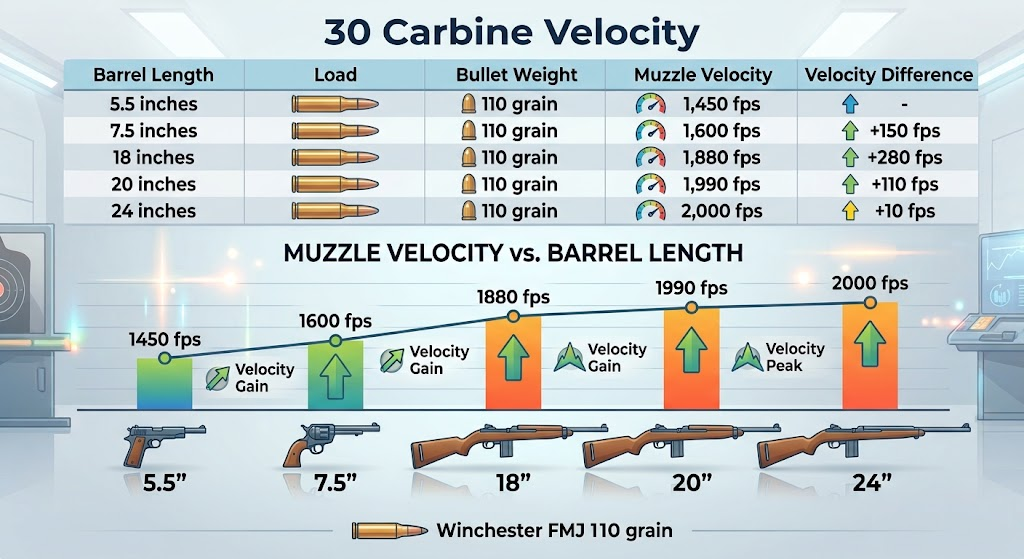
How Much Velocity Does 30 Carbine Gain From Barrel Length?
Chronograph data indicates that the .30 Carbine is heavily dependent on barrel length up to the standard 18 to 20-inch mark, after which velocity gains completely stall. Because the cartridge was engineered around the iconic M1 Carbine (which features an 18-inch barrel), its powder capacity is optimized to achieve full combustion within that specific length.
Between 5.5 inches (handgun length) and 18 inches (rifle length), the .30 Carbine gains an average of 35 to 40 fps per inch of barrel added. However, pushing past the 20-inch mark yields diminishing returns; moving from a 20-inch barrel to a 24-inch barrel adds a meager 10 fps, as bore friction eventually counteracts the spent gas pressure.
Does Barrel Length Affect 30 Carbine Velocity?
Yes, barrel length drastically affects .30 Carbine velocity, especially when transitioning between handguns and long guns.
If you fire standard 110-grain military surplus ammunition out of a short revolver or pistol, you sacrifice over 400 fps compared to an M1 Carbine. This velocity drop significantly reduces kinetic energy and alters point-of-impact at distance. If two M1 Carbines with identical 18-inch barrels record varying speeds, the discrepancy is usually caused by gas system leakage (wear on the piston or tappet), chamber wear, or lot-to-lot variations in surplus powder consistency.
30 Carbine Supersonic Velocity By Barrel Length
The .30 Carbine operates entirely as a supersonic intermediate cartridge, maintaining velocities well above the 1,125 fps sound barrier across all practical barrel lengths.
- 110 Grain (Standard FMJ): The definitive military specification load. It averages roughly 1,880 fps out of a standard 18-inch M1 Carbine, scales to 1,990 fps in a 20-inch barrel, and drops to 1,600 fps in a 7.5-inch handgun.
- 110 Grain (Soft Point / JHP): Commercial hunting and defensive loads utilize expanding bullets at identical powder weights, yielding roughly 1,850 fps from an 18-inch barrel to ensure proper terminal expansion on small game.
30 Carbine Subsonic Velocity By Barrel Length
While the .30-caliber projectile size often sparks interest in suppression, there is no commercially viable subsonic .30 Carbine ammunition.
Attempting to download the small straight-walled .30 Carbine case to stay below the speed of sound (1,125 fps) requires a severely reduced powder charge. This introduces extreme hazards, including erratic ignition, dangerous pressure inconsistencies, and a high risk of squib loads where the bullet gets lodged in the bore. Shooters wanting a suppressed .30-caliber platform standardly choose the .300 Blackout, which was purposefully engineered for subsonic efficiency.
30 Carbine 7.5 Inch Barrel Velocity
A 7.5-inch barrel is typically found on specialty revolvers chambered for the cartridge, such as the Ruger Blackhawk.
- 110-Grain Load: Averages approximately 1,600 fps.
- Considerations: While significantly faster than a standard .357 Magnum revolver at close range, the short barrel produces an intense muzzle blast and fireball as unburnt powder escapes the cylinder gap and bore.
30 Carbine 18 Inch Barrel Velocity
The 18-inch barrel is the legendary standard configuration for the M1 Carbine used by military forces worldwide.
- 110-Grain Load: Reaches approximately 1,880 fps.
- Considerations: This length extracts the cartridge’s intended design velocity, providing an exceptionally lightweight, low-recoil semi-automatic platform capable of hitting targets out to 200 yards.
30 Carbine 20 Inch Barrel Velocity
A 20-inch barrel represents the maximum practical length for commercial or sporterized M1 Carbine variants.
- 110-Grain Load: Yields approximately 1,990 fps.
- Considerations: Captures the absolute peak velocity of the cartridge, squeezing out an extra 110 fps over the standard military length before reaching total powder combustion.
30 Carbine 24 Inch Barrel Velocity
A 24-inch barrel is rarely encountered except on rare commercial bolt-action rifles (such as early Marlin or Ruger offerings) chambered in .30 Carbine.
- 110-Grain Load: Tops out at roughly 2,000 fps.
- Considerations: Provides zero practical ballistic benefit over a 20-inch barrel, adding unnecessary length and front-weight to an otherwise nimble cartridge profile.
30 Carbine Velocity And Energy By Barrel Length
The following table calculates muzzle energy based on tested velocity averages for a standard 110-grain full metal jacket load.
| Barrel Length | Bullet Weight | Velocity | Muzzle Energy |
| 5.5 inches | 110 grain | 1,450 fps | 513 ft-lbs |
| 7.5 inches | 110 grain | 1,600 fps | 625 ft-lbs |
| 18 inches | 110 grain | 1,880 fps | 863 ft-lbs |
| 20 inches | 110 grain | 1,990 fps | 967 ft-lbs |
| 24 inches | 110 grain | 2,000 fps | 977 ft-lbs |
Practical Applications
Muzzle velocity dictates how the .30 Carbine performs in practical use cases:
- Small Game & Varmint Hunting: Utilizing soft point commercial ammunition, an 18-inch M1 Carbine pushing a 110-grain bullet at 1,880 fps provides flat trajectories and humane terminal performance on coyotes, raccoons, and feral pests inside 150 yards.
- Recreational & Historical Shooting: The 1,880 fps velocity from an M1 Carbine produces minimal felt recoil, making it an exceptionally comfortable rifle for long days at the range or introducing new shooters to centerfire rifles.
- Handgun Target Shooting: Firing the cartridge from a 7.5-inch revolver generates roughly 625 ft-lbs of energy, serving as a unique, flat-shooting alternative to traditional magnum revolvers at the range.
What Is The Best Barrel Length For 30 Carbine?
The chronograph data strongly points to the 18-inch barrel as the absolute best and most authentic barrel length for the .30 Carbine.
Because the cartridge was meticulously designed around the M1 Carbine platform, an 18-inch tube perfectly balances complete powder combustion with optimal rifle handling. Dropping down to a handgun barrel strips away nearly 300 to 450 fps, while stretching the barrel past 20 inches offers no measurable speed gains. Sticking to the historical 18-inch length ensures you capture 95% of the cartridge’s velocity potential while keeping the rifle ultra-lightweight and fast-handling.
Pros and Cons
Short Barrel Pros (5.5-7.5 Inches)
- Delivers unique, high-velocity performance in a revolver platform.
- Highly compact for storage and pack transport.
Short Barrel Cons (5.5-7.5 Inches)
- Substantial velocity penalty (losing up to 430 fps compared to rifles).
- Extreme muzzle blast, concussion, and bright flash due to unburnt powder.
- Reduced kinetic energy transfer downrange.
Long Barrel Pros (18-20 Inches)
- Reaches true factory design velocities (1,880 to 1,990 fps).
- Perfectly balances the powder charge for clean combustion and minimal muzzle flash.
- Maximizes kinetic energy (approaching 970 ft-lbs) for effective short-range intermediate performance.
Long Barrel Cons (18-24 Inches)
- Barrels past 20 inches provide entirely redundant velocity returns due to complete powder exhaustion.
30 Carbine Velocity: What The Data Shows
Chronograph testing proves that the .30 Carbine is a purpose-built intermediate cartridge that relies on its native 18-inch barrel to perform as intended. An 18 to 20-inch barrel yields the highest practical velocities, pushing 110-grain projectiles up to 1,990 fps and generating nearly 970 ft-lbs of kinetic energy.
By analyzing the data curve, shooters can see that shortening the barrel to a handgun length introduces a heavy speed penalty, dropping velocities into the mid-1,500 fps range. Ultimately, the data confirms that keeping the .30 Carbine in an 18-inch rifle configuration maximizes its ballistic efficiency, flat trajectory, and historical utility.
FAQs
How fast is 30 Carbine from an 18-inch barrel?
From a standard 18-inch M1 Carbine barrel, a 110-grain bullet averages approximately 1,880 fps.
How fast is 30 Carbine from a 20-inch barrel?
A 20-inch barrel pushes standard 110-grain loads to roughly 1,990 fps, capturing the absolute peak velocity of the cartridge.
How fast is 30 Carbine from a revolver?
Fired from a 7.5-inch revolver, standard .30 Carbine ammunition drops to approximately 1,600 fps due to unburnt powder loss and shorter bore time.
Does barrel length affect 30 Carbine velocity?
Yes. The cartridge gains speed rapidly up to 18–20 inches. Past 20 inches, barrel length provides virtually no velocity gain.
How much velocity does 30 Carbine lose per inch?
When dropping from an 18-inch rifle down to a 7.5-inch handgun, the cartridge loses an average of roughly 35 to 40 fps per inch of barrel reduced.
What is the fastest 30 Carbine barrel length?
A 20-inch barrel produces the fastest practical muzzle velocity for the .30 Carbine, fully exhausting its small powder charge.
What is the best barrel length for 30 Carbine?
The 18-inch barrel is universally regarded as the best, matching historical military specifications and optimizing the cartridge’s powder burn.
Does 30 Carbine gain velocity from a longer barrel?
It gains velocity up to 20 inches. Extending the barrel to 24 inches adds only about 10 fps, making it statistically irrelevant.
How fast is subsonic 30 Carbine?
There is no commercially available subsonic .30 Carbine ammunition. The cartridge operates entirely at supersonic speeds, typically ranging from 1,450 fps (in pistols) to 2,000 fps (in rifles).
What is the velocity difference between a 7.5 and 18 inch 30 Carbine barrel?
For a 110-grain load, the velocity difference is roughly 280 fps (1,600 fps vs. 1,880 fps), resulting in a loss of over 230 ft-lbs of kinetic energy in the shorter barrel.