The typical .30 Carbine muzzle energy ranges from 930 to 980 foot-pounds for standard factory ammunition fired from an 18-inch rifle barrel. For example, standard Federal 110-grain full metal jacket produces 967 foot-pounds, while high velocity Buffalo Bore 110-grain loads generate a slightly higher 1,077 foot-pounds. This .30 Carbine muzzle energy variance depends almost entirely on the powder charge of the ammunition, the specific firearm barrel length, and the resulting muzzle velocity. An 18-inch standard carbine barrel will predictably yield much higher energy levels than a 7.5-inch revolver barrel. Built to bridge the gap between handguns and full size rifles, the .30 Carbine relies on high velocity lightweight projectiles to generate its kinetic payload.
.30 Carbine Muzzle Energy
| Ammunition / Load | Bullet Weight | Muzzle Velocity | Muzzle Energy |
| Prvi Partizan (PPU) FMJ | 110 grain | 1,950 fps | 929 ft-lbs |
| Armscor FMJ | 110 grain | 1,950 fps | 929 ft-lbs |
| Remington UMC Metal Case | 110 grain | 1,990 fps | 967 ft-lbs |
| Federal American Eagle FMJ | 110 grain | 1,990 fps | 967 ft-lbs |
| Winchester Super-X Hollow Point | 110 grain | 1,990 fps | 967 ft-lbs |
| Hornady Critical Defense FTX | 110 grain | 2,000 fps | 977 ft-lbs |
| Underwood Ammo Xtreme Penetrator | 110 grain | 2,000 fps | 977 ft-lbs |
| Buffalo Bore Soft Point | 110 grain | 2,100 fps | 1,077 ft-lbs |
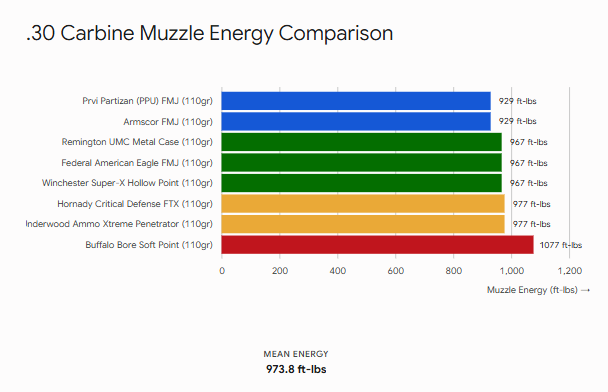
Explaining The 30 Carbine Muzzle Energy Chart
Based on the real world chronograph and factory test data above, we can identify several key performance baselines:
- Lowest Tested Muzzle Energy: The Prvi Partizan and Armscor 110-grain loads yield roughly 929 ft-lbs. These loads are slightly downloaded compared to original military specifications but still provide highly reliable cycling in surplus rifles.
- Highest Tested Muzzle Energy: The Buffalo Bore 110-grain Soft Point generates a highly impressive 1,077 ft-lbs. By utilizing modern powder formulations, it achieves an incredible 2,100 fps out of a standard 18-inch rifle barrel.
- Typical Range: The standard .30 Carbine energy baseline falls squarely between 960 and 980 ft-lbs. This is where nearly all traditional 110-grain ball ammunition operates.
- How Bullet Weight Affects Energy: The .30 Carbine is unique because it almost universally relies on a single bullet weight. Because the 110-grain projectile is the absolute standard across the industry, muzzle energy variations are dictated strictly by the powder charge rather than changes in bullet mass.
- How Velocity Affects Energy: Velocity has an exponential physical effect on kinetic energy. Pushing a 110-grain bullet from 1,950 fps up to 2,100 fps creates a massive jump in total kinetic energy, proving that speed is the most important factor in generating power.
Importantly, muzzle energy is strictly a physics measurement of a bullet’s mass and speed as it leaves the barrel. It is not a direct measurement of terminal performance, penetration, or absolute stopping power.
What Is The Muzzle Energy Of .30 Carbine?
The muzzle energy of .30 Carbine ammunition generally sits around 967 foot-pounds for standard pressure 110-grain loads fired from a standard 18-inch carbine barrel. This specific energy level was originally designed to provide military personnel with significantly more kinetic energy and effective range than a standard issue .45 ACP handgun could offer, without the heavy recoil of a full size battle rifle.
.30 Carbine Muzzle Energy By Bullet Weight
Unlike modern centerfire cartridges that offer dozens of different bullet weights, the .30 Carbine is highly standardized. The vast majority of factory ammunition is loaded with 110-grain bullets. However, some specialty manufacturers produce slightly lighter or heavier variants. The table below uses specific examples to illustrate how energy scales with these uncommon weights.
| Bullet Weight | Example Velocity | Muzzle Energy |
| 100 grain (Specialty DPX) | 2,000 fps | 888 ft-lbs |
| 110 grain (Federal FMJ) | 1,990 fps | 967 ft-lbs |
| 115 grain (Hard Cast Lead) | 1,850 fps | 874 ft-lbs |
Note: These figures represent specific specialty loads. The 110-grain bullet remains the industry standard for producing maximum reliable energy in this caliber.
.30 Carbine 110 Grain Muzzle Energy
The 110-grain bullet is the historic and traditional standard for the .30 Carbine. Moving at a robust 1,990 feet per second out of a rifle barrel, a standard .30 Carbine 110 grain muzzle energy typically measures exactly 967 ft-lbs. This load offers an excellent balance of flat trajectory and moderate kinetic energy. When loaded with modern hollow point or polymer tipped bullets, this 110-grain energy output is highly effective for self defense and small to medium predator hunting inside 100 yards.
.30 Carbine Muzzle Energy By Barrel Length
A cartridge’s advertised muzzle energy is nearly always derived from a standard 18-inch test barrel to match the original M1 Carbine. Firing that same ammunition from a modern pistol variant or a large frame revolver will result in drastically lower velocity and proportionally lower muzzle energy.
Using standard 110-grain factory ammunition, here is how .30 Carbine muzzle energy changes across common barrel lengths:
- 7.5 inches (e.g., Ruger Blackhawk Revolver): ~1,500 fps | 550 ft-lbs
- 12 inches (e.g., Universal Enforcer Pistol): ~1,700 fps | 705 ft-lbs
- 18 inches (e.g., Standard M1 Carbine): 1,990 fps | 967 ft-lbs
Because the .30 Carbine uses powders optimized for 18-inch rifle barrels, shortening the barrel to pistol lengths leaves much of the powder unburned. This creates a very loud muzzle blast and a massive fireball, while costing the shooter hundreds of foot-pounds of potential kinetic energy.
.30 Carbine Velocity And Muzzle Energy
To understand how .30 Carbine muzzle velocity and energy are related, it is important to conceptually understand kinetic energy physics. Because velocity has an exponential physical effect on energy calculations, adding just 100 fps to a .30 Carbine load yields a large increase in total muzzle energy.
For example, a standard 110-grain bullet traveling at 1,950 fps reliably generates 929 ft-lbs of energy. If a manufacturer uses a hotter powder charge to push that exact same 110-grain bullet to 2,100 fps, the energy jumps to over 1,070 ft-lbs simply because of how the physics of speed interact with mass. Because velocity dictates the final energy output so heavily, shooting this cartridge from a short barrel handgun strips away the speed it relies on to produce high foot-pounds of energy.
.30 Carbine Muzzle Energy vs .357 Magnum and 5.56 NATO
How does the .30 Carbine energy compare to a legendary magnum handgun cartridge and a modern intermediate rifle cartridge? The table below compares standard factory ammunition fired from rifle length barrels across three highly popular calibers.
| Cartridge | Bullet Weight | Muzzle Velocity | Muzzle Energy |
| .30 Carbine (18-inch barrel) | 110 grain | 1,990 fps | 967 ft-lbs |
| .357 Magnum (16-inch barrel) | 158 grain | 1,750 fps | 1,074 ft-lbs |
| 5.56 NATO (16-inch barrel) | 55 grain | 3,240 fps | 1,282 ft-lbs |
The .30 Carbine sits perfectly between traditional handgun calibers and modern rifle calibers. While a .357 Magnum fired from a lever action rifle produces slightly more raw kinetic energy due to its heavy bullet, the .30 Carbine shoots a lighter bullet significantly flatter. Both cartridges produce less energy than the hyper velocity 5.56 NATO cartridge.
What Muzzle Energy Actually Tells You
Muzzle energy is a useful comparative metric, but it has severe limitations when analyzing a cartridge’s effectiveness in real world scenarios.
- Muzzle Energy vs. Downrange Energy: Muzzle energy is measured inches from the barrel. Because lightweight, round nose .30 caliber bullets have very poor aerodynamic profiles, the .30 Carbine sheds its velocity and energy rapidly beyond 150 yards.
- Energy vs. Penetration: High muzzle energy does not guarantee optimal terminal performance. A classic 110-grain full metal jacket bullet often punches straight through a soft target without transferring its kinetic energy, whereas a modern soft point will expand rapidly and dump all 900 foot-pounds of energy into the target.
- Stopping Power: The .30 Carbine historically faced criticism when using military ball ammunition because it lacked the physical mass of a .45 ACP and the explosive speed of a .30-06. Proper expanding ammunition is required to make use of its kinetic energy.
.30 Carbine Muzzle Energy Pros
- Produces nearly 1,000 foot-pounds of kinetic energy with virtually zero felt recoil in a lightweight rifle.
- Offers double the kinetic energy of standard military handgun cartridges like the 9mm Luger and .45 ACP.
- Maintains lethal kinetic energy on small to medium targets out to roughly 150 yards.
.30 Carbine Muzzle Energy Limitations
- Round nose projectile designs cause energy to drop off incredibly fast past 150 yards, strictly limiting its effective hunting range.
- Loses a massive percentage of its kinetic energy when fired from short barrel revolvers or pistols due to incomplete powder burns.
- Lacks the sheer kinetic foot-pounds generated by modern intermediate rifle cartridges like the 5.56 NATO or .300 Blackout.
.30 Carbine Muzzle Energy: How Much Energy Does It Produce?
The .30 Carbine produces a typical muzzle-energy range of 930 to 980 foot-pounds for standard pressure ammunition fired from a full size carbine.
Common 110-grain full metal jacket loads reliably yield exactly 967 ft-lbs. Slightly downloaded surplus style ammunition typically produces around 930 ft-lbs. Modern defensive hollow point loads consistently hover near 970 to 980 ft-lbs. Handgun specific applications fired from 7.5-inch barrels predictably produce around 550 ft-lbs. The highest verified example in our research is the Buffalo Bore 110-grain Soft Point, which generates an impressive 1,077 ft-lbs out of a standard test barrel.
Ultimately, there is no single universal .30 Carbine muzzle-energy number. The final output depends entirely on the powder charge selected by the manufacturer and the length of the barrel firing it, with 18-inch rifles safely maximizing the cartridge’s kinetic potential.
FAQs
How much muzzle energy does a .30 Carbine have?
Standard .30 Carbine rifle loads typically generate between 930 and 980 foot-pounds of muzzle energy, while specialty high velocity ammunition can push slightly over 1,000 foot-pounds.
What is the muzzle energy of a 110 grain .30 Carbine?
A standard 110-grain .30 Carbine load traveling at roughly 1,990 fps produces approximately 967 foot-pounds of muzzle energy out of an 18-inch rifle barrel.
Does barrel length affect .30 Carbine muzzle energy?
Yes, drastically. Firing a .30 Carbine from a 7.5-inch revolver will result in less than 600 foot-pounds of muzzle energy, compared to the nearly 1,000 foot-pounds it generates from a standard 18-inch rifle barrel.
What is the highest energy .30 Carbine load?
High velocity modern loads produce the highest kinetic numbers. Boutique ammunition like the Buffalo Bore 110-grain Soft Point reaches 2,100 fps and produces 1,077 ft-lbs of muzzle energy.
How does .30 Carbine muzzle energy compare with .357 Magnum?
When fired from handguns, the .357 Magnum easily beats the .30 Carbine in energy. However, when both are fired from 16-inch to 18-inch rifles, their muzzle energies are remarkably similar, with both cartridges producing roughly 950 to 1,050 foot-pounds of energy.
How does .30 Carbine muzzle energy compare with 9mm?
The .30 Carbine produces nearly three times the raw kinetic energy of a standard 9mm Luger handgun. A standard 9mm pistol produces around 360 ft-lbs, whereas a .30 Carbine rifle produces closer to 970 ft-lbs.
Is .30 Carbine more powerful than .45 ACP?
Yes. The .30 Carbine generates significantly more kinetic energy and velocity than the .45 ACP. The .30 Carbine produces roughly 967 ft-lbs, while a standard .45 ACP pistol load generates only about 360 to 400 ft-lbs.
Does higher muzzle energy mean more stopping power on targets?
Not always. Muzzle energy is just a kinetic measurement. Stopping power relies heavily on the bullet’s ability to rapidly expand and transfer that energy to the target. This is why modern expanding hollow points are highly preferred over standard round nose military ball ammunition.
How is .30 Carbine muzzle energy calculated?
It is calculated using a standard kinetic energy physics calculation that combines the bullet’s physical weight with its flight speed. Because velocity has an exponential mathematical effect in this calculation, speed plays a significantly larger role in generating high foot-pounds of energy than the physical weight of the bullet alone.