The .30-06 Springfield is arguably the most versatile and historically significant centerfire rifle cartridge in American history. The short answer to .30-06 ballistics is this: A standard 150-grain bullet leaves the muzzle at approximately 2,900 feet per second (fps) generating over 2,800 foot-pounds (ft-lbs) of energy. When zeroed at 200 yards, it shoots flat enough that you only have to account for about 7 to 8 inches of bullet drop at 300 yards. It maintains enough velocity and terminal energy to ethically harvest deer, elk, and moose out to 400 yards and beyond.
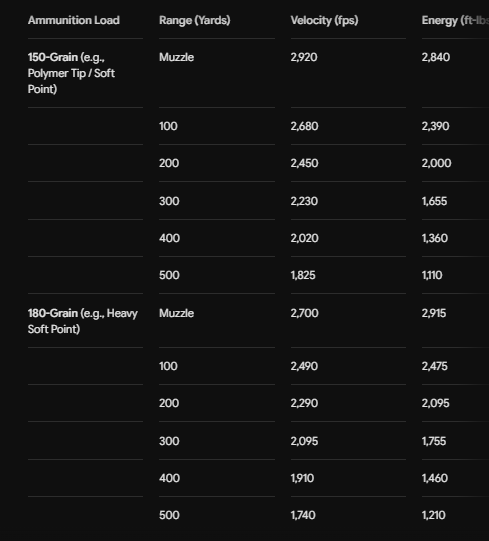
Here is the quick-reference ballistics chart for the two most popular hunting bullet weights (150-grain and 180-grain), assuming a standard 200-yard zero:
| Ammunition Load | Range (Yards) | Velocity (fps) | Energy (ft-lbs) | Trajectory (inches) |
| 150-Grain (e.g., Polymer Tip / Soft Point) | Muzzle | 2,920 | 2,840 | -1.5 (Sight Height) |
| 100 | 2,680 | 2,390 | +1.6 | |
| 200 | 2,450 | 2,000 | 0.0 (Zero) | |
| 300 | 2,230 | 1,655 | -7.2 | |
| 400 | 2,020 | 1,360 | -21.5 | |
| 500 | 1,825 | 1,110 | -44.0 | |
| 180-Grain (e.g., Heavy Soft Point) | Muzzle | 2,700 | 2,915 | -1.5 (Sight Height) |
| 100 | 2,490 | 2,475 | +1.9 | |
| 200 | 2,290 | 2,095 | 0.0 (Zero) | |
| 300 | 2,095 | 1,755 | -8.5 | |
| 400 | 1,910 | 1,460 | -24.8 | |
| 500 | 1,740 | 1,210 | -50.5 |
30-06 ballistics Calculator
Understanding .30-06 Ballistics
Introduced in 1906 (hence the “06”), the .30-06 Springfield served as the U.S. military’s primary rifle cartridge through two World Wars. Today, it remains the benchmark against which almost all other big-game hunting cartridges are measured.
The beauty of the .30-06 lies in its powder capacity and its ability to handle a massive variety of bullet weights, making it a true “do-it-all” cartridge. Here is a breakdown of how it performs.
1. Bullet Weights and Velocity
Because the .30-06 case holds a generous amount of powder, handloaders and factory ammunition manufacturers can utilize bullets ranging from featherweight 110-grain varmint loads all the way up to 220-grain bear-stopping solids.
- 150-Grain (~2,900 fps): This is the gold standard for whitetail deer, antelope, and feral hogs. It offers the flattest trajectory in the typical hunting ranges (out to 300 yards) and minimizes recoil.
- 165-Grain (~2,800 fps): Considered by many to be the “sweet spot” for the .30-06. It balances the high velocity of the 150-grain with the superior wind resistance and deeper penetration of the heavier bullets. Excellent for mule deer and elk.
- 180-Grain (~2,700 fps): The traditional choice for heavy, tough game like elk, moose, and black bear. While it starts slower and drops faster at extended ranges, it carries incredible momentum and penetrates deeply through heavy bone and muscle.
2. Kinetic Energy and Terminal Performance
The .30-06 is a powerhouse. For context, ethical hunters generally agree that you need about 1,000 ft-lbs of energy to cleanly kill a deer, and 1,500 ft-lbs for an elk.
Looking at the ballistics chart above:
- At 200 yards, both the 150-grain and 180-grain loads are carrying over 2,000 ft-lbs of energy. This is enough to pass entirely through large game animals.
- At 400 yards, the 180-grain bullet is still carrying nearly 1,500 ft-lbs of energy, maintaining its status as a lethal elk cartridge at distances where many other calibers start to run out of steam.
- It isn’t until past 500 yards that the energy levels drop below the recommended thresholds for large, heavy game.
3. Trajectory and Maximum Point Blank Range (MPBR)
The .30-06 does not shoot as flat as modern speedsters like the 6.5 Creedmoor or 7mm Remington Magnum, but its trajectory is highly predictable and very manageable.
Most hunters use a concept called Maximum Point Blank Range (MPBR) with the .30-06. If you sight your rifle in to hit about 1.5 to 2 inches high at 100 yards, the bullet will cross your line of sight again exactly at 200 yards (a 200-yard zero).
Because the vital zone of a deer is roughly 8 inches wide, this zeroing strategy means you can aim directly at the center of the animal’s chest from 0 out to about 250 yards without ever having to adjust your scope or hold over the target. The bullet will never rise more than a couple of inches above your crosshairs, and won’t drop out of the vital zone until right around the 275 to 300-yard mark.
4. Recoil Considerations
The primary trade-off for the .30-06’s impressive downrange ballistics is felt recoil.
A standard 8-pound hunting rifle firing a 165-grain .30-06 cartridge generates about 20 to 22 foot-pounds of recoil energy. This is a noticeable, sharp push. It is significantly more recoil than a .243 Winchester or a 6.5 Creedmoor (which sit around 12 to 14 ft-lbs), but it is generally considered manageable for most adult shooters with proper form. If you are sensitive to recoil, stepping down to a 150-grain bullet or using a rifle with a high-quality recoil pad can make a massive difference.