A 204 Ruger Ballistics Chart is a comprehensive and highly detailed reference table that tracks the velocity, kinetic energy, trajectory curve, and wind drift of the .204 Ruger cartridge over various distances. By carefully reviewing this specific chart, you can visualize exactly how your ultra-high-velocity, lightweight bullet will behave from the precise moment it leaves your barrel until it strikes a tiny target hundreds of yards downrange. This critical data allows you to accurately predict bullet drop, compensate for wind deflection, and verify that your projectile retains enough velocity for explosive expansion on varmints and predators across wide-open plains.
Shooters, predator hunters, and precision varmint enthusiasts use a 204 Ruger Ballistics Chart to unlock the absolute true potential of what is widely considered one of the fastest commercial centerfire cartridges on the planet. Introduced in 2004 as a joint venture between Hornady and Ruger, the .204 Ruger is based on a necked-down .222 Remington Magnum casing. It was specifically engineered to push lightweight .204 caliber bullets at mind-blowing speeds exceeding 4,000 feet per second. By analyzing the numbers today, a dedicated prairie dog hunter can confidently take a challenging shot at four hundred yards, knowing exactly how their polymer-tipped bullet will perform. In this comprehensive guide, you will learn how to analyze ballistics data, choose the absolute best bullet weight for your specific needs, determine the ideal zero distance, and see exactly how this laser-beam cartridge completely dominates the modern varmint hunting world.
204 Ruger Ballistics Chart
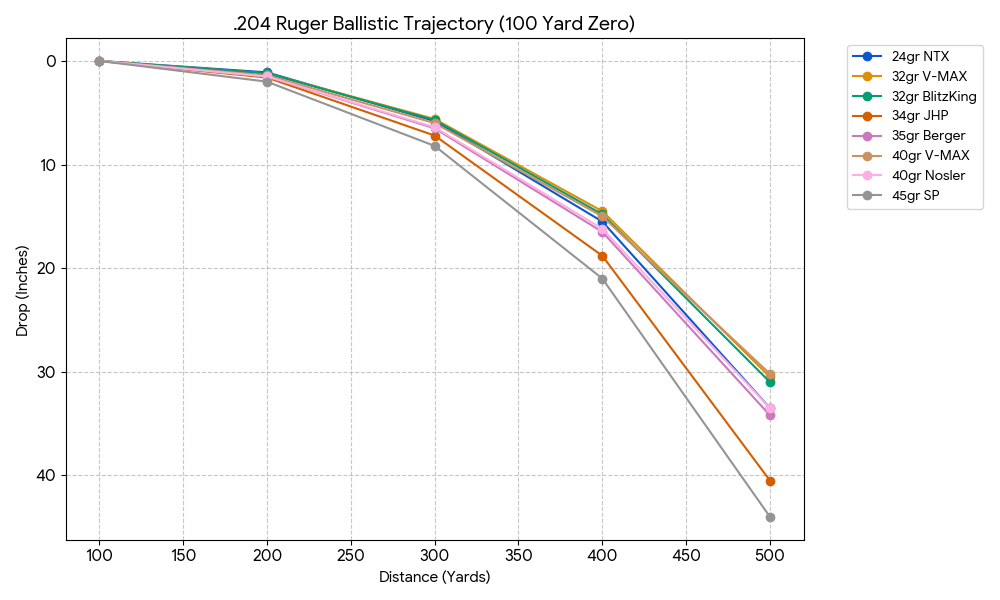
Below is a detailed ballistics table featuring popular factory-loaded ammunition available for the .204 Ruger today. The data represents a standard 24-inch test barrel (the optimal length for achieving maximum velocity) and assumes a 100-yard zero under standard sea-level atmospheric conditions.
| Bullet Weight | Bullet Type | Manufacturer | Muzzle Velocity | Velocity At 100 Yards | Velocity At 200 Yards | Velocity At 300 Yards | Velocity At 400 Yards | Velocity At 500 Yards | Muzzle Energy | Energy At 100 Yards | Energy At 200 Yards | Energy At 300 Yards | Energy At 400 Yards | Energy At 500 Yards | Trajectory At 100 Yards | Trajectory At 200 Yards | Trajectory At 300 Yards | Trajectory At 400 Yards | Trajectory At 500 Yards | Ballistic Coefficient | Sectional Density |
|---|---|---|---|---|---|---|---|---|---|---|---|---|---|---|---|---|---|---|---|---|---|
| 24 Grain | NTX (Lead-Free) | Hornady | 4400 fps | 3730 fps | 3135 fps | 2600 fps | 2125 fps | 1715 fps | 1032 ft lbs | 741 ft lbs | 524 ft lbs | 360 ft lbs | 240 ft lbs | 157 ft lbs | 0 inches | 1.1 inches drop | 5.8 inches drop | 15.5 inches drop | 33.5 inches drop | 0.145 | 0.083 |
| 32 Grain | V-MAX | Hornady | 4225 fps | 3675 fps | 3175 fps | 2725 fps | 2315 fps | 1945 fps | 1268 ft lbs | 960 ft lbs | 716 ft lbs | 528 ft lbs | 381 ft lbs | 269 ft lbs | 0 inches | 1.2 inches drop | 5.6 inches drop | 14.5 inches drop | 30.5 inches drop | 0.210 | 0.110 |
| 32 Grain | BlitzKing | Sierra | 4225 fps | 3660 fps | 3160 fps | 2710 fps | 2300 fps | 1930 fps | 1268 ft lbs | 952 ft lbs | 710 ft lbs | 522 ft lbs | 376 ft lbs | 265 ft lbs | 0 inches | 1.2 inches drop | 5.7 inches drop | 14.8 inches drop | 31.0 inches drop | 0.207 | 0.110 |
| 34 Grain | Jacketed Hollow Point | Winchester | 4050 fps | 3445 fps | 2910 fps | 2435 fps | 2005 fps | 1630 fps | 1239 ft lbs | 896 ft lbs | 639 ft lbs | 447 ft lbs | 303 ft lbs | 200 ft lbs | 0 inches | 1.6 inches drop | 7.2 inches drop | 18.8 inches drop | 40.5 inches drop | 0.165 | 0.117 |
| 35 Grain | Berger Varmint | Federal Premium | 3950 fps | 3445 fps | 2985 fps | 2570 fps | 2190 fps | 1845 fps | 1213 ft lbs | 923 ft lbs | 693 ft lbs | 513 ft lbs | 373 ft lbs | 264 ft lbs | 0 inches | 1.5 inches drop | 6.5 inches drop | 16.5 inches drop | 34.2 inches drop | 0.190 | 0.121 |
| 40 Grain | V-MAX | Hornady | 3900 fps | 3450 fps | 3040 fps | 2665 fps | 2315 fps | 1995 fps | 1351 ft lbs | 1057 ft lbs | 821 ft lbs | 631 ft lbs | 476 ft lbs | 353 ft lbs | 0 inches | 1.4 inches drop | 6.0 inches drop | 15.0 inches drop | 30.2 inches drop | 0.275 | 0.137 |
| 40 Grain | Nosler Ballistic Tip | Federal Premium | 3900 fps | 3415 fps | 2980 fps | 2585 fps | 2220 fps | 1885 fps | 1351 ft lbs | 1036 ft lbs | 789 ft lbs | 593 ft lbs | 438 ft lbs | 315 ft lbs | 0 inches | 1.5 inches drop | 6.4 inches drop | 16.2 inches drop | 33.5 inches drop | 0.239 | 0.137 |
| 45 Grain | Soft Point | Hornady | 3625 fps | 3155 fps | 2725 fps | 2335 fps | 1975 fps | 1650 fps | 1313 ft lbs | 995 ft lbs | 742 ft lbs | 545 ft lbs | 390 ft lbs | 272 ft lbs | 0 inches | 2.0 inches drop | 8.2 inches drop | 21.0 inches drop | 44.0 inches drop | 0.200 | 0.154 |
Understanding The Chart
A ballistics chart can look overwhelming at first glance due to the sheer volume of data presented. Breaking down each individual column reveals key information about how a specific load performs in the field.
Muzzle Velocity
Muzzle velocity is the exact speed at which the bullet exits the barrel of the firearm, measured in feet per second (fps). This is the defining characteristic of the .204 Ruger. Pushing 32-grain bullets at 4,225 fps and 24-grain bullets at 4,400 fps makes it one of the fastest production cartridges ever created. This blistering, hyper-velocity launch minimizes the time gravity has to act on the bullet, resulting in a perfectly flat trajectory over standard varmint hunting distances.
Retained Velocity
Retained velocity refers to the speed of the bullet at specific distances downrange. Air resistance constantly slows the bullet down as it travels through the atmosphere. Retained velocity is critical for varmint hunters because highly explosive, thin-jacketed bullets (like the V-MAX or BlitzKing) require massive impact velocities to fragment violently. Despite the bullets being incredibly light, their extreme starting speed ensures they arrive at 300 yards moving faster than many standard rifle cartridges do at the muzzle.
Kinetic Energy
Kinetic energy is the amount of destructive physical force the bullet carries, measured in foot-pounds (ft-lbs). The .204 Ruger generates roughly 1,200 to 1,350 ft-lbs of energy at the muzzle. While this is lower than traditional deer-hunting cartridges, the combination of hyper-velocity and rapidly expanding varmint bullets results in absolute devastating hydrostatic shock on small targets. All energy is dumped instantly into the animal, resulting in immediate, ethical kills and minimizing the risk of ricochets on open ground.
Trajectory
Trajectory indicates the actual physical path the bullet takes as it flies through the air, factoring in the constant downward pull of gravity. The trajectory chart displays bullet drop in inches at various yardages relative to a 100-yard zero. The .204 Ruger is famous for its laser-beam trajectory. A 32-grain bullet zeroed at 100 yards only drops roughly 5.6 inches at 300 yards, essentially allowing a hunter to hold dead-center on a prairie dog all the way out to a quarter-mile.
Ballistic Coefficient
The Ballistic Coefficient (BC) is a numerical value representing how efficiently a bullet cuts through the air. Higher numbers indicate better aerodynamic efficiency. The tiny .204 caliber bullets traditionally have lower absolute BC numbers (ranging from 0.145 to 0.275) simply because they lack heavy mass. However, because they are launched at 4,000+ fps, they traverse the distance to the target so quickly that wind simply does not have enough time to push them severely off course inside 300 yards.
Sectional Density
Sectional density is the ratio of a bullet’s weight compared directly to its diameter. This metric indicates potential penetration depth into a target. For the .204 Ruger, sectional density is extremely low (0.083 to 0.154). This is entirely by design. Varmint hunters do not want deep, pass-through penetration. They want the bullet to enter a coyote or groundhog and violently fragment, dumping all its energy immediately without exiting the other side.
Common .204 Ruger Bullet Weights
The cartridge is highly specialized, and selecting the proper bullet weight is critical for tailoring the rifle to your specific varmint hunting application.
24 Grain (Lead-Free)
The 24-grain bullet is the absolute lightest and fastest option available. Constructed of a frangible copper-alloy core (like the Hornady NTX), it is designed specifically for hunters operating in jurisdictions that mandate lead-free ammunition (like California). Pushed at a staggering 4,400 fps, it offers explosive performance on small ground squirrels but loses velocity extremely quickly past 250 yards due to its low mass.
32 Grain
The 32-grain bullet is the absolute gold standard for the .204 Ruger. It strikes the perfect mathematical balance between hyper-velocity (4,225 fps) and aerodynamic efficiency. It is the premier choice for hunting prairie dogs, woodchucks, and crows. The recoil is virtually non-existent, allowing the shooter to easily spot their own impacts through a high-magnification scope.
40 Grain
The 40-grain bullet is heavily favored by dedicated predator hunters targeting coyotes, bobcats, and foxes. While it launches slightly slower (3,900 fps), it possesses a significantly higher Ballistic Coefficient. This means it resists wind drift much better at 300 and 400 yards and carries significantly more kinetic energy upon impact, guaranteeing deep enough penetration to anchor a large coyote immediately.
45 Grain
The 45-grain bullet is the heaviest practical option loaded for standard 1-in-12 inch twist barrels. Typically offered in a traditional soft point configuration, this weight provides the deepest penetration available for the caliber. It is often used by hunters trying to save coyote pelts, as the soft point design generally produces a small entrance wound without a massive, explosive exit wound if no heavy bone is struck.
Effective Hunting Range
The .204 Ruger’s effective range is dictated entirely by its terminal ballistics and the size of the target. It is explicitly designed for thin-skinned game.
Prairie Dogs and Varmints
When hunting prairie dogs, ground squirrels, and woodchucks, the .204 Ruger completely dominates the open plains. Because the bullets are launched at over 4,000 fps, you can accurately harvest tiny targets out to 500 yards on calm days. The lack of recoil allows shooters to watch the spectacular impacts through the optic.
Coyotes, Foxes, and Bobcats
For coyotes and other predators, this cartridge is highly effective out to 350 to 400 yards when using the heavier 40-grain polymer-tipped ammunition. The hyper-velocity hydrostatic shock ensures instant ethical kills on fast-moving predators, making it widely considered the ultimate dedicated AR-15 and bolt-action coyote cartridge.
Whitetail Deer
Hunting whitetail deer or any big game with the .204 Ruger is highly unethical, universally frowned upon, and completely illegal in almost all jurisdictions. Deer require deep penetration through heavy muscle and bone. The lightweight, highly explosive .204 bullets are explicitly designed to fragment instantly on the surface. If utilized for deer, it will result in terrible, non-lethal superficial surface wounds.
Factors That Affect .204 Ruger Ballistics
Ballistics numbers are never completely static. The exact data provided in any velocity chart will change constantly based on environmental conditions and the physical characteristics of your rifle setup.
Barrel Length
Barrel length has a major direct impact on your final muzzle velocity. To achieve the blistering 4,000+ fps advertised velocities, a 24-inch or 26-inch barrel is typically required. While some modern AR-15 platforms use 20-inch barrels for maneuverability, shortening the barrel will result in a velocity loss of roughly 35 to 45 feet per second per inch removed, diminishing the hyper-velocity advantage of the cartridge.
Twist Rate
To properly stabilize the tiny .20 caliber bullets, rifle barrels must utilize the correct twist rate. The vast majority of factory .204 Ruger rifles use a 1-in-12 inch twist rate. This perfectly stabilizes the 32-grain and 40-grain bullets. If you attempt to handload exceptionally long, heavy custom bullets (like 50-grain match bullets), a standard 1:12 twist will fail to stabilize them, causing them to tumble in flight.
Wind Drift
Wind deflection is the greatest challenge for this caliber when shooting across open agricultural fields. While the bullets travel to the target incredibly fast, their extreme light weight makes them susceptible to lateral push. A heavy 15 mph crosswind will push a 32-grain bullet significantly at 400 yards. Varmint hunters must learn to read the wind perfectly when attempting extreme-range shots.
Best Zero Distance
Selecting the optimal zero distance depends entirely on how you plan to use your rifle in the field.
100 Yard Zero
A 100-yard zero provides a clean, perfect mathematical baseline. However, for a cartridge that shoots as flat as the .204 Ruger, a 100-yard zero is often considered a “waste” of the cartridge’s flat trajectory potential, as the bullet never gets a chance to utilize its upward arc.
200 Yard Zero (Maximum Point Blank Range)
The 200-yard zero is the absolute gold standard and most highly recommended zero for the .204 Ruger. When zeroed at 200 yards with a 32-grain bullet, the projectile will only rise roughly 0.8 inches high at 100 yards, and it will only drop about 4.5 inches at 300 yards. This creates a massive Maximum Point Blank Range (MPBR). A hunter can literally aim dead-center on a coyote from the muzzle all the way out to 300 yards and guarantee a lethal hit without ever touching their scope turrets or holding over the target.
.204 Ruger Ballistics Compared To Other Cartridges
To truly appreciate the brilliant engineering behind this modern hyper-velocity cartridge, we must compare it directly against its closest competitors in the varmint hunting world.
| Cartridge | Muzzle Velocity | Muzzle Energy | Trajectory At 300 Yards (100yd Zero) | Recoil | Effective Varmint Range | Rifle Platform |
|---|---|---|---|---|---|---|
| .204 Ruger (32gr) | 4225 fps | 1268 ft lbs | 5.6 inches drop | Virtually None | 500 Yards | Bolt / AR-15 |
| .223 Remington (50gr) | 3300 fps | 1209 ft lbs | 11.2 inches drop | Very Light | 400 Yards | Bolt / AR-15 |
| .22-250 Remington (50gr) | 3800 fps | 1603 ft lbs | 7.8 inches drop | Light | 600 Yards | Bolt Action |
| .17 Hornet (20gr) | 3650 fps | 592 ft lbs | 9.0 inches drop | None | 300 Yards | Bolt / Single-Shot |
| .22 WMR (30gr) | 2200 fps | 322 ft lbs | 68.0 inches drop | None | 150 Yards | Rimfire |
When compared to the standard .223 Remington, the .204 Ruger is significantly faster and shoots noticeably flatter. It generates less recoil than the .223, allowing the shooter to stay perfectly on target and watch the impact through the scope. However, .223 Remington ammunition is vastly cheaper and more widely available.
Against the legendary .22-250 Remington, the .204 Ruger offers a very compelling argument. The .22-250 generates more kinetic energy and hits coyotes harder at 500 yards. However, the .22-250 burns significantly more powder, generates more recoil (making spotting your own impacts difficult), and wears out barrels faster than the highly efficient .204 Ruger case.
Compared to rimfires like the .22 WMR or small centerfires like the .17 Hornet, the .204 Ruger is in an entirely different universe of performance, vastly outclassing them in range, energy, and wind-bucking capability.
Conclusion
Understanding a 204 Ruger Ballistics Chart reveals exactly why this hyper-velocity cartridge is considered one of the finest dedicated varmint and predator rounds ever engineered. By combining a highly efficient casing with lightweight, frangible .20 caliber projectiles, Hornady and Ruger created a cartridge that delivers a laser-flat trajectory, zero recoil, and explosive terminal performance. Whether you are decimating prairie dog towns across wide-open plains or calling in wary coyotes in the dead of winter, understanding the 204 Ruger’s trajectory curve allows you to extract maximum accuracy and devastating results at incredible distances.