Determining the most effective 17 HMR range requires precisely analyzing your specific target size, environmental wind conditions, and whether you are utilizing highly frangible 17-grain projectiles or deeper penetrating 20-grain hollow points. The .17 Hornady Magnum Rimfire delivers a highly capable and incredibly flat-shooting practical effective range of 150 to 200 yards for hunting small varmints like prairie dogs and ground squirrels. However, because the projectile is astonishingly light, it is strictly limited by rapid kinetic energy decay and extreme susceptibility to wind drift past the 150-yard mark. By perfectly matching your specific projectile weight to your barrel configuration and hunting application, you can fully maximize the blistering speed and laser-like trajectory of this modern rimfire cartridge.
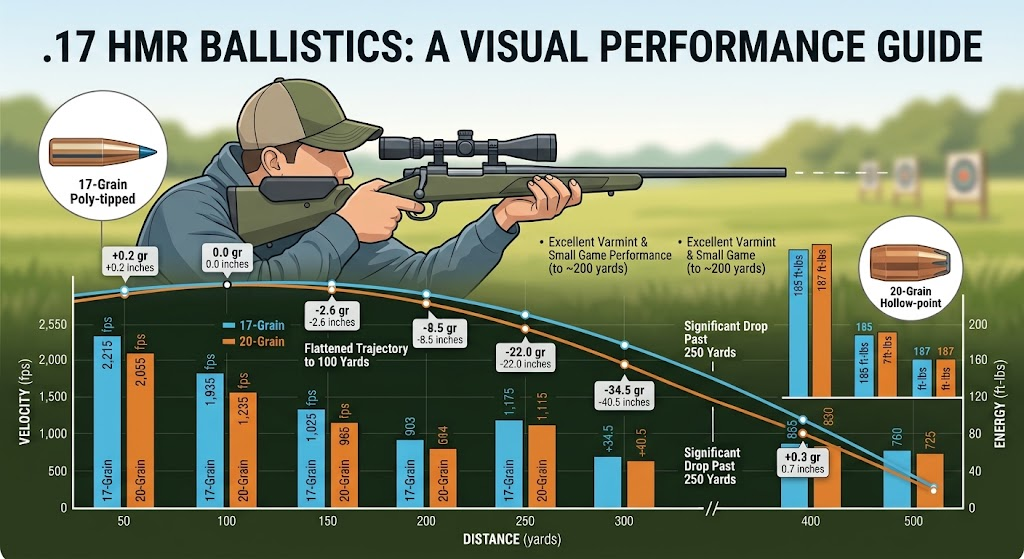
17 HMR Range Chart
| Distance | 17-Grain Velocity | 17-Grain Energy | 17-Grain Drop | 20-Grain Velocity | 20-Grain Energy | 20-Grain Drop |
| 50 yards | 2,215 fps | 185 ft-lbs | +0.2 inches | 2,055 fps | 187 ft-lbs | +0.4 inches |
| 100 yards | 1,905 fps | 137 ft-lbs | 0.0 inches | 1,775 fps | 140 ft-lbs | 0.0 inches |
| 150 yards | 1,625 fps | 100 ft-lbs | -2.6 inches | 1,515 fps | 102 ft-lbs | -3.2 inches |
| 200 yards | 1,385 fps | 72 ft-lbs | -8.5 inches | 1,295 fps | 74 ft-lbs | -10.0 inches |
| 250 yards | 1,175 fps | 52 ft-lbs | -18.5 inches | 1,115 fps | 55 ft-lbs | -22.0 inches |
| 300 yards | 1,015 fps | 39 ft-lbs | -34.5 inches | 985 fps | 43 ft-lbs | -40.5 inches |
| 400 yards | 865 fps | 28 ft-lbs | -86.0 inches | 830 fps | 31 ft-lbs | -98.0 inches |
| 500 yards | 760 fps | 22 ft-lbs | -165.0 inches | 725 fps | 23 ft-lbs | -185.0 inches |
Understanding the Ballistics Chart
The detailed data provided in the 17 HMR Range Chart is sourced directly from rigorous real-world ballistic modeling of the two most universally utilized factory loads on the commercial market. These numbers reflect performance from a standard 20-inch bolt-action rifle barrel under normal atmospheric conditions at sea level with an ambient temperature of 59 degrees Fahrenheit. Understanding these specific ballistic inputs is incredibly crucial for accurately translating the data to practical field conditions. Minor changes in barrel length, elevation, barometric pressure, and crosswinds will fundamentally alter these downrange figures.
For the 17-Grain column, the data meticulously reflects the wildly popular Hornady 17-grain V-MAX load. Fired from a 20-inch barrel, this highly specialized varmint load boasts a factory-rated muzzle velocity of 2,550 feet per second (fps) and an estimated G1 Ballistic Coefficient (BC) of .125. The rifle is zeroed at exactly 100 yards, which is the undisputed industry standard for this flat-shooting cartridge. This is a lightweight, polymer-tipped bullet explicitly designed for incredibly rapid expansion and violent fragmentation upon impact. This makes it an excellent, highly reliable baseline for evaluating small-game terminal performance.
For the 20-Grain column, the data represents the highly respected Hornady 20-grain XTP (Extreme Terminal Performance) hollow point load. Fired from a 20-inch barrel, this slightly heavier load leaves the muzzle at roughly 2,375 fps. It is intentionally engineered to provide deeper penetration and less explosive surface fragmentation, making it the preferred choice for slightly larger pests like foxes or raccoons. This heavier bullet also features a G1 BC of .125. The rifle is zeroed at 100 yards for a direct comparison, highlighting the slightly more parabolic arc required to meet the 100-yard crosshair compared to its faster 17-grain counterpart.
What Is The Effective Range Of 17 HMR?
Determining the true effective range of the .17 Hornady Magnum Rimfire requires deeply defining what the term effective means for your highly specific shooting application, target size, and local environmental conditions. Introduced to the commercial hunting market by Hornady Ammunition in 2002, the .17 HMR was brilliantly created by necking down a .22 Winchester Magnum Rimfire (.22 WMR) empty case to accept a microscopic .172-caliber projectile. The foundational goal was to create the fastest, flattest-shooting rimfire cartridge in global history.
Effective range in a civilian hunting context is rigidly defined as the absolute maximum distance at which the tiny projectile retains enough forward velocity to reliably expand upon impact while possessing enough kinetic energy to humanely harvest an animal without causing undue suffering. Most state wildlife agencies and professional varmint hunters demand a strict minimum of 30 to 40 foot-pounds of kinetic energy for an ethical harvest on small rodents like prairie dogs or ground squirrels. For larger predators like foxes, 100 foot-pounds of energy is generally required.
For most standard varmint hunting applications using high-quality 17-grain polymer-tipped ammunition, the practical effective range of the .17 HMR is firmly planted between 150 and 200 yards. At 150 yards, a standard 17-grain bullet will have dropped merely 2.6 inches (assuming a strict 100-yard zero) and will still stubbornly carry 100 foot-pounds of kinetic energy. This allows a hunter to aim dead-center on a small target at 150 yards without needing to calculate complex optical holdovers or dial elevation turrets.
If you push the cartridge past the 200-yard line, the microscopic bullet sheds almost all of its expansion-inducing velocity. At 250 yards, the kinetic energy plummets near 50 ft-lbs, and the bullet drops over 18 inches. At this extreme distance, even a perfectly placed direct hit on a prairie dog may result in the bullet failing to fragment, transferring very little lethal shock, and allowing the animal to crawl into a burrow to suffer. Furthermore, wind drift becomes virtually unmanageable past 200 yards for a projectile weighing less than a standard plastic thumbtack.
For precision target and competition shooting on a flat range, effective range is defined strictly as the maximum distance at which the shooter can reliably predict the bullet’s aggressive drop and extreme wind deflection to strike paper or steel targets. Because the .17 HMR boasts spectacular inherent mechanical accuracy, highly skilled marksmen routinely push the cartridge out to 300 yards on calm days. At 300 yards, the bullet has dropped nearly three feet, but the mechanical consistency of the ammunition allows shooters to ring steel plates with surprising regularity if they can expertly read the atmospheric conditions.
17 HMR 17-Grain Velocity And Range
The 17-grain polymer-tipped projectile is the absolute heart and soul of the .17 HMR platform. Ammunition lines such as the Hornady V-MAX, CCI VNT, and Federal Premium V-Shok dominate the market and are the primary reason the cartridge achieved immediate, unprecedented commercial success.
Velocity: These ultralight 17-grain loads typically leave the muzzle traveling at a blistering 2,550 fps, making them significantly faster than any commercially available .22 LR or .22 WMR load. However, because the tiny .172-caliber projectile has an incredibly low ballistic coefficient (usually hovering exactly around .125), it bleeds speed very aggressively. A bullet traveling at 2,550 fps will rapidly drop below the speed of sound (the transonic transition zone of roughly 1,125 fps) somewhere near the 260-yard mark depending on your specific altitude and barometric pressure.
Energy: At the muzzle, a 17-grain high-velocity load produces roughly 245 ft-lbs of kinetic energy. By the time it traverses to the 100-yard line, atmospheric friction ruthlessly reduces that energy to around 137 ft-lbs. By 200 yards, it retains approximately 72 ft-lbs. This kinetic energy profile is absolutely spectacular for explosive, devastating impacts on tiny rodents at 100 yards, but it severely limits the ethical hunting range on larger animals. The polymer tip is explicitly engineered to violently push backward into the lead core upon impact, causing the bullet to practically vaporize inside the target, ensuring instant lethality on prairie dogs without exiting the animal.
Trajectory and Bullet Drop: With a standard 100-yard zero, a 17-grain .17 HMR exhibits a miraculously flat trajectory inside of that critical 150-yard hunting envelope. It will rise a fraction of an inch at 50 yards, be dead-on at 100 yards, and drop a highly manageable 2.6 inches at 150 yards. This practically laser-flat trajectory allows hunters to completely ignore bullet drop calculations for any target inside of one and a half football fields. You simply place the crosshairs on the target and squeeze the trigger.
Practical Effective Range: For hunting small ground squirrels, prairie dogs, and starlings in open pastures, 150 to 200 yards is the absolute operational ceiling for 17-grain ammunition. While the terminal energy remains technically sufficient out to 250 yards for a tiny squirrel, the physical wind deflection and rapid velocity decay make ethical hits highly unpredictable.
17 HMR 20-Grain Velocity And Range
While the 17-grain V-MAX is famous for its spectacular surface fragmentation, many hunters demanded a rimfire projectile that could penetrate deeply into tougher animals without blowing apart on the first layer of thick muscle or bone. Hornady and CCI answered this demand by producing the slightly heavier 20-grain hollow point and jacketed soft point loads.
Velocity: A premium 20-grain load, such as the Hornady XTP or CCI GamePoint, pushes a heavier solid lead bullet at roughly 2,375 fps. Because it starts roughly 175 fps slower than the 17-grain load, it possesses a slightly more arcing trajectory. At 100 yards, it is still smoothly traveling at 1,775 fps. At 200 yards, it is moving at 1,295 fps.
Energy: The heavier 20-grain mass of the bullet slightly compensates for the lack of initial muzzle speed regarding energy retention. At the muzzle, a 20-grain bullet generates roughly 250 ft-lbs of energy. At 100 yards, it retains 140 ft-lbs. Because this ammunition utilizes controlled-expansion hollow points or dimpled soft points rather than polymer wedges, it does not physically explode upon impact. It relies entirely on deep, straight-line penetration and classic mushrooming to achieve lethality.
Trajectory and Bullet Drop: The trajectory of the 20-grain .17 HMR is slightly steeper than the 17-grain load, but still incredibly flat compared to a .22 LR. With a 100-yard zero, a 20-grain bullet will rise 0.4 inches at 50 yards, drop 3.2 inches at 150 yards, and drop 10 inches at 200 yards.
Practical Effective Range: For hunting slightly larger, tougher animals like raccoons, foxes, woodchucks, and potentially coyotes at very close range, the 20-grain bullet is highly effective out to 125 yards. Because the bullet flight is highly stabilized and penetrates deeply, it is the absolute preferred choice for hunters who want to preserve the pelt of a fox without causing massive, explosive exit wounds.
17 HMR Bullet Drop At Distance
Bullet drop is the ultimate mathematical hurdle for rimfire shooters attempting to stretch their platform’s legs beyond the traditional 100-yard mark. Let’s rigidly establish a strict 100-yard zero for a premium 17-grain V-MAX load and meticulously compare the drop at specific, granular intervals out to 500 yards.
Hornady 17gr V-MAX (100-yard zero):
- 25 yards: -0.5 inches
- 50 yards: +0.2 inches
- 75 yards: +0.4 inches
- 100 yards: 0.0 inches
- 125 yards: -1.0 inches
- 150 yards: -2.6 inches
- 200 yards: -8.5 inches
- 250 yards: -18.5 inches
- 300 yards: -34.5 inches
- 400 yards: -86.0 inches
- 500 yards: -165.0 inches
At 150 yards, a standard 17-grain .17 HMR has dropped a mere two and a half inches. This is an absolutely astonishing ballistic feat for a rimfire cartridge, completely outclassing the .22 LR, which drops nearly two feet at the exact same distance. By 200 yards, the .17 HMR has dropped 8.5 inches, requiring only a very slight optical holdover near the top of a prairie dog’s head to secure a vital hit.
However, by 300 yards, the bullet has dropped nearly three feet (34.5 inches). By 500 yards, it has dropped a massive 165 inches (nearly 14 feet). To physically overcome this extreme gravitational pull past 250 yards, shooters must use precision rifle scopes mounted on canted optic rails (usually 20 MOA bases). A standard hunting scope mounted perfectly flat to the receiver simply lacks the internal mechanical elevation travel in the turrets to dial 165 inches of drop. The incredibly steep parabolic trajectory past 250 yards means range estimation is overwhelmingly critical. Misjudging a 300-yard target by merely 20 yards will result in missing the target by several inches.
17 HMR Range By Barrel Length
The internal ballistics and powder combustion physics of the .17 HMR are highly unique in the rimfire world. Because the cartridge utilizes a relatively large case capacity paired with a microscopic bullet, ammunition manufacturers load it with slow-burning magnum rimfire powders. This means the entire powder charge requires a longer barrel to completely combust and generate maximum pressure compared to a standard .22 LR.
Here is a heavily detailed breakdown of average muzzle velocities using a high-quality 17-grain V-MAX load across various real-world barrel lengths:
- 6.5-inch Revolver barrel: ~1,950 fps
- 10-inch Pistol barrel: ~2,150 fps
- 16-inch Rifle barrel: ~2,420 fps
- 18-inch Rifle barrel: ~2,500 fps
- 20-inch Rifle barrel: ~2,550 fps
- 24-inch Rifle barrel: ~2,575 fps
As the ballistic data emphatically shows, maximum velocity is achieved right around the 20-inch to 22-inch mark.
How this affects range:
With a standard 20-inch bolt-action rifle barrel, your bullet easily maintains its maximum lethal velocity and perfectly flat trajectory, securing its absolute maximum effective hunting range out to 200 yards.
Interestingly, utilizing a highly compact 16-inch barrel (popular on semi-automatic platforms like the Alexander Arms AR-15 or Savage A17) costs the shooter roughly 130 fps. This slightly reduces the flat-shooting characteristics but keeps the cartridge highly effective out to 150 yards.
With a 6.5-inch revolver barrel (such as the Ruger Single-Six), you are starting a massive 600 fps slower right out of the muzzle. This severely limits the practical hunting range of a .17 HMR handgun to roughly 50 yards before the bullet completely loses the necessary velocity to physically expand and fragment. Firing a .17 HMR out of a short handgun essentially neuters the cartridge, degrading its performance down to standard .22 Magnum levels while producing a massive, concussive fireball of unburnt powder.
How Far Is 17 HMR Accurate?
Accuracy is the mechanical capability of the rifle, barrel harmonics, optic quality, and ammunition combination to place bullets predictably and repeatedly into a tight cluster. Range is how far the bullet can reliably travel while maintaining lethal energy or a mathematically manageable trajectory.
The .17 HMR is inherently one of the most accurate rimfire cartridges ever designed by human hands. Because it utilizes genuine, jacketed centerfire-style bullets featuring polymer tips and boat-tail designs, it completely bypasses the aerodynamic flaws of traditional heel-based lead rimfire bullets. Out of a high-end bolt-action rifle (such as a CZ 457, Tikka T1x, or Ruger Precision Rimfire) paired with premium Hornady ammunition, the cartridge easily and consistently achieves 0.5 MOA to 1 MOA accuracy straight out of the factory box. This means the rifle will shoot roughly 0.5-inch to 1-inch groups at 100 yards with stunning consistency.
Because of this supreme inherent mechanical accuracy, the .17 HMR is completely accurate enough to consistently strike a golf ball at 150 yards and confidently ring 6-inch steel plates at 300 yards on a perfectly calm day.
However, the absolute strict limitation on accuracy at distance is entirely environmental. The primary enemy of the .17 HMR is wind drift. The tiny 17-grain bullet is highly susceptible to wind deflection due to its microscopic physical mass. A mild 10 mph full-value crosswind will physically push a 17-grain .17 HMR bullet roughly 3.5 inches off target at 100 yards, and a staggering 15.5 inches off target at 200 yards. This extreme wind drift requires masterful wind-reading skills from the shooter. If you are hunting in a 15 mph prairie wind, the practical accurate range of the .17 HMR is heavily reduced to strictly 75 yards.
17 HMR Range For Hunting
The .17 HMR was universally recognized globally as an overnight sensation in the varmint hunting community, perfectly bridging the massive gap between the short-range .22 LR and the loud, highly expensive .223 Remington centerfire cartridge.
Prairie Dogs and Ground Squirrels
For thin-skinned, incredibly lightweight small game in open fields, the .17 HMR is biologically and ballistically perfect. Using quality 17-grain polymer-tipped ammunition, the practical effective range is firmly set at 150 to 200 yards. The extreme velocity causes the bullet to violently fragment upon impact, creating devastating hydrostatic shock that instantly dispatches the rodent without producing a ricochet risk.
Raccoons, Woodchucks, and Foxes
These are substantially tougher, thicker-skinned animals with denser bone structures and heavy winter pelts. While the .17 HMR can lethally harvest a fox, the hunter must limit their range strictly to 100 yards and heavily utilize the heavier 20-grain hollow point or soft point ammunition. Pushing past 100 yards on tough mid-sized pests with highly frangible 17-grain bullets drastically increases the chance of the bullet exploding harmlessly on the shoulder bone, resulting in a horrific surface wound and a lost animal.
Coyotes
Using a .17 HMR on a coyote is an incredibly controversial subject in the hunting community. While a perfectly placed shot to the brain or vital heart region can technically kill a 40-pound coyote, it is widely considered an unethical and underpowered caliber for heavy predators by professional hunters. The tiny 17-grain projectile completely lacks the physical weight and deep penetration depth required to immediately drop a large coyote, overwhelmingly resulting in agonizing, non-fatal wounds. If a shooter absolutely must use a .17 HMR for predator control in emergency livestock situations, the absolute maximum ethical range is 50 yards utilizing 20-grain solid or hollow point ammunition with strict broadside or head placement. For serious, dedicated predator hunting, a centerfire cartridge like a .223 Remington or .22-250 is absolutely mandatory.
17 HMR Range With A Suppressor
Shooting a .17 HMR suppressed is an excellent way to completely eliminate concussive muzzle blast and protect the shooter’s hearing, but it does absolutely nothing to make the cartridge silent.
Because every single commercially viable .17 HMR load on the market travels at blistering supersonic speeds (ranging from 2,375 to 2,550 fps), the bullet will always violently break the sound barrier. Adding a high-quality rimfire suppressor safely captures the escaping expanding gases at the muzzle, masking the physical location of the shooter, but the loud, distinct supersonic “crack” of the bullet tearing through the air will always remain present. You physically cannot load a .17 HMR down to subsonic speeds (under 1,125 fps) without getting the tiny bullet permanently stuck inside the rifle barrel due to excessive friction.
Firing suppressed ammo does not fundamentally alter the terminal range; the cartridge remains lethally locked at a 200-yard maximum. The suppressor serves primarily to reduce felt recoil to zero, eliminate muzzle blast, and safely save the hunter’s hearing during high-volume prairie dog shoots.
17 HMR vs .22 LR Range
How does the highly modernized, laser-accurate .17 HMR stack up against the century-old, universally beloved .22 Long Rifle in terms of range and overall capability? They are entirely different ballistic tools explicitly designed for vastly different distances and terminal applications.
| Category | .17 HMR | .22 Long Rifle | Winner |
| Muzzle Velocity | ~2,550 fps (17gr) | ~1,260 fps (36gr) | .17 HMR |
| Long-Range Trajectory (150 yds) | Laser flat, drops 2.6 inches | Drastic arc, drops 23.5 inches | .17 HMR |
| Energy at 150 yards | ~100 ft-lbs | ~54 ft-lbs | .17 HMR |
| Wind Drift Susceptibility | High | Extreme | .17 HMR |
| Meat Preservation | Highly destructive | Excellent, minimal damage | .22 LR |
| Ammunition Cost | Moderately expensive | Incredibly cheap | .22 LR |
| Suppressor Utility | Supersonic crack always present | Dead quiet with subsonic loads | .22 LR |
| Maximum Hunting Range | 150-200 yards | 75 yards | .17 HMR |
Ultimately, the choice strictly comes down to your intended range, target species, and financial budget. If your pest control engagements frequently stretch past 75 yards and you need to confidently drop a groundhog at 150 yards across a windy pasture, the flat-shooting .17 HMR is vastly superior in every single metric. However, if you are hunting edible squirrels at 35 yards in thick timber, want to cleanly preserve the meat for the table, desire to shoot silently without ear protection in the backyard, or want to practice all day for pennies per round, the .22 LR completely dominates the .17 HMR.
Is 17 HMR Good For Long Range?
In a hunting, defensive, or kinetic energy context, absolutely not. The .17 HMR is strictly a short-to-medium range varmint tool explicitly designed to completely dump its kinetic energy within the first 150 yards of flight.
Long-range shooting (defined typically in the modern centerfire era as 500 to 1,000 yards) requires a cartridge that actively pushes a highly aerodynamic, heavy bullet at incredibly high velocities to combat the relentless, constant forces of gravity and extreme wind drift. The .17 HMR bullet is microscopic, weighing only 17 grains. A 17-grain V-MAX fired at 2,550 fps physically drops nearly 14 feet (165 inches) at 500 yards and is heavily tossed around by even the slightest lateral breeze.
While lobbing .17 HMR rounds at 300 or 400-yard steel targets in a wide-open, perfectly calm field is a highly entertaining ballistic exercise for precision rimfire shooters, the projectile retains virtually zero reliable aerodynamic stability and practically zero ethical kinetic energy at those extreme distances. It is absolutely not an effective long-range cartridge for hunting or competitive centerfire precision shooting under any circumstances.
Pros and Cons
17 HMR Pros
- Unmatched, laser-flat trajectory completely revolutionizes rimfire hunting, perfectly allowing shooters to ignore bullet drop out to 150 yards.
- Highly explosive terminal ballistics on tiny varmints ensure rapid, ethical kills without the severe risk of bullets ricocheting across open pastures.
- Incredible inherent mechanical accuracy allows standard factory rifles to easily achieve sub-MOA precision straight out of the box.
- Virtually zero felt recoil, solidly cementing it as a premier caliber for teaching new shooters, beginners, and youth hunters marksmanship fundamentals safely.
- Significantly bridges the massive performance gap between the short-range .22 LR and highly expensive centerfire rifle cartridges like the .223 Remington.
17 HMR Cons
- Poor terminal energy and microscopic bullet mass strictly limit its ethical hunting use exclusively to small pests, rodents, and lightweight varmints.
- Extreme susceptibility to wind drift completely ruins accuracy past 150 yards on windy days, requiring constant optical adjustments.
- Ammunition is significantly more expensive than standard .22 LR, heavily increasing the financial cost of high-volume plinking and target practice.
- Cannot be effectively suppressed to completely silent levels, as the bullet will always aggressively break the sound barrier.
- Highly destructive on edible small game meat; a shoulder shot on a squirrel with a 17-grain V-MAX will completely ruin the front quarters of the animal.
17 HMR Range: Final Verdict
When meticulously consolidating all empirical ballistic data, velocity decay charts, and terminal kinetic energy thresholds, the .17 HMR range is highly defined by the cartridge’s unique physical limitations and blistering initial speed.
For hunting small varmints like prairie dogs and ground squirrels, the absolute maximum practical effective range is heavily cemented at 150 to 200 yards. Inside of this precise, flat-shooting envelope, a high-velocity 17-grain polymer-tipped projectile successfully retains enough kinetic energy (roughly 75 to 100 ft-lbs) to violently expand and instantly dispatch the pest ethically. Pushing past this 200-yard distance introduces the immense, unavoidable risk of extreme wind drift causing poor shot placement, coupled with a massive parabolic bullet drop that is virtually impossible to accurately compensate for without specialized optics.
For pest control on slightly tougher predators (like foxes or raccoons), the effective range must be restricted strictly to 100 yards utilizing the heavier 20-grain hollow point ammunition to absolutely guarantee deep penetration into vital organs before kinetic energy is completely lost.
Ultimately, the .17 HMR remains the undisputed king of the 150-yard rimfire envelope. It was purpose-built by Hornady to deliver overwhelming, explosive velocity and laser-flat precision at close-to-medium ranges. It is an absolute apex varmint tool that continues to dominate the wide-open pastures and agricultural fields of the world today.
FAQs
What is the effective range of a 17 HMR?
The effective range of a .17 HMR is 150 to 200 yards for hunting small varmints like prairie dogs, and strictly 100 yards for hunting tougher predators like foxes or raccoons using heavier ammunition.
How far can a 17 HMR shoot accurately?
Mechanically, a high-quality bolt-action .17 HMR rifle paired with premium ammunition can accurately hit an 8-inch steel plate at 300 yards on a perfectly calm day. However, extreme wind drift severely limits practical field accuracy to 150 yards for most shooters.
How much does a 17 HMR drop at 200 yards?
When explicitly zeroed at exactly 100 yards, a standard 17-grain high-velocity .17 HMR bullet physically drops approximately 8.5 inches at 200 yards.
How far is a 17 HMR lethal?
While completely unsuitable and highly unrecommended for hunting past 200 yards, a .17 HMR bullet fired at an optimal upward angle can travel over a mile and retains enough physical mass to be potentially lethal upon descent. Always practice absolute firearm safety.
Can a 17 HMR kill a coyote?
While a perfectly placed .17 HMR shot to the brain can theoretically kill a coyote at very close range (under 50 yards), it is highly unethical and overwhelmingly likely to result in a severely wounded, suffering animal. Centerfire rifles are strictly mandated for ethical coyote hunting.
What is the maximum range of a 17 HMR rifle?
The absolute maximum ballistic range (the total physical distance the bullet can physically travel before hitting the earth when fired at an optimal upward arc) is approximately 1.5 miles. However, its targeted effective hunting range is strictly under 200 yards.
Is the 17-grain or 20-grain better for 17 HMR range?
The 17-grain polymer-tipped bullet is vastly better for hunting small rodents inside of 150 yards because it provides a flatter trajectory and explosive expansion. The 20-grain bullet is vastly better for hunting tougher animals like raccoons inside 100 yards because it penetrates significantly deeper.
How far can you shoot a 17 HMR pistol accurately?
Due to the drastically shorter sight radius and massive velocity loss (losing over 600 fps) from a 6-inch revolver barrel, the practical accurate hunting range of a .17 HMR handgun is severely limited to roughly 50 yards.
What is the zero distance for a 17 HMR?
The universally accepted industry standard zero distance for a .17 HMR rifle is exactly 100 yards. This provides an incredibly flat trajectory that keeps the bullet perfectly within the optical crosshairs from 25 yards out to roughly 125 yards without requiring any elevation adjustments.
Can you shoot 300 yards with a 17 HMR?
Yes, shooting 300 yards with a .17 HMR is entirely possible on a flat, calm range. However, it requires dialing roughly 34.5 inches of elevation into your optic to correctly compensate for the massive bullet drop, and any wind will blow the tiny bullet completely off target.
Does a longer barrel increase 17 HMR range?
Yes, up to a point. The slow-burning magnum rimfire powder requires an 18-inch to 22-inch barrel to achieve absolute maximum velocity (roughly 2,550 fps). Barrels significantly shorter than 16 inches will aggressively bleed velocity and noticeably reduce the effective range.
How does wind affect a 17 HMR at 100 yards?
Wind heavily affects the microscopic, ultra-light 17-grain .17 HMR bullet severely. A mild 10 mph full-value crosswind will physically blow a standard 17-grain bullet roughly 3.5 inches off target at 100 yards, and nearly 15.5 inches off target at 200 yards.
What is the best 17 HMR ammo for prairie dogs?
For hunting prairie dogs and ground squirrels inside 200 yards, the Hornady 17-grain V-MAX or the CCI 17-grain VNT are the absolute best choices, providing laser-flat trajectories and explosive terminal fragmentation upon impact.