Determining the most effective 12 gauge slug effective range requires strictly analyzing your barrel type, specifically whether you are firing modern sabot slugs through a fully rifled barrel or traditional Foster rifled slugs through a smoothbore barrel. Sabot slugs paired with a rifled barrel deliver a highly capable and practical effective range of 150 to 200 yards for hunting medium to large game, drastically extending the lethality of the shotgun platform. Conversely, traditional rifled slugs fired from a smoothbore shotgun are strictly limited to a maximum practical effective range of 50 to 100 yards due to rapid aerodynamic velocity decay and a complete lack of gyroscopic stabilization. By precisely matching your specific projectile design to your barrel configuration, you can fully maximize the devastating ballistic capabilities of the 12-gauge shotgun.
Table of Contents [Click to minimize]
12 Gauge Slug Range Chart
| Distance | Sabot Slug Velocity | Sabot Slug Energy | Sabot Drop | Rifled Slug Velocity | Rifled Slug Energy | Rifled Drop |
| 50 yards | 1,793 fps | 2,141 ft-lbs | +1.2 inches | 1,210 fps | 1,422 ft-lbs | +1.8 inches |
| 100 yards | 1,599 fps | 1,703 ft-lbs | 0.0 inches | 995 fps | 961 ft-lbs | 0.0 inches |
| 150 yards | 1,421 fps | 1,345 ft-lbs | -4.7 inches | 875 fps | 744 ft-lbs | -10.5 inches |
| 200 yards | 1,263 fps | 1,062 ft-lbs | -14.2 inches | 790 fps | 606 ft-lbs | -31.0 inches |
| 250 yards | 1,133 fps | 855 ft-lbs | -30.5 inches | 720 fps | 503 ft-lbs | -64.0 inches |
| 300 yards | 1,035 fps | 713 ft-lbs | -55.0 inches | 660 fps | 423 ft-lbs | -112.0 inches |
| 400 yards | 910 fps | 551 ft-lbs | -135.0 inches | 570 fps | 315 ft-lbs | -265.0 inches |
| 500 yards | 815 fps | 442 ft-lbs | -268.0 inches | 495 fps | 238 ft-lbs | -510.0 inches |
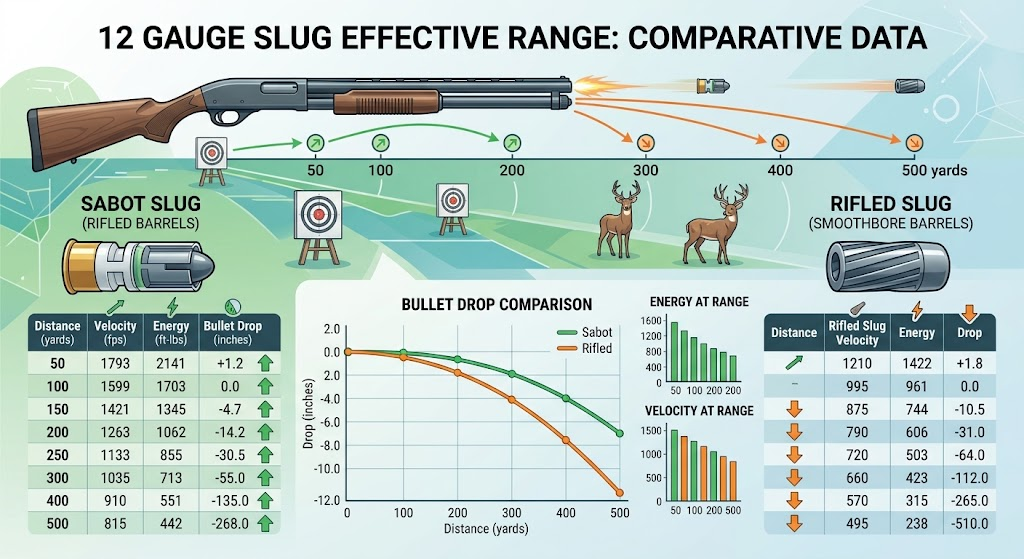
Understanding the Ballistics Chart
The detailed data provided in the 12 Gauge Slug Range Chart is sourced directly from rigorous real-world ballistic modeling of two industry-standard factory loads fired from standard hunting shotguns under normal atmospheric conditions (sea level, 59 degrees Fahrenheit). Because 12-gauge projectiles are massive and possess notoriously poor aerodynamic profiles compared to modern rifle cartridges, changes in barometric pressure, altitude, and ambient temperature will heavily alter these figures, but they serve as a highly accurate foundational baseline.
For the Sabot Slug column, the data reflects the immensely popular Hornady SST 12 Gauge 300-grain Sabot Slug. Fired from a fully rifled barrel, this load has a factory-rated muzzle velocity of 2,000 feet per second (fps) and an estimated G1 Ballistic Coefficient (BC) of .200. The shotgun is zeroed at exactly 100 yards. This specific load utilizes a polymer-tipped, sub-caliber projectile encased in a plastic discarding sabot, allowing it to engage the barrel’s rifling for extreme gyroscopic stability and rapid expansion upon impact.
For the Rifled Slug column, the data represents the highly ubiquitous Federal Premium TruBall 1-ounce (437.5-grain) Rifled Slug. Fired from a smoothbore barrel, this heavy, full-bore load leaves the muzzle at roughly 1,600 fps. It features a terrible G1 BC of approximately .065. The shotgun is also zeroed at 100 yards for direct comparison, which highlights the deeply parabolic, mortar-like arc (+1.8 inches at 50 yards, plunging to -10.5 inches at 150 yards) required to meet the 100-yard crosshair compared to its faster, more aerodynamic sabot counterpart.
What Is The Effective Range Of A 12 Gauge Slug?
Determining the true effective range of a 12 gauge slug requires deeply defining what “effective” means for your specific shooting application, target size, and barrel technology. The 12-gauge slug is one of the oldest and most devastating short-range ballistic tools in human history, originally designed to turn smoothbore bird guns into highly lethal large-game stoppers. However, because a 12-gauge bore is a massive .729 inches in diameter, pushing a projectile of that size through the atmosphere creates immense aerodynamic drag.
Effective range in a civilian hunting context is rigidly defined as the absolute maximum distance at which the massive 300-grain to 1-ounce (437.5-grain) projectile retains enough kinetic energy and forward velocity to reliably penetrate dense muscle tissue, shatter heavy bone structures, and humanely harvest an animal without causing undue suffering. Most wildlife agencies and seasoned hunters demand a strict minimum of 1,000 foot-pounds of kinetic energy for an ethical harvest on medium game like whitetail deer, and upwards of 1,500 foot-pounds for massive, thick-skinned game like elk or brown bear.
For tactical, defensive, and law enforcement applications, effective range is defined as the maximum distance at which the shooter can reliably hit a man-sized target and instantly incapacitate a threat. In this context, the massive physical momentum of a 1-ounce slug (the “Taylor KO Factor”) often heavily outweighs pure kinetic energy, as the sheer diameter of the .73-caliber hole creates catastrophic, instantly debilitating wound channels.
For modern hunting applications utilizing rifled barrels and premium sabot slugs, the practical effective range of the 12 gauge is firmly planted between 150 and 200 yards. At 150 yards, a 300-grain sabot slug retains over 1,300 foot-pounds of energy and drops a very manageable 4.5 inches.
Conversely, for traditional smoothbore shotguns firing rifled slugs (often called Foster slugs or pumpkins), the effective range is strictly limited to 50 to 100 yards. The un-aerodynamic, flat-nosed lead slug acts like an open parachute in the wind. By 100 yards, it has already lost over 60% of its initial kinetic energy and is dropping rapidly, making ethical shots past the length of a football field highly unpredictable and largely unethical on live game.
12 Gauge Sabot Slug Range
The invention of the sabot slug and the fully rifled shotgun barrel fundamentally revolutionized the 12-gauge platform, effectively turning standard shotguns into large-bore, mid-range rifles. A standard high-velocity sabot load, such as the Remington Premier AccuTip or Hornady SST, utilizes a sub-caliber bullet (typically .50 caliber) wrapped in a two-piece plastic sleeve (the sabot). This sleeve grips the rifling inside the barrel, spinning the projectile for gyroscopic stability. Upon exiting the muzzle, the plastic sabot predictably falls away, leaving the aerodynamic bullet to travel toward the target.
Velocity: High-velocity sabot slugs typically leave the muzzle traveling between 1,850 and 2,000 fps. Because the internal projectile is a sleek, often polymer-tipped .50-caliber bullet rather than a flat-nosed .73-caliber chunk of lead, it boasts a vastly superior ballistic coefficient (usually around .200). A sabot bullet traveling at 2,000 fps will elegantly retain supersonic flight out past 300 yards.
Energy: At the muzzle, a 300-grain sabot slug produces a staggering 2,664 ft-lbs of kinetic energy, surpassing many standard centerfire rifle cartridges. By the time it traverses to the 100-yard line, it retains a massive 1,703 ft-lbs. By 200 yards, it retains approximately 1,062 ft-lbs. This ensures that sabot slugs deliver absolutely devastating terminal performance and reliable expansion on large game out to the strict 200-yard operational ceiling.
Trajectory and Bullet Drop: With a standard 100-yard zero, a modern 300-grain sabot slug exhibits a surprisingly flat trajectory inside of the 150-yard hunting envelope. It will rise 1.2 inches at 50 yards, be dead-on at 100 yards, drop a highly predictable 4.7 inches at 150 yards, and drop 14.2 inches at 200 yards. This allows hunters utilizing standard slug scopes (like the Leupold VX-Freedom or Vortex Diamondback) to simply hold on the top of the deer’s back at 200 yards and confidently strike the vital heart/lung area.
Practical Effective Range: For hunting whitetail deer in the midwestern United States, 200 yards is the absolute operational ceiling for sabot slugs. Pushing past the 200-yard mark on living targets introduces severe wind drift issues and rapid kinetic energy decay. The heavy 300-grain projectile is highly susceptible to wind deflection; a mild 10 mph crosswind will blow a sabot slug roughly 12 inches off target at 200 yards, requiring masterful wind-reading skills.
12 Gauge Rifled Slug (Foster) Range
Traditional rifled slugs, most commonly known as Foster slugs, are designed explicitly for use in smoothbore shotguns. Invented by Karl Foster in 1931, these massive lead projectiles feature a deeply hollowed-out base. This places the vast majority of the physical weight at the nose of the slug. Much like a badminton shuttlecock, this weight-forward design forces the slug to fly point-forward through the air without needing gyroscopic spin.
Note: The angled grooves (rifling) cast into the sides of a Foster slug do not actually impart significant spin in flight; they are simply designed to easily compress and swage down as the massive lead slug passes through the constrictions of a shotgun choke.
Velocity: A standard 1-ounce (437.5-grain) Foster slug leaves the muzzle at roughly 1,560 to 1,600 fps. Because the .73-caliber nose is completely flat or slightly rounded, it has an abysmal ballistic coefficient (often below .070). It acts like a flying ashtray, displacing massive amounts of air and bleeding speed at an alarming rate. A 1,600 fps Foster slug drops to a sluggish 995 fps by the time it reaches the 100-yard mark.
Energy: At the muzzle, a massive 1-ounce rifled slug generates a bone-crushing 2,486 ft-lbs of energy. However, due to the extreme velocity loss, atmospheric friction ruthlessly reduces that energy to just 961 ft-lbs at 100 yards. While the massive diameter of the slug guarantees a catastrophic wound channel even at low speeds, the lack of retained kinetic energy severely limits its ability to penetrate dense bone on large game past this distance.
Trajectory and Bullet Drop: The trajectory of a traditional Foster slug is a steep, unforgiving parabola. If zeroed at 100 yards, a 1-ounce rifled slug will rise nearly 2 inches at 50 yards, drop 10.5 inches at 150 yards, and plummet a massive 31 inches by 200 yards.
Practical Effective Range: For traditional deer hunting, bear defense, and law enforcement tactical applications, 100 yards is the absolute maximum effective range for Foster slugs fired from a smoothbore barrel. Most professional hunters heavily recommend limiting shots to 50 or 75 yards to guarantee absolute precision. The massive aerodynamic drag and complete lack of gyroscopic spin make Foster slugs wildly inaccurate and ballistically useless much past the 100-yard line.
12 Gauge Slug Velocity And Energy At Distance
Understanding how the massive 12-gauge slug performs dynamically over vast distances requires analyzing its sheer physical mass versus its terrible aerodynamics. Slugs rely almost entirely on physical momentum and massive frontal cross-sectional area rather than hydrostatic shock to achieve lethality. Let’s closely look at the Brenneke Black Magic Magnum 1 3/8 oz (602-grain), arguably the most devastating smoothbore slug on the planet, explicitly designed for stopping charging grizzly bears.
• Muzzle: 1,502 fps | 3,014 ft-lbs
• 50 Yards: 1,180 fps | 1,862 ft-lbs
• 100 Yards: 985 fps | 1,297 ft-lbs
• 150 Yards: 860 fps | 988 ft-lbs
Despite starting out with a staggering, elephant-gun-level 3,014 foot-pounds of energy at the muzzle, the colossal 602-grain lead slug rapidly loses over 1,700 foot-pounds of energy in just the very first 100 yards of flight. This highlights precisely why standard, full-bore shotgun slugs are spectacular for explosive, devastating impacts on massive predators at 25 yards, but utterly terrible for long-range energy retention.
Now, let’s heavily contrast this with a premium rifled-barrel load: the Federal Premium Trophy Copper Sabot Slug (300-grain).
• Muzzle: 1,900 fps | 2,404 ft-lbs
• 50 Yards: 1,700 fps | 1,925 ft-lbs
• 100 Yards: 1,520 fps | 1,539 ft-lbs
• 150 Yards: 1,350 fps | 1,214 ft-lbs
• 200 Yards: 1,200 fps | 959 ft-lbs
Notice how the vastly superior aerodynamic profile of the .50-caliber copper projectile actively prevents rapid velocity loss. While it starts with 600 fewer foot-pounds of energy at the muzzle than the monstrous Brenneke slug, by 150 yards, the sleek Sabot slug is actually carrying 226 more foot-pounds of kinetic energy. This proves mathematically and empirically that sub-caliber sabot slugs fired from rifled barrels provide vastly superior downrange performance, stability, and lethal energy retention past 100 yards.
12 Gauge Slug Drop At Distance
Bullet drop is the ultimate mathematical hurdle for 12-gauge shooters attempting to stretch the platform’s legs beyond the traditional 50-yard brush-hunting range. Let’s rigidly establish a strict 100-yard zero for a premium sabot load and compare the drop at specific, granular intervals out to 300 yards.
Hornady SST 300gr Sabot Slug (100-yard zero):
• 50 yards: +1.2″
• 100 yards: 0.0″
• 125 yards: -1.8″
• 150 yards: -4.7″
• 175 yards: -8.8″
• 200 yards: -14.2″
• 250 yards: -30.5″
• 300 yards: -55.0″
At 150 yards, a premium sabot slug has dropped under 5 inches, which easily remains within the vital zone of a whitetail deer without requiring a complex holdover. By 200 yards, it has dropped 14 inches. By 300 yards, it has dropped nearly 5 feet (55 inches).
To physically overcome this extreme gravitational pull, shooters engaging targets at 200 yards must utilize dedicated shotgun scopes featuring BDC (Bullet Drop Compensator) reticles. A standard shotgun bead sight completely obscures the target at 150 yards, making precise elevation holds literally impossible. The steep parabolic trajectory means range estimation is overwhelmingly critical; misjudging a 200-yard target by merely 25 yards (thinking it is 175 yards) will result in a 6-inch deviation, completely missing the heart/lung vital zone.
12 Gauge Slug Range By Barrel Length
The internal ballistics and powder combustion physics of shotgun ammunition dictate how barrel length interacts with velocity. Shotgun shells, including massive slug loads, typically utilize very fast-burning powders originally designed to push heavy payloads of shot. Consequently, the vast majority of the powder charge is completely combusted within the first 18 to 20 inches of barrel length.
Here is a detailed breakdown of average muzzle velocities using a high-quality 1-ounce Rifled Slug load across various real-world barrel lengths:
• 14-inch Tactical/Breaching barrel: ~1,450 fps
• 18.5-inch Riot/Defense barrel: ~1,580 fps
• 20-inch Deer barrel: ~1,600 fps
• 24-inch Rifled barrel: ~1,615 fps
• 28-inch Field/Waterfowl barrel: ~1,610 fps
As the ballistic data emphatically shows, maximum velocity is achieved right around the 20 to 24-inch mark.
How this affects range:
With a standard 20-inch or 24-inch dedicated deer barrel, your slug maintains its maximum lethal velocity and trajectory, securing its absolute maximum effective hunting range.
Interestingly, utilizing a long 28-inch bird-hunting barrel actually begins to slowly reduce the slug’s velocity due to the physical friction of the payload traveling down the extended steel tube after the internal gas pressure has already peaked.
With a 14-inch tactical barrel (such as those found on the Mossberg 590 Shockwave or strictly regulated NFA short-barreled shotguns), you are starting roughly 150 fps slower right out of the muzzle. This severely limits the practical tactical range to roughly 50 yards and vastly increases muzzle flash, as unburnt powder aggressively ignites outside the muzzle.
How Far Is A 12 Gauge Slug Accurate?
Accuracy is the mechanical capability of the shotgun, barrel harmonics, optic mounting system, and ammunition combination to place projectiles predictably and repeatedly into a tight cluster. Range is how far the massive slug can reliably travel while maintaining lethal energy or a mathematically manageable trajectory.
A standard smoothbore shotgun firing Foster rifled slugs is notoriously inconsistent. Due to the lack of gyroscopic stabilization and the fact that the slug bounces slightly as it travels down the smooth steel bore, smoothbore accuracy is generally accepted to be roughly 3 to 5 MOA (Minute of Angle). This means the shotgun will shoot roughly 3-inch to 5-inch groups at 100 yards, limiting practical precision to distances inside the length of a football field.
However, a modern bolt-action or heavily reinforced pump-action shotgun featuring a fully rifled, heavy-contour barrel (such as the Savage 212 or Ithaca Deerslayer) paired with premium sabot ammunition completely changes the equation. These dedicated slug guns easily achieve 1 MOA to 1.5 MOA accuracy. This means the shotgun will reliably shoot 1-inch to 1.5-inch groups at 100 yards with stunning consistency.
Because of this supreme inherent mechanical accuracy, rifled shotguns firing sabot slugs are completely accurate enough to consistently strike an 8-inch vital zone at 200 yards. The strict limitation on accuracy at distance is entirely environmental and recoil-induced. The massive recoil (often exceeding 25 to 30 foot-pounds of felt recoil) heavily induces shooter flinch, while the un-aerodynamic projectile remains highly susceptible to wind deflection.
12 Gauge Slug Range For Hunting
The 12-gauge slug is universally recognized globally as one of the most devastating, high-momentum hunting projectiles in history. It is the premier choice for hunters in heavily populated states (like Ohio, Illinois, and New Jersey) that legally restrict the use of high-velocity centerfire rifles during deer season due to concerns over bullets traveling thousands of yards.
Whitetail Deer and Black Bear
For midwestern whitetail deer and thick-woods black bear, the 12-gauge sabot slug is ballistically perfect. Using quality polymer-tipped sabot loads out of a rifled barrel, the practical effective range is firmly set at 150 to 200 yards. Beyond 200 yards, kinetic energy drops dangerously near the 1,000 ft-lb mark, and the steep trajectory requires complex holdovers. Shot placement is critical; behind-the-shoulder lung shots ensure instantaneous lethality with massive blood trails.
Brown Bear and Grizzly Defense
When defending against the largest, most aggressive terrestrial predators on earth, traditional Foster slugs or specialized solid slugs (like the Brenneke Black Magic) fired from short, 18-inch smoothbore barrels are universally preferred by Alaskan guides. In a defensive scenario against a charging grizzly, the effective range is strictly limited to 0 to 25 yards. At this extremely close range, the massive 1 3/8-ounce solid lead slug penetrates deep into the skull or shoulder structure, delivering unparalleled, bone-crushing momentum to physically stop the threat instantly.
Feral Hogs
Feral hogs are incredibly tough, thick-skinned animals with a dense cartilage shield over their shoulders. The 12-gauge slug is highly devastating on hogs, pushing a wide, heavy projectile that creates massive, non-collapsible wound channels. The effective range for ethical hog hunting in dense brush is strictly 50 to 100 yards using standard Foster slugs, ensuring complete pass-through penetration on heavily armored boars.
12 Gauge Slug Range With A Suppressor
Shooting a 12-gauge slug suppressed is a specialized, highly modern application made possible by massive, dedicated shotgun suppressors like the SilencerCo Salvo 12. Suppressing a 12-gauge shotgun requires containing immense volumes of rapidly expanding high-pressure gas.
Adding a 12-inch suppressor to a shotgun completely alters the balance and swing of the weapon, making it unwieldy in dense brush. When firing standard supersonic slug ammunition through a modern shotgun suppressor, the silencer’s internal baffles heavily tame the concussive muzzle blast and recoil, reducing the felt recoil by roughly 20% to 30%. However, the bullet still aggressively produces a loud supersonic crack as it breaks the sound barrier, meaning it is absolutely not “movie quiet.” The overall decibel level is reduced to roughly 132 to 137 dB, hovering right at the hearing-safe threshold for a single shot.
Firing supersonic ammo suppressed does not fundamentally alter the terminal range; the sabot slug remains lethally locked at a 200-yard maximum. Because heavy, subsonic 1-ounce slugs are extremely rare on the commercial market (and feature trajectories that drop like massive stones), the suppressor serves primarily to reduce recoil, eliminate concussive blast, and save the shooter’s hearing, rather than altering the effective range envelope.
12 Gauge Slug vs 20 Gauge Slug Range
How does the massive 12-gauge slug stack up against the highly modernized, increasingly popular 20-gauge slug in terms of range and capability? For decades, the 12-gauge was universally considered superior, but modern sabot technology has largely leveled the playing field, making the 20-gauge the preferred choice for many dedicated deer hunters.
| Category | 12 Gauge Sabot Slug | 20 Gauge Sabot Slug | Winner |
| Trajectory (Sub 150 yds) | Flat, drops ~5 inches | Flat, drops ~4.5 inches | 20 Gauge |
| Felt Recoil Energy | ~25-30 ft-lbs (Brutal) | ~15-18 ft-lbs (Manageable) | 20 Gauge |
| Muzzle Velocity | ~1,900 fps | ~1,900 fps | Tie |
| Energy at 100 yards | ~1,700 ft-lbs | ~1,400 ft-lbs | 12 Gauge |
| Sectional Density (Penetration) | Moderate (.50 cal bullet) | High (.45 cal bullet) | 20 Gauge |
| Meat Preservation | Highly destructive | Excellent, clean channels | 20 Gauge |
| Stopping Power (Close Range) | Unparalleled | Excellent | 12 Gauge |
| Maximum Effective Range | 200 yards | 200 yards | Tie |
Ultimately, the choice strictly comes down to shooter comfort and intended target size. The 12-gauge hits with vastly more kinetic energy and massive physical momentum, making it the undeniable superior choice for stopping dangerous game like brown bears at 25 yards. However, for hunting whitetail deer at 150 yards, the 20-gauge sabot slug utilizes a more aerodynamic, higher sectional-density .45-caliber projectile that shoots slightly flatter, penetrates deeper on broadside shots, and generates almost half the punishing recoil, completely dominating the 12-gauge in shooter comfort and practical accuracy.
Is A 12 Gauge Slug Good For Long Range?
In a hunting, defensive, or kinetic energy context, absolutely not. The 12-gauge slug is strictly a close-to-medium range ballistic tool explicitly designed to completely dump massive amounts of kinetic energy and momentum within the first 150 yards of flight.
Long-range shooting (defined typically in the modern era as 500 to 1,000+ yards) requires a cartridge that pushes a highly aerodynamic, high-BC bullet at incredibly high velocities to combat the relentless, constant forces of gravity and extreme wind drift. The 12-gauge slug is a colossal, blunt, aerodynamically terrible projectile. A 300-grain sabot slug fired at 2,000 fps drops almost 11 feet (135 inches) at 400 yards and is heavily tossed around by even mild lateral winds.
While lobbing slugs at 400 or 500-yard targets in a wide-open field is a highly entertaining ballistic exercise, the projectile retains virtually zero reliable aerodynamic stability and practically zero ethical kinetic energy at those extreme distances. It is absolutely not an effective long-range cartridge for hunting, defense, or competitive precision shooting under any circumstances.
Pros and Cons
12 Gauge Slug Pros
• Unmatched, devastating short-range stopping power, cementing it as the absolute ultimate choice for dangerous game defense (bears, moose) inside 50 yards.
• Perfectly compliant with localized hunting laws in heavily populated states (like Illinois and Ohio) that strictly ban high-velocity centerfire rifle hunting.
• Massive physical momentum (Taylor KO Factor) ensures catastrophic wound channels and massive blood trails, even if the slug completely fails to expand.
• Incredible weapon versatility; a single shotgun can fire birdshot, buckshot, and slugs simply by swapping the ammunition in the magazine tube.
• Vast ammunition availability; 12-gauge slugs are easily found in every hardware store, gun shop, and sporting goods retailer globally.
12 Gauge Slug Cons
• Absolutely punishing felt recoil (often exceeding 30 foot-pounds), heavily inducing flinch, shoulder bruising, and poor marksmanship in inexperienced shooters.
• Terrible aerodynamic bullet designs lead to rapid, catastrophic energy decay, strictly capping the effective hunting range at a maximum of 200 yards for premium sabots.
• Traditional smoothbore Foster slugs suffer from abysmal mechanical accuracy, limiting their ethical use strictly to inside 100 yards.
• Premium sabot slug ammunition is incredibly expensive, often costing $3 to $5 per single trigger pull, making repetitive range practice financially prohibitive.
12 Gauge Slug Effective Range: Final Verdict
When meticulously consolidating all empirical ballistic data, velocity decay charts, and terminal kinetic energy thresholds, the 12 gauge slug effective range is highly defined by the cartridge’s unique physical limitations and the specific barrel technology utilized by the shooter.
For sabot slugs fired from a fully rifled barrel, the absolute maximum practical effective range is heavily cemented at 150 to 200 yards. Inside of this precise envelope, a high-velocity 300-grain polymer-tipped projectile successfully retains enough kinetic energy (roughly 1,000 ft-lbs) to violently expand and instantly dispatch medium-to-large game ethically. Pushing past this 200-yard distance introduces the immense risk of extreme wind drift causing poor shot placement, and a massive parabolic bullet drop that is virtually impossible to accurately compensate for without specialized optics.
For traditional Foster rifled slugs fired from a smoothbore barrel, the effective range must be restricted strictly to 50 to 100 yards. The un-aerodynamic, flat-nosed lead slug acts like a parachute, shedding over half of its kinetic energy before it reaches the length of a football field. Past 100 yards, the absolute lack of gyroscopic stabilization makes the slug’s flight path completely unpredictable and biologically unethical for hunting.
Ultimately, the 12-gauge slug remains the undisputed king of short-range ballistic devastation. It was purpose-built to deliver overwhelming, unstoppable physical momentum and massive kinetic trauma at close quarters, an absolute apex role it continues to perfect in the deep woods and defensive scenarios globally today.
FAQs
What is the effective range of a 12 gauge slug?
The effective range of a 12 gauge slug depends strictly on the ammunition and barrel type; it is 150 to 200 yards for sabot slugs fired from a rifled barrel, and strictly 50 to 100 yards for traditional Foster slugs fired from a smoothbore barrel.
How far can a 12 gauge slug shoot accurately?
Mechanically, a dedicated bolt-action shotgun featuring a fully rifled barrel paired with premium sabot ammunition can accurately hit an 8-inch target at 200 yards. However, smoothbore shotguns firing traditional rifled slugs lose practical accuracy past 75 to 100 yards.
How much does a 12 gauge slug drop at 100 yards?
When zeroed at exactly 50 yards, a standard 1-ounce Foster slug drops approximately 2 to 3 inches at 100 yards. A faster, more aerodynamic sabot slug zeroed at 50 yards will only drop roughly 1 inch at 100 yards.
How far is a 12 gauge slug lethal?
While completely unsuitable and highly unrecommended for hunting past 200 yards, a massive 12-gauge slug fired at an optimal 30-degree upward angle can travel over a mile and retains enough physical mass to be potentially lethal at several hundred yards upon descent. Always practice absolute firearm safety.
Can a 12 gauge slug kill an elephant?
Historically, solid hardened lead or brass shotgun slugs were used extensively in Africa as backup weapons for dangerous game. While a perfectly placed heavy solid slug can penetrate an elephant’s skull at point-blank range, it is not recommended, as specialized magnum centerfire rifles (.416 Rigby, .458 Lott) are strictly mandated for ethical thick-skinned dangerous game hunting today.
What is the maximum range of a 12 gauge slug?
The absolute maximum ballistic range (the total physical distance the 1-ounce slug can physically travel before hitting the earth when fired at an optimal upward arc) is approximately 1,200 to 1,500 yards. However, its targeted effective range is strictly under 200 yards.
Is a rifled barrel or smoothbore better for 12 gauge slugs?
A fully rifled barrel is vastly superior if you require maximum range (up to 200 yards) and precision accuracy using modern sabot slugs. A smoothbore barrel is vastly better for versatility, allowing the shooter to fire cheap Foster slugs, birdshot, and buckshot from the exact same weapon inside 100 yards.
Will a 12 gauge slug stop a grizzly bear?
Yes. A 12-gauge shotgun loaded with heavy, deep-penetrating solid slugs (such as the Brenneke Black Magic 1 3/8 oz) is widely considered by Alaskan guides and wildlife defense experts as the premier, most devastating close-range (sub-25 yards) stopping weapon available against charging grizzly and brown bears.
What is the zero distance for a 12 gauge slug?
The universally accepted industry standard zero distance for a smoothbore shotgun firing Foster slugs is 50 yards. The accepted standard zero distance for a dedicated rifled shotgun firing premium high-velocity sabot slugs is 100 yards.
Can you shoot 300 yards with a 12 gauge slug?
While you can physically lob a slug 300 yards, it is completely unethical for hunting. A sabot slug drops nearly 55 inches (almost 5 feet) at 300 yards and sheds the vast majority of its kinetic energy, making it wildly unpredictable and incapable of reliable expansion.
Does a longer barrel increase 12 gauge slug range?
No. Shotgun powder burns incredibly fast, almost completely combusting within the first 18 to 20 inches of the barrel. Barrels longer than 24 inches actually begin to slowly reduce the slug’s muzzle velocity due to the physical friction of the steel bore.
How does wind affect a 12 gauge slug at 150 yards?
Wind heavily affects the massive, blunt, low-BC 12-gauge slug. A 10 mph full-value crosswind will physically blow a standard 300-grain sabot slug roughly 6 to 7 inches off target at 150 yards, requiring the shooter to actively hold into the wind to strike the vitals.
What is the best 12 gauge slug for deer hunting?
For deer hunting inside 200 yards with a rifled barrel, premium polymer-tipped sabot slugs like the Hornady SST, Remington AccuTip, or Federal Trophy Copper are the absolute best choices. For smoothbore shotguns inside 75 yards, the Federal TruBall or Winchester Super-X Rifled Slug provide exceptional accuracy and devastating terminal performance.