When comparing 22 ARC vs 22 LR, the main difference is that the .22 ARC (Advanced Rifle Cartridge) is a high-velocity centerfire rifle round built for long-range target shooting and predator hunting, while the .22 LR (Long Rifle) is a low-velocity rimfire round designed for short-range plinking and small game. The .22 ARC fires heavy, aerodynamic bullets at over 3,000 feet per second (fps) from AR-15s and centerfire bolt-action rifles, whereas the .22 LR fires lightweight lead bullets at roughly one-third the speed and less than one-tenth the energy from rimfire firearms. Because they use completely different ignition systems and chamber specifications, they are not interchangeable.
22 ARC vs 22 LR: Main Differences
| Specification | 22 ARC | 22 LR |
| Cartridge Name | .22 Advanced Rifle Cartridge (.22 ARC) | .22 Long Rifle (.22 LR) |
| Bullet Diameter | 0.224 inches (SAAMI manufacturer spec) | 0.223 to 0.2255 inches (SAAMI heeled/standard spec) |
| Bullet Weight | 62 to 88 grains (Hornady factory loads) | 29 to 60 grains (36 to 40 grains standard) |
| Bullet Type | Polymer-tipped boat-tail (ELD-VT, ELD Match, ELD-X), monolithic copper (CX) | Lead Round Nose (LRN), Copper-Plated Hollow Point (CPHP), Copper-Plated Round Nose (CPRN) |
| Case Length | 1.525 inches (SAAMI spec) | 0.613 inches (SAAMI maximum spec) |
| Overall Length | 2.260 inches (SAAMI maximum spec) | 1.000 inch (SAAMI maximum spec) |
| Case Type | Rimless, tapered bottleneck brass | Rimmed, straight-wall brass |
| Rim Type | Rimless (0.441-inch recessed extractor groove) | Rimmed (0.278-inch maximum rim diameter) |
| Primer Type | Centerfire, Small Rifle Primer (SRP) | Rimfire (priming compound spun inside the case rim) |
| Typical Muzzle Velocity | 2,820 to 3,300 fps (Hornady factory spec, 24-inch test barrel) | 1,050 to 1,280 fps (standard/high-velocity loads, 16- to 20-inch barrel); up to 1,640 fps (hyper-velocity) |
| Typical Muzzle Energy | 1,475 to 1,590 ft-lb (Hornady factory spec, 62 gr to 88 gr loads) | 95 to 145 ft-lb (36 gr to 40 gr loads); up to 204 ft-lb (hyper-velocity) |
| Effective Range | 400 to 600 yards for varmints/medium game; 800 to 1,000+ yards for targets (general estimate) | 50 to 75 yards for small game; 100 to 150 yards for target shooting (general estimate) |
| Trajectory | Very flat; retains supersonic velocity past 1,000 yards with heavy match bullets | Steep, rainbow-like arc; transitions to subsonic speeds at or before 100 yards |
| Bullet Drop | -2.4 inches at 200 yards; -9.9 inches at 300 yards (Hornady 62 gr ELD-VT at 3,300 fps, 100-yard zero) | -6.5 inches at 100 yards; -48.0 inches at 200 yards (CCI 40 gr Mini-Mag at 1,235 fps, 50-yard zero) |
| Recoil | Very light centerfire recoil (approx. 3.5 to 4.5 ft-lb of free recoil energy, general estimate) | Virtually nonexistent (approx. 0.2 ft-lb of free recoil energy, general estimate) |
| Accuracy | Sub-MOA capable from factory match rifles out to several hundred yards | 0.5 to 1.5 MOA at 50 yards with match ammo; wind drift rapidly degrades groups past 100 yards |
| Firearm Compatibility | Dedicated .22 ARC centerfire chambers only (AR-15 requires 6.5 Grendel/6mm ARC bolt face) | Dedicated .22 LR rimfire chambers (and select .22 Short/Long/Long Rifle tubular actions) |
| Common Firearm Types | AR-15 semi-automatic rifles, centerfire bolt-action rifles | Rimfire bolt-action, semi-automatic, lever-action rifles, revolvers, and semi-automatic pistols |
| Hunting Applications | Prairie dogs, groundhogs, coyotes, bobcats, foxes, and deer/antelope (where .22 centerfire is legal) | Squirrels, rabbits, chipmunks, rats, and close-range varmints/pests |
| Target Shooting | Long-range steel shooting, PRS gas-gun competition, mid-range precision benchrest | Casual backyard/range plinking, NRL22, rimfire benchrest, Olympic 50-meter rifle/pistol |
| Ammunition Availability | Moderate; produced primarily by Hornady and boutique loaders, stocked at specialty retailers | Universal; widely produced by all major manufacturers and stocked at nearly every sporting goods store |
| Ammunition Cost | $1.35 to $1.80+ per round ($27 to $36 per 20-round box, retail estimate) | $0.06 to $0.12 per round for bulk/standard; $0.25 to $0.50+ for match grade (retail estimate) |
| Main Advantages | Exceptional ballistic coefficient, flat trajectory, low wind drift, fits standard AR-15 receivers | Extremely inexpensive, minimal noise and recoil, vast firearm selection, zero barrel wear |
| Main Disadvantages | High cost per round, limited factory load variety, overkill for small edible game | Severe wind sensitivity, rapid bullet drop past 75 yards, rimfire ignition less reliable than centerfire |
Winner Statement: The .22 ARC leads in overall velocity, muzzle energy, and long-range performance, while the .22 LR wins in affordability and low-recoil versatility. Neither cartridge replaces the other, so the best choice depends entirely on your intended shooting distance and target type.
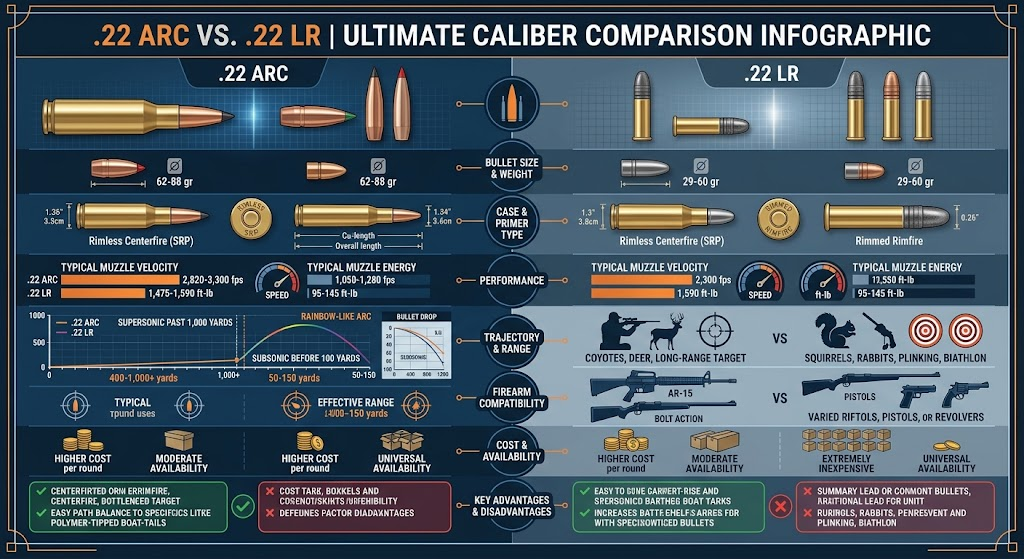
22 ARC vs 22 LR: Key Differences Explained
1. Bullet Diameter and Cartridge Dimensions
The .22 ARC is a centerfire bottleneck cartridge derived from the 6.5 Grendel case to fire 0.224-inch jacketed bullets. It has a 1.525-inch case length, a 0.441-inch rim, and a 2.260-inch overall length. The .22 LR is a tiny, straight-walled rimfire cartridge with a 0.613-inch case length, a 1.000-inch overall length, and a 0.223 to 0.2255-inch heeled lead bullet.
2. Bullet Weight and Bullet Types
Standard .22 LR loads use 36- to 40-grain solid lead or copper-plated bullets, with specialty loads ranging from 29 to 60 grains. The .22 ARC uses fast 1:7-inch twist barrels to stabilize heavy, aerodynamic 62- to 88-grain boat-tail bullets, including Hornady ELD-VT, ELD Match, ELD-X, and 70-grain monolithic copper CX projectiles.
3. Muzzle Velocity Comparison
In a 22 ARC vs 22 LR speed comparison, the .22 ARC is roughly three times faster. From a 24-inch barrel, Hornady .22 ARC loads reach 3,300 fps with 62-grain bullets and 2,820 fps with 88-grain bullets. Standard and high-velocity 40-grain .22 LR loads travel between 1,070 and 1,260 fps, while hyper-velocity 32-grain loads top out at 1,640 fps.
4. Muzzle Energy Comparison
The .22 ARC generates 1,475 to 1,590 ft-lb of muzzle energy across its factory lineup, retaining around 1,000 ft-lb at 300 yards. A 40-grain .22 LR produces only 102 to 135 ft-lb at the muzzle and drops to about 76 ft-lb at 100 yards, giving the .22 ARC 11 to 15 times more starting power.
5. Trajectory and Bullet Drop
Because of their massive speed difference, these rounds use different sight-in distances. Sighted in at 50 yards, a 40-grain CCI Mini-Mag .22 LR (1,235 fps) drops -6.5 inches at 100 yards and -48.0 inches at 200 yards. Sighted in at 100 yards, a 62-grain Hornady ELD-VT .22 ARC (3,300 fps) drops just -2.4 inches at 200 yards, -9.9 inches at 300 yards, and -47.2 inches at 500 yards.
6. Effective Range
The .22 LR is effective to 50 to 75 yards for small-game hunting and 100 to 150 yards for target shooting before wind drift and bullet drop become severe. The .22 ARC is effective from 400 to 600 yards on varmints, up to 300 yards on medium game where legal, and past 1,000 yards on steel targets.
7. Recoil Comparison
A .22 LR rifle generates about 0.2 ft-lb of free recoil energy, which feels almost imperceptible. The .22 ARC produces roughly 3.5 to 4.5 ft-lb of recoil, which is noticeably more than a rimfire but still very light and comparable to a standard .223 Remington.
8. Accuracy Comparison
With subsonic match ammo, a quality .22 LR rifle can shoot 0.5-inch groups at 50 yards, though wind rapidly opens groups past 100 yards. The .22 ARC shoots 0.5 to 1.0 MOA at 100 yards and maintains tight precision across hundreds of yards because its heavy boat-tail bullets resist crosswinds and stay supersonic past 1,000 yards.
9. Hunting and Practical Applications
The .22 LR is built for short-range small edible game like squirrels and rabbits, harvesting them cleanly without ruining meat. The high-velocity .22 ARC will destroy small game meat, making it suited for open-country varmints like prairie dogs and coyotes, plus deer and antelope where .22 centerfires are legal.
10. Rifle Compatibility
These cartridges are not interchangeable due to different chamber sizes and firing pins (centerfire vs. rimfire). The .22 LR works in dedicated rimfire rifles and handguns. The .22 ARC works only in centerfire bolt-action rifles and AR-15s equipped with a .22 ARC barrel and a 6.5 Grendel / 6mm ARC bolt and magazine.
11. Ammunition Cost and Availability
Every major ammo maker produces .22 LR, with bulk packs costing $0.06 to $0.12 per round and match ammo costing $0.25 to $0.50. Factory .22 ARC ammo is made mainly by Hornady and boutique loaders, costing $1.35 to $1.80+ per round, though its centerfire brass can be reloaded.
12. Advantages and Disadvantages
- 22 ARC Pros and Cons: Offers flat trajectory, high wind resistance, and AR-15 compatibility, but suffers from high ammo cost ($1.35+ per round), limited factory variety, and excessive damage on small game.
- 22 LR Pros and Cons: Offers ultra-low cost ($0.06+ per round), minimal noise, zero recoil, and wide firearm availability, but suffers from short range, heavy wind drift, and non-reloadable cases.
22 ARC vs 22 LR: Which Is Better for Hunting?
Neither cartridge works for every hunt, as each serves a distinct game category.
For small edible game like squirrels and rabbits inside 60 yards, the .22 LR is better. A 36- or 40-grain lead bullet provides clean penetration without destroying edible meat or creating loud muzzle blast. A .22 ARC is far too destructive for small game.
For varmints and predators like prairie dogs, groundhogs, foxes, and coyotes from 100 to 500 yards, the .22 ARC is better. At 200 yards, the .22 LR lacks the energy and flat trajectory for ethical predator hunting, whereas the .22 ARC delivers instant fragmentation and nearly 1,000 ft-lb of energy. Where local laws permit .22 centerfire cartridges for medium game, the .22 ARC with 70-grain CX or 80-grain ELD-X bullets can also take deer and antelope inside 300 yards. Neither round is suitable for large game like elk or bear.
22 ARC vs 22 LR: Which Should You Choose?
- Budget-Friendly Recreational Shooting: Choose the .22 LR. You can fire 500 rounds for the cost of one 20-round box of .22 ARC.
- Training and Plinking: Choose the .22 LR. Zero recoil and low noise help new shooters learn fundamentals without flinching.
- Small-Game Hunting: Choose the .22 LR. It cleanly takes squirrels and rabbits inside 75 yards while preserving meat.
- Varmint Hunting: Choose the .22 ARC. Its flat trajectory and high energy easily anchor coyotes and prairie dogs out to 500 yards.
- Longer-Range Shooting: Choose the .22 ARC. Heavy 75- to 88-grain match bullets stay supersonic past 1,000 yards with low wind drift.
Frequently Asked Questions
1. Is 22 ARC the same as 22 LR?
No. The .22 ARC is a 2.260-inch bottleneck centerfire rifle cartridge, while the .22 LR is a 1.000-inch straight-walled rimfire cartridge.
2. What is the main difference between 22 ARC and 22 LR?
The main difference in 22 ARC vs 22 LR is power and design. The centerfire .22 ARC fires 62- to 88-grain jacketed bullets at 2,820 to 3,300 fps for long-range shooting, while the rimfire .22 LR fires 29- to 60-grain lead bullets at 1,050 to 1,640 fps for short-range use.
3. Which is faster, 22 ARC or 22 LR?
The .22 ARC is nearly three times faster, reaching 2,820 to 3,300 fps compared to 1,050 to 1,280 fps for standard and high-velocity .22 LR loads.
4. Which has more muzzle energy?
The .22 ARC has 11 to 15 times more muzzle energy, producing 1,475 to 1,590 ft-lb at the muzzle compared to 95 to 145 ft-lb for standard .22 LR loads.
5. Which has less bullet drop?
The .22 ARC has far less bullet drop. With a 100-yard zero, a 62-grain .22 ARC drops -2.4 inches at 200 yards, whereas a 40-grain .22 LR with a 50-yard zero drops -48.0 inches at 200 yards.
6. Which cartridge has more recoil?
The .22 ARC has more recoil at 3.5 to 4.5 ft-lb of free recoil energy, compared to 0.2 ft-lb for the .22 LR, though both are very mild to shoot.
7. Is 22 ARC more powerful than 22 LR?
Yes. With over 1,500 ft-lb of energy, the .22 ARC can harvest coyotes at 400+ yards and deer where legal, while the .22 LR is limited to small game inside 75 yards.
8. Which cartridge is cheaper to shoot?
The .22 LR is about 15 to 20 times cheaper, costing $0.06 to $0.12 per round for standard ammo compared to $1.35 to $1.80+ per round for the .22 ARC.
9. Can a 22 ARC rifle shoot 22 LR ammunition?
No. They have completely different chamber dimensions, case diameters, and firing pin locations, making them incompatible.
10. Which is better for hunting?
The .22 LR is better for small edible game like squirrels and rabbits under 75 yards, while the .22 ARC is better for varmints, coyotes, and medium game from 100 to 500 yards.