The 7mm Backcountry (SAAMI abbreviated as 7mm BC) is a revolutionary centerfire rifle cartridge featuring a maximum case length of 2.417 inches (61.39 mm) and a maximum overall cartridge length of 3.340 inches (84.84 mm).Introduced by Federal Premium, this cartridge departs from traditional brass, utilizing a patented Peak Alloy steel case.Based on official SAAMI specifications, the case features a 0.472 inch rim diameter, a 0.4698 inch base diameter, a 0.4585 inch shoulder diameter, and a 0.317 inch neck diameter. These dimensions, combined with the one piece steel alloy construction, allow the cartridge to safely operate at an unprecedented 80,000 psi maximum average pressure, driving magnum velocities from short barreled rifles.
7mm Backcountry Case Dimensions
| Case Dimension | Inches | Millimeters | Specification Type | Source | Notes |
| Case Length | 2.417 | 61.39 | Maximum | SAAMI / Federal | Fits standard long action receivers. |
| Rim Diameter | 0.472 | 11.99 | Maximum | SAAMI / Federal | Fits standard .473 inch class bolt faces. |
| Rim Thickness | 0.049 | 1.24 | Maximum | SAAMI / Federal | Controls extractor engagement. |
| Base Diameter | 0.4698 | 11.93 | Maximum | SAAMI / Federal | Measured just above the extractor groove. |
| Shoulder Diameter | 0.4585 | 11.65 | Maximum | SAAMI / Federal | Body to shoulder intersection. |
| Neck Diameter | 0.317 | 8.05 | Maximum | SAAMI / Federal | Outside case neck diameter. |
| Shoulder Angle | 30° | N/A | Half Angle | SAAMI / Federal | Steep shoulder promotes efficient powder burn. |
| Overall Length | 3.340 | 84.84 | Maximum | SAAMI / Federal | Matches the .30-06 Springfield standard length. |
| Case Capacity | ~73.0 | 4.70 cm³ | Nominal (H2O) | Federal Data | Utilizes high tensile Peak Alloy steel walls. |
| Maximum Pressure | 80,000 | 551.6 MPa | Max Average | SAAMI (Piezo) | Exceeds the mechanical limits of traditional brass. |
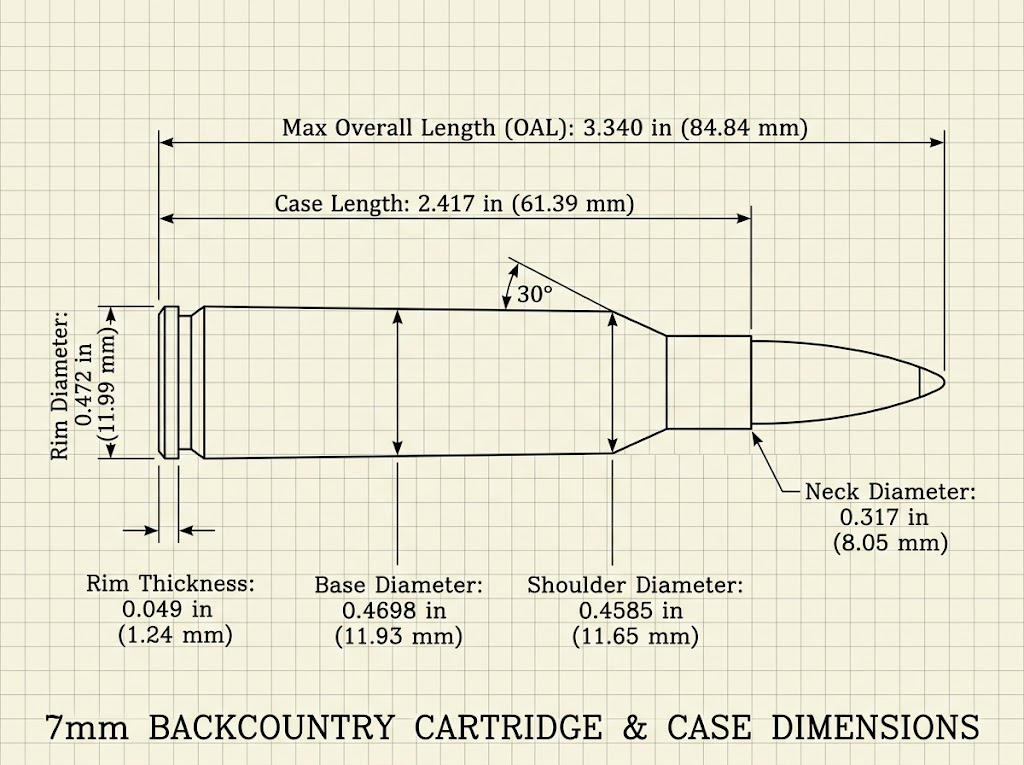
Understanding The 7mm Backcountry Case Dimensions
To understand how the 7mm Backcountry interacts with a rifle chamber, bolt, and magazine, you must analyze its discrete geometric components in the context of its unique steel construction.
- Case Length: Measured from the base of the rim to the case mouth, case length determines how far the steel alloy extends into the chamber before contacting the end of the neck clearance.
- Rim Diameter and Thickness: The rim provides the gripping surface for the rifle extractor. The 0.472 inch diameter ensures the cartridge centers on a standard long action bolt face, avoiding the need for a magnum bolt.
- Base Diameter: This is the widest part of the main cartridge body, situated just ahead of the extractor groove. It governs how the cartridge seats into the rear of the chamber and stacks within a standard magazine.
- Shoulder Diameter and Geometry: The shoulder acts as the physical stop that prevents the cartridge from pushing too far into the barrel. Its diameter and 30 degree angle dictate chamber fit, headspacing, and powder column efficiency.
- Neck Diameter: The neck holds the 0.284 inch projectile. The outside diameter must clear the chamber walls to allow the steel to expand and release the projectile safely upon firing.
- Overall Cartridge Length (OAL): The measurement from the case base to the tip of the seated bullet. At 3.340 inches, it fits perfectly inside standard long action magazines.
- Case Capacity: The internal volume of the case, generally expressed in grains of water (gr H2O). This dictates the maximum powder charge the cartridge can safely hold to generate its 80,000 psi operating pressure.
7mm Backcountry Case Dimensions In Inches And Millimeters
Official SAAMI standardization utilizes inches, but metric parameters are frequently referenced by international precision shooters.
| Dimension | Measurement (Inches) | Measurement (Millimeters) |
| Maximum Case Length | 2.417 in | 61.39 mm |
| Maximum Rim Diameter | 0.472 in | 11.99 mm |
| Maximum Base Diameter | 0.4698 in | 11.93 mm |
| Maximum Shoulder Diameter | 0.4585 in | 11.65 mm |
| Maximum Neck Diameter | 0.317 in | 8.05 mm |
| Maximum Overall Length | 3.340 in | 84.84 mm |
7mm Backcountry Case Length
The published maximum case length for the 7mm Backcountry is 2.417 inches (61.39 mm). Because the cartridge is designed around high tensile steel rather than softer brass, the case stretching characteristics differ from traditional ammunition.
While brass flows forward significantly under the extreme pressures of firing and resizing, the Peak Alloy steel case of the 7mm Backcountry demonstrates incredible dimensional stability. Handloaders utilizing Federal’s approved reloading processes will find that the steel cases require less frequent trimming, though maintaining a consistent trim length just under the 2.417 inch maximum remains critical to ensure safe chamber fit and uniform bullet release.
7mm Backcountry Base And Rim Dimensions
The 7mm Backcountry features a rimless, bottleneck design based heavily on the .30-06 Springfield parent case architecture.Its base diameter measures 0.4698 inches, while the rim diameter is slightly wider at 0.472 inches.
This 0.472 inch rim diameter is a foundational standard. It dictates that the cartridge fits a standard standard bolt face. Despite operating at a massive 80,000 psi, the cartridge does not require a magnum bolt face because the bolt thrust generated by the 0.4698 inch case head at 80,000 psi is structurally equivalent to the bolt thrust generated by a wider 0.532 inch magnum case head operating at 65,000 psi.
7mm Backcountry Shoulder And Neck Dimensions
Above the taper of the body, the case steps down to grip a 7mm (0.284 caliber) bullet.The shoulder diameter at the intersection of the case body is 0.4585 inches. From there, the Peak Alloy angles inward at a steep 30 degree half angle to meet the neck.
The neck diameter reaches a maximum allowable SAAMI specification of 0.317 inches. To safely release a 0.284 inch bullet, the chamber neck must be slightly wider than the cartridge neck. The 30 degree shoulder prevents the powder column from burning inefficiently in short 20 inch barrels, driving magnum velocities while minimizing the muzzle blast typically associated with overbore cartridges.
7mm Backcountry Case Capacity
Case capacity heavily influences internal ballistics, powder selection, and pressure generation. The nominal, industry accepted capacity for the 7mm Backcountry is approximately 73.0 grains of water, or roughly 4.70 cubic centimeters.
While 73.0 grains is a relatively standard capacity for a .30-06 derived case, the 7mm Backcountry extracts magnum performance from this volume entirely by utilizing the strength of its steel walls. Traditional brass cases yield and rupture at 80,000 psi. The proprietary steel alloy allows Federal to pack modern, temperature stable powders into this 73.0 grain volume and detonate them at pressures that push heavy 175 grain bullets to 3,000 fps from short, suppressor ready barrels.
7mm Backcountry Case Dimensions vs 7mm PRC
The 7mm Backcountry and the 7mm PRC are both modern, high performance 7mm cartridges, but they achieve their velocities using completely different geometric approaches.
| Dimension | 7mm Backcountry | 7mm PRC | Source |
| Case Length | 2.417 in | 2.280 in | SAAMI |
| Rim Diameter | 0.472 in | 0.532 in | SAAMI |
| Base Diameter | 0.4698 in | 0.532 in | SAAMI |
| Shoulder Diameter | 0.4585 in | 0.515 in | SAAMI |
| Neck Diameter | 0.317 in | 0.315 in | SAAMI |
| Overall Length | 3.340 in | 3.340 in | SAAMI |
| Max Pressure | 80,000 psi (Steel) | 65,000 psi (Brass) | SAAMI |
The 7mm PRC utilizes a traditional brass magnum case design. It features a fat 0.532 inch base and a shorter 2.280 inch case length to pack a large volume of powder behind long, heavy bullets. The 7mm Backcountry utilizes a standard 0.4698 inch base and a longer 2.417 inch case length. Because it uses a narrower base, it can fit more rounds in a standard hunting rifle magazine than the fat 7mm PRC. The 7mm Backcountry compensates for its smaller internal volume by operating at 80,000 psi within its steel case, whereas the brass 7mm PRC is limited to 65,000 psi.
7mm Backcountry Case Dimensions vs Similar Cartridges
The 7mm Backcountry exists in a competitive landscape of long action 7mm hunting cartridges.
| Cartridge | Case Length | Base Diameter | Shoulder Angle | Neck Diameter | Overall Length |
| 7mm Backcountry | 2.417 in | 0.4698 in | 30° | 0.317 in | 3.340 in |
| .280 Ackley Imp. | 2.525 in | 0.470 in | 40° | 0.315 in | 3.330 in |
| 7mm Rem Mag | 2.500 in | 0.512 in | 25° | 0.315 in | 3.290 in |
| .280 Remington | 2.540 in | 0.470 in | 17.5° | 0.315 in | 3.330 in |
| .30-06 Springfield | 2.494 in | 0.471 in | 17.5° | 0.340 in | 3.340 in |
7mm Backcountry vs .280 Ackley Improved Case Dimensions
The 7mm Backcountry is visually very similar to the .280 Ackley Improved, as both are ultimately descendants of the .30-06 Springfield case architecture.
They share nearly identical base diameters (0.4698 inches versus 0.470 inches) and rim diameters. However, the .280 Ackley Improved features a longer 2.525 inch case length and an ultra steep 40 degree shoulder.The 7mm Backcountry utilizes a shorter 2.417 inch case length and a 30 degree shoulder. The shorter case length of the 7mm Backcountry leaves more room inside the 3.340 inch overall magazine length to seat extremely long, high ballistic coefficient bullets without pushing the ogive into the rifling lands.
7mm Backcountry Chamber And Case Dimensions
A rifle chamber must be fractionally larger than the cartridge it accepts. The relationship between 7mm Backcountry case dimensions and chamber dimensions centers heavily on headspacing and pressure containment.
Headspace for the 7mm Backcountry is measured from the bolt face to a specific datum line on the 30 degree case shoulder.Because the cartridge operates at 80,000 psi, the steel alloy case obturates (expands) to seal the chamber just like brass, but it requires significantly more force to yield. The chamber dimensions must be cut to exact SAAMI specifications, as the high tensile steel case is less forgiving of oversized chambers than malleable brass. Proper cartridge dimensions ensure safe alignment, efficient extraction, and reliable bullet entry.
7mm Backcountry Case Forming And Resizing
Because the 7mm Backcountry relies on a proprietary Peak Alloy steel case to safely contain 80,000 psi, handloaders absolutely cannot form 7mm Backcountry cases from standard brass .30-06 or .280 Remington casings.
Firing a brass case in a 7mm Backcountry chamber with 7mm Backcountry load data would result in a catastrophic, highly dangerous failure of the brass case head. Reloading the 7mm Backcountry requires saving the factory steel cases and adhering strictly to laboratory tested processes published by Federal. When resizing the steel cases, handloaders will experience different tactile feedback and require specific case lubricants compared to sizing traditional brass.
7mm Backcountry Manufacturer Specifications vs Actual Measurements
There is a documented difference between absolute SAAMI standards and the dimensions of a physical cartridge sitting on a reloading bench.
SAAMI lists maximum material conditions. Ammunition manufacturers intentionally produce the steel cases slightly smaller than these maximums to guarantee their cartridges will chamber in any rifle, regardless of how tightly the manufacturer cut the chamber. A fired 7mm Backcountry case expands to the exact dimensions of the specific rifle chamber it was fired in. When a handloader runs this fired steel brass through a full length sizing die, the machine compresses the base, shoulder, and neck back down to factory nominal tolerances.
Common Questions
What are the 7mm Backcountry case dimensions?
The key maximum case dimensions for the 7mm Backcountry include a 2.417 inch case length, a 0.472 inch rim diameter, a 0.4698 inch base diameter, a 0.4585 inch shoulder diameter, and a 0.317 inch neck diameter.
What is the 7mm Backcountry case length?
The maximum SAAMI case length for the 7mm Backcountry is 2.417 inches (61.39 mm).
What is the 7mm Backcountry rim diameter?
The 7mm Backcountry rim diameter is 0.472 inches (11.99 mm), which fits standard long action bolt faces common to the .30-06 Springfield.
What is the 7mm Backcountry base diameter?
The base diameter of the 7mm Backcountry, measured just above the extractor groove, is 0.4698 inches (11.93 mm).
What is the 7mm Backcountry shoulder diameter?
The maximum shoulder diameter of the 7mm Backcountry is 0.4585 inches (11.65 mm).
What is the 7mm Backcountry neck diameter?
The maximum outside neck diameter of the 7mm Backcountry is 0.317 inches (8.05 mm).
What is the 7mm Backcountry case capacity?
The nominal case capacity of the 7mm Backcountry is approximately 73.0 grains of water (H2O), or 4.70 cubic centimeters.
What is the 7mm Backcountry overall length?
The maximum overall cartridge length for the 7mm Backcountry is 3.340 inches (84.84 mm) under SAAMI specifications, designed to fit standard long action magazines.
How does 7mm Backcountry compare with 7mm PRC case dimensions?
The 7mm Backcountry utilizes a standard 0.4698 inch base and a 2.417 inch case length, operating at 80,000 psi in a steel case.The 7mm PRC is a magnum cartridge utilizing a wider 0.532 inch base and a shorter 2.280 inch case length, operating at 65,000 psi in a brass case.
How does 7mm Backcountry compare with .280 Ackley Improved case dimensions?
While both trace their lineage to the .30-06 Springfield, the 7mm Backcountry features a shorter 2.417 inch case length with a 30 degree shoulder.The .280 Ackley Improved has a longer 2.525 inch case length with a steeper 40 degree shoulder.Furthermore, the Backcountry uses a high pressure steel case.
What is the 7mm Backcountry maximum pressure?
The SAAMI maximum average pressure for the 7mm Backcountry is 80,000 psi (551.6 MPa).This is achieved using a patented Peak Alloy steel case, as traditional brass cannot withstand pressures of this magnitude.