When building or buying a straight-walled rifle, the industry standard 350 Legend twist rate is 1:16. This 1:16 twist perfectly stabilizes the most common projectile weights, ranging from 145-grain target loads to 180-grain hunting rounds. Twist rate directly dictates gyroscopic stability by imparting the correct spin based on a bullet’s length and weight. Because 350 Legend bullets are relatively short and wide, they do not require the ultra-fast twist rates seen in modern bottleneck cartridges. While 1:16 handles almost all factory ammunition including 255-grain subsonics, custom builders utilizing ultra-heavy specialized bullets sometimes opt for faster 1:14 or 1:10 barrels. Always remember that different rifles, barrel lengths, and ammunition profiles can produce varying levels of downrange accuracy and stability.
Table of Contents [Click to open]
350 Legend Twist Rate Chart
| Twist Rate | Common 350 Legend Bullet Weights | Typical Bullet Type | General Suitability |
| 1:10 / 1:12 | 250 – 280 grain | Ultra-Heavy Subsonic | Custom suppressed subsonic rifles with long projectiles |
| 1:14 | 180 – 255 grain | Heavy Hunting / Subsonic | Alternative fast twist for heavy suppressed loads |
| 1:16 | 145 – 255 grain | FMJ / Hunting / Subsonic | The universal SAAMI standard for all-around factory use |
Explaining The Chart
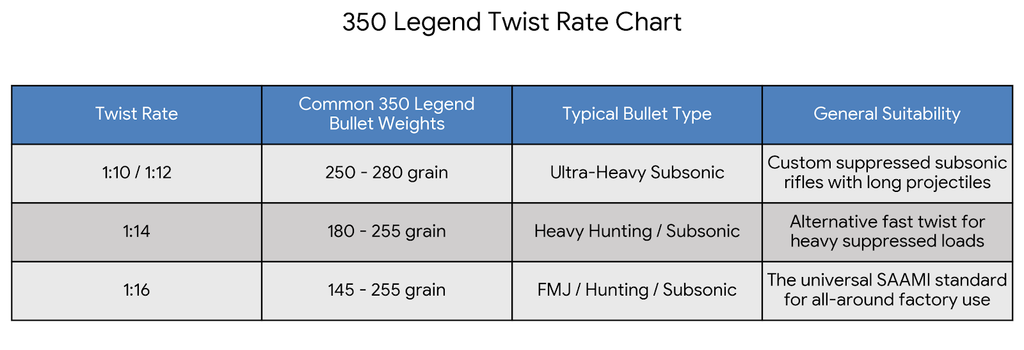
A 350 Legend twist rate chart is relatively straightforward compared to other calibers because the cartridge was designed with a single universal standard in mind. The twist rate represents the ratio of barrel inches required for the bullet to complete one full 360-degree rotation.
- What a 1:16 twist means: The bullet completes one full rotation for every 16 inches it travels down the barrel. Established by Winchester and adopted by SAAMI, this is the gold standard that stabilizes 99% of factory 350 Legend ammunition, from lightweight plinking rounds to heavy subsonics.
- What a 1:14 twist means: A slightly faster twist occasionally used by custom barrel manufacturers. It spins the bullet a bit faster, providing extra gyroscopic stability for heavy 200+ grain hunting or subsonic loads, especially in very short barrels.
- What a 1:10 or 1:12 twist means: These are specialized, fast twist rates used almost exclusively for custom subsonic builds. They are necessary only when a shooter is handloading exceptionally long, heavy projectiles (250 to 280 grains) that require rapid rotation to avoid tumbling at low velocities.
Twist rate stabilizes the projectile by creating gyroscopic stability. Because the 350 Legend is a .35-caliber (.355″ projectile diameter) straight-walled cartridge, the bullets are short and stout rather than long and sleek. As a result, the 350 Legend commonly uses slower twists than modern bottleneck centerfire rifle cartridges, which often require 1:7 or 1:8 twists to stabilize long, aerodynamic bullets. Bullet length matters as much as weight, but 350 Legend bullets naturally lack the extreme length that necessitates ultra-fast twists.
350 Legend Twist Rate By Bullet Weight
| Bullet Weight | Typical 350 Legend Load | Recommended Twist | Stability |
| 145 grain | Winchester FMJ Target | 1:16 | Excellent |
| 150 grain | Deer Season XP (Polymer Tip) | 1:16 | Excellent |
| 160 grain | Copper Monolithic (Solid) | 1:16 | Excellent |
| 170 grain | Hornady American Whitetail (SP) | 1:16 | Excellent |
| 180 grain | Winchester Power-Point | 1:16 | Excellent |
| 255 grain | Winchester Super Suppressed | 1:16 or 1:14 | Good to Excellent (1:16 works for factory profile) |
Use real factory ammunition data when assessing stability. Do not assume bullet weight alone determines the required twist rate. A 160-grain copper monolithic bullet is physically longer than a 170-grain lead-core soft point, meaning the aerodynamic forces acting on it are different, though both stabilize flawlessly in a 1:16 twist.
What Is The Best Twist Rate For 350 Legend?
For nearly every shooter and hunter, the best twist rate for 350 Legend is 1:16. Because the cartridge was engineered around this specific rifling specification, ammunition manufacturers design their bullets to fly perfectly from a 1:16 barrel. Unless you are building a custom AR-15 or bolt-action rifle exclusively for handloaded, ultra-heavy subsonic bullets, there is no practical reason to deviate from the 1:16 standard.
350 Legend 1:16 Twist Rate
The 350 Legend 1:16 twist is the undisputed standard. From Ruger American bolt-action rifles to CMMG and Faxon AR-15 barrels, 1:16 is what you will find on the shelf. This twist rate perfectly balances the rotational needs of short, flat-based 145-grain FMJs and heavier 180-grain hunting soft points. It provides ample gyroscopic stability without over-spinning the bullet, ensuring consistent accuracy for deer hunting inside 200 yards.
350 Legend 1:14 Twist Rate
While uncommon, some custom barrel makers offer a 350 Legend 1:14 twist. This faster twist is generally marketed toward shooters who plan to run heavy 180-grain to 255-grain bullets through short-barreled rifles (SBRs) or AR-pistols. Because shorter barrels yield lower velocities, a faster twist can help compensate by ensuring the bullet reaches adequate RPMs to stabilize before exiting the muzzle.
350 Legend Twist Rate For 180 Grain Bullets
The best 350 Legend twist rate for 180 grain bullets is 1:16. The 180-grain soft point is one of the most popular choices for whitetail deer hunting. Despite being on the heavier end of supersonic 350 Legend loads, these bullets are still relatively short and stabilize easily in a standard 1:16 factory barrel.
350 Legend Twist Rate For 150 Grain Bullets
The 150-grain polymer-tipped bullet (such as the Winchester Deer Season XP) is arguably the most popular hunting round for this caliber. The ideal 350 Legend twist rate for 150 grain bullets is 1:16. The 1:16 twist maximizes the accuracy and ballistic performance of this mid-weight projectile, yielding excellent groups and devastating terminal performance.
350 Legend Twist Rate For Subsonics
Shooting subsonics in the 350 Legend usually involves 250-grain to 255-grain bullets traveling under 1,050 fps. Factory subsonic loads, like the Winchester Super Suppressed 255gr, are specifically engineered with a blunt profile to stabilize in standard 1:16 barrels. However, if you are handloading long, custom subsonic projectiles, you may find that a 1:16 barrel allows the bullet to yaw. In those niche custom scenarios, a faster 1:10 or 1:14 twist is preferred for maximum 350 Legend bullet stability.
350 Legend Bullet Types
Understanding your projectile type is crucial for predicting stability:
- Standard FMJ (145gr): Short, flat-based bullets used for target practice. Flawless in 1:16.
- Polymer Tip (150gr): Highly effective hunting rounds. The polymer tip adds slight length but poses no stability issues for a 1:16 twist.
- Soft Point / Cup-and-Core (170gr-180gr): Traditional lead core hunting bullets. Short and dense; 1:16 handles them easily.
- Monolithic Solid (160gr): 100% copper bullets. They are longer than lead bullets of the same weight, but still easily stabilized by a 1:16 twist due to the .35 caliber diameter.
- Heavy Subsonic (255gr): Very heavy, low-velocity projectiles. Factory versions work in 1:16, but custom elongated versions may require faster twists.
Bullet design and length profoundly affect stabilization. The 350 Legend gets away with a slow twist rate solely because its .355″ diameter forces the bullets to be short and wide.
350 Legend Twist Rate And Bullet Stability
Gyroscopic stability relies on a formula combining twist rate, bullet length, bullet weight, and velocity.
- Twist Rate: The mechanical rate of spin. Faster twists stabilize longer bullets.
- Bullet Length: The primary aerodynamic factor. Longer bullets require a faster twist to keep them from flipping end-over-end.
- Velocity: Faster bullets spin at higher RPMs. A 150-grain bullet at 2,300 fps generates high RPMs and stabilizes easily. A 255-grain bullet at 1,000 fps generates low RPMs and requires the bullet to be physically short enough for a 1:16 twist to maintain stability.
- Ammunition Design: A blunt, flat-nose bullet has the center of gravity further forward than a sleek spitzer bullet, making the blunt bullet easier to stabilize at slower twist rates.
Do not claim that every 350 Legend bullet of the same weight requires exactly the same twist rate. A monolithic copper bullet and a lead soft point will interact with the rifling differently based on their overall length.
Barrel Length
A common point of confusion is whether barrel length changes the twist rate. It does not.
Twist rate is a fixed, physical specification cut into the steel of the barrel. A 350 Legend with a 16-inch barrel and a 1:16 twist spins the bullet at the exact same rate per inch of travel as a 20-inch barrel with a 1:16 twist. Barrel length determines how long the bullet remains in the bore, which dictates muzzle velocity, but it does not alter the physical twist rate. Do not confuse barrel length with twist rate.
Accuracy
Twist rate significantly affects accuracy when a projectile is insufficiently or excessively stabilized.
If a custom heavy subsonic bullet is insufficiently stabilized (shot through a 1:16 twist when it needed a 1:10), it will yaw in flight. This degrades accuracy immediately, opens up group sizes, and eventually causes the bullet to keyhole (hit the target sideways).
Because 350 Legend bullets are short and fired at moderate velocities (usually under 2,300 fps), over-stabilization is rarely a concern. The 1:16 twist is universally accurate with almost every factory load on the market, proving that the engineers matched the twist rate to the caliber perfectly.
Best Twist Rate By Use
| Use Case | Recommended Twist Rate | Typical Bullet Weight |
| General 350 Legend | 1:16 | 145 – 180 grain |
| Deer Hunting | 1:16 | 150 – 180 grain |
| Target Shooting / Plinking | 1:16 | 145 grain |
| Factory Subsonics | 1:16 | 255 grain |
| Custom Heavy Subsonics | 1:10 or 1:14 | 250 – 280 grain |
Pros And Cons
Slower Twist Rates
(Example: 1:16)
- Pros: The industry standard; universally available in all factory rifles and AR-15 barrels; highly accurate with 99% of factory ammunition; perfectly balances target and hunting loads.
- Cons: May struggle to stabilize custom handloaded, ultra-heavy, elongated subsonic bullets.
Faster Twist Rates
(Examples: 1:10, 1:14)
- Pros: Safely and accurately stabilizes the longest, heaviest subsonic projectiles on the market, guaranteeing point-forward flight at low velocities.
- Cons: Almost exclusively requires a custom barrel; unnecessary for standard hunting and target ammunition.
350 Legend Twist Rate Chart: Which Twist Rate Is Best?
When referencing the 350 Legend twist rate chart, the final verdict is clear: 1:16 is the best and most commonly used twist rate for the 350 Legend. Winchester designed the cartridge around this specification, and every major ammunition manufacturer builds their loads to perform flawlessly in a 1:16 barrel.
- General shooting & Target practice: Stick with 1:16. It is perfectly optimized for 145-grain FMJs.
- Deer & Hog Hunting: Use 1:16. It delivers supreme accuracy with 150-grain to 180-grain soft points and polymer tips.
- Factory Subsonics: Use 1:16. Factory 255-grain loads are built blunt specifically to stabilize in standard rifles.
- Custom Heavy Subsonics: If you are a handloader pushing the limits with extreme heavy-for-caliber bullets, consider a custom 1:10 or 1:14 twist to guarantee stability.
FAQs
What is the standard 350 Legend twist rate?
The SAAMI and industry standard 350 Legend twist rate is 1:16, meaning the bullet completes one 360-degree rotation every 16 inches.
What is the best twist rate for 350 Legend?
For the vast majority of shooters, hunters, and factory ammunition types, the best twist rate is 1:16.
What does a 1:16 twist mean?
A 1:16 twist means the rifling grooves inside the barrel force the bullet to make one complete rotation for every 16 inches it travels forward.
What is a 1:14 twist good for in 350 Legend?
A 1:14 twist is an alternative, faster twist rate occasionally used in short-barreled rifles to ensure stability for heavy hunting and subsonic loads.
What twist rate is best for 150 grain 350 Legend?
The standard 1:16 twist rate is perfect for 150-grain bullets, providing optimal gyroscopic stability and excellent hunting accuracy.
What twist rate is best for 180 grain 350 Legend?
A 1:16 twist barrel handles 180-grain hunting bullets exceptionally well, delivering the stability needed for accurate shots on medium game.
Does 350 Legend bullet weight affect twist rate?
Yes. Extremely heavy subsonic bullets (250+ grains) push the limits of the 1:16 twist and may require faster twists (like 1:10) if they are custom-loaded and unusually long.
Does bullet length affect 350 Legend twist rate?
Absolutely. Bullet length is the primary factor in stabilization. Because .35 caliber bullets are short and wide, they don’t require the fast twists seen in narrow, aerodynamic calibers.
Does barrel length affect twist rate?
No. Twist rate is the mechanical ratio of the rifling cut into the barrel. Barrel length only determines velocity, not the actual rate of twist.
Can a 1:16 twist shoot subsonic 350 Legend bullets?
Yes, factory subsonic ammunition (like Winchester’s 255-grain load) is specifically designed with a short, blunt profile to stabilize accurately in standard 1:16 barrels.
What twist rate do AR-15s in 350 Legend use?
Almost all factory AR-15 barrels chambered in 350 Legend (such as those from CMMG and Faxon) use the industry standard 1:16 twist.
Why doesn’t the 350 Legend use a 1:8 twist?
The 350 Legend shoots short, fat .355″ diameter bullets. A 1:8 twist is meant for long, sleek bullets (like a 5.56mm or 6.5mm). A 1:8 twist on a short bullet would severely over-stabilize it and is unnecessary.
Does twist rate affect 350 Legend accuracy?
Yes. If the twist is too slow to stabilize a highly specialized, long bullet, the bullet will tumble in flight. Matching standard ammo to the 1:16 standard ensures peak 350 Legend bullet stability and accuracy.