The best Mini 14 twist rate for modern shooters is a versatile 1:7 or 1:9 twist, depending on whether you prefer heavy match ammunition or standard bulk loads.
The ideal twist rate is directly dictated by a projectile’s weight, overall length, aerodynamic design, and muzzle velocity.
A modern 1:7 twist easily handles heavy 77-grain match bullets and military-grade projectiles.
The traditional 1:9 twist rate excels with standard 55-grain full metal jacket ammunition and 62-grain loads, though it struggles with bullets over 75 grains.
Older legacy Mini 14 rifles featured a slow 1:7 or 1:10 twist depending on the era, but historical ranch rifles famously utilized a sluggish 1:7 or 1:10 that struggled with modern heavy loads.
Table of Contents [Click to open]
Mini 14 Twist Rate Chart
| Twist Rate | Era / Production | Common Bullet Weights | Typical Bullet Use | Stability/Compatibility |
| 1:7 | Modern Tactical / Match | 55gr to 80gr | Heavy Match / Duty | Best for modern heavy match bullets (77gr+); handles military and civilian loads. |
| 1:9 | Modern Standard Ranch | 40gr to 69gr | Plinking / Varmint / Duty | Most common current factory twist; exceptional for standard 55gr and 62gr ammunition. |
| 1:7 (Legacy) | Older Series (Pre-2008) | 40gr to 55gr | Varmint / Light Target | Legacy thin-barrel production; notoriously prone to stringing shots with heavier bullets. |
Understanding the Mini 14 Twist Rate Chart
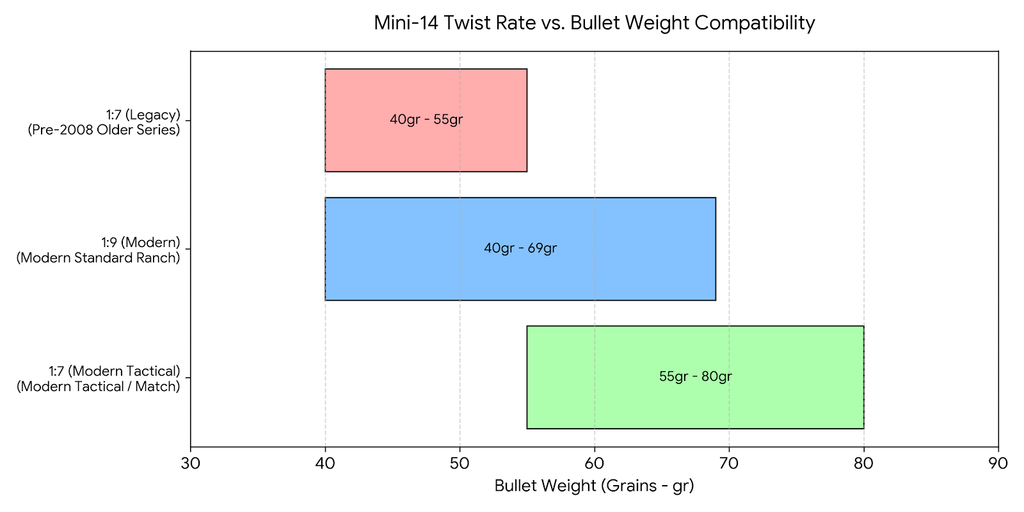
Rifling twist rate refers to the exact distance it takes for the rifling inside the barrel to complete one full 360-degree rotation. For the Ruger Mini 14 platform, understanding these measurements is crucial due to Ruger’s historic manufacturing revisions:
- 1:7 Twist: One complete rifling rotation in 7 inches of barrel length.
- 1:9 Twist: One complete rifling rotation in 9 inches of barrel length.
- 1:10 or 1:7 (Legacy): Older production variations found on vintage pre-2008 thin-barrel rifles.
Why faster twists are expressed with smaller numbers:
Because the bullet completes its full rotation in a shorter distance, the rifling must be cut at a steeper angle. This steeper angle forces the projectile to spin much faster, generating a higher Revolutions Per Minute (RPM) count as it exits the muzzle.
How twist rate affects Mini 14 stability:
Bullets require gyroscopic stability to fly straight. A heavy, long bullet requires a much faster spin to remain stable in flight. For decades, the Mini 14 was built with slow twist rates tailored strictly for lightweight 55-grain commercial ammunition. When modern shooters attempt to fire long, heavy 77-grain match bullets out of an older legacy Mini 14, the slow twist fails to stabilize them, causing tumbling and terrible group sizes.
Bullet Weight Comparison
| Bullet Weight | Recommended Twist | Modern 1:7 | Modern 1:9 | Legacy Barrels |
| 40 grain | 1:9 or Legacy | Marginal | Excellent | Excellent |
| 50 grain | 1:9 or Legacy | Good | Excellent | Excellent |
| 55 grain | 1:9 | Excellent | Excellent | Good |
| 62 grain | 1:9 or 1:7 | Excellent | Excellent | Marginal |
| 69 grain | 1:7 or 1:9 | Excellent | Excellent | Unstable |
| 75 grain | 1:7 | Excellent | Marginal | Unstable |
| 77 grain | 1:7 | Excellent | Unstable | Unstable |
| 80 grain | 1:7 | Excellent | Unstable | Unstable |
What Is The Best Twist Rate For A Mini 14?
The best twist rate for a modern Ruger Mini 14 is the 1:9 twist for general-purpose shooting and the 1:7 twist for tactical or match applications. Unlike AR-15 platforms where barrel changes are simple, the Mini 14 receiver and barrel assembly is fixed. Selecting the correct twist rate at the time of purchase is vital because you cannot easily swap out a Mini 14 barrel.
Mini 14 1:7 Twist Rate
The modern 1:7 twist rate is found on current tactical models and specific heavy-barrel variants of the Mini 14. Ruger adopted this fast twist to satisfy shooters demanding compatibility with military-spec 62-grain penetrators and heavy 77-grain match ammunition. If you want to shoot long-range precision .223 or 5.56 out of your Mini 14, the modern 1:7 twist is the required choice.
Mini 14 1:9 Twist Rate
The 1:9 twist rate is the baseline standard for most modern Ruger Mini 14 Ranch Rifles. This twist rate is optimized for the vast majority of commercial ammunition available on store shelves, specifically 55-grain full metal jacket and 62-grain soft points. It provides stellar accuracy for general range use, training, and ranch work without over-spinning lightweight varmint rounds.
Mini 14 Twist Rate For 55 Grain Bullets
The ideal Mini 14 twist rate for 55 grain bullets is a 1:9 twist. This weight forms the historical backbone of the .223 Remington cartridge. A 1:9 barrel stabilizes 55-grain ammunition with incredible precision, offering flat trajectories and reliable performance across all modern Mini 14 configurations.
Mini 14 Twist Rate For 62 Grain Bullets
The best Mini 14 twist rate for 62 grain ammunition is a 1:9 or a 1:7 twist. Standard lead-core 62-grain loads shoot exceptionally well out of a 1:9 barrel. However, if you are shooting military surplus M855 Green Tip ammunition featuring a steel penetrator, a 1:7 twist ensures absolute stability for the longer projectile profile.
Mini 14 Twist Rate For 77 Grain Bullets
The recommended Mini 14 twist rate for 77 grain bullets is exclusively the modern 1:7 twist. Older legacy Mini 14 rifles and standard 1:9 ranch models will fail to stabilize a heavy 77-grain match projectile, resulting in severe accuracy loss. If long-range heavy match performance is your goal, ensure your Mini 14 features a 1:7 barrel.
Mini 14 Twist Rate And Bullet Stability
While bullet weight is a convenient metric, bullet length dictates twist rate requirements far more than weight alone.
The length-to-diameter ratio of a projectile determines its aerodynamic stability. Monolithic copper bullets or long, polymer-tipped match projectiles require more rotational force than traditional lead-core bullets of the exact same weight. Furthermore, the Mini 14 platform is historically sensitive to barrel harmonics and whip. A bullet that is poorly stabilized or over-spun can exacerbate group-stringing issues common in older, thin-profile Mini 14 barrels.
Barrel Length and Twist Rate
Barrel length does not change the physical rifling twist rate cut into the bore. A 1:9 twist completes one rotation every 9 inches whether your Mini 14 has an 18.5-inch standard barrel or a shorter tactical barrel. However, barrel length determines muzzle velocity. A standard 18.5-inch Mini 14 barrel generates higher velocity than a truncated 16.1-inch tactical model. Because velocity heavily aids gyroscopic stability, understanding your muzzle velocity helps clarify how your chosen twist rate handles marginal bullet weights.
Stability Testing
Ballisticians evaluate bullet stability using mathematical formulas like the Miller Twist Rule to generate a Gyroscopic Stability Factor.
- SG > 1.5: Fully stable; the bullet achieves its optimal ballistic coefficient.
- SG 1.0 to 1.5: Marginally stable; the bullet flies forward but loses aerodynamic efficiency.
- SG < 1.0: Unstable; the bullet tumbles in flight.
Environmental factors like cold, dense air at sea level increase aerodynamic drag, meaning marginal bullets shot out of a 1:9 Mini 14 barrel are more likely to destabilize in winter conditions than during hot summer months.
Best Twist Rate By Use
| Use Case | Recommended Twist Rate | Suitable Bullet Weights |
| General Range & Plinking | 1:9 | 50gr to 62gr |
| Standard Ranch Utility | 1:9 | 45gr to 62gr |
| Tactical & Heavy Match | 1:7 | 62gr to 80gr |
| Varmint Hunting | 1:9 | 40gr to 55gr |
| 55 Grain Bulk Ammunition | 1:9 | 45gr to 69gr |
| 77 Grain Match Shooting | 1:7 | 69gr to 80gr |
Pros And Cons
Modern Fast Twist Rates (1:7)
Pros:
- Stabilizes heavy, high-ballistic-coefficient match bullets up to 80 grains.
- Fully compatible with military-grade 62-grain and 77-grain duty loads.
- Unlocks long-range precision capabilities for the Mini 14 platform.
Cons:
- Can over-spin ultra-light, thin-jacketed 40-grain varmint bullets.
- Less optimized for standard cheap 55-grain bulk plinking loads.
Modern Standard Twist Rates (1:9)
Pros:
- Perfectly optimizes standard 55-grain and 62-grain commercial ammunition.
- Delivers exceptional accuracy for general range use and predator control.
- Avoids over-spinning lightweight factory loads.
Cons:
- Incapable of stabilizing heavy match bullets weighing 75 grains or more.
- Limits the rifle’s effective range in heavy crosswinds.
Mini 14 Twist Rate Chart: Which Twist Rate Is Best?
When referencing a Mini 14 twist rate chart, the 1:9 twist is the best choice for general-purpose shooters, as it matches the design intent of standard commercial .223 Remington ammunition. However, the 1:7 twist is the best choice for modern tactical users, as it opens up the platform to heavy, barrier-penetrating military rounds and high-BC match projectiles.
For specific rifle setups, select accordingly:
- Standard Ranch Rifle and general use: 1:9 twist.
- Tactical models and heavy match shooting: 1:7 twist.
- Legacy vintage collection shooting: Stick to 50gr to 55gr ammunition.
FAQs
What is the best twist rate for a Mini 14?
The 1:9 twist is best for standard ranch rifles shooting 55-grain ammo, while the 1:7 twist is best for tactical models shooting heavy match and military projectiles.
What twist rate do modern Mini 14 rifles have?
Modern production Ruger Mini 14 rifles typically feature either a 1:9 twist (standard Ranch models) or a 1:7 twist (Tactical models).
What twist rate do older Mini 14 rifles have?
Older pre-2008 legacy Mini 14 rifles often featured a slow twist rate, historically optimized for lightweight 55-grain and 50-grain varmint bullets.
Can a Mini 14 shoot 77 grain bullets?
Yes, but only if your modern Mini 14 features a 1:7 twist barrel. Older 1:9 barrels or legacy thin barrels will fail to stabilize 77-grain bullets.
Can a Mini 14 shoot 55 grain bullets?
Yes, 55-grain ammunition shoots exceptionally well out of both 1:9 and 1:7 modern Mini 14 twist rates.
Does barrel length affect twist rate on a Mini 14?
Barrel length does not change the physical rifling twist rate cut into the bore, though longer barrels increase muzzle velocity and slightly improve overall bullet stability.