The best .308 Winchester twist rate for most shooters is 1:10, as it provides the greatest versatility for a wide variety of ammunition.
While the ideal twist depends on a projectile’s weight, length, and velocity, the 1:10 easily stabilizes everything from 150-grain hunting loads to heavy 200-grain match bullets.
Slower twist rates like 1:12 are precision-tailored for standard 150-grain to 168-grain projectiles but will often cause heavier, longer bullets to tumble.
A specialized 1:11 or 1:11.25 twist rate is considered the gold standard for dedicated sniper platforms firing 168-grain and 175-grain match-grade ammunition.
Matching your specific bullet weight and length to the correct rifling twist rate is strictly required to maximize downrange accuracy and gyroscopic stability.
Table of Contents [Click to open]
.308 Twist Rate Chart
| Twist Rate | Common Bullet Weights | Typical Bullet Use | Stability/Compatibility |
| 1:10 | 150gr to 220gr | General / Heavy Match | Most versatile modern twist; stabilizes long 175gr+ match and solid copper bullets perfectly. |
| 1:11 | 150gr to 175gr | Precision / Sniper | The absolute sweet spot for 168gr and 175gr match ammunition; military standard for M24. |
| 1:11.25 | 168gr to 175gr | Heavy Target | Highly specialized match barrel twist designed specifically for the 175gr Sierra MatchKing. |
| 1:12 | 110gr to 168gr | Standard Hunting | Classic twist rate for 150gr hunting loads; struggles with very long or heavy match bullets. |
Understanding the .308 Twist Rate Chart
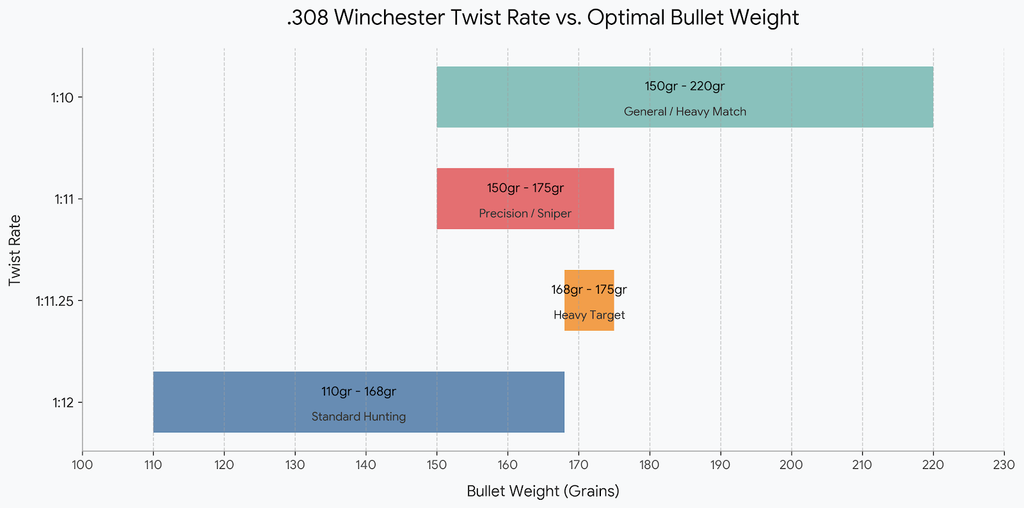
Rifling twist rate refers to the exact distance required for the rifling inside the barrel to complete one full 360-degree rotation. For the .308 Winchester, here is what the numbers mean:
- 1:10 Twist: One complete rifling rotation in 10 inches of barrel length.
- 1:11 Twist: One complete rifling rotation in 11 inches of barrel length.
- 1:12 Twist: One complete rifling rotation in 12 inches of barrel length.
Why faster twists use smaller numbers:
A bullet fired from a 1:10 barrel is forced to complete its full rotation in a shorter distance than a 1:12 barrel. This requires a steeper rifling angle, which spins the bullet much faster and generates higher Revolutions Per Minute (RPM) upon exiting the muzzle.
How twist rate affects .308 bullet stability:
Rifle bullets require gyroscopic stability to cut through the air and resist tumbling. Heavier, longer bullets require a significantly faster spin (a smaller twist rate number like 1:10) to remain stable in flight. Conversely, shorter and lighter bullets require less spin and perform flawlessly in a 1:12 twist.
Bullet Weight Comparison
| Bullet Weight | Recommended Twist | 1:10 | 1:11 | 1:12 |
| 110 grain | 1:12 | Good | Excellent | Excellent |
| 125 grain | 1:12 | Excellent | Excellent | Excellent |
| 150 grain | 1:12 or 1:10 | Excellent | Excellent | Excellent |
| 168 grain | 1:11 or 1:10 | Excellent | Excellent | Excellent |
| 175 grain | 1:10 or 1:11 | Excellent | Excellent | Marginal |
| 185 grain | 1:10 | Excellent | Marginal | Unstable |
| 200 grain | 1:10 | Excellent | Unstable | Unstable |
| 220 grain | 1:10 | Excellent | Unstable | Unstable |
What Is The Best Twist Rate For .308?
There is no single universally superior twist rate for the .308 Winchester, as the perfect choice depends on the specific ammunition you intend to shoot. However, the 1:10 twist rate is widely considered the best overall choice for modern rifles. It acts as a universal stabilizer, generating enough RPM to shoot heavy 185-grain precision bullets while remaining perfectly capable of firing standard 150-grain deer hunting loads with extreme accuracy.
.308 1:10 Twist Rate
The 1:10 twist is the modern standard for most commercial .308 Winchester and 7.62x51mm NATO rifles. Manufacturers favor the 1:10 twist because it guarantees stability for virtually any commercially available factory load. It is aggressive enough to stabilize ultra-long monolithic copper hunting bullets and heavy 185-grain to 200-grain match bullets. It handles common 150-grain and 168-grain loads effortlessly.
.308 1:11 Twist Rate
The .308 twist rate 1:11, along with the highly specific 1:11.25, is the ultimate sweet spot for dedicated precision shooters. The legendary M24 Sniper Weapon System utilizes a 1:11.25 twist specifically to optimize the flight characteristics of the 175-grain M118LR match ammunition. This twist rate perfectly balances rotational speed for 168-grain and 175-grain bullets, preventing over-stabilization while ensuring absolute precision at long distances.
.308 1:12 Twist Rate
For decades, the 1:12 twist was the standard factory specification for civilian .308 hunting rifles. It is precision-tailored for standard 150-grain soft point hunting bullets and lightweight 125-grain varmint loads. The 1:12 provides a relaxed spin that minimizes bullet deformation and bore wear. Its primary limitation is an inability to reliably stabilize long, high-ballistic-coefficient target bullets weighing 175 grains or more, particularly in dense, cold air.
.308 Twist Rate For 150 Grain Bullets
The ideal .308 twist rate for 150 grain bullets is incredibly forgiving. A 1:12 twist is traditionally considered the most perfectly optimized rate for 150-grain hunting ammunition. However, a 150-grain projectile will shoot exceptionally well out of a 1:10 or 1:11 barrel, making it one of the most versatile bullet weights on the market.
.308 Twist Rate For 168 Grain Bullets
The best twist rate for 168 grain match bullets, such as the famous Sierra MatchKing, is a 1:11 or 1:10. This weight sits comfortably in the middle of the .308 capability spectrum. Almost any standard .308 barrel, including a 1:12, will stabilize a lead-core 168-grain bullet under normal atmospheric conditions.
.308 Twist Rate For 175 Grain Bullets
The recommended .308 twist rate for 175 grain bullets is 1:10 or 1:11. The 175-grain projectile is the gold standard for long-range .308 shooting. A 1:10 barrel will stabilize this bullet effortlessly in any weather condition. A 1:12 barrel will often struggle to stabilize a 175-grain bullet, leading to a drop in ballistic coefficient and potential keyholing on target.
.308 Twist Rate And Bullet Stability
Shooters frequently categorize twist rates by bullet weight, but bullet length dictates twist rate requirements far more than weight alone.
A bullet’s length-to-diameter ratio is the primary factor in gyroscopic stability. Modern solid copper hunting bullets are physically longer than traditional lead bullets of the exact same weight because copper is less dense. Therefore, a 168-grain solid copper bullet requires a faster twist rate (like 1:10) to remain stable, whereas a 168-grain lead bullet might perform perfectly in a slower 1:12 barrel. Polymer tips and aggressive boat tails also increase a projectile’s overall length, pushing the center of pressure forward and demanding a faster spin.
Barrel Length and Twist Rate
Barrel length does not alter the physical twist rate machined into the bore. A 1:10 twist completes one rotation every 10 inches whether the barrel is 16 inches long or 24 inches long. However, a longer barrel generates higher muzzle velocity. Because the bullet is traveling faster as it leaves the muzzle, it exits with a higher overall RPM. In ultra-short .308 barrels, shooters occasionally rely on a slightly faster twist rate to compensate for lost velocity and ensure the bullet achieves adequate rotational stability.
Stability Testing
Ballisticians evaluate bullet stability using mathematical formulas to generate a Gyroscopic Stability Factor (SG).
- SG > 1.5: Fully stable; the bullet achieves its maximum aerodynamic ballistic coefficient.
- SG 1.0 to 1.5: Marginally stable; the bullet flies nose-forward but suffers increased drag and reduced long-range accuracy.
- SG < 1.0: Unstable; the bullet will tumble in flight.
Atmospheric conditions heavily impact this metric. Dense air at sea level in freezing temperatures requires a much faster twist rate to stabilize a marginal bullet compared to thin, warm air at high mountain altitudes.
Best Twist Rate By Use
| Use Case | Recommended Twist Rate | Suitable Bullet Weights |
| General .308 Shooting | 1:10 | 150gr to 200gr |
| Standard Hunting | 1:12 or 1:10 | 125gr to 168gr |
| Monolithic Copper Bullets | 1:10 | 130gr to 168gr |
| Precision Match | 1:11 or 1:11.25 | 168gr to 175gr |
| Heavy Subsonic / Target | 1:10 | 185gr to 220gr+ |
| 150 Grain Ammunition | 1:12 or 1:10 | 110gr to 168gr |
| 168 Grain Ammunition | 1:11 or 1:10 | 150gr to 175gr |
| 175 Grain Ammunition | 1:10 or 1:11 | 168gr to 200gr |
Pros And Cons
Fast Twist Rates (1:10)
Pros:
- Easily stabilizes heavy, high-ballistic-coefficient match bullets (175gr to 220gr).
- Required for shooting long, solid-copper hunting rounds.
- Maintains superior bullet stability in dense, freezing weather at sea level.
Cons:
- Can slightly over-stabilize lightweight 110-grain varmint bullets, magnifying tiny bullet imperfections.
- Creates slightly more barrel friction.
Slow Twist Rates (1:12)
Pros:
- Perfectly optimizes standard 150-grain hunting ammunition.
- Delivers extreme accuracy with lightweight varmint loads.
- Produces slightly less bore wear over thousands of rounds.
Cons:
- Incapable of reliably stabilizing heavy (175gr+) match and defensive ammunition.
- Severely limits the rifle’s effective range due to lighter bullet requirements.
.308 Twist Rate Chart: Which Twist Rate Is Best?
When consulting a .308 twist rate chart, the 1:10 twist is undeniably the best and most versatile twist rate for the vast majority of rifle setups today. It eliminates the guesswork of ammunition selection, allowing you to seamlessly transition between 150-grain hunting loads, 168-grain target loads, and heavy 185-grain precision bullets without ever losing gyroscopic stability.
For specialized applications, select accordingly:
- General-purpose and heavy target: 1:10 twist.
- Dedicated 168gr to 175gr match shooting: 1:11 or 1:11.25 twist.
- 150-grain hunting and lightweight loads: 1:12 twist.
FAQs
What is the best twist rate for .308?
The 1:10 twist rate is universally considered the best all-around option for .308 Winchester, as it successfully stabilizes standard 150-grain hunting ammo alongside heavy 185-grain match projectiles.
What is the 1:10 twist rate good for?
The 1:10 twist is excellent for stabilizing long, heavy projectiles ranging from 168 grains to over 200 grains, making it a top choice for long-range precision and solid copper hunting bullets.
What is the 1:11 twist rate good for?
The 1:11 twist is the ultimate sweet spot for dedicated precision rifles firing 168-grain and 175-grain match bullets, offering the perfect balance of RPM and stability.
What is the 1:12 twist rate good for?
The traditional 1:12 twist is optimized for standard 150-grain hunting ammunition and lightweight 110-grain to 125-grain varmint loads.
What twist rate is best for 150 grain .308?
A 1:12 twist is traditionally considered the most perfectly optimized rate for 150-grain bullets, though they will shoot highly accurately out of a 1:10 or 1:11 barrel.
What twist rate is best for 168 grain .308?
A 1:11 or 1:10 twist handles standard 168-grain ammunition perfectly, providing ideal gyroscopic stability for maximum precision.
What twist rate is best for 175 grain .308?
A 1:10 or 1:11 twist rate is best for 175-grain bullets, as the faster rifling is necessary to keep these long, heavy projectiles from tumbling in flight.
What twist rate is best for 185 grain .308?
A 1:10 twist rate is mandatory for 185-grain bullets and heavier. Slower twists will generally fail to stabilize these long projectiles.
Can a 1:10 twist shoot 150 grain bullets?
Yes, a 1:10 twist can shoot 150-grain bullets very accurately. While it spins them faster than mathematically necessary, it does not negatively impact standard hunting ammunition.
Can a 1:12 twist shoot 175 grain bullets?
Usually no. A 1:12 twist is typically too slow to adequately stabilize a 175-grain bullet, especially in cold air. The projectile will lack sufficient RPMs, causing it to wobble or strike the target sideways.
Does barrel length affect twist rate?
Barrel length does not change the physical twist rate cut into the bore. However, a longer barrel increases muzzle velocity, which results in higher bullet RPMs and marginally aids in gyroscopic stability.
Does bullet length matter more than bullet weight for twist rate?
Yes, bullet length is the primary factor dictating twist rate requirements. Longer bullets shift the center of aerodynamic pressure, requiring a faster rotational spin to remain stable in flight regardless of their overall weight.