The typical .300 PRC muzzle energy ranges from 3,700 to over 4,000 foot-pounds for standard factory loads. For example, the Hornady 212-grain ELD-X produces 3,850 ft-lbs, while the heavy Berger 245-grain Elite Hunter generates a massive 4,025 ft-lbs of kinetic energy. This .300 PRC muzzle energy variance depends heavily on the specific bullet weight, the powder charge of the ammunition, the barrel length of the rifle, and the resulting muzzle velocity. A full size 26-inch rifle barrel will naturally yield significantly higher energy levels than a shorter 20-inch hunting barrel. Built for extreme long range precision and big game hunting, the .300 PRC relies on heavy, aerodynamic projectiles driven at magnum velocities to deliver its devastating kinetic payload.
.300 PRC Muzzle Energy
| Ammunition / Load | Bullet Weight | Muzzle Velocity | Muzzle Energy |
| Copper Creek Barnes LRX | 200 grain | 2,900 fps | 3,734 ft-lbs |
| Federal Premium Terminal Ascent | 210 grain | 2,850 fps | 3,787 ft-lbs |
| Hornady Outfitter CX | 190 grain | 3,000 fps | 3,797 ft-lbs |
| Hornady Precision Hunter ELD-X | 212 grain | 2,860 fps | 3,850 ft-lbs |
| Remington Premier Long Range Speer Impact | 215 grain | 2,850 fps | 3,877 ft-lbs |
| Hornady Match ELD-M | 225 grain | 2,810 fps | 3,945 ft-lbs |
| Berger Elite Hunter | 245 grain | 2,720 fps | 4,025 ft-lbs |
| Berger Elite Hunter | 205 grain | 2,985 fps | 4,057 ft-lbs |
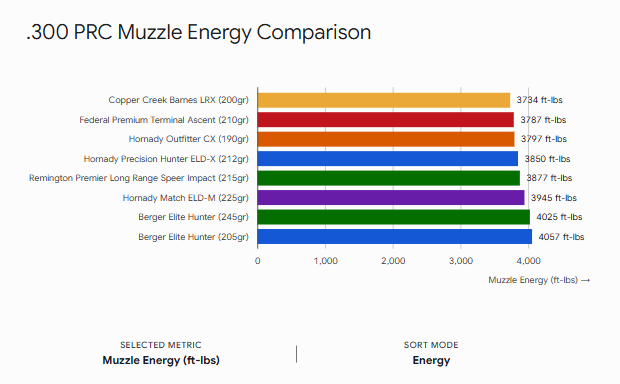
Explaining The 300 PRC Muzzle Energy Chart
Based on the real world factory and chronograph data above, we can identify several key performance baselines:
- Lowest Tested Muzzle Energy:The Copper Creek 200-grain Barnes LRX yields 3,734 ft-lbs. While this is the lowest on our specific chart, it still carries substantially more energy than most traditional hunting cartridges.
- Highest Tested Muzzle Energy:The Berger 205-grain Elite Hunter generates a highly impressive 4,057 ft-lbs. By utilizing a mid-weight bullet pushed by a large powder charge, it achieves an incredible 2,985 fps out of a rifle barrel.
- Typical Range:The standard .300 PRC energy baseline falls exactly between 3,700 and 4,050 ft-lbs. This is where all traditional big game hunting and extreme long range target ammunition sits.
- How Bullet Weight Affects Energy: Heavier bullets do not always equal more energy. The heavy 245-grain Berger load produces excellent energy (4,025 ft-lbs) due to its massive weight, but the lighter 205-grain Berger load edges it out (4,057 ft-lbs) because it can be driven much faster.
- How Velocity Affects Energy: Velocity has an exponential physical effect on kinetic energy, making it a critical performance factor. Pushing a bullet close to 3,000 fps creates drastically more energy than pushing it at 2,700 fps.
Importantly, muzzle energy is strictly a physics measurement of a bullet’s mass and speed as it leaves the barrel. It is not a direct measurement of terminal performance, tissue damage, or absolute stopping power.
What Is The Muzzle Energy Of .300 PRC?
The muzzle energy of .300 PRC ammunition generally sits around 3,800 to 3,950 foot-pounds for standard pressure loads fired from a full size 24-inch rifle barrel.However, depending on the specific application, ranging from lightweight monolithic hunting rounds to ultra-heavy match cartridges, the .300 PRC energy spectrum spans from roughly 3,700 ft-lbs up to over 4,050 ft-lbs.
.300 PRC Muzzle Energy By Bullet Weight
Because manufacturers load the .300 PRC across several bullet weights specifically designed for high ballistic coefficients, muzzle energy shifts significantly depending on the projectile selected. The table below uses specific factory load examples to illustrate how energy scales with weight and velocity.
| Bullet Weight | Example Velocity | Muzzle Energy |
| 190 grain (Hornady Outfitter CX) | 3,000 fps | 3,797 ft-lbs |
| 205 grain (Berger Elite Hunter) | 2,985 fps | 4,057 ft-lbs |
| 212 grain (Hornady ELD-X) | 2,860 fps | 3,850 ft-lbs |
| 225 grain (Hornady ELD-M) | 2,810 fps | 3,945 ft-lbs |
| 245 grain (Berger Elite Hunter) | 2,720 fps | 4,025 ft-lbs |
Note: These figures represent specific factory loads. Not every .300 PRC load of the same bullet weight produces the exact same energy.
.300 PRC 212 Grain Muzzle Energy
The 212-grain bullet is widely considered the gold standard for .300 PRC hunting ammunition, particularly for elk and moose. Because it is heavy enough to penetrate deep but light enough to be driven fast, it offers a perfect balance. Standard 212-grain rifle loads typically produce around 3,850 ft-lbs of energy. The Hornady Precision Hunter ELD-X reaches 2,860 fps out of a 24-inch barrel, generating massive kinetic energy and expanding reliably on heavy game at extended ranges.
.300 PRC 225 Grain Muzzle Energy
The 225-grain bullet is the preferred weight for extreme long range match shooting. Moving at a robust 2,810 fps out of a rifle barrel, a standard .300 PRC 225 grain muzzle energy typically measures exactly 3,945 ft-lbs. While it travels slower than lighter bullets, its incredibly high ballistic coefficient allows it to retain that kinetic energy far better across vast distances.
.300 PRC 245 Grain Muzzle Energy
The 245-grain bullet pushes the physical limits of the .30 caliber bore. Because the cartridge has massive powder capacity, it can still drive this ultra-heavy bullet at 2,720 fps. As a result, .300 PRC 245 grain muzzle energy hovers around 4,025 ft-lbs. This heavy bullet provides unparalleled wind deflection resistance and retains lethal energy past 1,000 yards.
.300 PRC Muzzle Energy By Barrel Length
A rifle cartridge’s advertised muzzle energy is nearly always derived from a 24-inch or 26-inch test barrel. Firing that same ammunition from a shorter 20-inch mountain rifle will result in drastically lower velocity and proportionally lower muzzle energy.
Using standard Hornady 212-grain ELD-X ammunition (rated at 2,860 fps from a 24-inch barrel), here is how .300 PRC muzzle energy changes across common barrel lengths assuming a 25 fps loss per inch:
- 20 inches (e.g., Compact mountain rifles): ~2,760 fps | 3,586 ft-lbs
- 22 inches (e.g., Standard hunting rifles): ~2,810 fps | 3,717 ft-lbs
- 24 inches (e.g., Factory test barrels): 2,860 fps | 3,850 ft-lbs
- 26 inches (e.g., Precision match rifles): ~2,910 fps | 3,986 ft-lbs
Because the .300 PRC uses large volumes of slow burning powder, shortening the barrel leaves much of the powder unburned. This creates a loud muzzle blast and costs the shooter hundreds of foot-pounds of potential kinetic energy.
.300 PRC Velocity And Muzzle Energy
To understand how .300 PRC muzzle velocity and energy are related, it is important to conceptually understand kinetic energy physics. To calculate muzzle energy, you multiply the bullet weight in grains by the velocity in feet per second squared, and then divide that total by the constant number 450,436.
Because velocity is multiplied by itself in this calculation, it has an exponential physical effect on energy. Adding just 100 fps to a .300 PRC load yields a much larger increase in muzzle energy than adding a few grains of bullet weight. For example, a 205-grain bullet traveling at 2,985 fps reliably generates 4,057 ft-lbs of energy. You can push a much heavier 212-grain bullet, but because it travels slower at 2,860 fps, it produces only 3,850 ft-lbs. Because velocity dictates the final energy output so heavily, shooting this cartridge from a short barrel strips away the speed it relies on to produce high foot-pounds of energy.
.300 PRC Muzzle Energy vs .300 Win Mag and .338 Lapua
How does the .300 PRC energy compare to the legendary .300 Winchester Magnum and the massive .338 Lapua Magnum? The table below compares standard factory ammunition across three highly popular long range calibers.
| Cartridge | Bullet Weight | Muzzle Velocity | Muzzle Energy |
| .300 Win Mag | 180 grain | 2,960 fps | 3,501 ft-lbs |
| .300 PRC | 212 grain | 2,860 fps | 3,850 ft-lbs |
| .338 Lapua Magnum | 250 grain | 2,950 fps | 4,831 ft-lbs |
The .300 PRC provides a noticeable kinetic energy upgrade over the traditional .300 Win Mag.By utilizing a modern cartridge design that accommodates heavier bullets without seating them deep into the powder column, the .300 PRC easily pushes past the 3,800 ft-lbs mark.However, it still falls short of the massive .338 Lapua Magnum, which uses significantly more powder to drive a much larger 250-grain bullet.
What Muzzle Energy Actually Tells You
Muzzle energy is a useful comparative metric, but it has severe limitations when analyzing a rifle cartridge’s effectiveness in real world hunting or tactical scenarios.
- Muzzle Energy vs. Downrange Energy: Muzzle energy is measured inches from the barrel. Because .300 PRC bullets have incredibly high ballistic coefficients, they retain their velocity and energy far better downrange than older cartridge designs. The .300 PRC retains roughly 60 percent of its energy at 500 yards.
- Energy vs. Penetration: High muzzle energy does not guarantee deep penetration. A lightweight hunting bullet with massive energy might expand violently and stop shallow on heavy game, whereas a heavier bonded bullet will penetrate deeply through bone and tissue.
- Stopping Power: The .300 PRC relies on hydrostatic shock and wide wound channels to stop big game. This requires proper bullet selection and expansion at the target distance, not just raw kinetic energy at the muzzle.
- Recoil: High muzzle energy results directly in heavy free recoil. The .300 PRC generates over 32 foot-pounds of recoil energy, which requires a muzzle brake or suppressor to manage comfortably.
.300 PRC Muzzle Energy Pros
- Produces significantly more kinetic energy than standard .30 caliber magnums like the .300 Win Mag.
- Extremely high ballistic coefficients allow the cartridge to retain over 2,000 foot-pounds of energy at 500 yards.
- Capable of delivering ethical, lethal kinetic energy to elk and moose at extended ranges.
.300 PRC Muzzle Energy Limitations
- Generates severe recoil that can induce flinching in inexperienced shooters.
- Requires a minimum 24-inch barrel to properly burn its powder and achieve its advertised kinetic energy numbers.
- Ammunition is expensive and produces rapid barrel wear due to the massive powder charges required to generate 4,000 ft-lbs of energy.
.300 PRC Muzzle Energy: How Much Energy Does It Produce?
The .300 PRC produces a typical muzzle energy range of 3,700 to 4,050 foot-pounds for standard pressure ammunition fired from a 24-inch or 26-inch rifle barrel.
Common 212-grain hunting loads produce exactly 3,850 ft-lbs. The heavier 225-grain match loads reliably yield 3,945 ft-lbs. Lightweight 190-grain monolithic loads typically produce around 3,797 ft-lbs. The highest verified example in our research is the Berger 205-grain Elite Hunter, which generates an impressive 4,057 ft-lbs out of a standard test barrel.
Ultimately, there is no single universal .300 PRC muzzle energy number. The final output depends entirely on the ammunition selected and the length of the barrel firing it, with 26-inch precision rifles safely maximizing the cartridge’s absolute kinetic potential.
FAQs
How much muzzle energy does a .300 PRC have?
Standard .300 PRC rifle loads typically generate between 3,700 and 4,050 foot-pounds of muzzle energy, depending on the bullet weight and barrel length.
What is the muzzle energy of a 212 grain .300 PRC?
A standard 212-grain .300 PRC load traveling at roughly 2,860 fps produces approximately 3,850 foot-pounds of muzzle energy out of a 24-inch rifle barrel.
How much energy does a 225 grain .300 PRC have?
High ballistic coefficient 225-grain match loads produce roughly 3,945 ft-lbs of energy, relying on heavy mass and excellent aerodynamics to retain that power over vast distances.
What is the muzzle energy of a 245 grain .300 PRC?
Heavy 245-grain factory loads produce around 4,025 ft-lbs of energy. These ultra-heavy bullets are designed to resist wind drift and maintain kinetic energy past 1,000 yards.
Does barrel length affect .300 PRC muzzle energy?
Yes, drastically. Firing a .300 PRC from a shorter 20-inch hunting barrel will result in a loss of roughly 100 fps, dropping the muzzle energy by over 250 foot-pounds compared to a standard 24-inch barrel.
What is the highest energy .300 PRC load?
Mid-weight, high velocity loads produce the highest kinetic numbers at the muzzle. Ammunition like the Berger 205-grain Elite Hunter reaches 2,985 fps and produces 4,057 ft-lbs of muzzle energy.
How does .300 PRC muzzle energy compare with .300 Win Mag?
The .300 PRC produces roughly 350 foot-pounds more kinetic energy than a standard .300 Win Mag. By utilizing a modern case design, the .300 PRC can load longer, heavier bullets without sacrificing powder capacity.
How does .300 PRC muzzle energy compare with .338 Lapua Magnum?
The .338 Lapua Magnum produces significantly more muzzle energy than the .300 PRC. A standard .338 Lapua produces over 4,800 ft-lbs of energy, whereas the .300 PRC peaks around 4,050 ft-lbs.
Is .300 PRC powerful enough for elk hunting?
Yes. The .300 PRC is widely considered one of the best elk hunting cartridges available. It retains over 2,000 foot-pounds of kinetic energy at 500 yards, which is more than enough to ethically harvest large bull elk.
Does higher muzzle energy mean more stopping power on big game?
Not always. Muzzle energy is just a kinetic measurement. Stopping power on big game relies heavily on the bullet’s ability to penetrate thick bone and expand reliably into the vitals. This is why heavy, controlled expansion bullets are preferred over standard target ammunition.
How is .300 PRC muzzle energy calculated?
It is calculated using a standard kinetic energy physics calculation that combines the bullet’s physical weight with its flight speed. Because velocity has an exponential mathematical effect in this calculation, speed plays a significantly larger role in generating high foot-pounds of energy than the physical weight of the bullet alone.