The typical .357 Magnum muzzle energy ranges from 400 to over 650 foot-pounds for standard factory loads, with high performance boutique ammunition exceeding 800 foot-pounds. For example, standard Federal 158-grain Hydra-Shok produces 539 ft-lbs, while Underwood’s 125-grain XTP load generates a massive 802 ft-lbs of energy. This 357 Magnum energy variance depends entirely on the bullet weight, the powder charge of the ammunition, the barrel length of the revolver, and the resulting muzzle velocity. A full size 6-inch revolver barrel will naturally yield significantly higher energy levels than a 2-inch concealed carry snub-nose. Built for defensive stopping power, the .357 Magnum relies on extreme velocities to generate its legendary kinetic payload.
.357 Magnum Muzzle Energy
| Ammunition / Load | Bullet Weight | Muzzle Velocity | Muzzle Energy |
| Speer Gold Dot Short Barrel JHP | 135 grain | 990 fps | 294 ft-lbs |
| Winchester USA White Box JHP | 110 grain | 1,295 fps | 410 ft-lbs |
| Remington HTP JSP | 158 grain | 1,235 fps | 535 ft-lbs |
| Federal Premium Hydra-Shok JHP | 158 grain | 1,240 fps | 539 ft-lbs |
| Federal Premium Barnes Expander | 140 grain | 1,400 fps | 609 ft-lbs |
| Hornady Critical Defense FTX | 125 grain | 1,500 fps | 624 ft-lbs |
| Buffalo Bore Heavy Outdoorsman | 180 grain | 1,400 fps | 783 ft-lbs |
| Underwood Ammo XTP JHP | 125 grain | 1,700 fps | 802 ft-lbs |
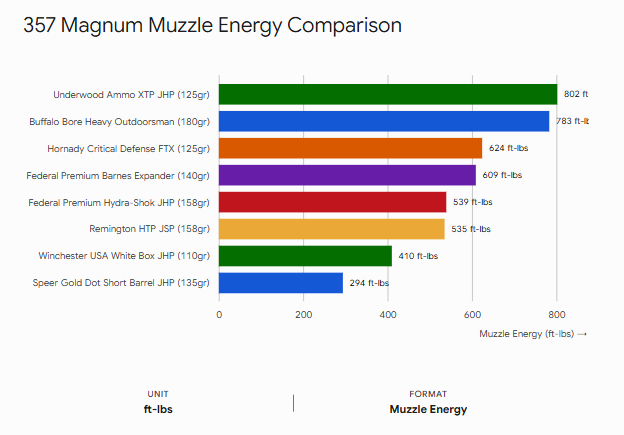
Explaining The .357 Magnum Muzzle Energy Chart
Based on the real world chronograph and factory test data above, we can identify several key performance baselines:
- Lowest Tested Muzzle Energy: The Speer Gold Dot Short Barrel 135-grain JHP yields 294 ft-lbs. This load is deliberately formulated with faster burning powders to reduce blinding muzzle flash and heavy recoil in 2-inch concealed carry revolvers, trading raw energy for control.
- Highest Tested Muzzle Energy: The Underwood Ammo 125-grain XTP generates a staggering 802 ft-lbs. By combining a lightweight bullet with a maximum safe powder charge, it achieves an incredible 1,700 fps out of a standard revolver barrel.
- Typical Range: The standard .357 Magnum muzzle energy baseline falls between 500 and 650 ft-lbs. This is where most traditional 158-grain duty ammunition and 125-grain defensive hollow points operate.
- How Bullet Weight Affects Energy: Heavier bullets do not inherently equal more energy. Because kinetic energy favors speed over mass, lighter bullets driven at extreme velocities, like the 125-grain Hornady load, often produce higher raw ft-lbs than traditional 158-grain slugs moving at moderate speeds.
- How Velocity Affects Energy: Velocity has an exponential physical effect on kinetic energy, making it the dominant factor. Pushing a 125-grain bullet to 1,700 fps creates drastically more energy than pushing a 158-grain bullet to 1,240 fps.
Importantly, muzzle energy is strictly a physics measurement of a bullet’s mass and speed as it leaves the barrel. It is not a direct measurement of terminal performance, penetration, or absolute stopping power.
What Is The Muzzle Energy Of .357 Magnum?
The muzzle energy of .357 Magnum ammunition generally sits around 500 to 650 foot-pounds (ft-lbs) for standard pressure loads fired from a full size 4-inch revolver barrel. However, depending on the specific application, ranging from reduced recoil snub-nose loads to high pressure hunting cartridges, the .357 Magnum energy spectrum spans from roughly 300 ft-lbs up to over 800 ft-lbs.
.357 Magnum Muzzle Energy By Bullet Weight
Because manufacturers load .357 Magnum across several bullet weights, muzzle energy shifts significantly depending on the projectile selected. The table below uses specific factory load examples to illustrate how energy scales with weight and velocity.
| Bullet Weight | Example Velocity | Muzzle Energy |
| 110 grain (Winchester JHP) | 1,295 fps | 410 ft-lbs |
| 125 grain (Hornady Critical Defense) | 1,500 fps | 624 ft-lbs |
| 140 grain (Federal Barnes) | 1,400 fps | 609 ft-lbs |
| 158 grain (Federal Hydra-Shok) | 1,240 fps | 539 ft-lbs |
| 180 grain (Buffalo Bore Heavy) | 1,400 fps | 783 ft-lbs |
Note: These figures represent specific factory loads. Not every .357 Magnum load of the same bullet weight produces the exact same energy.
.357 Magnum 125 Grain Muzzle Energy
The 125-grain bullet is widely considered the gold standard for .357 Magnum defensive ammunition. Because it is incredibly light, it can be driven extremely fast. Standard 125-grain loads typically produce between 550 and 650 ft-lbs of energy. These lighter bullets expand violently and dump their energy quickly, which is why the 125-grain .357 Magnum built its legendary reputation in law enforcement during the 20th century. High performance versions from boutique manufacturers can push this weight well past 750 ft-lbs.
.357 Magnum 158 Grain Muzzle Energy
The 158-grain bullet is the historic and traditional standard for both the .38 Special and the .357 Magnum. Moving at a robust 1,200 to 1,250 fps, a standard .357 Magnum 158 grain muzzle energy typically measures between 500 and 550 ft-lbs. While the raw kinetic energy numbers are slightly lower than the hyper velocity 125-grain loads, the heavier 158-grain bullet carries significantly more momentum, ensuring deeper penetration through heavy clothing or light barriers.
.357 Magnum Muzzle Energy By Barrel Length
A cartridge’s advertised muzzle energy is usually derived from a solid test barrel or a vented 4-inch test barrel to simulate a standard duty revolver. Firing that same ammunition from a short 2-inch carry revolver will result in significantly lower velocity and proportionally lower muzzle energy. Additionally, firing it from a lever action rifle will drastically increase the energy.
Using estimated chronograph data for standard 158-grain factory ammunition, here is how .357 Magnum muzzle energy changes across common barrel lengths:
- 2 inches (e.g., Snub-nose revolvers): ~1,000 fps | 350 ft-lbs
- 3 inches (e.g., Compact carry revolvers): ~1,120 fps | 440 ft-lbs
- 4 inches (e.g., Standard duty revolvers): ~1,235 fps | 535 ft-lbs
- 6 inches (e.g., Full size hunting revolvers): ~1,350 fps | 639 ft-lbs
- 16 inches (e.g., Lever action rifles): ~1,750 fps | 1,074 ft-lbs
The .357 Magnum uses slow burning powders that require sufficient barrel length to fully ignite. Moving from a standard handgun to a lever action rifle routinely adds 400 to 500 fps, transforming the round from a powerful handgun cartridge into a highly capable 1,000+ ft-lb brush rifle cartridge.
.357 Magnum Velocity And Muzzle Energy
To understand how .357 Magnum muzzle velocity and energy are related, it is important to conceptually understand kinetic energy physics. Because velocity has an exponential physical effect on energy, adding just 100 fps to a .357 Magnum load yields a much larger increase in muzzle energy than adding a few grains of bullet weight.
For example, a standard Hornady 125-grain bullet traveling at 1,500 fps reliably generates 624 ft-lbs of energy. The speed is mathematically the most important factor in generating that high number. You can push a much heavier 158-grain bullet, but because it travels slower at 1,240 fps, it only generates 539 ft-lbs. Because velocity dictates the final energy output so heavily, any loss in speed out of a short barrel will drastically reduce the total foot-pounds produced.
.357 Magnum Muzzle Energy vs 9mm and .38 Special
How does the .357 Magnum energy compare to other highly popular defensive handguns? The table below compares standard pressure premium defensive ammunition across three dominant calibers.
| Cartridge | Bullet Weight | Muzzle Velocity | Muzzle Energy |
| .38 Special | 158 grain | 800 fps | 225 ft-lbs |
| 9mm Luger | 124 grain | 1,150 fps | 364 ft-lbs |
| .357 Magnum | 125 grain | 1,500 fps | 624 ft-lbs |
The .357 Magnum completely outclasses both the .38 Special and the 9mm Luger in raw kinetic energy. The massive powder capacity of the magnum cartridge case allows it to push a bullet at speeds that standard semi automatic pistol cartridges simply cannot reach, resulting in nearly double the muzzle energy of a standard 9mm.
What Muzzle Energy Actually Tells You
Muzzle energy is a useful comparative metric, but it has severe limitations when analyzing a cartridge’s effectiveness in real world scenarios.
- Muzzle Energy vs. Downrange Energy: Muzzle energy is measured inches from the barrel. Because revolver bullets generally have flat or hollow point profiles, the .357 Magnum sheds velocity and energy rapidly beyond 75 yards.
- Energy vs. Penetration: High muzzle energy does not guarantee deep penetration. A lightweight 110-grain hollow point with massive energy will expand rapidly and stop shallow, whereas a heavy 180-grain hard cast bullet with similar energy will penetrate completely through thick bone and muscle.
- Energy vs. Expansion: Hollow point expansion requires velocity, not just raw energy. Firing full power loads from a 2-inch barrel can result in sufficient energy on paper, but insufficient velocity to force the bullet to open upon impact.
- Stopping Power: The .357 Magnum derives its legendary effectiveness from a perfect balance of deep penetration and rapid expansion, not purely from its kinetic energy numbers.
.357 Magnum Muzzle Energy Pros
- Massive kinetic energy output makes it highly effective for self defense and medium game hunting.
- Exceptional energy retention when fired from carbines and lever action rifles.
- The wide variety of factory loads allows shooters to tailor the energy output from soft recoiling 110-grain loads to heavy 180-grain bear defense loads.
.357 Magnum Muzzle Energy Limitations
- High energy levels translate directly to severe, snappy recoil that is difficult for casual shooters to master in lightweight revolvers.
- Standard magnum loads produce excessive muzzle blast, concussion, and flash in barrels shorter than 4 inches.
- Lighter, high energy hollow points have a tendency to over penetrate or fragment at close ranges if they fail to expand properly.
.357 Magnum Muzzle Energy: How Much Energy Does It Produce?
The .357 Magnum produces a typical muzzle energy range of 500 to 650 foot-pounds for standard pressure ammunition fired from a full size revolver.
Common 110-grain high velocity loads produce around 400 to 450 ft-lbs. The legendary 125-grain defensive loads reliably yield 550 to 650 ft-lbs. Traditional 158-grain duty loads typically produce 500 to 550 ft-lbs. Heavy 180-grain hard cast hunting loads consistently hover near 750 to 800 ft-lbs. The highest verified example in our research is the Underwood Ammo 125-grain XTP, which generates an immense 802 ft-lbs out of a standard barrel.
Ultimately, there is no single universal .357 Magnum muzzle energy number. The final output depends entirely on the ammunition selected and the length of the barrel firing it, with 4-inch to 6-inch barrels safely maximizing the cartridge’s kinetic potential in handguns, and lever action rifles unlocking its absolute maximum power.
FAQs
How much muzzle energy does a .357 Magnum have?
Standard .357 Magnum loads typically generate between 500 and 650 foot-pounds of muzzle energy, while specialty hunting and boutique ammunition can push between 700 and 800 foot-pounds.
What is the muzzle energy of a 158 grain .357 Magnum?
A standard 158-grain .357 Magnum load traveling at roughly 1,200 to 1,250 fps produces between 500 and 550 foot-pounds of muzzle energy out of a 4-inch barrel.
How much energy does a 125 grain .357 Magnum have?
Standard 125-grain defensive loads produce roughly 550 to 650 ft-lbs, relying on high velocity to generate their immense power and rapid expansion.
What is the muzzle energy of a 180 grain .357 Magnum?
Most 180-grain factory hunting loads produce between 700 and 800 ft-lbs of energy. These heavy bullets are designed for deep penetration on dangerous game.
Does barrel length affect .357 Magnum muzzle energy?
Yes. Firing a .357 Magnum from a 2-inch snub-nose revolver will result in significantly less velocity and lower muzzle energy compared to firing the exact same ammunition from a standard 4-inch barrel or a 16-inch rifle.
What is the highest energy .357 Magnum load?
Boutique ammunition manufacturers like Underwood and Buffalo Bore produce the highest energy loads. The Underwood Ammo 125-grain XTP reaches 1,700 fps and produces 802 ft-lbs of muzzle energy.
How does .357 Magnum muzzle energy compare with 9mm?
The .357 Magnum produces nearly double the raw kinetic energy of a standard 9mm Luger. While a 9mm generally sits around 350 to 400 ft-lbs, the .357 Magnum comfortably operates in the 550 to 650 ft-lbs range.
How does .357 Magnum muzzle energy compare with .44 Magnum?
The .44 Magnum produces significantly more muzzle energy than the .357 Magnum. Standard .44 Magnum loads generally produce 800 to 1,000 ft-lbs, whereas standard .357 Magnum loads sit closer to 600 ft-lbs.
Is .357 Magnum more powerful than .45 ACP?
Yes. The .357 Magnum generates significantly more kinetic energy and velocity than the .45 ACP, though the .45 ACP utilizes a heavier, wider projectile to achieve its terminal effects.
Does higher muzzle energy mean more stopping power for self defense?
No. Muzzle energy is just a kinetic measurement of mass and velocity. Stopping power in handguns relies heavily on proper bullet design, penetration depth, reliable expansion, and most importantly, shot placement.
How is .357 Magnum muzzle energy calculated?
It is calculated using a standard kinetic energy physics concept that combines the bullet’s physical weight with its velocity. Because velocity has an exponential effect in this calculation, speed plays a slightly larger mathematical role in generating high foot-pounds of energy than the raw weight of the bullet alone.