The main .38 Special ammo types include Lead Round Nose (LRN), Wadcutter (WC), Lead Semi-Wadcutter (SWC), Full Metal Jacket (FMJ), Jacketed Hollow Point (JHP), and +P (overpressure) ammunition. LRN, Wadcutter, and FMJ loads are the standard choices for affordable range training and paper target competition. JHP and +P ammunition are specifically engineered for civilian concealed carry and home defense to maximize stopping power. Because the .38 Special is a fundamentally civilian and law enforcement cartridge, all of these ammunition types are widely available to everyday shooters without restriction.
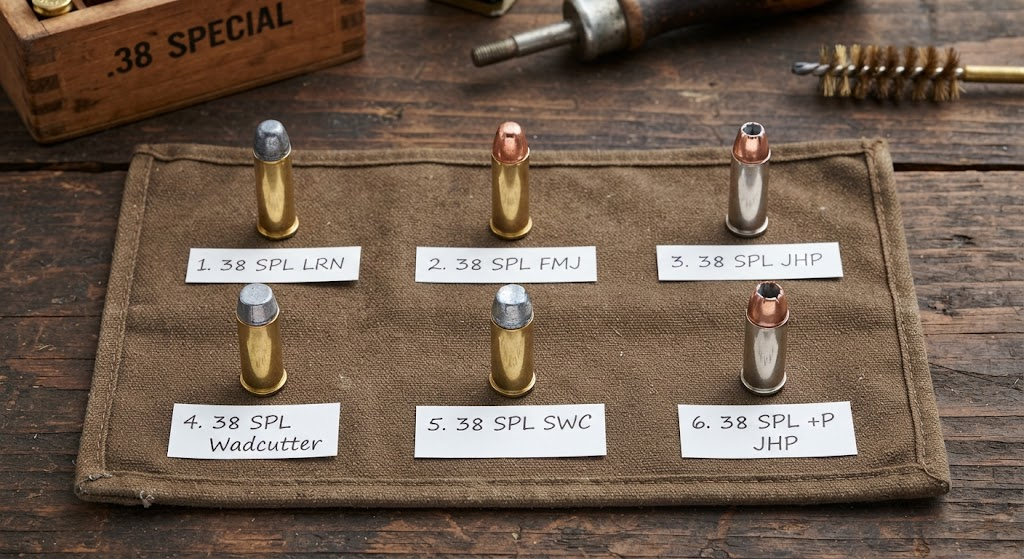
Table of Contents [Click to open]
.38 Special Ammo Types
The .38 Special is one of the most prolific revolver cartridges in history, utilizing a wide variety of projectile designs to accommodate different barrel lengths and shooting applications. For target shooters, the focus is on low recoil and clean holes in paper. For personal defense, particularly in short-barreled “snub-nose” revolvers, shooters rely on lighter hollow points or higher-pressure +P loads to ensure consistent terminal expansion.
Below is a comprehensive comparison of the core .38 Special ammunition types based on published manufacturer data:
| Ammo Type | Typical Bullet/Projectile | Main Purpose | Typical Weight | Typical Velocity | Key Characteristic |
| LRN | Lead Round Nose | Target shooting / historic | 158 gr | 755 fps | Exposed soft lead, round profile |
| Wadcutter | Flat Solid Lead (HBWC) | Target competition | 148 gr | 710 fps | Flat profile, cuts clean paper holes |
| FMJ | Full Metal Jacket | Range training | 130 gr | 800 fps | Copper jacket, clean burning |
| SWC | Lead Semi-Wadcutter | General plinking | 158 gr | 800 fps | Flat nose with a sharp shoulder |
| JHP | Jacketed Hollow Point | Self-defense | 125 gr | 900 fps | Expands on impact |
| +P JHP | Overpressure Hollow Point | Maximum self-defense | 125 gr | 945 fps | Higher pressure for reliable expansion |
.38 Special LRN Ammo
.38 Special LRN (Lead Round Nose) ammo is the original, historic standard for the cartridge. This ammunition features a completely unjacketed lead bullet with a rounded nose profile. The traditional standard load is a 158-grain bullet traveling at roughly 750 to 770 feet per second (fps). While LRN ammunition is highly affordable and offers mild recoil, it provides zero expansion and is generally considered obsolete for modern self-defense. It remains popular today strictly for inexpensive target practice and cowboy action shooting.
.38 Special Wadcutter Ammo
.38 Special Wadcutter ammo features a specialized, completely flat-faced lead cylinder designed specifically for paper target competition. A standard target load, such as the Federal Gold Medal 148-grain Hollow Base Wadcutter (HBWC), travels at a very mild 710 fps. Because the front of the bullet is perfectly flat, it acts like a hole punch upon impact, cutting a perfectly round, easily scorable hole in a paper target. Wadcutters generate exceptionally low recoil, making them ideal for training new shooters.
.38 Special FMJ Ammo
.38 Special FMJ (Full Metal Jacket) ammo is the modern standard for high-volume indoor and outdoor range training. Unlike heavy 158-grain lead loads, standard FMJ ammunition often uses a lighter 130-grain bullet traveling at 800 fps. The copper jacket fully encapsulates the lead core, preventing lead buildup (fouling) inside the revolver’s barrel and reducing airborne lead exposure at indoor ranges. It does not expand on impact and is not recommended for personal defense.
.38 Special JHP Ammo
.38 Special JHP (Jacketed Hollow Point) ammo is engineered for civilian concealed carry and home defense. The bullet features a hollow cavity at the nose that forces the lead and copper jacket to peel outward into a mushroom shape upon striking soft tissue. A standard-pressure 125-grain JHP typically travels at 900 fps. The expansion prevents the bullet from passing entirely through an attacker, transferring all its kinetic energy into the target while mitigating the risk of striking bystanders.
.38 Special +P Ammo
.38 Special +P (Overpressure) ammo is loaded to a higher internal pressure specification than standard .38 Special ammunition. Because the .38 Special is a relatively low-velocity cartridge, standard JHP bullets sometimes fail to expand when fired from short 2-inch revolver barrels. By loading the cartridge to +P pressures, manufacturers safely push a 125-grain JHP to roughly 945 fps, or a 110-grain JHP over 1,000 fps. This extra velocity guarantees reliable expansion. One of the most famous variants is the “FBI Load”, a 158-grain Lead Semi-Wadcutter Hollow Point (LSWCHP) +P that was heavily used by law enforcement for decades.
.38 Special Ammo Types Compared
Different .38 Special bullet types explained by their optimal application:
- Target Competition: 148-grain Wadcutters are unmatched for scoring paper targets due to their flat profile and ultra-low recoil.
- Volume Range Training: 130-grain FMJ is the best option for keeping the firearm clean during long practice sessions.
- Concealed Carry (Snub-Nose): 110-grain or 125-grain +P JHP ammunition is critical to achieving the velocity required for hollow point expansion in short barrels.
- Home Defense (Full-Size): Standard pressure 125-grain JHP or the heavy 158-grain LSWCHP +P provides massive energy transfer with highly manageable recoil.
- Historical/Cowboy Shooting: 158-grain LRN provides the traditional ballistic profile required by cowboy action shooting rules.
How To Choose .38 Special Ammo
Choosing the right .38 Special ammunition types depends heavily on your revolver’s barrel length and its pressure rating. If you carry a modern lightweight aluminum “snub-nose” revolver, you must verify that the barrel is stamped with “+P”. If it is rated for +P, select a lightweight 110-grain or 125-grain +P JHP from a reputable manufacturer like Hornady or Federal to ensure the bullet will expand despite the short barrel. If you are shooting an older, vintage revolver from the mid-20th century, strictly avoid +P ammunition as it can damage the cylinder. For all vintage revolvers, stick to standard pressure 158-grain LRN or 130-grain FMJ.
Pros And Cons Of Different .38 Special Ammo Types
Lead Round Nose (LRN)
- Pros: Very inexpensive, traditional feel, mild recoil.
- Cons: Exposed lead fouls the barrel quickly, zero expansion makes it a poor choice for defense.
Wadcutter (WC)
- Pros: Lowest recoil of any .38 Special load, cuts perfect holes for easy scoring.
- Cons: Poor aerodynamics at long range, very difficult to load quickly using a speedloader due to the flat face.
Full Metal Jacket (FMJ)
- Pros: Affordable range ammo, keeps the barrel clean, widely available in bulk.
- Cons: Over-penetrates in self-defense scenarios, does not transfer energy efficiently.
Jacketed Hollow Point (JHP)
- Pros: Rapid expansion, reduced risk of over-penetration, optimal for home defense.
- Cons: Can fail to expand if fired from snub-nose revolvers without enough velocity.
+P Overpressure Ammo
- Pros: Maximum stopping power and reliable hollow point expansion, even from short barrels.
- Cons: Snappier recoil, louder report, and cannot be safely fired in older, non-+P rated revolvers.
FAQs
What are the different types of .38 Special ammo?
The main types include Lead Round Nose (LRN), Wadcutter (WC), Semi-Wadcutter (SWC), Full Metal Jacket (FMJ), Jacketed Hollow Point (JHP), and +P (overpressure) ammunition.
What is .38 Special LRN ammo?
LRN stands for Lead Round Nose. It is a traditional, unjacketed solid lead bullet with a rounded tip, used almost exclusively for inexpensive target practice.
What is .38 Special Wadcutter ammo?
A wadcutter is a flat-faced lead bullet seated flush with the mouth of the brass casing. It is designed to punch perfectly round holes in paper targets for competitive shooting.
What is .38 Special FMJ ammo?
FMJ (Full Metal Jacket) features a lead core completely covered by a copper jacket. It is the standard commercial choice for indoor range training because it prevents lead buildup in the barrel.
What is .38 Special JHP ammo?
JHP (Jacketed Hollow Point) ammo has a hollow cavity in the nose. Upon impact, the cavity fills with fluid and forces the bullet to expand, making it the top choice for self-defense.
What does +P mean in .38 Special ammo?
The “+P” designation means the cartridge is loaded to a higher internal pressure than standard .38 Special specifications. This generates more velocity, ensuring hollow points expand properly.
Can I shoot +P ammo in any .38 Special revolver?
No. You should only fire +P ammunition in revolvers that have “+P” stamped on the barrel. Firing overpressure ammunition in older or lighter revolvers not rated for it can cause catastrophic failure.
What is the best .38 Special ammo for a snub-nose revolver?
A lightweight +P JHP (such as a 110-grain or 125-grain load) is generally best for a snub-nose, as the higher pressure compensates for the velocity lost in the short 2-inch barrel.
What is the famous FBI Load for .38 Special?
The “FBI Load” is a 158-grain Lead Semi-Wadcutter Hollow Point (LSWCHP) loaded to +P pressures. It was historically favored by law enforcement for its deep penetration and reliable expansion.
Can I shoot .38 Special ammo in a .357 Magnum?
Yes. A .357 Magnum revolver can safely chamber and fire all standard and +P .38 Special ammunition types, making the .38 Special an excellent low-recoil training option for magnum owners.
What is the difference between .38 Special and 9mm?
The .38 Special is a rimmed cartridge designed for revolvers, typically operating at lower pressures and velocities. The 9mm is a rimless cartridge designed for semi-automatic pistols, operating at much higher pressures.
Is .38 Special good for self-defense?
Yes, when loaded with modern JHP or +P ammunition, the .38 Special has a proven, decades-long track record of effectiveness for civilian concealed carry and home defense.
.38 Special Ammo Types: Final Answer
When examining .38 Special ammo types, the primary categories are dictated by target shooting and self-defense. Wadcutter and Lead Round Nose (LRN) ammunition provide ultra-low recoil and extreme cost-efficiency for classic paper target practice. Modern Full Metal Jacket (FMJ) loads serve as the standard for keeping revolvers clean during high-volume training. For personal protection, Jacketed Hollow Point (JHP) rounds deliver the necessary terminal expansion, with +P overpressure variants specifically designed to maximize the performance of short-barreled snub-nose revolvers.