The main 357 magnum ammo types include Jacketed Hollow Point (JHP), Jacketed Soft Point (JSP), Full Metal Jacket (FMJ), Lead Semi-Wadcutter (LSWC), Hard Cast, and Specialty or Flex Tip ammunition. JHP rounds are the gold standard for civilian concealed carry and home defense, while JSP and Hard Cast loads are engineered for deep penetration when hunting medium to large game. FMJ and LSWC rounds are commonly available to civilian shooters as cost-effective options for volume target practice. Because the .357 Magnum is a highly versatile revolver cartridge, shooters have unrestricted access to almost all of these commercial variants.
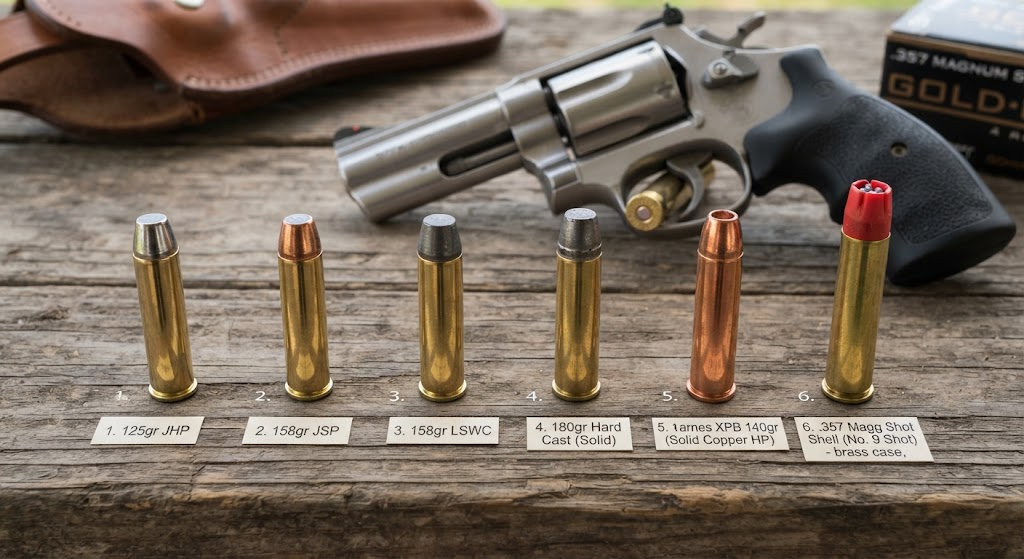
Table of Contents [Click to open]
357 Magnum Ammo Types
The .357 Magnum is one of the most versatile handgun cartridges available, utilizing a wide spectrum of projectile designs to accomplish entirely different ballistic goals. For personal defense, the focus is on rapid expansion and energy transfer to stop a threat quickly. For handgun hunting or wilderness defense, shooters rely on heavy, non-deforming projectiles that penetrate deeply through muscle and bone. For range training, the priority shifts to affordable, non-expanding lead or copper-jacketed bullets.
Below is a comprehensive comparison of the core 357 magnum ammunition types based on published manufacturer data:
| Ammo Type | Typical Bullet/Projectile | Main Purpose | Typical Weight | Typical Velocity | Key Characteristic |
| JHP | Jacketed Hollow Point | Self-defense / personal protection | 125 gr | 1,450 fps | Expands rapidly to prevent over-penetration |
| JSP | Jacketed Soft Point | Hunting medium game | 158 gr | 1,240 fps | Controlled expansion with deep penetration |
| FMJ | Full Metal Jacket | Target shooting / training | 158 gr | 1,200 fps | Non-expanding copper jacket |
| LSWC | Lead Semi-Wadcutter | Target practice / outdoor carry | 158 gr | 1,235 fps | Cuts clean holes in paper targets |
| Hard Cast | Solid Lead Flat Nose | Bear defense / large game | 180 gr | 1,400 fps | Extreme penetration without deformation |
| Flex Tip | Polymer Tipped (FTX) | Lever-action rifles / hunting | 140 gr | 1,440 fps | Aerodynamic tip safe for tubular magazines |
357 Magnum JHP Ammo
357 Magnum JHP (Jacketed Hollow Point) ammo is the premier choice for law enforcement and civilian self-defense. The benchmark load is the 125-grain JHP, pioneered by companies like Federal and Remington. Fired from a 4-inch revolver barrel, a 125-grain Federal JHP reaches roughly 1,450 feet per second (fps) and generates nearly 580 ft-lbs of muzzle energy. The hollow cavity is designed to fill with fluid and aggressively peel back into a mushroom shape, transferring maximum energy into the target while limiting the risk of over-penetration.
357 Magnum JSP Ammo
357 Magnum JSP (Jacketed Soft Point) ammo bridges the gap between expanding hollow points and deeply penetrating solid bullets. Ammunition like the Federal 158-grain JSP travels at approximately 1,240 fps. Instead of a hollow cavity, the nose features an exposed lead core. Upon impact, a JSP expands more slowly and retains more of its original weight than a JHP. This makes JSP ammunition the ideal choice for handgun hunters pursuing deer or feral hogs, where deep penetration through a heavy shoulder blade is required.
357 Magnum FMJ Ammo
357 Magnum FMJ (Full Metal Jacket) ammo, sometimes labeled as TMJ (Total Metal Jacket), is primarily used for target shooting and training [1.1.5]. This ammunition features a lead core completely encased in a copper jacket. Standard 158-grain FMJ loads, like those from Sellier & Bellot or Fiocchi, typically travel at roughly 1,200 to 1,260 fps. Because FMJ bullets do not expand on impact, they are not recommended for self-defense. However, they are highly affordable and feed reliably in lever-action rifles.
357 Magnum LSWC Ammo
357 Magnum LSWC (Lead Semi-Wadcutter) ammo features a specialized cast lead bullet with a flat nose and a sharp shoulder. Remington and other manufacturers commonly load 158-grain LSWC bullets to roughly 1,235 fps. The sharp shoulder of the semi-wadcutter acts like a hole punch, cutting a perfectly clean, circular hole in paper targets for easy scoring during competitions. LSWC rounds are also popular among outdoorsmen for general field use and small game hunting because the flat nose delivers solid blunt-force trauma without destroying excess meat.
357 Magnum Hard Cast Ammo
357 Magnum Hard Cast ammo is purpose-built for extreme penetration against dangerous predators like bears or moose. Unlike standard soft lead bullets, hard cast bullets are alloyed with antimony and tin to make them incredibly rigid. A prime example is the Buffalo Bore 180-grain Hard Cast Flat Nose, which exits a standard barrel at an impressive 1,400 fps. The bullet will not deform or mushroom on impact, allowing it to smash straight through thick hide, heavy bone, and dense muscle tissue to reach vital organs.
357 Magnum Flex Tip Ammo
357 Magnum Flex Tip ammo, prominently featured in the Hornady LEVERevolution line, uses an elastomer polymer tip (FTX). This ammunition was explicitly designed for use in lever-action rifles with tubular magazines. Traditional pointed bullets can accidentally ignite the primer of the cartridge in front of them under recoil. The soft polymer tip eliminates this risk. A 140-grain Hornady FTX travels at 1,440 fps and offers superior aerodynamics and consistent expansion for rifle hunters.
357 Magnum Ammo Types Compared
Different 357 magnum bullet types explained by their optimal application:
- Self-Defense: 125-grain JHP rounds are mathematically proven to offer the best balance of expansion, penetration, and stopping power for concealed carry and home defense.
- Medium Game Hunting: 158-grain JSP rounds offer controlled expansion for hunting deer-sized game out to 50 yards with a revolver, or 100 yards with a lever-action rifle.
- Target Shooting: FMJ and LSWC rounds provide cost-effective practice. LSWC is specifically preferred by competitive target shooters for scoring clean holes.
- Wilderness Defense: Heavy 180-grain Hard Cast flat-nose bullets are strictly engineered to stop dangerous predators by delivering maximum, non-deforming penetration.
- Lever-Action Rifles: Hornady FTX polymer-tipped ammunition maximizes the ballistic coefficient for extended range hunting while remaining completely safe in tubular magazines.
How To Choose 357 Magnum Ammo
Choosing the correct 357 magnum ammo types depends on your specific firearm barrel length and intended target. If you carry a short 2-inch snub-nose revolver for self-defense, a 125-grain JHP is highly recommended, as it is engineered to achieve reliable expansion even at lower velocities. If you are carrying a 4-inch or 6-inch revolver in bear country, standard hollow points will lack the necessary penetration, making heavy 180-grain Hard Cast ammunition the required choice. For high-volume range sessions, always opt for 158-grain FMJ to save money and reduce lead fouling in your barrel. Additionally, remember that any .357 Magnum revolver can safely fire .38 Special ammunition, providing an even softer recoiling option for training.
Pros And Cons Of Different 357 Magnum Ammo Types
Jacketed Hollow Point (JHP)
- Pros: Massive energy transfer, rapid expansion, reduced risk of over-penetration in urban environments.
- Cons: Can fail to expand if fired from very short barrels or if the hollow cavity plugs with heavy clothing.
Jacketed Soft Point (JSP)
- Pros: Deep penetration and consistent weight retention for hunting medium game.
- Cons: Over-penetrates on human-sized targets, making it a liability for urban self-defense.
Full Metal Jacket (FMJ)
- Pros: Highly affordable, feeds flawlessly in rifles, leaves less lead residue in the barrel than unjacketed rounds.
- Cons: Zero expansion limits its effectiveness for hunting or defense.
Lead Semi-Wadcutter (LSWC)
- Pros: Cuts perfectly clean holes in paper, excellent for small game, very cost-effective.
- Cons: Exposed lead can cause faster barrel fouling; sharp shoulders can occasionally cause feeding issues in lever-action rifles.
Hard Cast Solid
- Pros: Unmatched straight-line penetration against massive, heavy-boned predators.
- Cons: Heavy recoil, expensive, and completely inappropriate for urban self-defense due to extreme over-penetration.
FAQs
What are the different types of 357 magnum ammo?
The main types include Jacketed Hollow Point (JHP), Jacketed Soft Point (JSP), Full Metal Jacket (FMJ), Lead Semi-Wadcutter (LSWC), Hard Cast, and Flex Tip ammunition.
What is 357 magnum JHP ammo?
JHP stands for Jacketed Hollow Point. These bullets have a hollowed-out nose designed to expand rapidly upon impact, creating a massive wound channel while preventing over-penetration.
What is 357 magnum JSP ammo?
Jacketed Soft Point bullets feature an exposed lead tip instead of a hollow cavity. They expand slower than JHPs, allowing for deeper penetration on medium-sized game like deer.
What is 357 magnum FMJ ammo?
FMJ (Full Metal Jacket) ammo features a lead core fully encased in a copper jacket. It does not expand and is primarily used for affordable target practice and range training.
What is 357 magnum LSWC ammo?
Lead Semi-Wadcutter ammo uses an unjacketed lead bullet with a flat nose and a sharp shoulder, designed to punch clean, readable holes in paper targets.
What is the difference between 357 magnum JHP and JSP?
JHP is engineered to open quickly and violently for self-defense, whereas JSP is designed to open slowly and hold together for deep penetration during hunting.
What type of 357 magnum ammo is best for self-defense?
The 125-grain Jacketed Hollow Point (JHP) is widely considered the optimal choice for .357 Magnum self-defense, offering a proven track record of rapid expansion and high energy transfer.
What type of 357 magnum ammo is best for target shooting?
Standard 158-grain FMJ or LSWC ammunition is best for target shooting because these types are significantly cheaper than specialized defensive or hunting rounds.
What 357 magnum ammo is best for bear defense?
For large predator defense, 180-grain or 200-grain Hard Cast solid lead flat-nose bullets are best, as they provide the extreme, non-deforming penetration needed to break through heavy bone.
Can a 357 magnum shoot 38 Special ammo?
Yes. Because the .357 Magnum case is simply a lengthened .38 Special case, any firearm chambered in .357 Magnum can safely fire .38 Special ammunition.
What is 357 magnum Flex Tip ammo?
Flex Tip (FTX) ammo features a soft polymer tip inserted into a hollow point. It is specifically designed to safely feed and stack in the tubular magazines of lever-action rifles without risk of accidental primer detonation.
Why are 125-grain and 158-grain bullets so common in 357 magnum?
The 158-grain weight is the original historic standard for the cartridge, offering deep penetration. The lighter 125-grain weight was developed later specifically to maximize velocity (often exceeding 1,400 fps) for explosive terminal performance in self-defense.
Is 357 magnum ammo commonly available?
Yes, the .357 Magnum is one of the most popular centerfire revolver cartridges in the world, and nearly all ammunition manufacturers produce multiple types of loads for it.
357 Magnum Ammo Types: Final Answer
When evaluating 357 magnum ammo types, ammunition selection dictates the capability of the firearm. Jacketed Hollow Point (JHP) rounds, particularly in the 125-grain weight class, represent the gold standard for civilian self-defense and law enforcement carry. For handgun and lever-action hunting, Jacketed Soft Point (JSP) and polymer-tipped FTX rounds deliver controlled expansion on medium game. To combat massive, thick-skinned predators in the backcountry, heavy 180-grain Hard Cast bullets provide crucial, non-deforming penetration. Finally, for standard range practice, shooters rely on universally available Full Metal Jacket (FMJ) and Lead Semi-Wadcutter (LSWC) ammunition to balance performance and affordability.