The main 50 BMG ammo types include Ball, Armor-Piercing (AP), Incendiary, Armor-Piercing Incendiary (API), Tracer, Match, and Training or Frangible ammunition. Ball and Match ammunition are the most commonly available types for civilian shooters, engineered for general target practice and extreme long-range precision, respectively. Specialized military variants, such as AP, Incendiary, API, and Tracer, are designed for anti-materiel use, trajectory observation, and vehicle penetration. While military surplus ammunition does enter the civilian market, access to types like API and Tracer is often heavily restricted by local laws and civilian shooting range regulations due to severe fire hazards and target destruction.
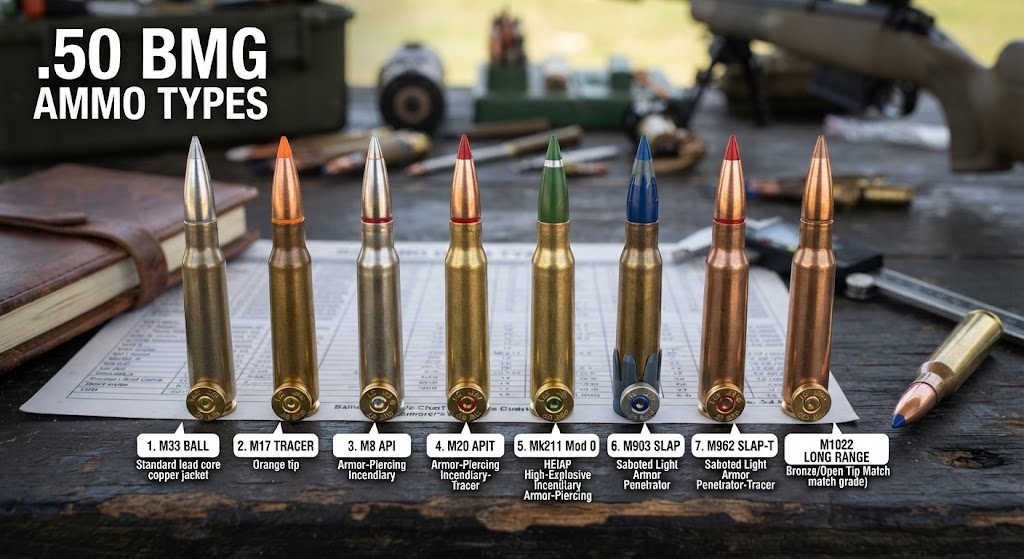
Table of Contents [Click to open]
50 BMG Ammo Types
The .50 Browning Machine Gun (12.7×99mm NATO) cartridge utilizes a wide variety of projectile designs to accomplish different ballistic goals. For military forces, these rounds are deployed in heavy machine guns and anti-materiel rifles to disable light armor and unexploded ordnance. For civilian shooters, the focus is largely on high-ballistic-coefficient target rounds for extreme long-range (ELR) shooting. The different 50 BMG bullet types are typically identified by military-standard color-coded tips.
Below is a comprehensive comparison of the core 50 BMG ammunition types based on published manufacturer and military data:
| Ammo Type | Typical Bullet/Projectile | Main Purpose | Typical Weight | Typical Velocity | Key Characteristic |
| Ball | Full Metal Jacket (M33) | Target shooting / personnel | 661 gr | 2,910 fps | Plain tip, copper/gilding metal jacket |
| AP | Hardened Core (M2) | Light armor penetration | 706.7 gr | 2,930 fps | Black tip, hardened steel/tungsten core |
| Incendiary | Incendiary Filler (M1) | Igniting flammable targets | ~640 gr | ~2,950 fps | Blue tip, bursts into flame on impact |
| API | AP + Incendiary (M8) | Penetration and fire | 622.5 gr | ~2,800 fps | Silver tip, hardened core + incendiary |
| Tracer | Pyrotechnic Base (M17) | Observing trajectory | ~643 gr | 2,910 fps | Red or brown tip, luminous trace |
| Match | Solid Copper / A-Tip | Extreme long-range precision | 750 gr | 2,815 fps | Extremely high ballistic coefficient |
| Training | Plastic (M858) / Frangible | Short-range training safety | ~50-600 gr | Varies widely | Blue plastic or powdered metal core |
50 BMG Ball Ammo
50 BMG ball ammo is the standard, general-purpose cartridge used for anti-personnel, unarmored targets, and standard range training. The most common military specification is the Lake City M33 Ball, which features a 661-grain full metal jacket (FMJ) projectile. Fired from a standard military barrel, M33 ball ammunition produces a muzzle velocity of roughly 2,910 feet per second (fps) and generates over 12,400 ft-lbs of muzzle energy. For civilians, standard ball ammo manufactured by Federal, PMC, and Lake City represents the most cost-effective way to shoot the .50 BMG.
50 BMG Armor-Piercing Ammo
50 BMG AP ammo is engineered to defeat light armor, concrete shelters, and hardened vehicle barriers. The U.S. military M2 AP cartridge utilizes a 706.7-grain projectile with a manganese-molybdenum steel core. Identified by a black painted tip, the M2 AP round has a muzzle velocity of approximately 2,930 fps and can penetrate nearly an inch of face-hardened steel at 200 yards. While highly effective for military applications, AP ammunition rapidly degrades steel targets at civilian ranges.
50 BMG Incendiary Ammo
50 BMG incendiary ammo is designed specifically to ignite flammable materials, such as aviation fuel or lightly armored vehicle fuel tanks. The military M1 Incendiary round, identifiable by its blue bullet tip, contains an IM 11 incendiary composition that bursts into intense flame upon impacting a hardened target. Due to the severe fire risk it poses, incendiary ammunition is strictly prohibited at almost all civilian and public shooting ranges.
50 BMG API Ammo
50 BMG API ammo (Armor-Piercing Incendiary) combines the penetrating power of an AP round with the destructive fire-starting capability of an incendiary round. The M8 API features a silver tip, a 622.5-grain projectile, and an IM 11 incendiary filler. A more advanced variant is the Mk211 Mod 0 (Raufoss), a 665-grain high-explosive incendiary armor-piercing (HEIAP) round with a green-over-white tip. Firing at 2,950 fps, the Mk211 utilizes a tungsten penetrator and a pyrotechnic ignition train to devastate military materiel. This is highly specialized, expensive, and legally complex ammunition.
50 BMG Tracer Ammo
50 BMG tracer ammo allows the shooter to visually track the flight path of the bullet to walk fire onto a target. Rounds like the M17 or M1 Tracer (red or brown tips) contain a pyrotechnic charge at the base of the bullet. Upon firing, the burning powder ignites the tracer compound, which burns brightly during flight. The M1 Tracer can be observed out to roughly 1,750 meters. Like incendiary rounds, tracers pose a massive fire hazard in dry environments.
50 BMG Match Ammo
50 BMG match ammo is meticulously manufactured to absolute tolerances for extreme long-range competitive and tactical shooting. Unlike standard ball ammo, match ammo utilizes aerodynamically superior projectiles. A prime example is the Hornady 750-grain A-Tip Match round, which features a muzzle velocity of 2,815 fps and an incredibly high G1 ballistic coefficient of 1.050. This allows the bullet to remain supersonic past 2,000 yards. Match ammunition prioritizes consistency in brass wall thickness, powder charge, and bullet concentricity.
50 BMG Training Ammo
50 BMG training ammo is designed for use where standard range restrictions prohibit the firing of live, full-power 12.7mm ammunition. The M858 and M860 are plastic training cartridges (often molded with blue plastic cases and bullets) designed for short-range target practice. They limit maximum travel distance to roughly 700 meters. Frangible brass or copper-powder ammunition is also available, designed to disintegrate upon hitting steel targets, completely eliminating ricochet hazards for close-quarter heavy rifle drills.
50 BMG Ammo Types Compared
Different 50 BMG ammo types explained by their optimal application:
- Target Shooting: Standard M33 ball ammunition is ideal for volume shooting at paper or steel targets within 1,000 yards due to its lower cost.
- Long-Range Shooting: Match-grade ammunition (such as 750-grain Hornady or Barnes solid copper rounds) is essential for precision shooting beyond 1,000 yards.
- Training: Plastic training rounds (M858) or commercial frangible loads are utilized for short-range drills and to preserve steel targets.
- Military Applications: Mk211 Raufoss, M8 API, and M2 AP are strictly engineered to destroy engine blocks, unexploded ordnance, and light armor.
- Historical/Surplus Use: Surplus M33 and M2 AP rounds are popular among collectors and historical firearm enthusiasts.
- Hunting: While generally considered extreme overkill, solid copper expanding rounds can legally be used in select jurisdictions for ultra-long-range hunting of massive, dangerous game.
How To Choose 50 BMG Ammo
Choosing the right 50 BMG ammunition types depends entirely on the rifle platform, the shooting distance, and the backstop. If shooting a semi-automatic Barrett M82A1 at 500 yards, surplus M33 ball ammunition provides a cost-effective, reliable option. If shooting a bolt-action McMillan TAC-50 at 2,000 yards, match ammunition with a high ballistic coefficient (over 1.000 G1) is mathematically required to fight wind drift and maintain precision. Ensure that your local shooting range allows .50 caliber rifles, and verify that they allow standard FMJ ball, as steel-core AP and tracers are almost universally banned at commercial facilities.
Pros And Cons Of Different 50 BMG Ammo Types
Ball (M33)
- Pros: Most affordable, widely available, easiest on rifle barrels.
- Cons: Lower ballistic coefficient (0.620 G1) means it suffers from significant wind drift at distances past 1,000 yards.
Armor-Piercing (M2)
- Pros: Unmatched barrier penetration for civilian-legal (in most areas) surplus ammo.
- Cons: Will punch straight through expensive AR500 steel targets; often banned at ranges.
API / Incendiary (M8 / Mk211)
- Pros: Maximum terminal ballistic effect on heavy machinery and materiel.
- Cons: Extremely expensive, difficult to source, legality varies by jurisdiction, causes extreme fire hazards.
Match (750gr A-Tip)
- Pros: Retains supersonic speeds past a mile; delivers elite precision.
- Cons: Highly expensive per round ($8.00 to $10.00+ each).
FAQs
What are the different types of 50 BMG ammo?
The main types include Ball, Armor-Piercing (AP), Incendiary, Armor-Piercing Incendiary (API), Tracer, Match, and Training/Frangible ammunition.
What is 50 BMG ball ammo?
Ball ammo, like the military M33, is a standard full metal jacket round containing a lead core (or mild steel) wrapped in a copper jacket, used for general target practice and anti-personnel roles.
What is 50 BMG AP ammo?
Armor-Piercing (AP) ammo, such as the M2 black tip, contains a hardened steel or tungsten penetrator core designed to pierce light vehicle armor and concrete.
What is 50 BMG incendiary ammo?
Incendiary ammo (blue tip) is packed with a chemical compound (such as IM 11) that ignites upon impact with a hard surface, used to start fires in fuel tanks or aviation equipment.
What is 50 BMG API ammo?
API stands for Armor-Piercing Incendiary. Rounds like the silver-tipped M8 feature both a hardened penetrator to punch through armor and an incendiary payload to cause catastrophic fire damage inside the target.
What is 50 BMG tracer ammo?
Tracer ammo features a pyrotechnic mixture at the base of the bullet that burns brightly in flight, allowing the gunner to visually track the bullet’s path and correct their aim.
What is 50 BMG match ammo?
Match ammo is loaded to extremely strict tolerances using heavy, aerodynamic bullets (like 750-grain solid copper or A-Tip projectiles) to maximize accuracy and range for precision civilian and sniper use.
What is the difference between 50 BMG ball and AP?
Ball ammo uses a soft lead or mild steel core meant for general targets, while AP ammo uses a hardened high-density core (like manganese-molybdenum steel) specifically engineered to push through armor plating.
What type of 50 BMG ammo is best for target shooting?
For targets inside 1,000 yards, standard M33 ball is best due to cost. For targets beyond 1,000 yards, 750-grain match ammunition is best due to its superior wind deflection.
What 50 BMG ammo is commonly available?
Standard ball (FMJ) and commercial match ammunition are the most widely available .50 BMG ammunition types for civilians.
What is the difference between military and commercial 50 BMG ammo?
Military ammo is typically loaded for volume machine-gun fire, prioritizing barrier penetration (AP/API) and observation (Tracer). Commercial ammo prioritizes precision accuracy for single-shot or semi-auto rifles (Match) or affordable range time (standard FMJ).
Is 50 BMG armor-piercing ammo legal for civilians?
Under federal U.S. law, .50 BMG AP ammo is generally not classified as “armor-piercing handgun ammunition” and can be owned, but specific state laws heavily regulate or ban its possession. Always check local laws.
How far can a 50 BMG bullet travel?
Depending on the angle of departure, a standard .50 BMG projectile can travel well over 4 miles (approximately 7,000 meters) before hitting the ground, making safe backstops critical.
Why is 50 BMG match ammo so expensive?
It requires massive brass cases, nearly 250 grains of specialized slow-burning powder, massive primers, and highly engineered, CNC-machined projectiles (like solid brass or aluminum-tipped copper) manufactured to zero-tolerance specifications.
50 BMG Ammo Types: Final Answer
When examining 50 BMG ammo types, the classification comes down to the projectile’s core and tip. Standard M33 Ball is the foundational round for training and general civilian target shooting. Military applications rely heavily on color-coded specialized rounds, such as M2 Armor-Piercing (black tip), M1 Incendiary (blue tip), M8 API (silver tip), and Mk211 Raufoss, to disable vehicles and materiel. For the civilian marksman attempting to maximize the extreme long-range ballistics of the cartridge, heavily optimized 750-grain match ammunition provides the necessary ballistic coefficient to strike targets beyond 2,000 yards.