The main pros of the Ruger Precision Rimfire in 17 HMR are its highly adjustable chassis, excellent sub-MOA accuracy potential, and clever adjustable bolt throw, while the main cons are its hefty weight for a field gun and a bolt lift that can feel somewhat stiff out of the box. This bolt-action rimfire rifle scales down Ruger’s wildly successful centerfire precision platform into an affordable, feature-rich rimfire trainer. While it consistently delivers match-grade precision that makes short work of prairie dogs and ground squirrels, its 6.8-pound bare weight means it is far better suited for shooting from a bipod than carrying through the woods. Because it features a Quick-Fit adjustable stock, an AR-style grip, and a free-floated M-LOK handguard, it serves as the ultimate benchrest trainer and a devastatingly precise varmint eradication tool.
Ruger 17 HMR Precision Rifle Pros And Cons
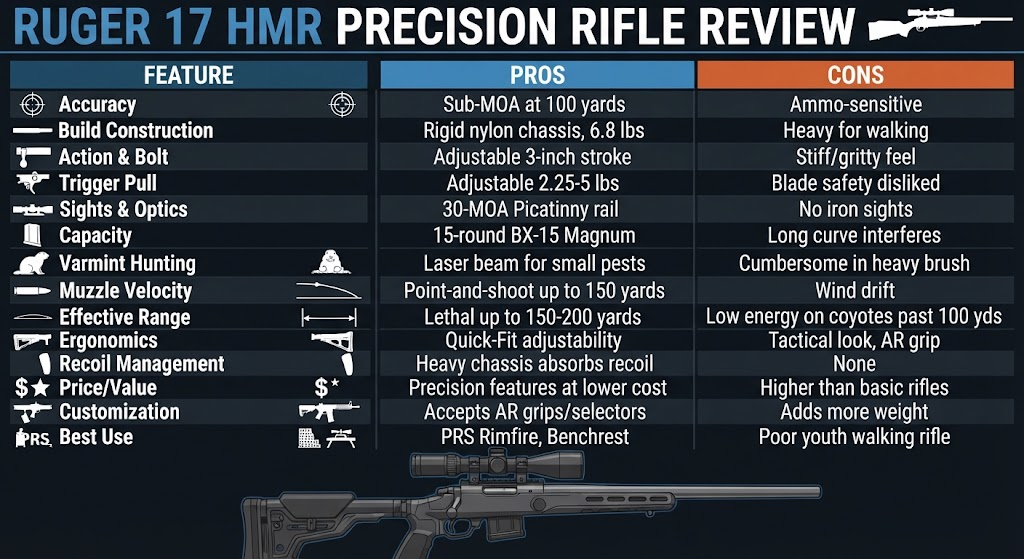
| Feature | Pros | Cons |
| Accuracy | Consistently capable of sub-MOA groups at 100 yards with premium polymer-tipped ammunition. | Rimfire barrels can be highly ammo-sensitive, requiring trial and error to find the perfect load. |
| Build construction | Features a cold hammer-forged 1137 alloy steel barrel and a rigid glass-filled nylon chassis. | Weighs 6.8 lbs unscoped, making it quite heavy for a walking varmint hunter. |
| Action and bolt | Innovative adjustable bolt throw lets you mimic a short-action centerfire rifle’s 3-inch stroke. | The bolt lift can feel slightly stiff and gritty when cocking the striker on a new rifle. |
| Trigger pull | Ruger Marksman Adjustable trigger is crisp, clean, and adjustable from 2.25 to 5 pounds. | The center trigger blade safety mechanism is disliked by some traditional benchrest shooters. |
| Sights and optics | Comes factory-equipped with a 30-MOA Picatinny rail, perfect for long-range rimfire optics. | Lacks iron sights completely, requiring the mandatory purchase of a magnified rifle scope. |
| Capacity | Feeds reliably from Ruger’s excellent 15-round BX-15 Magnum detachable box magazines. | The long curved magazine can slightly interfere when shooting off low-profile bench bags. |
| Varmint hunting performance | An absolute laser beam on small pests, allowing for ethical headshots on groundhogs and squirrels. | Heavy chassis and long overall footprint make it cumbersome in thick woods or heavy brush. |
| Muzzle velocity | The 18-inch barrel maximizes the powder burn of the 17 HMR for blazing fast velocities. | Still significantly slower and less powerful than centerfire varmint rounds like the .223 Remington. |
| Trajectory | Flat enough for a simple point-and-shoot zero inside 125 to 150 yards. | The ultra-light 17-grain bullet drifts aggressively in the wind at longer distances. |
| Effective hunting range | Highly lethal on small game and pests out to 150 or 200 yards on calm, windless days. | Drops below the kinetic energy threshold needed for ethical shots on coyotes past 100 yards. |
| Ergonomics | Quick-Fit adjustable stock perfectly dials in length of pull and comb height for any shooter. | The AR-style pistol grip and tactical aesthetic do not appeal to traditional wood-stock hunters. |
| Recoil management | The heavy chassis completely absorbs the microscopic recoil of the 17 HMR cartridge. | None. |
| Price/value | Offers centerfire precision rifle features and adjustability at a fraction of the cost. | Priced significantly higher than standard entry-level rimfire plinking rifles. |
| Customization | Accepts standard AR-15 pistol grips and safety selectors for endless aftermarket upgrading. | Upgrading to heavier precision parts will only add to the rifle’s already substantial weight. |
| Best use | PRS Rimfire competition, long-range benchrest shooting, and stationary varmint hunting. | A poor choice for a youth walking rifle due to its heavy, tactical profile. |
Accuracy
The Ruger Precision Rimfire is engineered strictly for accuracy. It utilizes an 18-inch cold hammer-forged barrel with a 1:9-inch twist rate perfectly tailored for the 17 HMR cartridge. Because the barrel is completely free-floated inside the aluminum M-LOK handguard, nothing touches the steel to disrupt barrel harmonics. When paired with high-quality ammunition like Hornady 17-grain V-MAX, the rifle is highly capable of shooting sub-MOA (less than one inch) groups at 100 yards, allowing shooters to pick off tiny targets at impressive distances.
Build Construction And Chassis
Instead of an expensive machined aluminum lower, Ruger utilizes a highly rigid glass-filled nylon chassis for the lower receiver, paired with a hard-coat anodized aluminum free-float handguard. This construction keeps the cost down while maintaining the structural rigidity required for precision shooting. The rifle features a threaded muzzle (1/2×28 thread pitch) straight from the factory, making it incredibly easy to attach a rimfire suppressor or a muzzle brake.
Action, Bolt, And Magazines
One of the most unique features of this rifle is its adjustable bolt throw. By simply removing a spring clip on the bolt, shooters can change the bolt throw from a traditional 1.5-inch rimfire length to a 3-inch short-action centerfire length. This allows the rifle to act as a perfect, low-cost training replica for a full-size precision rifle. It feeds flawlessly from Ruger’s proprietary rotary magazines, specifically utilizing the 15-round BX-15 Magnum magazine, which provides excellent capacity for long strings of fire.
Trigger System
Accuracy relies heavily on a clean trigger, and Ruger equips this rifle with their proven Marksman Adjustable trigger. It features a center safety blade that must be fully depressed to fire. The pull weight is externally adjustable from 2.25 pounds up to 5 pounds using a simple wrench stored in the stock. At its lowest setting, the trigger breaks like glass with virtually zero creep, making it exceptionally easy to execute precise shots without pulling the crosshairs off target.
Ergonomics And Adjustability
The stock is where the “Precision” namesake truly shines. The rifle features Ruger’s Quick-Fit adjustable Precision Rimfire stock. Using simple cam levers, you can quickly and infinitely adjust both the length of pull and the comb height to perfectly align your eye behind any sized scope. Furthermore, the rifle accepts standard AR-15 pistol grips and AR-style safety selectors, allowing you to match the exact grip angle and feel of your favorite modern sporting rifle.
Varmint Hunting Performance
When chambered in the flat-shooting 17 HMR, this rifle is an absolute terror on small varmints. The tiny polymer-tipped bullets expand violently upon impact, ensuring rapid kills on prairie dogs, groundhogs, and squirrels. Because the rifle is relatively heavy and meant to be shot off a bipod or a bench, it excels at stationary over-watch hunting over farm fields.
Velocity And Trajectory
The 17 HMR cartridge is a massive step up in performance from the traditional .22 Long Rifle. Firing a 17-grain projectile, it achieves a muzzle velocity of approximately 2,550 feet per second. This blistering speed results in a laser-flat trajectory. Inside 125 yards, hunters can essentially aim dead-center on small targets without worrying about bullet drop. However, because the bullet is so light, wind drift is a severe limiting factor; even a mild crosswind will aggressively push the bullet off target at 150 yards.
Recoil Management
The recoil of a 17 HMR rifle is practically nonexistent to begin with. When that tiny cartridge is fired from a heavy, 6.8-pound tactical chassis, the recoil is completely nullified. This absolute lack of movement allows the shooter to stay perfectly locked into their optic to watch their own bullet trace and observe the impact on the target, which is critical for making rapid wind corrections during precision shooting.
Price And Value
While the Ruger Precision Rimfire costs more than budget plinking rifles, it provides outstanding value for its specific niche. You are paying for a highly adjustable chassis, a match-grade trigger, AR-15 parts compatibility, and a factory 30-MOA optics rail. For shooters who want to dip their toes into PRS (Precision Rifle Series) rimfire competitions or want a cheap-to-shoot trainer for their centerfire sniper rifle, the value is simply unbeatable.
Main Drawbacks
The most meaningful disadvantages of the Ruger Precision Rimfire are its weight and its aesthetics. At nearly 7 pounds before adding a heavy scope and a bipod, it is not a rifle you want to carry through the woods all day hunting squirrels. Additionally, the bolt lift can be noticeably stiff and slightly gritty when cocking the firing pin, which can disrupt your shooting position if you aren’t deliberate with your cycling. Finally, the tactical chassis design simply does not appeal to traditional hunters who prefer blued steel and walnut.
Final Verdict
Is Ruger 17 HMR Precision Rifle good?
Yes, it is an exceptionally accurate, feature-rich chassis rifle that dominates the rimfire precision market.
This rifle is best suited for PRS Rimfire competitors, long-range benchrest shooters, varmint hunters who shoot from a stationary bipod, and centerfire precision shooters looking for a highly adjustable, low-cost training platform.
However, casual shooters looking for a cheap weekend plinking gun, youth hunters needing a lightweight walking rifle, or traditionalists who despise the tactical AR-15 aesthetic would be much better served by a standard Ruger American Rimfire or a classic lever-action.
Frequently Asked Questions (FAQs)
1. Is the barrel threaded on the Ruger Precision Rimfire?
Yes, the 18-inch cold hammer-forged barrel comes factory threaded with a standard 1/2×28 thread pitch, making it perfectly ready to accept a rimfire suppressor or a muzzle brake.
2. What is the magazine capacity of the 17 HMR model?
The rifle typically ships with one Ruger BX-15 Magnum detachable box magazine, which holds 15 rounds of 17 HMR or .22 WMR ammunition.
3. Can I shoot .22 Long Rifle in this gun?
No. This specific model is chambered exclusively for 17 HMR. Firing .22 LR out of a 17 HMR chamber is impossible and extremely dangerous. Ruger makes a separate version of this rifle chambered in .22 LR.
4. How does the adjustable bolt throw work?
The bolt features a removable spring clip. With the clip installed, the bolt stops at 1.5 inches, typical of a rimfire. If you remove the clip, the bolt pulls back a full 3 inches, simulating the exact bolt stroke of a short-action centerfire rifle like a 6.5 Creedmoor.
5. Is the trigger adjustable?
Yes. The Ruger Marksman Adjustable trigger can be easily tuned by the user from 2.25 pounds up to 5 pounds using the included hex wrench, which is cleverly stored in a compartment inside the stock.
6. Can I change the pistol grip?
Yes. The rifle chassis accepts standard AR-15 pistol grips, allowing you to easily swap out the factory grip for a Magpul, Ergo, or any other AR-compatible grip of your choice.
7. Does the rifle come with iron sights?
No. The barrel is completely smooth and free-floated. You must purchase and install a magnified rifle scope to aim the firearm.
8. What does the 30-MOA Picatinny rail do?
The factory-installed scope rail is tilted downward by 30 Minutes of Angle. This allows your scope to have much more internal upward elevation adjustment, which is critical for dialing in bullet drop at extreme long ranges (200+ yards).
9. How much does the Ruger Precision Rimfire weigh?
Unscoped and unloaded, the rifle weighs 6.8 pounds. Once you add a heavy precision optic, scope rings, and a bipod, it can easily tip the scales past 8.5 pounds.
10. Is the 17 HMR a good cartridge for coyote hunting?
While the 17 HMR is extremely fast and accurate, it is generally considered marginal for coyotes. The tiny 17-grain bullet lacks the deep penetration and kinetic energy required for reliable, ethical kills on coyotes, especially beyond 100 yards. It is best reserved for smaller game like groundhogs and prairie dogs.