The main pros of the 300 Blackout are its unmatched performance in short barrels, exceptionally quiet subsonic capabilities when suppressed, and flawless integration into standard AR-15 platforms, while the main cons are its steep trajectory past 150 yards and relatively high ammunition cost. Designed by Advanced Armament Corporation to give the AR-15 the close-range stopping power of a 7.62x39mm, this dual-purpose cartridge allows shooters to seamlessly switch between hard-hitting supersonic hunting loads and whisper-quiet subsonic rounds. While it consistently delivers devastating terminal performance on feral hogs and deer in thick brush, it is strictly a close-range tool. Because the heavy bullets are launched at relatively low velocities, the energy and trajectory drop off dramatically past 200 yards, meaning hunters and tactical shooters must respect its distance limitations.
300 Blackout Pros And Cons
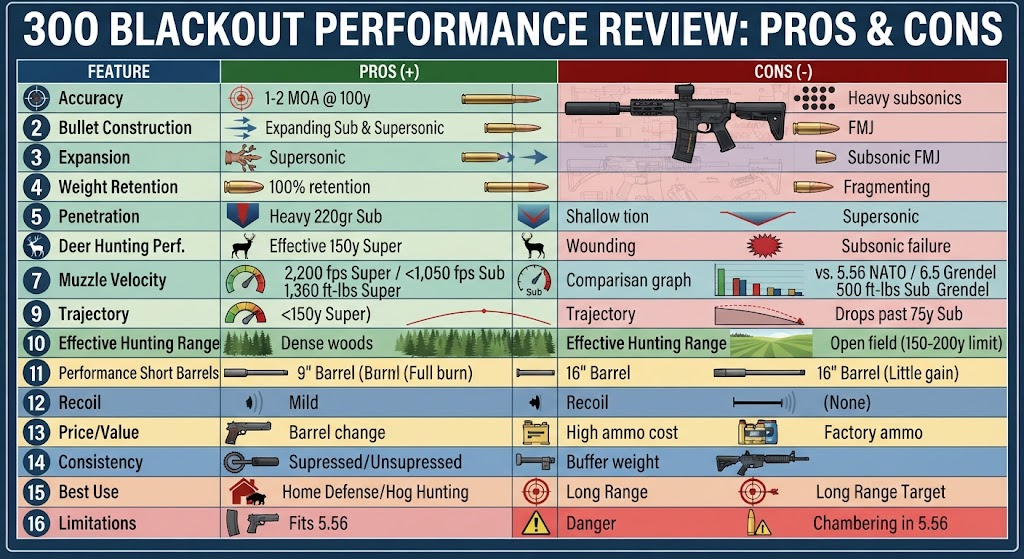
| Feature | Pros | Cons |
| Accuracy | Capable of 1 to 2 MOA at 100 yards, perfectly adequate for its intended short-range use. | Not a precision cartridge, and heavy subsonic loads can group poorly in some barrels. |
| Bullet construction | Offers everything from specialized expanding subsonics to premium supersonic copper solids. | Standard heavy target bullets used for subsonics will not expand on game. |
| Expansion | Supersonic hunting loads expand violently to create massive wound channels on medium game. | Subsonic loads require expensive, purpose-built bullets to expand at low velocities. |
| Weight retention | Copper monolithic and bonded supersonic bullets retain near 100 percent of their mass. | Non-bonded supersonic cup and core bullets can fragment on heavy shoulder bones. |
| Penetration | Heavy 220-grain subsonic loads carry immense momentum for deep, straight-line penetration. | Supersonic rounds lack the velocity needed for deep penetration on heavy, thick-skinned game. |
| Deer hunting performance | Highly lethal on whitetails inside 150 yards when using proper 110 to 125-grain supersonic loads. | Subsonic loads often fail to create an ethical wound channel, leading to lost game. |
| Muzzle velocity | Supersonic loads hit roughly 2,200 fps, while subsonics are carefully tuned to stay below 1,050 fps. | Cannot compete with the high velocities of the 5.56 NATO or the 6.5 Grendel. |
| Muzzle energy | Supersonics generate roughly 1,360 ft-lbs, offering a massive upgrade over 5.56 in short barrels. | Subsonic energy hovers around 500 ft-lbs, which is equivalent to pistol calibers. |
| Trajectory | Supersonic loads shoot flat enough for a simple point-and-shoot zero inside 150 yards. | Subsonic loads drop like a rock past 75 yards, making range estimation critical. |
| Effective hunting range | Perfect for dense woods, thickets, and suppressed night hunting for feral hogs. | Strictly limited to 150-200 yards maximum with supersonic ammunition. |
| Performance from shorter barrels | Achieves full powder burn in a 9-inch barrel, making it the ultimate short-barreled rifle cartridge. | Utilizing a 16-inch barrel offers very little velocity gain compared to other rifle calibers. |
| Recoil | Exceptionally mild, allowing for incredibly fast and accurate follow-up shots. | None. |
| Price/value | Provides a massive ballistic upgrade to an AR-15 with only a simple barrel change. | Factory ammunition is significantly more expensive than standard 5.56 NATO practice ammo. |
| Consistency | Modern factory loads cycle reliably in both suppressed and unsuppressed AR-15 platforms. | Shooters must carefully balance buffer weights to cycle both sub and super loads reliably. |
| Best use | Suppressed home defense, feral hog eradication, and short-range whitetail deer hunting. | A poor choice for long-range target shooting or hunting in wide open agricultural fields. |
| Limitations | Fits standard 5.56 NATO magazines and uses the exact same bolt carrier group. | Carelessness can lead to chambering a 300 Blackout round in a 5.56 rifle, causing catastrophic failure. |
Accuracy
The 300 Blackout is plenty accurate for tactical and hunting applications within its intended engagement distances. A quality barrel will consistently deliver 1 to 2-inch groups at 100 yards with supersonic ammunition. However, because it launches heavy, slow projectiles, it is not an inherently precision-oriented cartridge for benchrest shooting. Subsonic ammunition can sometimes be finicky, requiring shooters to test different brands to find a heavy bullet that stabilizes perfectly in their specific barrel.
Bullet Construction And Expansion
Because the cartridge serves two completely different purposes, bullet selection is critical. Supersonic hunting loads, typically ranging from 110 to 125 grains, feature polymer tips or hollow points designed to expand rapidly at moderate velocities. Subsonic loads, usually weighing 200 to 220 grains, require specialized construction if used for hunting. Standard subsonic match bullets will simply poke a clean hole through a target without expanding, whereas purpose-built expanding subsonics feature specialized cavities to force expansion at low speeds.
Penetration And Weight Retention
When loaded with premium solid copper supersonic bullets, the 300 Blackout offers fantastic penetration and near 100 percent weight retention, allowing it to punch through the shoulder bones of feral hogs. Heavy subsonic loads also penetrate deeply due to their massive weight and slow momentum, though they will not create the destructive temporary wound cavity associated with high-velocity rifle rounds.
Deer Hunting Performance
As a brush gun cartridge, the 300 Blackout is exceptional for whitetail deer. When using supersonic hunting ammunition, it delivers terminal ballistics very similar to the legendary .30-30 Winchester. It puts deer down quickly and efficiently inside 150 yards. However, ethical hunters should strongly avoid using standard subsonic ammunition on deer, as the lack of expansion and low energy can lead to unnecessary suffering and lost animals.
Velocity And Energy
The velocity and energy of the 300 Blackout vary drastically depending on the load. Supersonic ammunition pushes a 110-grain bullet at roughly 2,200 to 2,300 feet per second, yielding around 1,360 foot-pounds of energy. This is highly lethal on medium game. Conversely, subsonic ammunition intentionally stays below the speed of sound at roughly 1,000 feet per second. This results in only about 500 foot-pounds of muzzle energy, which is comparable to a .45 ACP pistol round.
Trajectory And Range
Trajectory is the primary limitation of the 300 Blackout. With supersonic loads, shooters can zero at 100 yards and confidently take shots out to 200 yards with minimal holdover. Beyond 200 yards, the bullet drops aggressively. Subsonic ammunition has a true rainbow trajectory. A heavy 220-grain bullet will drop several inches at 100 yards and plummet violently beyond that, making precise range estimation absolutely mandatory for subsonic shooting.
Recoil
One of the greatest benefits of the 300 Blackout is its incredibly soft recoil impulse. Even with supersonic hunting loads, it produces slightly more recoil than a 5.56 NATO but far less than standard hunting cartridges like the .308 Winchester. When firing subsonic ammunition suppressed, the recoil is virtually nonexistent. This makes it an outstanding choice for home defense, allowing for rapid, accurate follow-up shots in stressful situations.
Price And Value
The true value of the 300 Blackout lies in its platform compatibility. Because it utilizes the exact same magazines, bolt carrier group, and lower receiver as a standard 5.56 AR-15, shooters can completely upgrade their rifle’s stopping power by simply buying a new barrel or upper receiver. However, factory ammunition remains noticeably more expensive than .223 Remington practice rounds, meaning high-volume training will cost more.
Main Drawbacks
The most dangerous disadvantage of the 300 Blackout is its physical similarity to the 5.56 NATO. Because it uses the same magazines, a shooter can accidentally load a 300 Blackout cartridge into a 5.56 rifle. If fired, the larger .30 caliber bullet will wedge into the smaller .22 caliber barrel, causing the rifle to explode and potentially causing severe injury. Shooters must be meticulously organized to keep their ammunition and magazines separated.
Final Verdict
Is 300 Blackout good?
Yes, it is a phenomenal and highly versatile cartridge when used within its limits.
This caliber is best suited for shooters who own a suppressor, tactical home defense applications, and hunters pursuing feral hogs or deer in dense woods. The ability to shoot full-power supersonic rounds and ultra-quiet subsonic rounds from the same short-barreled rifle is an unmatched advantage.
However, shooters who hunt in wide-open spaces, those who want to shoot precision targets past 300 yards, or budget-conscious shooters who want cheap practice ammo would be much better served by a 5.56 NATO or a 6.5 Grendel.
Frequently Asked Questions (FAQs)
1. What is the parent case of the 300 Blackout?
The 300 Blackout was created by taking standard .223 Remington or 5.56 NATO brass, cutting it down, and expanding the neck to accept a .30 caliber bullet.
2. Can I use standard AR-15 magazines for 300 Blackout?
Yes. One of the primary design goals of the cartridge was flawless feeding from standard 5.56 NATO AR-15 magazines without modifying the follower or the feed lips.
3. Do I need a different bolt carrier group to shoot 300 Blackout?
No. The 300 Blackout shares the exact same rim diameter as the 5.56 NATO, meaning it uses a standard mil-spec 5.56 bolt carrier group. You only need a 300 Blackout barrel.
4. What is the best barrel length for this cartridge?
The 300 Blackout is optimized for short barrels. It achieves full powder burn and optimal ballistics in barrels as short as 8 to 9 inches, making it perfect for short-barreled rifles and AR pistols.
5. Is it safe to hunt deer with subsonic 300 Blackout?
It is generally not recommended. Standard subsonic bullets will not expand at such low velocities, acting like full metal jackets. If you must hunt with subsonics, you must use specialized, expensive expanding bullets at very close ranges.
6. How does 300 Blackout compare to 7.62x39mm?
With supersonic ammunition, the ballistic performance is nearly identical to the legendary 7.62x39mm AK-47 round. However, the 300 Blackout feeds much more reliably in an AR-15 platform than the heavily tapered 7.62x39mm case.
7. Can I accidentally chamber a 300 Blackout in a 5.56 rifle?
Yes, and doing so will destroy the rifle and likely injure the shooter. You must clearly mark your magazines and keep the two types of ammunition strictly separated to prevent this catastrophic error.
8. Do I need an adjustable gas block?
While not strictly required, an adjustable gas block is highly recommended if you plan to switch frequently between supersonic and subsonic ammunition, especially when using a suppressor, to ensure reliable cycling.
9. What twist rate is best for 300 Blackout?
A 1:7 or 1:8 barrel twist rate is standard and highly recommended. A fast twist rate is required to properly stabilize the exceptionally long, heavy 220-grain subsonic bullets in flight.
10. How quiet is a suppressed subsonic 300 Blackout?
It is incredibly quiet. Because the bullet never breaks the sound barrier, there is no supersonic crack. When paired with a quality suppressor, the loudest sound is often the mechanical cycling of the AR-15 action hitting the buffer tube.