The main pros of 25 Creedmoor are its exceptional balance of high ballistic coefficient bullets, low recoil, and better barrel life than the 6mm Creedmoor, while the main cons are the lack of widespread factory ammunition and the requirement for custom rifle builds. This necked down version of the 6.5 Creedmoor utilizes modern, heavy .257 caliber projectiles that provide an incredibly flat trajectory and excellent wind resistance. While it consistently delivers match winning precision for competitive shooters and lethal energy for medium game hunters, it is primarily a handloader’s cartridge. Because it bridges the gap between the 6mm and 6.5mm bore sizes, it offers an optimal blend of long range performance and manageable recoil, though shooters must rely on boutique ammunition manufacturers or load their own rounds to fully utilize its potential.
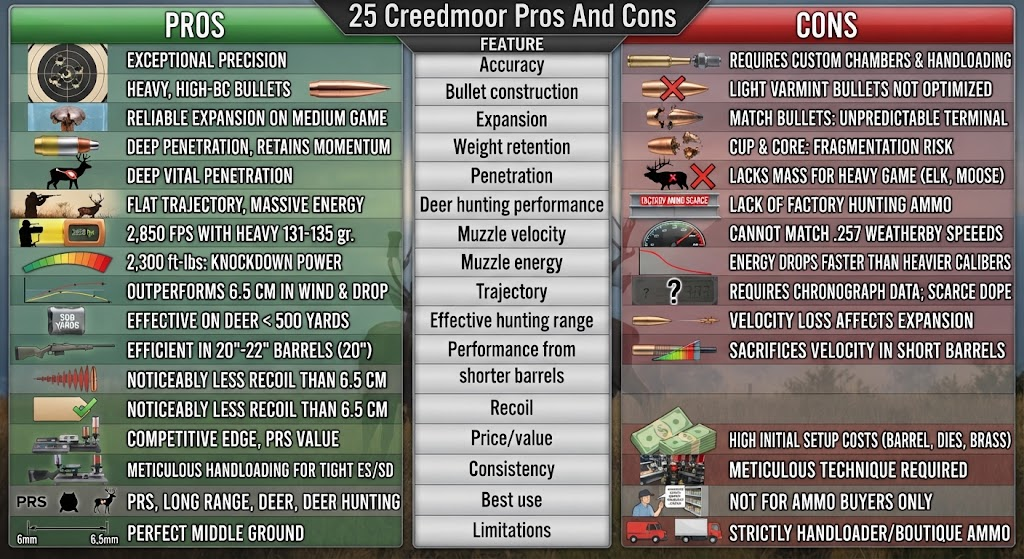
25 Creedmoor Pros And Cons
| Feature | Pros | Cons |
| Accuracy | Exceptional inherent precision due to modern cartridge design and high quality brass. | Heavily dependent on custom barrel chambers and careful handloading practices. |
| Bullet construction | Access to modern, heavy, high ballistic coefficient .257 caliber match and hunting bullets. | Older, lightweight quarter bore varmint bullets are not optimized for this cartridge’s twist rates. |
| Expansion | Heavy hunting bullets deliver reliable expansion on medium game at extended distances. | Match bullets are not designed for hunting and can exhibit unpredictable terminal performance. |
| Weight retention | Heavy 130 class bullets retain momentum and mass very well for deep penetration. | Lighter cup and core bullets driven at high velocities may fragment on heavy bone. |
| Penetration | Consistently drives deep into the vitals of deer and antelope on broadside shots. | Lacks the sheer mass required for reliable, deep penetration on heavy game like elk or moose. |
| Deer hunting performance | Hits with authority, offering a perfectly flat trajectory and massive energy transfer for deer. | Lack of over the counter factory hunting ammunition makes it difficult for casual hunters to adopt. |
| Muzzle velocity | Pushes heavy 131 to 135 grain bullets at approximately 2,850 fps for a flat initial trajectory. | Cannot match the extreme velocities of overbore magnums like the .257 Weatherby. |
| Muzzle energy | Generates roughly 2,300 ft-lbs of energy, easily taking down medium game at long ranges. | Energy drops below the ethical big game threshold faster than heavier 6.5mm or 7mm cartridges. |
| Trajectory | Exceptionally flat shooting, outperforming the 6.5 Creedmoor in wind deflection and bullet drop. | Trajectory calculations require precise chronograph data since factory load data is scarce. |
| Effective hunting range | Highly effective on deer sized game out to 500 yards or more in the hands of a skilled marksman. | Rapid loss of velocity at extreme ranges can lead to failure of hunting bullets to expand properly. |
| Performance from shorter barrels | Highly efficient powder burn allows for excellent performance in 20 inch to 22 inch barrels. | Shorter barrels sacrifice the velocity needed to maximize the heavy bullet’s ballistic advantages. |
| Recoil | Noticeably less recoil than the 6.5 Creedmoor, allowing shooters to spot their own bullet trace. | None. |
| Price/value | Provides a competitive edge in precision rifle matches without stepping up to larger calibers. | Initial setup costs are high due to the need for custom barrels, reloading dies, and premium brass. |
| Consistency | Incredibly tight extreme spreads and standard deviations when handloaded with premium components. | Requires meticulous reloading techniques to achieve the consistency needed for long range precision. |
| Best use | Precision Rifle Series (PRS) competitions, long range steel target shooting, and open country deer hunting. | Not a practical choice for shooters who rely exclusively on buying factory ammunition at local stores. |
| Limitations | Offers the perfect middle ground between the 6mm and 6.5mm Creedmoor cartridges. | Strictly a handloader or boutique ammunition cartridge with very little mainstream factory support. |
Accuracy
The 25 Creedmoor is built for extreme precision. Because it is primarily a custom chambering, rifles are usually built with high quality match barrels spun up by skilled gunsmiths. Shooters regularly achieve half MOA groups or better. The cartridge design features the same optimized shoulder angle and case capacity as its parent case, which promotes highly consistent powder ignition and inherently accurate barrel harmonics.
Bullet Construction And Expansion
Historically, the quarter bore (.257 caliber) suffered from a lack of high ballistic coefficient bullets. This changed completely with the introduction of heavy projectiles like the 131 grain Blackjack ACE, 133 grain Berger Elite Hunter, and 134 grain Hornady ELD Match. These long, sleek bullets cut through the wind efficiently and, when selected in hunting configurations, expand reliably upon impact to create massive wound cavities.
Penetration And Weight Retention
Using modern heavy for caliber hunting bullets, the 25 Creedmoor offers excellent penetration on medium game. The high sectional density of a 133 grain or 135 grain bullet ensures it drives deep and retains enough weight to reach vital organs from standard broadside angles. While it is highly capable on deer, it is not designed to punch through the heavy shoulder plates of a bull elk.
Deer Hunting Performance
For open country deer and antelope hunting, this cartridge is an absolute powerhouse. It offers a flat trajectory that minimizes holdover errors in the field and hits with enough retained energy to ensure quick, ethical kills. The lack of recoil allows hunters to stay in the scope, watch the animal’s reaction to the shot, and execute rapid follow up shots if necessary.
Velocity And Energy
When loaded with a heavy 131 to 135 grain bullet, the 25 Creedmoor typically achieves muzzle velocities around 2,800 to 2,900 feet per second from a standard 24 inch barrel. This generates roughly 2,300 to 2,500 foot pounds of muzzle energy. This puts it perfectly in the sweet spot for medium game hunting and long range target shooting without burning excessive amounts of powder.
Trajectory And Range
The trajectory is where this cartridge truly outshines its parent case. A heavy .257 caliber bullet driven at 2,850 feet per second shoots incredibly flat and bucks the wind significantly better than a standard 140 grain 6.5 Creedmoor load. This makes it highly effective for ringing steel plates well past 1,000 yards and taking ethical, calculated shots on game out to 500 yards.
Recoil
The recoil impulse is exceptionally mild, sitting perfectly in the middle ground between the 6mm Creedmoor and the 6.5 Creedmoor. This is a massive advantage for competitive shooters. The recoil is soft enough that shooters do not get pushed off their shooting position, allowing them to spot their own bullet trace through the optic and adjust for wind holds instantly.
Price And Value
The value proposition is complex and highly dependent on the user. For a serious competitive shooter or dedicated handloader, it offers incredible performance and noticeably longer barrel life than a 6mm Creedmoor, saving money on frequent barrel replacements. However, for the casual shooter, the cost of custom dies, premium brass, and the absolute lack of cheap factory practice ammunition makes it a very expensive caliber to adopt.
Main Drawbacks
The most significant disadvantage of the 25 Creedmoor is the lack of widespread factory ammunition. You cannot walk into a local sporting goods store and buy a box off the shelf. It requires custom rifle builds or aftermarket barrel swaps, and shooters must be comfortable handloading their own ammunition or paying a steep premium for boutique custom loaded ammunition.
Final Verdict
Is 25 Creedmoor good?
Yes, it is a phenomenal cartridge that represents the absolute cutting edge of short action precision rifle design.
This load is best suited for dedicated handloaders, Precision Rifle Series (PRS) competitors, and western hunters who want a low recoiling, incredibly flat shooting rifle for open country deer and antelope. It perfectly fills the ballistic gap between 6mm and 6.5mm cartridges.
However, shooters who do not want to reload their own ammunition, or those who strictly hunt dense woods where long range ballistics do not matter, would be much better served by sticking to the standard, widely available 6.5 Creedmoor or .308 Winchester.
Frequently Asked Questions (FAQs)
1. What is the parent case of the 25 Creedmoor?
The 25 Creedmoor is based directly on the 6.5 Creedmoor case. The neck of the brass is simply sized down to accept a smaller .257 caliber bullet.
2. Why choose the 25 Creedmoor over the 6.5 Creedmoor?
The 25 Creedmoor shoots a lighter, more aerodynamic bullet at a higher velocity. This results in a flatter trajectory, less wind drift, and slightly less felt recoil compared to the 6.5 Creedmoor, making it superior for precision target shooting.
3. Is barrel life better than the 6mm Creedmoor?
Yes. Because the .257 caliber bore is larger than a 6mm (.243) bore, there is more surface area to distribute the heat and pressure of the burning powder. This generally results in longer precision barrel life.
4. Can I buy factory ammunition for the 25 Creedmoor?
Factory ammunition is extremely limited. A few boutique manufacturers offer custom loaded ammunition, but the vast majority of shooters handload their own rounds using custom dies.
5. What is the ideal barrel twist rate for this cartridge?
To properly stabilize the heavy 130 grain to 135 grain high ballistic coefficient bullets that make this cartridge so effective, a fast barrel twist rate of 1:7 or 1:7.5 is required.
6. Does Hornady make bullets for the 25 Creedmoor?
Yes. Recognizing the growing popularity of the quarter bore wildcats, Hornady introduced the 134 grain ELD Match bullet specifically to cater to cartridges like the 25 Creedmoor.
7. Can I shoot 25 Creedmoor in an AR-10 platform?
Yes. Because it shares the exact same overall length and case dimensions as the 6.5 Creedmoor, it fits perfectly in AR-10 magazines and short action bolt rifles.
8. Where can I get brass for reloading?
Premium brass manufacturers like Alpha Munitions and Peterson produce factory headstamped 25 Creedmoor brass. Alternatively, you can simply run high quality 6.5 Creedmoor brass through a 25 Creedmoor sizing die.
9. Is the 25 Creedmoor a good cartridge for deer hunting?
Absolutely. When loaded with proper hunting projectiles like the Berger Elite Hunter, it provides massive energy transfer and surgical precision, making it devastating on deer and antelope.
10. Is the recoil safe and manageable for young hunters?
Yes. The recoil is incredibly mild. When paired with a quality muzzle brake or a suppressor, the felt recoil is virtually nonexistent, making it a fantastic choice for youth or recoil sensitive hunters.