The main pros of Winchester Deer Season XP 243 95 grain are its devastating terminal performance on deer, exceptionally flat trajectory, and high accuracy, while the main cons are its tendency to cause excessive meat damage on shoulder hits and lower weight retention compared to bonded bullets. This specialized load uses a large diameter polymer tip designed specifically for rapid expansion and massive energy transfer on thin-skinned game. While it consistently delivers quick knockdown power for whitetail hunters, it is strictly designed for medium game rather than heavy, thick-boned animals. Because it launches a highly aerodynamic projectile at over 3,000 feet per second, it offers an extended ethical hunting range and remains an incredibly popular, budget-friendly option for deer hunters nationwide.
Winchester Deer Season XP 243 95 Grain Pros And Cons
| Feature | Pros | Cons |
| Accuracy | Capable of sub-MOA groups in well-tuned rifles, making it excellent for precision shots. | The polymer tip can occasionally become deformed during rough feeding in certain action types. |
| Bullet construction | The massive Extreme Point polymer tip initiates immediate and violent expansion upon impact. | The traditional cup and core design lacks bonding, which can lead to jacket separation on heavy bone. |
| Expansion | Creates enormous wound cavities for rapid knockdowns and massive energy transfer. | Can over-expand or fragment entirely at close range before reaching deep vitals. |
| Weight retention | Retains enough weight to destroy the lungs and heart on broadside shots. | Exhibits poor weight retention compared to premium solid copper or bonded bullets. |
| Penetration | Reaches vitals effectively on standard broadside and slightly quartering angles. | Lacks the deep penetration needed for steep quartering angles or punching through heavy shoulder plates. |
| Deer hunting performance | Frequently drops deer in their tracks due to the catastrophic internal damage. | Often fails to provide an exit wound, which can result in very poor blood trails if the animal runs. |
| Muzzle velocity | A blistering factory rating of 3,100 fps ensures a very flat flight path across open fields. | High impact velocity at close range increases the likelihood of the bullet exploding on the surface. |
| Muzzle energy | Delivers a potent 2,027 ft-lbs of energy at the muzzle to ensure lethal performance. | Energy is shed rapidly if the bullet fragments early upon impact rather than carrying through. |
| Trajectory | Incredibly flat shooting, requiring very little holdover for shots inside 300 yards. | The lighter 95-grain bullet is slightly more susceptible to wind drift than heavier 30 caliber projectiles. |
| Effective hunting range | Excellent terminal performance and accuracy out to 300 yards and slightly beyond. | Energy drops below the ideal 1,000 ft-lbs mark for deer right around the 350 to 400 yard mark. |
| Performance from shorter barrels | Still maintains high enough velocities in 18 to 20 inch barrels to ensure reliable expansion. | Shorter barrels will result in louder muzzle blast and slightly reduced effective range. |
| Recoil | Exceptionally light and manageable, making it a favorite for new shooters and youth hunters. | None. |
| Price/value | Very affordably priced compared to premium hunting ammunition lines. | You trade the premium bonded construction of more expensive ammo for the lower price tag. |
| Consistency | Features reliable primers and uniform powder charges for consistent shot-to-shot velocities. | Terminal performance can be unpredictable if the bullet strikes heavy bone rather than soft tissue. |
| Best use | Perfect for whitetail deer, mule deer, and pronghorn antelope at medium to long ranges. | Not recommended for elk, moose, or large bears due to the rapid fragmentation. |
| Limitations | Ideal for open agricultural fields and precision broadside lung shots. | Deflects easily in heavy brush compared to heavier, slower brush gun bullets. |
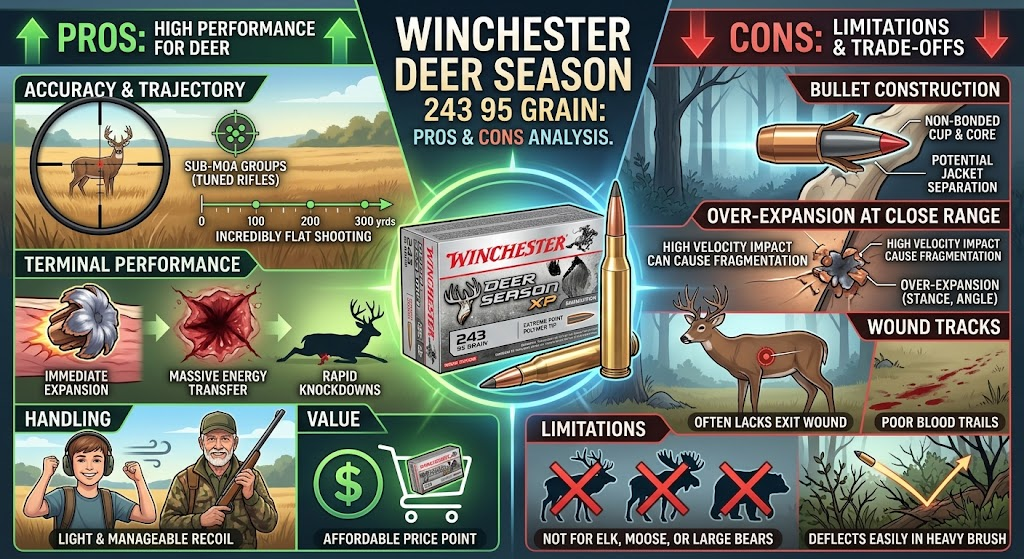
Accuracy
Winchester Deer Season XP in .243 Winchester is widely known for delivering excellent accuracy straight out of the box. Because the .243 is inherently an accurate cartridge with very low recoil, shooters can often achieve sub-MOA groups measuring less than one inch at 100 yards with a capable rifle. The streamlined polymer tip and boat-tail design help stabilize the bullet in flight, making it highly reliable for precision shot placement at extended distances.
Bullet Construction And Expansion
The defining feature of this ammunition is the Extreme Point bullet. Winchester designed this projectile with a massive polymer tip that takes up a significantly larger percentage of the frontal surface area compared to standard polymer-tipped bullets. Upon impact, this oversized tip is driven back into the lead core, initiating immediate, violent, and rapid expansion. This design is intended specifically to dump maximum energy into thin-skinned game as quickly as possible.
Penetration And Weight Retention
Because the bullet is designed to expand so rapidly, penetration and weight retention are its weakest attributes. This is a traditional cup and core bullet, meaning the lead core is not chemically bonded to the copper jacket. When it strikes a deer, especially at high velocities or if it hits the shoulder bone, the bullet often sheds a massive amount of its weight and fragments. While it penetrates deeply enough to destroy the lungs on a broadside shot, it is not built to drive completely through heavy muscle and bone.
Deer Hunting Performance
For its namesake purpose of deer hunting, this load is devastatingly effective under the right conditions. The massive energy transfer often results in deer dropping in their tracks, which is exactly what most hunters want. However, hunters must be aware that this rapid fragmentation often means there is no exit wound. If the deer does happen to run after being shot, the lack of an exit hole can result in a very sparse blood trail, making tracking difficult.
Velocity And Energy
Winchester rates this 95-grain load at a blistering 3,100 feet per second at the muzzle, generating 2,027 foot-pounds of muzzle energy from a standard 24-inch test barrel. This high velocity is what drives the rapid expansion of the Extreme Point bullet. Even when fired from shorter 20-inch or 22-inch hunting barrels, the velocity remains high enough to guarantee reliable terminal performance and hard-hitting energy transfer on medium game.
Trajectory And Range
The .243 Winchester is famous for being a flat-shooting cartridge, and this specific load maximizes that advantage. With a ballistic coefficient of 0.380, the bullet cuts through the air efficiently. If you zero your rifle at 200 yards, the bullet will only impact about 1.5 inches high at 100 yards and will drop roughly 6.5 inches at 300 yards. This allows hunters to utilize a simple point-and-shoot method for almost any deer inside of 300 yards without worrying about complex holdovers.
Recoil
One of the greatest benefits of the .243 Winchester cartridge is its incredibly mild recoil, and this 95-grain load is no exception. It produces very little kick, making it highly comfortable to shoot from the bench or in the field. This low recoil makes it an outstanding option for youth hunters, smaller framed shooters, or anyone who wants to avoid the flinch-inducing punch of larger magnum calibers.
Price And Value
Winchester designed the Deer Season XP line to be an affordable, purpose-built hunting round for the average deer hunter. It is priced very competitively, usually sitting well below the cost of premium monolithic copper or bonded ammunition. For a hunter who wants highly effective deer ammunition without spending a fortune for a box of 20 rounds, this load offers fantastic value.
Main Drawbacks
The most significant disadvantage of the Winchester Deer Season XP 243 95 grain is the excessive meat damage it causes if shot placement is poor. If the bullet strikes the front shoulder, the rapid fragmentation will ruin a substantial amount of meat. Additionally, the lack of an exit wound can make tracking a challenge in thick woods, and the fragile nature of the bullet makes it a poor choice for larger game like elk.
Final Verdict
Is Winchester Deer Season XP 243 95 grain good?
Yes, it is an outstanding and highly lethal choice for deer hunting, provided you use it correctly.
This load is best suited for hunters targeting whitetail, mule deer, and antelope in open areas where precise, broadside lung shots are the norm. The accuracy, flat trajectory, and massive energy transfer will reliably put deer down fast.
However, hunters who hunt in thick brush, prefer taking steep quartering shots, prioritize complete pass-throughs for heavy blood trails, or want to save the shoulder meat should consider a tougher bonded bullet or solid copper option instead.
Frequently Asked Questions (FAQs)
1. What is the maximum effective range of the Winchester Deer Season XP 243 95 grain?
For ethical hunting on deer-sized game, the maximum effective range is generally between 300 and 400 yards. Beyond 400 yards, the bullet’s energy drops below the recommended 1,000 foot-pounds required to reliably and ethically harvest a deer.
2. Can I use this ammo to hunt elk or moose?
No. This bullet is designed for rapid expansion on thin-skinned medium game. It lacks the weight retention and deep penetration required to reliably punch through the heavy bones and thick muscle of elk or moose.
3. Will this bullet leave a good blood trail?
Not always. Because the Extreme Point bullet is designed to dump all its energy inside the animal, it frequently fragments and fails to produce an exit wound. Without an exit wound, blood trails can be very minimal.
4. What is the muzzle velocity of this load?
The factory advertised muzzle velocity is 3,100 feet per second when fired from a standard 24-inch test barrel.
5. How much does this bullet drop at 300 yards?
If your rifle is zeroed at 200 yards, you can expect the 95-grain bullet to drop approximately 6.5 to 7 inches at 300 yards, depending on your specific barrel length and environmental conditions.
6. Does this ammo cause a lot of meat damage?
It can cause severe meat damage if it hits heavy bone. The rapid expansion and fragmentation will ruin the meat on a shoulder hit. To preserve meat, hunters should aim strictly for the lungs right behind the shoulder.
7. Is the Winchester Deer Season XP a bonded bullet?
No. It features a traditional cup and core construction, meaning the lead core and the copper jacket are not welded or bonded together. This allows for the rapid expansion the bullet is known for.
8. What makes the Extreme Point tip different from other polymer tips?
The Extreme Point polymer tip has a significantly larger diameter and takes up more of the bullet’s frontal profile than standard tips. This larger surface area forces the bullet to open up immediately and violently upon impact.
9. Can I use this ammunition for coyote hunting?
Yes. The flat trajectory, high velocity, and rapid expansion make it devastatingly effective on coyotes. However, it will likely cause massive pelt damage, so it is not ideal if you are hunting coyotes to sell their fur.
10. What is the ideal barrel twist rate for the 95-grain .243 bullet?
Most standard .243 Winchester rifles come with a 1:10 or 1:9 barrel twist rate, both of which are perfectly suited to stabilize this 95-grain projectile.