The effective range of a .410 slug is strictly limited to 50 yards for deer hunting and up to 100 yards for pest control or target shooting. Because the lightweight 1/4-ounce projectile has exceptionally poor aerodynamics, it bleeds velocity and kinetic energy almost immediately after leaving the muzzle. Practical accuracy relies heavily on proper choke selection in a smoothbore or the use of a specialized rifled barrel. While the maximum projectile flight distance can reach roughly 800 yards, the severe bullet drop renders the .410 slug completely ineffective at long ranges.
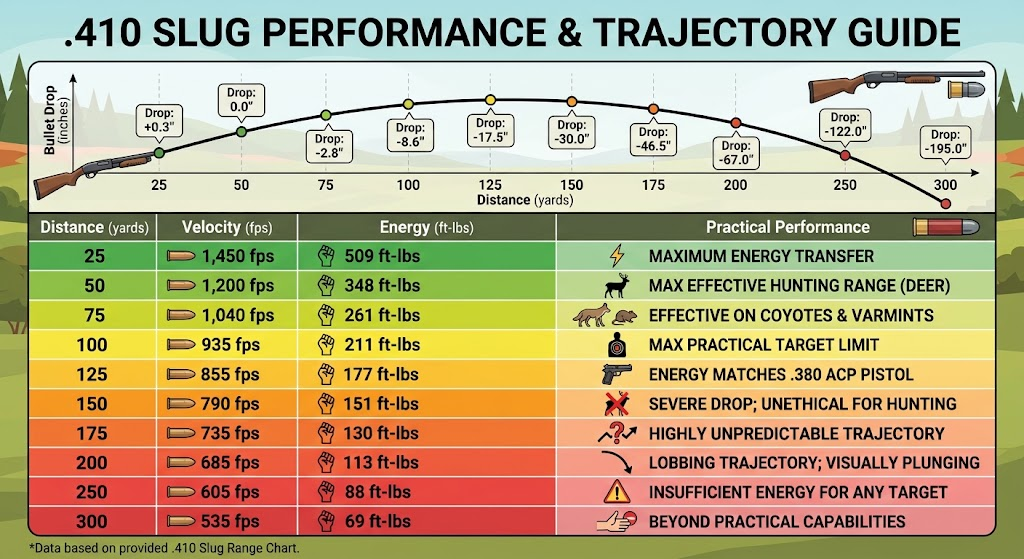
.410 Slug Range Chart
| Distance | Velocity (fps) | Energy (ft-lbs) | Bullet Drop (inches) | Practical Performance |
| 25 yards | 1,450 | 509 | +0.3 | Maximum energy transfer |
| 50 yards | 1,200 | 348 | 0.0 | Maximum effective hunting range on deer |
| 75 yards | 1,040 | 261 | -2.8 | Effective on coyotes and small varmints |
| 100 yards | 935 | 211 | -8.6 | Maximum practical target limit |
| 125 yards | 855 | 177 | -17.5 | Energy matches a .380 ACP pistol |
| 150 yards | 790 | 151 | -30.0 | Severe drop; unethical for hunting |
| 175 yards | 735 | 130 | -46.5 | Highly unpredictable trajectory |
| 200 yards | 685 | 113 | -67.0 | Lobbing trajectory; visually plunging |
| 250 yards | 605 | 88 | -122.0 | Insufficient energy for practically any target |
| 300 yards | 535 | 69 | -195.0 | Beyond practical capabilities |
The data in the .410 slug range chart above is based on the Winchester Super-X 3-inch 1/4 oz (109-grain) Rifled Hollow Point Slug. These figures reflect a standard 24-inch smoothbore test barrel, a muzzle velocity of 1,800 fps, a .045 G1 Ballistic Coefficient (BC), and a standard 50-yard zero with a simple bead or low-profile iron sight. Your exact .410 slug ballistics will vary depending on your shotgun’s barrel length and choke constriction.
What Is The Effective Range Of A .410 Slug?
The .410 bore is the smallest common shotgun gauge, and its slug performance is heavily restricted by its lightweight payload.
- Effective Target Range: 100 yards. Beyond this distance, the blunt projectile drops into subsonic speeds, and the trajectory requires holdovers that are practically impossible with traditional shotgun bead sights.
- Effective Hunting Range (Medium Game): 50 yards. While a 50-yard shot retains enough energy to penetrate a deer’s vitals, shooting beyond this distance risks wounding the animal due to rapid energy loss.
- Maximum Projectile Range: Fired at a 30-degree angle, a 1/4-ounce .410 slug will travel roughly 800 yards before hitting the ground. It carries lethal potential on descent, meaning shooters must always be aware of their backstop.
.410 Slug Velocity And Energy At Distance
A .410 slug starts with impressive speed but has very little mass. A 1/4-ounce slug weighs roughly 109 grains, making it lighter than a standard 9mm pistol bullet (115 grains). Because it is blunt, it sheds energy faster than almost any centerfire rifle cartridge.
Using the Winchester Super-X 1/4 oz (1,800 fps muzzle velocity), the cartridge generates 784 ft-lbs of muzzle energy.
- At 25 yards: Velocity is 1,450 fps; Energy is 509 ft-lbs.
- At 50 yards: Velocity is 1,200 fps; Energy is 348 ft-lbs.
- At 100 yards: Velocity is 935 fps; Energy is 211 ft-lbs.
By the time the slug reaches 100 yards, it hits with roughly the same kinetic energy as a .380 ACP pocket pistol fired at point-blank range, which is wildly insufficient for reliable expansion on large animals.
.410 Slug Bullet Drop At Distance
Because the ballistic coefficient of a standard Foster-style rifled slug is abysmal (around .045), the air resistance rapidly degrades its flight path, resulting in a steep rainbow trajectory.
Using a standard 50-yard zero:
- 75 Yards: -2.8 inches
- 100 Yards: -8.6 inches
- 150 Yards: -30.0 inches
If you attempt to stretch the shotgun to 150 yards, you must aim roughly two and a half feet above your target. Combined with the lack of precision inherent to most smoothbore .410 shotguns, striking a vital zone at this distance is virtually impossible.
.410 Slug Range By Barrel Length
The effective range of a .410 slug heavily depends on the platform firing it. The .410 is unique because it is commonly fired from full-length shotguns as well as compact revolvers (like the Taurus Judge or Smith & Wesson Governor).
- 24-inch to 26-inch Shotgun Barrels: Achieves the advertised factory velocity of 1,800 fps. Provides the maximum 50-yard hunting range.
- 18.5-inch Tactical Shotguns: Loses approximately 100 to 150 fps. Effective range remains roughly 40 to 50 yards, but energy falls slightly faster.
- 3-inch to 6-inch Revolvers: Velocity plummets. Fired from a short-barreled revolver, a .410 slug may only achieve 800 to 900 fps at the muzzle, generating less than 200 ft-lbs of energy. In a revolver, the effective range is strictly limited to 10 to 15 yards for personal defense or pest control.
.410 Slug Range For Hunting
Hunting with a .410 slug requires immense discipline and an understanding of its limitations.
- Deer: The absolute maximum ethical range is 50 yards. Many jurisdictions strictly outlaw the .410 for deer hunting because its kinetic energy falls well below the standard 1,000 ft-lb threshold required for clean kills on medium game. If your state allows it, it should only be used at close ranges by highly accurate shooters.
- Coyotes and Varmints: Because lighter animals require less energy for a clean kill, the effective hunting range on coyotes can be stretched to 75 yards, provided the shooter is using a shotgun with proper sights rather than a simple brass bead.
(Note: Always check your local hunting regulations regarding minimum gauge and energy requirements for specific game animals).
.410 vs 20 Gauge vs 12 Gauge Slug Range
When compared to its larger siblings, the .410 is severely outclassed in both range and knockdown power. A 20-gauge slug weighs roughly three times as much as a .410 slug, and a 12-gauge slug weighs exactly four times as much. This massive difference in weight translates directly to downrange kinetic energy and ethical hunting distances.
Comparison Table
| Category | .410 Bore (1/4 oz) | 20 Gauge (3/4 oz) | 12 Gauge (1 oz) |
| Projectile Weight | 109 grains | 328 grains | 437.5 grains |
| Muzzle Velocity | 1,800 fps | 1,600 fps | 1,600 fps |
| Muzzle Energy | 784 ft-lbs | 1,864 ft-lbs | 2,487 ft-lbs |
| 50-Yard Energy | 348 ft-lbs | 1,215 ft-lbs | 1,640 ft-lbs |
| Bullet Drop (100 Yds) | -8.6″ (50 yd zero) | -6.5″ (50 yd zero) | -6.5″ (50 yd zero) |
| Effective Range (Deer) | 50 yards | 100 yards | 100 yards |
| Ideal Application | Close-range pests | Medium game / Youth | Big game / Bear defense |
Data baseline: Standard Foster-style rifled slugs fired from 24-inch smoothbore barrels.
Pros and Cons
.410 Slug Pros
- Virtually zero felt recoil, making it an excellent training tool for youth and smaller-statured shooters.
- Highly maneuverable and lightweight platforms available.
- Sufficient stopping power for small predators, raccoons, and foxes within 50 yards.
.410 Slug Cons
- Critically low kinetic energy for medium game; illegal for deer hunting in many states.
- Poor ballistic coefficient causes velocity to drop off a cliff past 50 yards.
- Ammunition is often significantly more expensive than standard 12-gauge or 20-gauge slugs.
- Smoothbore .410 shotguns often struggle with mechanical accuracy past 50 yards.
.410 Slug Range: How Far Can It Really Shoot?
When evaluating .410 slug ballistics, here is the final verdict on its practical capabilities:
- General Shooting: Inside 50 yards, it is accurate, highly controllable, and very effective on thin-skinned pests.
- Hunting: Hard capped at 50 yards for deer (where legal). Beyond that, the 109-grain projectile loses the kinetic energy required to cleanly punch through muscle and bone.
- 75 Yards: The practical limit for target shooting with a simple bead sight. Drop is roughly 3 inches, but energy falls to 261 ft-lbs.
- 100 Yards: Effective only for paper targets. The slug drops over 8 inches, and the 211 ft-lbs of retained energy is equivalent to a pocket pistol.
- Beyond 100 Yards: Completely ineffective. The 30-inch drop at 150 yards and the sub-200 ft-lb energy make it useless for any tactical or hunting application.
- Revolvers: Firing a .410 slug from a handgun (like a Judge) cuts the velocity in half, limiting the practical range to standard self-defense distances of 10 to 15 yards.
FAQs
What is the effective range of a .410 slug?
The effective hunting range is strictly 50 yards on medium game, and the practical target shooting range is roughly 75 to 100 yards before bullet drop becomes unmanageable.
How far can a .410 slug shoot accurately?
From a well-made shotgun, the slug remains mechanically accurate out to roughly 100 yards, though traditional bead sights make aiming difficult at that distance.
What is the maximum range of a .410 slug?
Fired at an optimal upward trajectory, the lightweight 109-grain projectile will physically travel about 800 yards before hitting the ground.
Is a .410 slug good for hunting deer?
It is highly marginalized for deer. While it can kill a deer within 50 yards with perfect shot placement, it lacks the kinetic energy for reliable clean kills and is illegal for deer hunting in several jurisdictions.
What is the .410 slug range at 100 yards?
At 100 yards, a standard 1/4-ounce .410 slug retains roughly 211 ft-lbs of energy and drops nearly 9 inches (with a 50-yard zero). It is effective for paper targets but unethical for hunting.
How much does a .410 slug drop at 100 yards?
If your shotgun is zeroed at 50 yards, a standard 1,800 fps slug will drop approximately 8.5 to 9 inches at 100 yards.
Does barrel length affect .410 slug range?
Yes, dramatically. Firing a .410 slug from a 24-inch shotgun yields 1,800 fps, while firing it from a 3-inch revolver barrel yields less than 900 fps, effectively turning it into a short-range handgun round.
How does .410 slug range compare with 20 gauge?
The 20-gauge slug completely outclasses the .410. A 20-gauge slug is three times heavier, delivering significantly more downrange energy and doubling the ethical hunting range to 100 yards.