The 22 ARC (Advanced Rifle Cartridge) is a high-velocity precision cartridge designed to deliver .22-250 Remington performance from a standard AR-15 platform, boasting an effective range that extends past 1,000 yards for target shooting. When evaluating the 22 ARC effective range, hunters will find a highly practical varmint hunting distance of 500 to 600 yards using the 62-grain ELD-VT load traveling at 3,300 feet per second. Beyond these typical hunting distances, the heavy, high-BC projectiles retain supersonic flight up to 1,150 yards, depending on specific environmental conditions and barrel length. This unique ballistic profile allows the cartridge to perfectly bridge the gap between close-range pest control and extreme long-range precision marksmanship without requiring a large-frame rifle.
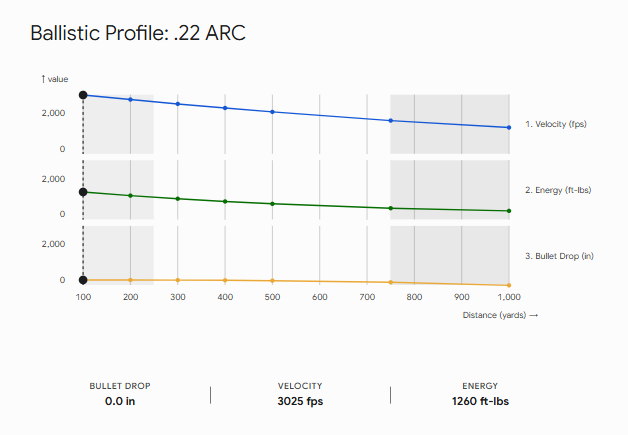
22 ARC Effective Range Chart
| Distance | Bullet Velocity | Muzzle/Downrange Energy | Bullet Drop | Practical Use |
| 100 yards | 3,025 fps | 1,260 ft-lbs | 0.0 inches | Ideal Zero / Varmints |
| 200 yards | 2,770 fps | 1,055 ft-lbs | -1.7 inches | Point Blank Hunting |
| 300 yards | 2,525 fps | 880 ft-lbs | -8.2 inches | Coyote / Predator |
| 400 yards | 2,295 fps | 725 ft-lbs | -20.5 inches | Extended Varmint |
| 500 yards | 2,075 fps | 592 ft-lbs | -40.2 inches | Long Range Pest Control |
| 750 yards | 1,585 fps | 345 ft-lbs | -130.5 inches | Precision Target Shooting |
| 1000 yards | 1,195 fps | 196 ft-lbs | -305.0 inches | Maximum Accurate Range |
The ballistic data in the chart above was calculated using the Hornady 62-grain ELD-VT (V-Match) factory ammunition load fired from a 24-inch test barrel. This specific 22 ARC load utilizes a G1 Ballistic Coefficient (BC) of 0.395 and leaves the muzzle at an impressive velocity of 3,300 feet per second (fps). The bullet drop figures reflect a standard 100-yard zero using a sight height of 1.5 inches above the bore.
This 62-grain ELD-VT load is widely considered the standard baseline for varmint and predator applications with the 22 ARC cartridge. It strikes an excellent balance between blistering muzzle velocity and aerodynamic efficiency. However, it is vital to understand that changing to a heavier, higher-BC projectile, such as the 75-grain ELD-M or the massive 88-grain ELD-M, will drastically alter the 22 ARC effective range, bullet drop, and wind deflection profile. The chart provided serves as a highly reliable baseline for the fastest commercial ammunition available on the market today.
What Is The Effective Range Of 22 ARC?
The effective range of the 22 ARC is universally categorized as a medium-to-long distance, maxing out at approximately 1,000 to 1,150 yards for precision target shooting and 500 to 600 yards for ethical varmint hunting scenarios. It is an inherently specialized cartridge designed to operate within the exact physical constraints of a standard AR-15 magazine well, utilizing the 6.5 Grendel bolt face and magazine geometry. The engineers at Hornady designed this round specifically to match or exceed the performance of the legendary .22-250 Remington while utilizing a modern, short, and fat case design.
Because the 22 ARC utilizes incredibly long, aerodynamic, heavy-for-caliber projectiles, it easily cuts through the air with minimal aerodynamic drag. This aerodynamic efficiency is quantified by the bullet’s Ballistic Coefficient (BC). The vast majority of modern 22 ARC bullets feature a G1 BC hovering between 0.395 and 0.545. Compared to standard .223 Remington bullets, which often feature a G1 BC around 0.250 to 0.300, the 22 ARC retains its velocity and kinetic energy far more efficiently downrange.
As a direct result of this high BC, the cartridge maintains supersonic flight over vast distances. A 88-grain bullet that leaves the barrel at 2,820 fps does not drop below the speed of sound until it passes the 1,100-yard marker. Remaining above the transonic zone (roughly Mach 1.2 or 1,340 fps) is critical for long-range accuracy. Once a projectile transitions from supersonic to subsonic flight, it experiences severe turbulence that can destabilize the bullet, ruining predictability. Therefore, the absolute maximum effective range of the 22 ARC is dictated by its ability to cheat the wind and maintain supersonic speeds, anchoring it firmly as a true 1,000-yard cartridge.
22 ARC Velocity And Energy At Distance
Muzzle velocity and kinetic energy are the foundational metrics that drive terminal ballistics and long-range trajectory. To understand exactly how the 22 ARC performs downrange, we must look at how different loads retain or lose these critical metrics over specific distances. The 22 ARC is designed to fire bullets ranging from lightweight 62-grain varmint rounds up to ultra-heavy 88-grain match rounds.
62-Grain Hornady ELD-VT (V-Match)
- Bullet Type: Polymer-Tipped Varmint Match
- Barrel Length: 24 inches
- Muzzle Velocity: 3,300 fps
- Muzzle Energy: 1,499 ft-lbs
- Ballistic Coefficient (G1): 0.395
- 200-Yard Velocity / Energy: 2,770 fps / 1,055 ft-lbs
- 500-Yard Velocity / Energy: 2,075 fps / 592 ft-lbs
The 62-grain ELD-VT is highly regarded by predator hunters because its unique design incorporates a large air cavity beneath the polymer tip, shifting the center of gravity rearward while ensuring explosive fragmentation upon impact. Driven at 3,300 fps, it shoots incredibly flat, extending the realistic hunting range. Even at a full 500 yards, it hits a target with nearly 600 ft-lbs of energy, which is more than enough to ethically harvest coyotes and other medium-sized predators.
75-Grain Hornady ELD-M (Hornady Black)
- Bullet Type: Extremely Low Drag Match
- Barrel Length: 24 inches
- Muzzle Velocity: 3,075 fps
- Muzzle Energy: 1,574 ft-lbs
- Ballistic Coefficient (G1): 0.467
- 200-Yard Velocity / Energy: 2,655 fps / 1,173 ft-lbs
- 500-Yard Velocity / Energy: 2,095 fps / 731 ft-lbs
This 75-grain load represents the ultimate middle ground for the 22 ARC cartridge. It sacrifices a small amount of muzzle velocity in exchange for a significantly higher ballistic coefficient. By the time it reaches the 500-yard mark, the velocity remains above 2,000 fps. This load provides excellent target performance while resisting wind deflection far better than the 62-grain option, making it ideal for practical precision rifle competitions.
88-Grain Hornady ELD-M (Match)
- Bullet Type: Extremely Low Drag Match Heavy
- Barrel Length: 24 inches
- Muzzle Velocity: 2,820 fps
- Muzzle Energy: 1,553 ft-lbs
- Ballistic Coefficient (G1): 0.545
- 200-Yard Velocity / Energy: 2,505 fps / 1,225 ft-lbs
- 500-Yard Velocity / Energy: 2,070 fps / 835 ft-lbs
The 88-grain load behaves entirely differently from traditional .22 caliber ammunition. Because it utilizes such a massive, long projectile, it requires a fast 1:7 barrel twist rate to stabilize properly. While it starts at a relatively slow 2,820 fps, it maintains its velocity remarkably well over long distances. The retained kinetic energy downrange is staggering. At 500 yards, it delivers 835 ft-lbs of energy, outperforming many heavier .30 caliber cartridges in energy retention simply because it refuses to slow down.
22 ARC Bullet Drop At Distance
Bullet drop is the primary metric shooters must master to maximize the 22 ARC maximum effective range. Gravity accelerates all fired objects toward the earth at a constant rate of 9.8 meters per second squared. The longer a bullet is in the air, the further gravity is able to pull it downward. Because the 22 ARC travels incredibly fast, its time of flight to a 500-yard target is substantially shorter than traditional cartridges, resulting in a very forgiving drop arc.
Assuming a rigid 100-yard zero and a standard sight height of 1.5 inches, here is the exact bullet drop for the three primary load archetypes at specific distances.
62-Grain ELD-VT Drop Data (3,300 fps Muzzle Velocity)
- 100 yards: 0.0 inches
- 200 yards: -1.7 inches
- 300 yards: -8.2 inches
- 400 yards: -20.5 inches
- 500 yards: -40.2 inches
- 800 yards: -155.5 inches
- 1000 yards: -305.0 inches
75-Grain ELD-M Drop Data (3,075 fps Muzzle Velocity)
- 100 yards: 0.0 inches
- 200 yards: -2.1 inches
- 300 yards: -9.8 inches
- 400 yards: -24.2 inches
- 500 yards: -46.5 inches
- 800 yards: -168.2 inches
- 1000 yards: -312.5 inches
88-Grain ELD-M Drop Data (2,820 fps Muzzle Velocity)
- 100 yards: 0.0 inches
- 200 yards: -2.8 inches
- 300 yards: -11.9 inches
- 400 yards: -28.2 inches
- 500 yards: -52.8 inches
- 800 yards: -180.5 inches
- 1000 yards: -325.0 inches
While the 88-grain bullet drops slightly more at 1,000 yards than the 62-grain bullet (325 inches compared to 305 inches), the 88-grain bullet deflects significantly less in the wind. When shooting at 1,000 yards, accounting for vertical drop is easily managed with modern optic turrets. However, compensating for wind drift is the hardest part of long-range marksmanship. The 88-grain bullet provides a massive advantage in turbulent weather, making it the superior choice for extreme distances despite the slightly steeper drop arc.
22 ARC Range By Barrel Length
One of the most important considerations when building or buying a rifle is how barrel length affects the 22 ARC range. Traditional long-range rifle cartridges require long barrels to allow the slow-burning rifle powder enough time to fully combust and accelerate the projectile. The 22 ARC is optimized for use in the AR-15 platform, which means shooters will commonly use barrels ranging from 16 inches up to 24 inches.
According to extensive chronograph data collected from reliable ballistic testing sources, the 22 ARC is a highly efficient cartridge, but it still relies on barrel length to generate its impressive speeds. The factory ammunition is tested in a 24-inch barrel to yield maximum published velocities.
When cutting a 24-inch barrel down to a 20-inch barrel, you can expect a loss of approximately 25 to 30 fps per inch of barrel reduction. A 20-inch barrel firing the 62-grain ELD-VT will yield roughly 3,180 fps, compared to the factory stated 3,300 fps. This negligible drop means a 20-inch rifle maintains nearly identical 22 ARC effective range, trajectory, and downrange kinetic energy as a full-sized 24-inch rifle, while remaining much more maneuverable in the field.
As the barrel length drops from 20 inches down to a standard 16-inch carbine length, the velocity loss remains consistent at roughly 30 fps per inch. A 16-inch barrel will shoot the 62-grain bullet around 3,060 fps. While this is a noticeable decrease from the 24-inch test barrel, a 16-inch 22 ARC still outperforms a 20-inch .223 Remington in every measurable ballistic category. The short, fat powder column of the 22 ARC case ensures complete powder burn, limiting massive muzzle flashes and keeping the cartridge highly effective even in compact AR-15 configurations.
How Far Is 22 ARC Accurate?
It is absolutely crucial to distinguish between mechanical accuracy, maximum range, effective range, and practical hunting range. They are entirely different concepts that are often incorrectly treated as interchangeable in online shooting forums.
Mechanically, a high-quality 22 ARC upper receiver built with a premium heavy-contour barrel is easily capable of sub-MOA (Minute of Angle) accuracy at 100 yards. This means the rifle and cartridge combination can mechanically place a five-shot group within a 1-inch circle at 100 yards, a 5-inch circle at 500 yards, or a 10-inch circle at 1,000 yards.
However, the 22 ARC accurate range in practical field conditions relies heavily on the shooter’s ability to read environmental variables. Wind drift is the largest problem for accuracy. Wind deflection is a mathematical product of time of flight and the Ballistic Coefficient of the bullet. A standard 10-mph direct crosswind will blow a 88-grain 22 ARC bullet roughly 5.5 inches off course at 500 yards. By comparison, a standard 55-grain .223 Remington bullet will be pushed over 20 inches by that exact same wind at that exact same distance.
By the time the 88-grain bullet reaches 1,000 yards, the wind drift in a 10-mph crosswind is roughly 65 inches. Therefore, while the rifle is mechanically capable of printing tight groups on paper from a heavy bench rest, the practical accurate range for striking a specific small target under field conditions is heavily limited by the shooter’s skill in reading mirage and wind vectors. For most experienced marksmen, the accurate range is highly predictable out to 800 yards.
22 ARC 100 Yard Performance
At exactly 100 yards, the 22 ARC is an absolute laser beam of a cartridge. When zeroed at this distance, a standard supersonic 62-grain load is carrying roughly 1,260 ft-lbs of kinetic energy and is traveling at over 3,000 fps even from shorter barrels.
This is the exact distance where the cartridge requires zero thought or calculation. In competitive shooting scenarios, the incredibly flat trajectory means the shooter does not have to worry about holdovers. For varmint hunters, a 100-yard shot with a 22 ARC creates a devastating wound channel, often dropping coyotes or prairie dogs directly in their tracks due to massive hydrostatic shock and rapid expansion of the polymer-tipped bullets. The trajectory is entirely flat at this distance, requiring no dialing of optic turrets and no specialized reticle math. The shooter simply places the center of the crosshairs on the vital zone of the target and squeezes the trigger.
22 ARC 200 Yard Performance
Stretching the 22 ARC range to 200 yards showcases exactly why this cartridge is superior to legacy .22 caliber options.
Using a standard 100-yard zero, a 62-grain projectile will drop a negligible 1.7 inches. This creates what hunters call a Point Blank Range. Within 200 yards, the shooter does not need to adjust their point of aim. By aiming directly at the center of a coyote’s chest, the bullet will never rise or fall enough to miss the vital zone. At this range, the velocity is still a blistering 2,770 fps, and the kinetic energy sits comfortably above 1,000 ft-lbs.
The 200-yard line is where the 22 ARC completely outclasses standard AR-15 chamberings. The bullet retains so much speed that explosive fragmentation is guaranteed upon impact. If you anticipate taking 200-yard shots in wide-open fields, the 22 ARC provides an unmatched level of confidence and terminal performance.
22 ARC 300 Yard Performance
Attempting to use the 22 ARC at 300 yards is well within the standard operational capacity of the cartridge. The 22 ARC range at 300 yards is where the aerodynamic advantages of the Hornady ELD bullets truly begin to shine against older designs.
A 62-grain bullet zeroed at 100 yards will drop approximately 8.2 inches by the time it reaches the 300-yard line. The velocity remains extremely high at roughly 2,525 fps, and the kinetic energy only drops to 880 ft-lbs.
Furthermore, the time of flight required to reach 300 yards is exceptionally short, minimizing the effect of sudden wind gusts. At 300 yards, a 10-mph crosswind will only push the 88-grain bullet roughly 4.5 inches horizontally. This minimal deflection allows precision shooters to make rapid follow-up shots on steel targets without losing their sight picture. For varmint hunters, 300 yards is considered a highly ethical and practical effective range of the 22 ARC, ensuring reliable expansion and instant incapacitation.
22 ARC Effective Range For Hunting
The 22 ARC has gained a massive following in the predator hunting community, affectionately earning a reputation as the ultimate AR-15 varmint cartridge. However, the 22 ARC hunting range depends heavily on the specific size, anatomy, and toughness of the animal being pursued, as it is still fundamentally a .22 caliber projectile.
The practical hunting range for prairie dogs, groundhogs, and small pests extends easily to 600 yards. These animals require very little kinetic energy to harvest ethically. The primary limiting factor is simply the shooter’s ability to hit a very small target at extreme distances. The 62-grain ELD-VT is the undisputed king of this application, offering incredibly flat trajectories and explosive terminal performance.
Coyotes and foxes are notoriously tough predators, but they are still thin-skinned compared to big game. The 22 ARC is highly effective against coyotes out to 500 yards. The high velocity ensures that the bullet expands violently, dumping all of its kinetic energy inside the chest cavity to minimize tracking.
For medium game like white-tailed deer or antelope, hunters must exercise extreme caution. While the 22 ARC produces over 1,000 ft-lbs of energy at 200 yards, .22 caliber bullets are generally designed for rapid fragmentation rather than deep penetration. If a hunter intends to use the 22 ARC for deer, they must select a heavy, controlled-expansion bullet designed specifically for medium game and strictly restrict their shots to 200 yards or less. You must always verify your local hunting regulations before heading into the field, as many states strictly prohibit the use of .22 caliber cartridges for deer hunting, regardless of the cartridge’s velocity or kinetic energy.
22 ARC vs 223 Remington Range
| Category | 22 ARC (62gr) | .223 Rem (55gr) | .223 Rem (77gr) |
| Muzzle Velocity | 3,300 fps | 3,240 fps | 2,750 fps |
| Muzzle Energy | 1,499 ft-lbs | 1,282 ft-lbs | 1,293 ft-lbs |
| Bullet Drop (500y) | -40.2 inches | -54.5 inches | -64.2 inches |
| Wind Drift (500y/10mph) | 16.5 inches | 32.5 inches | 24.8 inches |
| Effective Range | 1,000+ yards | 600 yards | 800 yards |
| Hunting Range | 600 yards | 300 yards | 400 yards |
Both the 22 ARC and the .223 Remington were designed to fit the AR-15 platform, but they take entirely different ballistic approaches to solving long-range problems. When analyzing the 22 ARC vs 223 Remington range, shooters must weigh case capacity against standard parts compatibility.
The .223 Remington is constrained by its overall length and its relatively small powder capacity. When shooting standard 55-grain loads, the .223 Remington leaves the muzzle at roughly 3,240 fps, but the lightweight, low-BC bullets shed velocity rapidly. At 500 yards, a 55-grain .223 Rem drops 54.5 inches and gets blown 32.5 inches horizontally by a 10-mph wind.
By comparison, the 22 ARC pushes a heavier, highly aerodynamic 62-grain bullet at a faster muzzle velocity of 3,300 fps. Because the 22 ARC case is shorter and wider, it allows manufacturers to seat very long, high-BC bullets outside of the powder column while still fitting inside an AR-15 magazine. At 500 yards, the 22 ARC drops only 40.2 inches and drifts only 16.5 inches in the wind. The 22 ARC produces significantly more kinetic energy at every distance, making it far superior for long-range precision and predator hunting. The only advantage of the .223 Remington is cheaper ammunition and standard 30-round magazine capacities.
22 ARC vs 6mm ARC Range
Comparing the 22 ARC vs 6mm ARC range highlights two cartridges built on the exact same parent case, optimized for slightly different applications. Both utilize the 6.5 Grendel case necked down to a smaller diameter.
The 6mm ARC utilizes heavier .243 caliber bullets, typically ranging from 103 grains to 108 grains. These heavier bullets have even higher ballistic coefficients than the 22 ARC, allowing them to retain energy slightly better at extreme distances past 1,000 yards. The 6mm ARC is widely considered the superior choice for engaging medium game like deer at longer distances because the heavier bullets offer deeper penetration and better weight retention.
However, the 22 ARC shoots significantly flatter at medium ranges. Because the .22 caliber bullets are lighter, they can be driven much faster at the muzzle. Inside of 600 yards, the 22 ARC has less bullet drop and requires fewer holdover adjustments than the 6mm ARC. The 22 ARC also produces noticeably less felt recoil, making it easier for shooters to spot their own impacts through their rifle scope. The 6mm ARC is a long-range tactical tool, while the 22 ARC is the ultimate flat-shooting varmint laser.
Is 22 ARC Good For Long Range?
The definitive answer is yes. The 22 ARC is exceptionally well-suited for long-range shooting applications of all kinds.
Long-range shooting, typically defined as engaging targets past 500 yards, requires cartridges with very high muzzle velocities and extremely aerodynamic bullets that can cheat the wind and retain supersonic flight over vast distances. The heavy, sleek bullets used in the 22 ARC have fantastic ballistic coefficients. Even when fired from 18-inch barrels, the 88-grain ELD-M will easily remain supersonic past 1,000 yards.
Furthermore, at long range, the bullet will retain enough velocity to provide visible splash on steel targets, allowing the shooter to make accurate wind calls and rapid corrections. The combination of low recoil, high velocity, and high ballistic coefficients makes the 22 ARC one of the most capable long-range cartridges ever designed for the AR-15 platform.
22 ARC Pros
- Extreme Flat Trajectory: The cartridge generates immense velocity, creating a very flat trajectory that minimizes holdovers inside 400 yards.
- AR-15 Compatibility: It easily fits a standard mil-spec AR-15 lower receiver with a simple bolt, barrel, and magazine swap, utilizing the 6.5 Grendel architecture.
- High BC Bullets: It is specifically chambered with fast 1:7 twist barrels to stabilize long, heavy-for-caliber bullets that drastically outperform traditional .223 Remington loads in the wind.
- Low Recoil: It produces minimal felt recoil, allowing shooters to stay on target and spot their own impacts during precision competitions.
22 ARC Cons
- Proprietary Parts: It requires specific 6.5 Grendel style bolts and magazines, meaning you cannot use your standard 5.56 NATO equipment.
- Barrel Life: Driving bullets at 3,300 fps creates intense heat and pressure, which will erode the throat of the barrel much faster than a standard .223 Remington, typically degrading peak accuracy around 2,000 to 3,000 rounds.
- Magazine Capacity: Because the case is fatter than a standard .223, a standard size magazine will hold fewer rounds.
- Hunting Limitations: Despite the impressive ballistics, it is still a .22 caliber projectile, making it sub-optimal and often illegal for hunting large game animals.
22 ARC Effective Range: Final Verdict
The clear, evidence-based reality is that the 22 ARC is a dedicated 0 to 1,000-yard cartridge that completely redefines what the AR-15 platform is capable of achieving. It was designed from the ground up to be a long-range precision tool and the ultimate predator hunting round.
For general target shooting and precision rifle competitions, its absolute effective range easily stretches to 1,000 yards, shining brightest in windy conditions where its high-BC bullets effortlessly outperform legacy .22 caliber cartridges.
For hunting varmints and predators like coyotes, the practical range is a highly reliable 500 to 600 yards. Within that specific envelope, the high-velocity loads hit with explosive kinetic energy, creating devastating wound channels and ensuring ethical harvests.
For shooters looking to maximize the ballistic potential of their AR-15 without stepping up to an AR-10 platform, the 22 ARC ballistics offer unmatched, flat-shooting performance that genuinely rivals the legendary .22-250 Remington.
FAQs
What is the effective range of 22 ARC?
The widely accepted effective range for precision target shooting is 1,000 yards. For ethical varmint and predator hunting, the maximum effective range is roughly 600 yards, depending on the specific load and barrel length.
How far can 22 ARC shoot accurately?
Mechanically, a high-quality rifle can shoot sub-MOA groups out to 1,000 yards on a paper target. In field conditions, the practical accurate range for most experienced marksmen is 800 yards due to wind reading limitations.
How far is 22 ARC effective for hunting?
For ethical hunting on coyotes and small predators, the effective range is up to 600 yards with high-velocity ammunition. For medium game like deer (where legal), shots should be strictly restricted to 200 yards using heavy, controlled-expansion bullets.
How far can a 22 ARC shoot?
The maximum projectile range when fired at an optimal upward angle is several miles. However, the heavy bullet will drop below the speed of sound and lose predictability shortly after passing the 1,150-yard mark.
Is 22 ARC good at 100 yards?
Yes, 100 yards is a perfect zeroing distance for the 22 ARC cartridge. The trajectory is exceptionally flat, the bullet retains massive amounts of kinetic energy, and the terminal ballistics are devastatingly effective on varmints.
Is 22 ARC effective at 200 yards?
Yes, it acts as a true point-blank cartridge at 200 yards. Using a 100-yard zero, the bullet will only drop roughly 1.7 inches, allowing the shooter to aim directly at the center of the target without calculating complex holdovers.
Is 22 ARC effective at 300 yards?
Absolutely. At 300 yards, the standard 62-grain bullet drops roughly 8 inches, retains over 2,500 fps of velocity, and is highly resistant to wind drift, making it incredibly effective for predator hunting.
How much does 22 ARC drop at 100 yards?
If the rifle is zeroed at 100 yards, there is zero drop. If the rifle is zeroed at 200 yards, a standard 62-grain bullet will impact approximately 1 to 1.5 inches high at the 100-yard target line.
How much does 22 ARC drop at 200 yards?
When zeroed at 100 yards, a standard 62-grain supersonic bullet will drop roughly 1.7 inches at 200 yards. Heavier 88-grain bullets traveling at slower velocities will drop slightly more, landing around 2.8 inches low.
Does barrel length affect 22 ARC range?
Yes, it relies on barrel length to generate velocity. Reducing the barrel from 24 inches to 16 inches loses about 250 fps, which slightly reduces the effective range, though a 16-inch 22 ARC still outperforms a 20-inch .223 Remington.
Is 22 ARC good for deer hunting?
It can be used for deer hunting within 200 yards using heavy 88-grain bullets, provided it is legal in your state. However, it is fundamentally a .22 caliber round, and many hunters prefer larger calibers like 6mm ARC or 6.5 Grendel for deer.
Is 22 ARC good for coyote hunting?
It is widely considered one of the premier coyote hunting cartridges available for the AR-15 platform. The high-velocity bullets shoot incredibly flat and expand violently, dropping predators instantly with minimal tracking.
Is 22 ARC good for long range?
Yes. The heavy projectiles have incredible ballistic coefficients, causing them to retain velocity and resist wind deflection. This makes the cartridge perfectly suited for long-range target shooting out to 1,000 yards.
How does 22 ARC compare with 223 Remington?
The 22 ARC shoots flatter, resists wind significantly better, and retains more kinetic energy at all distances compared to the .223 Remington. The 22 ARC effectively doubles the practical range of a standard .22 caliber AR-15.
How does 22 ARC compare with 6mm ARC?
The 6mm ARC utilizes heavier bullets that retain energy better past 800 yards, making it superior for medium game. The 22 ARC shoots flatter inside 600 yards and has less recoil, making it superior for varmint hunting and precision shooting.