The .25 Creedmoor produces roughly 11 to 13 foot-pounds of free recoil energy in a standard precision or hunting rifle, placing it firmly in the mild to moderate recoil category. Originally a wildcat cartridge created by necking down the 6.5 Creedmoor to accept .257-caliber bullets, it has gained immense popularity for delivering exceptional long-range ballistics with a kick that is remarkably gentle. The exact amount of .25 Creedmoor recoil you experience will always vary depending on your specific rifle weight, bullet weight, muzzle velocity, and powder load.
25 Creedmoor Recoil Chart
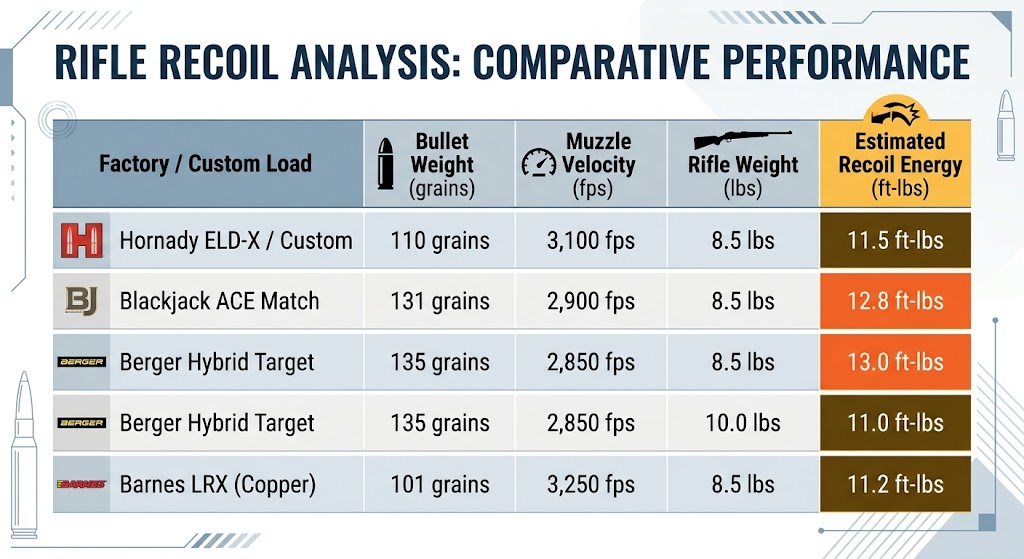
The following table displays estimated free recoil energy for popular .25 Creedmoor boutique factory loads and common custom handloads. Because this cartridge is predominantly chambered in precision bolt-action rifles and heavy-barreled hunting rigs, these calculations use a baseline 8.5-pound rifle weight to ensure a consistent comparison.
| Factory / Custom Load | Bullet Weight | Muzzle Velocity | Rifle Weight | Estimated Recoil Energy |
| Hornady ELD-X / Custom | 110 grains | 3,100 fps | 8.5 lbs | 11.5 ft-lbs |
| Blackjack ACE Match | 131 grains | 2,900 fps | 8.5 lbs | 12.8 ft-lbs |
| Berger Hybrid Target | 135 grains | 2,850 fps | 8.5 lbs | 13.0 ft-lbs |
| Berger Hybrid Target | 135 grains | 2,850 fps | 10.0 lbs | 11.0 ft-lbs |
| Barnes LRX (Copper) | 101 grains | 3,250 fps | 8.5 lbs | 11.2 ft-lbs |
How Much Recoil Does 25 Creedmoor Have?
In practical terms, a standard .25 Creedmoor load shooting a heavy 131-grain bullet generates an average of 12.5 foot-pounds of free recoil energy and a recoil velocity of roughly 9.5 feet per second in an 8.5-pound rifle. Recoil energy dictates the physical rearward force delivered to your shoulder, while recoil velocity determines how fast or sharp that impact feels.
Because both of these metrics are quite low, the .25 Creedmoor generates very manageable rearward thrust. The recoil velocity is slow enough that the kick completely lacks any harsh, punishing snap, resulting in a smooth shooting experience that splits the difference perfectly between the 6mm Creedmoor and the 6.5 Creedmoor.
What Does 25 Creedmoor Recoil Feel Like?
During a hunt for deer or antelope, the recoil of a .25 Creedmoor is essentially unnoticeable. Shooters typically describe it as a gentle, rolling push backward. It is universally classified as a mild-recoiling cartridge that introduces zero hesitation or flinching.
At the shooting range, the .25 Creedmoor is an absolute pleasure for high-volume shooting. You can easily fire dozens of rounds during an extended practice session or precision rifle match without experiencing any shoulder fatigue. The minimal recoil impulse allows precision shooters to easily track their bullet trace and spot their own impacts through the scope in real time.
25 Creedmoor Recoil Compared To Other Cartridges
To understand how the .25 Creedmoor fits into the broader cartridge landscape, it helps to compare it directly to other popular short-action and quarter-bore chamberings. The data below assumes a standard rifle weight of 8.5 pounds for all cartridges to ensure an accurate, apples-to-apples comparison.
| Cartridge | Common Bullet Weight | Muzzle Velocity | Estimated Recoil Energy |
| .22 Creedmoor | 88 grains | 3,150 fps | 8.9 ft-lbs |
| 6mm Creedmoor | 108 grains | 2,940 fps | 11.4 ft-lbs |
| .25 Creedmoor | 131 grains | 2,900 fps | 12.8 ft-lbs |
| 6.5 Creedmoor | 140 grains | 2,700 fps | 12.5 ft-lbs |
| .25-06 Remington | 117 grains | 3,100 fps | 14.5 ft-lbs |
| .308 Winchester | 150 grains | 2,820 fps | 15.5 ft-lbs |
What Affects 25 Creedmoor Recoil?
While the recoil is inherently mild, several physical and mechanical factors determine exactly how much kick your specific rifle will produce.
- Rifle Weight: A heavier rifle absorbs more rearward momentum. A heavy precision chassis setup with a bull barrel and a large optic will kick noticeably less than a lightweight mountain hunting rifle.
- Bullet Weight: The .25 Creedmoor revitalized the .257 caliber by utilizing heavy, high-ballistic-coefficient projectiles ranging from 110 to 135 grains. Pushing these heavier bullets requires more force, which slightly increases the opposite rearward push compared to traditional 90-grain varmint bullets.
- Muzzle Velocity: Faster bullets generate more recoil. Because the .25 Creedmoor drives heavy bullets at excellent speeds, it delivers a slightly faster impulse than slower small-bore rounds.
- Powder Charge: The mass of the burning powder leaving the barrel adds to the total rearward thrust. The .25 Creedmoor uses a highly efficient, moderate powder charge, keeping overall recoil significantly lower than older long-action cartridges.
- Muzzle Devices: Threading a muzzle brake or suppressor onto the barrel will trap or redirect escaping gases, further mitigating the already light recoil.
How To Reduce 25 Creedmoor Recoil
Because the .25 Creedmoor produces roughly 11 to 13 foot-pounds of recoil energy, mitigation is rarely necessary for adult shooters. However, if you are setting up a rifle for a youth shooter or want absolute zero muzzle jump during precision target matches, you can easily tame it further.
The most popular method is attaching a suppressor. Because many custom .25 Creedmoor precision rifles come with threaded barrels, adding a silencer eats up the muzzle blast, adds stabilizing weight to the front of the gun, and reduces felt recoil to nearly nothing.
Alternatively, installing a small muzzle brake will eliminate almost all perceived recoil, though it will drastically increase the side concussion at the range. Adding physical weight to the rifle via a heavier stock, bipod, or scope will also help soak up the minimal energy before it reaches your shoulder.
Is 25 Creedmoor Recoil Too Much For Hunting?
The .25 Creedmoor recoil is definitely not too much for hunting. In fact, its exceptionally mild kick paired with devastating terminal ballistics is its primary selling point for deer, antelope, and predator hunting.
Because the recoil is so light, it is an outstanding cartridge for youth hunters, beginners, and anyone who wants to place shots with absolute precision without flinching. The heavy, high-BC .257 caliber bullets penetrate deeply, buck the wind exceptionally well, and retain impressive energy downrange, making it highly effective on medium game out to extended distances.
Frequently Asked Questions
Does the 25 Creedmoor kick more than the 6.5 Creedmoor?
They are virtually identical. The .25 Creedmoor pushes slightly lighter bullets than the 6.5 Creedmoor but at faster velocities, resulting in nearly the exact same free recoil energy. In rifles of the same weight, a shooter cannot feel the difference between the two.
How does 25 Creedmoor recoil compare to the .25-06 Remington?
The .25 Creedmoor kicks noticeably less than the .25-06 Remington. The .25-06 is a long-action cartridge that burns roughly 10 to 15 grains more powder to achieve its velocities. That extra burning powder mass creates more rearward rocket effect, giving the .25-06 a stouter kick.
Can a youth shooter handle 25 Creedmoor recoil?
Absolutely. With free recoil energy hovering around 12 foot-pounds, it is an exceptionally friendly centerfire rifle cartridge. It is an ideal choice for young or recoil-sensitive hunters who need more downrange energy than a .223 Remington can provide without the heavy kick of a .308 Winchester.