The .375 Holland & Holland Magnum produces roughly 30 to 40 foot-pounds of free recoil energy in a standard dangerous game rifle, placing it firmly in the heavy-bore magnum category. Introduced in 1912, it is globally celebrated as the gold standard for African safaris and large bear hunting, delivering massive terminal power accompanied by a very heavy, authoritative shove. The exact amount of .375 H&H recoil you experience will always vary depending on your specific rifle weight, bullet weight, muzzle velocity, and powder load.
.375 H&H Magnum Recoil Chart
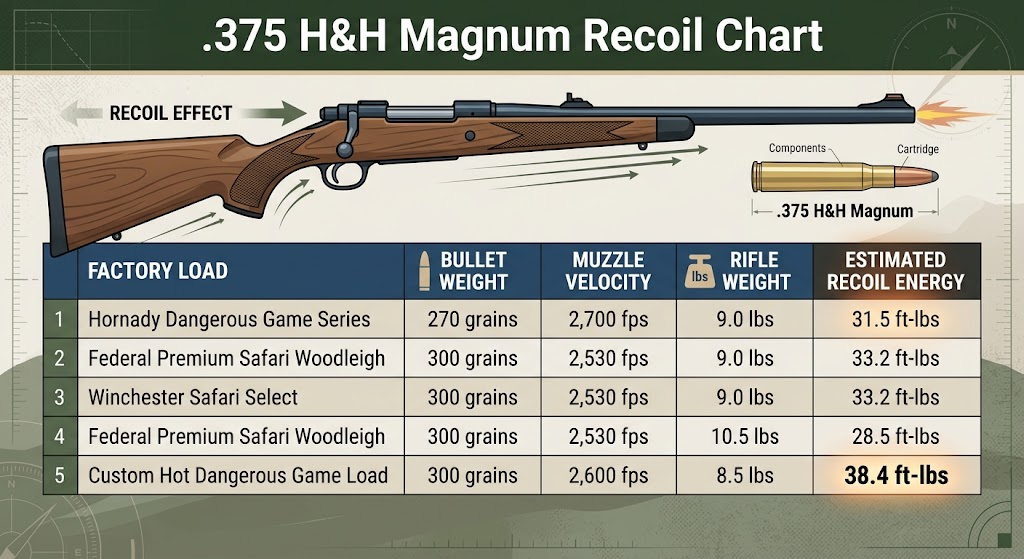
The following table displays estimated free recoil energy for popular .375 H&H Magnum factory loads across different rifle weights. Because dangerous game rifles are built heavier to handle big calibers (typically ranging from 8.5 to 10 pounds), these calculations account for that added mass to provide an accurate picture of rearward force.
| Factory Load | Bullet Weight | Muzzle Velocity | Rifle Weight | Estimated Recoil Energy |
| Hornady Dangerous Game Series | 270 grains | 2,700 fps | 9.0 lbs | 31.5 ft-lbs |
| Federal Premium Safari Woodleigh | 300 grains | 2,530 fps | 9.0 lbs | 33.2 ft-lbs |
| Winchester Safari Select | 300 grains | 2,530 fps | 9.0 lbs | 33.2 ft-lbs |
| Federal Premium Safari Woodleigh | 300 grains | 2,530 fps | 10.5 lbs | 28.5 ft-lbs |
| Custom Hot Dangerous Game Load | 300 grains | 2,600 fps | 8.5 lbs | 38.4 ft-lbs |
How Much Recoil Does .375 H&H Magnum Have?
In practical terms, a standard 300-grain .375 H&H hunting load generates an average of 33 foot-pounds of free recoil energy and a recoil velocity of roughly 14.5 feet per second in a 9-pound rifle. Recoil energy dictates the physical rearward force delivered to your shoulder, while recoil velocity determines how fast or sharp that impact feels.
Because the .375 H&H pushes massive, heavy bullets out of a large-capacity case, it generates substantial rearward momentum. However, unlike high-pressure modern short magnums that deliver a sharp, snappy punch, the .375 H&H is famous for a relatively smooth, rolling push due to its tapered case design and moderate chamber pressure curve.
What Does .375 H&H Magnum Recoil Feel Like?
During a dangerous game hunt or a high-stakes encounter, adrenaline completely masks the physical impact. Shooters typically describe the recoil as a massive, heavy shove backward rather than a sharp, bruising snap. It is universally classified as a heavy recoiling cartridge, but one that is remarkably well-behaved for its power class.
At the shooting range, the feeling is definitely demanding. Firing twenty or thirty consecutive full-power 300-grain rounds from a bench rest will result in significant shoulder fatigue and muscle soreness. However, because the recoil impulse is a deep push rather than a sharp jab, most experienced shooters find it far more tolerable than high-velocity .300 or .338 magnums.
.375 H&H Magnum Recoil Compared To Other Cartridges
To understand how the .375 H&H fits into the broader cartridge landscape, it helps to compare it directly to other popular heavy-recoiling hunting options. The data below assumes a standard rifle weight of 9.0 pounds for all chamberings to ensure a fair, direct comparison.
| Cartridge | Common Bullet Weight | Muzzle Velocity | Estimated Recoil Energy |
| .30-06 Springfield | 180 grains | 2,700 fps | 17.5 ft-lbs |
| .300 Win Mag | 180 grains | 2,950 fps | 27.4 ft-lbs |
| 300 PRC | 212 grains | 2,860 fps | 34.7 ft-lbs |
| .375 H&H Magnum | 300 grains | 2,530 fps | 33.2 ft-lbs |
| .338 Lapua Magnum | 250 grains | 2,950 fps | 39.5 ft-lbs |
| .458 Winchester Magnum | 500 grains | 2,050 fps | 54.0 ft-lbs |
What Affects .375 H&H Magnum Recoil?
Because the .375 H&H handles heavy payloads, several physical factors dictate exactly how much kick your specific rifle will produce.
- Rifle Weight: This is the most crucial variable. Dangerous game rifles are traditionally built with dense wood stocks and heavier steel contours, bringing the total weight up to 9 or 10 pounds to act as an energy sponge.
- Bullet Weight: The cartridge is legendary for its performance with heavy 300-grain monolithic or soft-point bullets. Pushing these massive projectiles requires immense force, which directly increases rearward momentum.
- Muzzle Velocity: Operating at moderate velocities (around 2,500 to 2,700 fps) rather than hyper-magnum speeds keeps the recoil velocity from feeling overly harsh or violent.
- Stock Design and Fit: Traditional safari rifles feature classic straight-comb stocks and thick rubber recoil pads designed to direct the heavy push straight back into the shoulder rather than slapping the shooter’s cheek.
How To Reduce .375 H&H Magnum Recoil
Because the .375 H&H produces over 30 foot-pounds of recoil energy, proper setup is important for comfortable practice sessions.
The single best modification is ensuring your rifle features a modern, high-performance deceleration recoil pad (such as a Pachmayr Decelerator or LimbSaver). Because traditional safari rifles often featured hard rubber or leather buttpads, upgrading to a modern squishy pad completely transforms the felt experience of that heavy push.
While traditionalists generally avoid muzzle brakes on dangerous game rifles (as brakes drastically increase muzzle blast and noise in tight hunting quarters), threading on a suppressor or a removable muzzle brake can slash free recoil energy by 35 to 40 percent if you plan on extended target practice at the range.
Is .375 H&H Magnum Recoil Too Much For Hunting?
The .375 H&H Magnum recoil is entirely appropriate for its intended purpose of hunting large, dangerous, and thick-skinned game such as Cape buffalo, elephant, lion, and large brown bears. For experienced big-game hunters who practice good fundamentals, the recoil is fully manageable.
However, the .375 H&H is absolutely too much for standard deer hunting, and its recoil is far too heavy for newer shooters, youth, or anyone prone to flinching. Handing a lightweight .375 H&H to an unaccustomed shooter is a guaranteed way to induce a severe flinch. It is a specialized tool meant for experienced hands pursuing serious game.
Frequently Asked Questions
Does the .375 H&H kick harder than a .300 Win Mag?
They are very close, but the .375 H&H typically generates slightly more total free recoil energy (around 33 ft-lbs vs 27 ft-lbs) because it launches much heavier bullets. However, many shooters report that the .375 H&H feels softer because its recoil impulse is a smooth, heavy push rather than a sharp snap.
Is .375 H&H recoil worse than .338 Lapua Magnum?
No, the .338 Lapua Magnum generally kicks slightly harder and has a faster, sharper recoil velocity because it drives high-BC bullets at much higher speeds under extreme pressures.
Can you shoot a .375 H&H comfortably without a muzzle brake?
Yes. In fact, the vast majority of traditional dangerous game rifles do not have muzzle brakes. Because the rifle weighs 9 to 10 pounds and the cartridge’s pressure curve creates a rolling push rather than a sharp jab, most adult shooters with proper form can handle it comfortably without a brake.