The 7mm Precision Rifle Cartridge produces around 23 to 28 foot-pounds of free recoil energy in a standard hunting rifle, placing it firmly in the magnum recoil category. This level of kick is noticeably heavier than short-action cartridges but slightly milder than larger .30 caliber magnums. The exact amount of 7mm PRC recoil you experience will always vary depending on your specific rifle weight, bullet weight, muzzle velocity, and powder load.
7mm PRC Recoil Chart
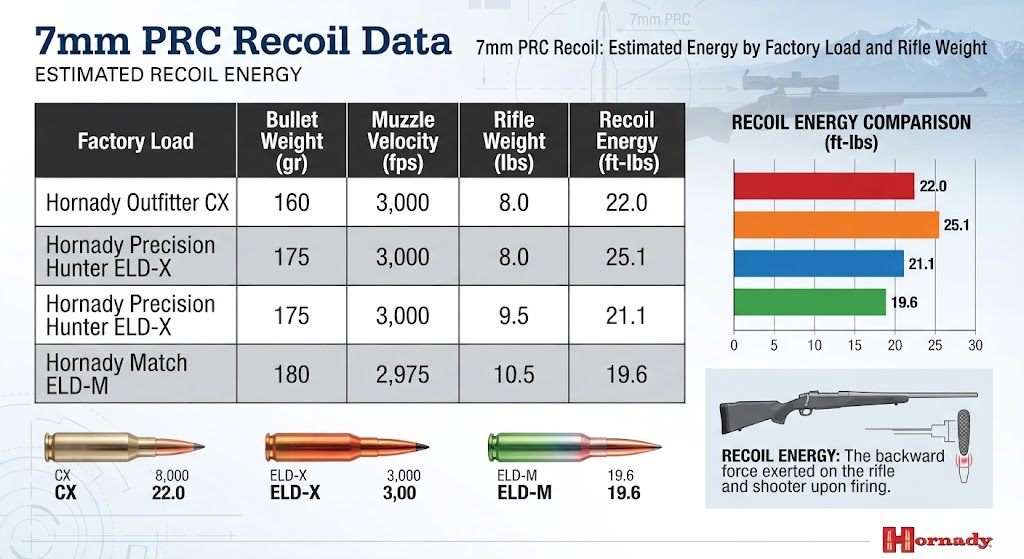
The following table displays estimated free recoil energy for popular 7mm PRC factory loads across different rifle weights. These calculations account for bullet mass, powder charge mass, and muzzle velocity.
| Factory Load | Bullet Weight | Muzzle Velocity | Rifle Weight | Estimated Recoil Energy |
| Hornady Outfitter CX | 160 grains | 3,000 fps | 8.0 lbs | 22.0 ft-lbs |
| Hornady Precision Hunter ELD-X | 175 grains | 3,000 fps | 8.0 lbs | 25.1 ft-lbs |
| Hornady Precision Hunter ELD-X | 175 grains | 3,000 fps | 9.5 lbs | 21.1 ft-lbs |
| Hornady Match ELD-M | 180 grains | 2,975 fps | 10.5 lbs | 19.6 ft-lbs |
How Much Recoil Does 7mm PRC Have?
In practical terms, the 7mm PRC generates an average of 24 foot-pounds of free recoil energy and a recoil velocity of roughly 13.5 feet per second in an 8.5-pound rifle. Recoil energy measures the actual physical force pushed backward into the shooter’s shoulder. Recoil velocity measures how fast that force is delivered, which translates to the “sharpness” or “snap” of the kick.
Because the 7mm PRC is designed to push heavy, high-ballistic-coefficient bullets at magnum velocities, it generates substantial rearward force. The recoil is significant enough that it requires proper shooting fundamentals to manage effectively, especially during extended range sessions where fatigue can induce a flinch.
What Does 7mm PRC Recoil Feel Like?
During a hunt, the adrenaline of the moment often masks the physical sensation of the 7mm PRC recoil. Shooters typically describe it as a heavy, firm push rather than a sharp, violent snap. It is universally considered a moderate to heavy recoiling cartridge.
At the shooting range, the feeling is much more apparent. Shooting a lightweight 7mm PRC hunting rifle from a bench rest without a muzzle brake will become uncomfortable for most shooters after a dozen rounds. The recoil impulse is stout enough to easily push you off target, meaning you will lose your sight picture through the scope if your shooting position is not perfectly stable.
7mm PRC Recoil Compared To Other Cartridges
To understand where the 7mm PRC sits in the broader cartridge landscape, we must compare it against other popular chamberings. The data below assumes a standard rifle weight of 8.5 pounds for all cartridges to ensure a fair comparison.
| Cartridge | Common Bullet Weight | Muzzle Velocity | Estimated Recoil Energy |
| .308 Winchester | 168 grains | 2,700 fps | 14.8 ft-lbs |
| 6.5 PRC | 143 grains | 2,960 fps | 15.4 ft-lbs |
| .30-06 Springfield | 180 grains | 2,700 fps | 18.4 ft-lbs |
| 7mm Rem Mag | 160 grains | 2,950 fps | 20.0 ft-lbs |
| 7mm PRC | 175 grains | 3,000 fps | 23.7 ft-lbs |
| .300 Win Mag | 180 grains | 2,950 fps | 25.5 ft-lbs |
What Affects 7mm PRC Recoil?
Several distinct physical and mechanical factors dictate exactly how much recoil a 7mm PRC rifle will produce.
- Rifle Weight: This is the most critical variable. A heavier rifle absorbs more rearward momentum, lowering the free recoil energy that reaches your shoulder.
- Bullet Weight: Pushing a heavier 180-grain bullet requires more force than a 160-grain bullet, which directly increases the opposite rearward force.
- Muzzle Velocity: Faster bullets generate more recoil. The 7mm PRC operates at around 3,000 feet per second, driving up the recoil velocity.
- Powder Charge: The mass of the burning powder leaving the barrel acts like a rocket jet. The 7mm PRC uses large powder charges of nearly 70 grains, adding noticeably to the total recoil.
- Muzzle Brakes: Brakes redirect the expanding gases sideways and backwards, physically pulling the rifle forward to counteract the rearward kick.
- Suppressors: A silencer traps and slows expanding gases. This reduces the rocket effect at the muzzle and adds physical weight to the end of the barrel.
- Recoil Pads: A premium rubber recoil pad does not reduce the actual energy, but it compresses to spread the force over a longer duration, lowering perceived recoil.
How To Reduce 7mm PRC Recoil
If the factory recoil level is too high, you can apply several practical methods to tame the rifle.
The most effective method is installing a high-quality muzzle brake. A well-designed radial or directional brake can reduce free recoil energy by 40 to 50 percent. This takes a 25 ft-lb 7mm PRC down to the recoil level of a standard .308 Winchester. However, this drastically increases the muzzle blast and noise directed back toward the shooter.
Alternatively, threading on a suppressor provides excellent recoil reduction while also protecting your hearing. You can also add physical weight to the rifle system. Upgrading to a heavier chassis, utilizing a thicker barrel contour, or simply attaching a heavier scope will soak up more energy before it hits your body. Finally, upgrading the factory buttpad to a specialized recoil pad will soften the felt impact on your shoulder.
Is 7mm PRC Recoil Too Much For Hunting?
The 7mm PRC is widely considered an exceptional hunting cartridge for medium to large game like mule deer and elk. For experienced shooters who practice good fundamentals, the recoil is entirely manageable for hunting scenarios. The heavy bullets retain massive amounts of energy for long-range harvesting, making the recoil tradeoff worthwhile for western hunters.
However, the 7mm PRC is generally not recommended for newer shooters, children, or anyone sensitive to heavy recoil. Handing a lightweight 7mm PRC to a novice is a quick way to induce a flinch, which destroys accuracy. If a newer shooter must use the cartridge, a muzzle brake or suppressor is practically mandatory to ensure they can practice comfortably and shoot ethically in the field.
Frequently Asked Questions
Does the 7mm PRC kick more than the 7mm Rem Mag?
Yes, but only slightly. While they have similar powder capacities, the 7mm PRC is specifically designed to shoot heavier, longer bullets. Pushing a 175-grain bullet naturally generates more recoil than the 150-grain or 160-grain bullets traditionally used in the 7mm Rem Mag.
Can I shoot 7mm PRC without a muzzle brake?
You can comfortably shoot a 7mm PRC without a muzzle brake if you are accustomed to magnum rifles or if you are shooting a heavier rifle platform. Lightweight mountain rifles chambered in 7mm PRC will be physically punishing without a brake.
Is 7mm PRC recoil worse than .300 Win Mag?
No. The .300 Winchester Magnum typically generates slightly more recoil energy than the 7mm PRC because the .300 Win Mag pushes heavier bullets using slightly larger powder charges. The difference is minor but noticeable side by side.