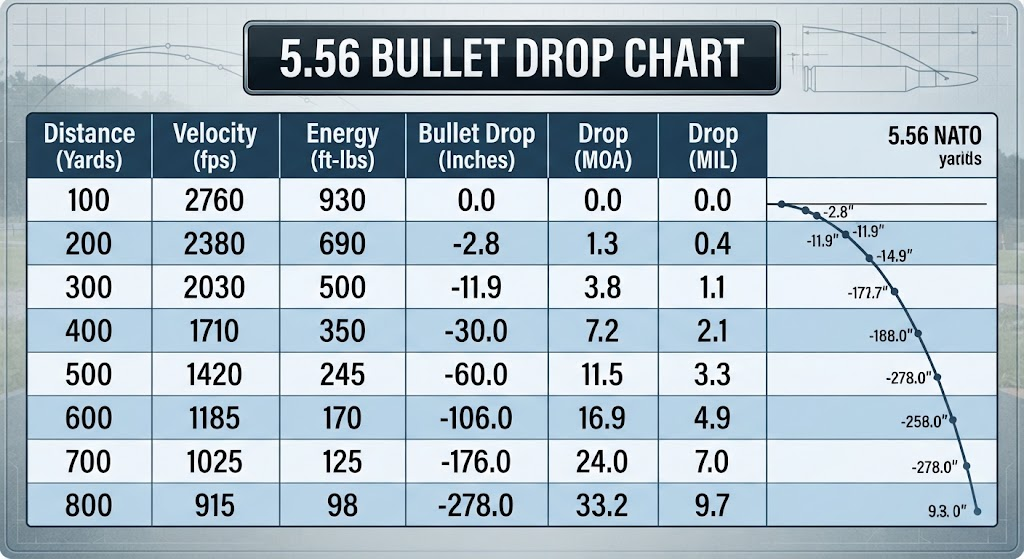
A 5.56 bullet drop chart provides the precise trajectory data required to maximize the accuracy of the world’s most popular intermediate cartridge. The actual bullet drop of your rifle depends on the specific ammunition load, bullet weight, muzzle velocity, ballistic coefficient, chosen zero distance, and environmental conditions. By reviewing a reliable ballistic chart, shooters can understand exactly how much their projectile arcs over distance and make rapid optic adjustments. The chart below breaks down the critical flight metrics needed to effectively engage targets at various ranges.
5.56 Bullet Drop Chart
| Distance (Yards) | Velocity (fps) | Energy (ft-lbs) | Bullet Drop (Inches) | Drop (MOA) | Drop (MIL) |
| 100 | 2760 | 930 | 0.0 | 0.0 | 0.0 |
| 200 | 2380 | 690 | -2.8 | 1.3 | 0.4 |
| 300 | 2030 | 500 | -11.9 | 3.8 | 1.1 |
| 400 | 1710 | 350 | -30.0 | 7.2 | 2.1 |
| 500 | 1420 | 245 | -60.0 | 11.5 | 3.3 |
| 600 | 1185 | 170 | -106.0 | 16.9 | 4.9 |
| 700 | 1025 | 125 | -176.0 | 24.0 | 7.0 |
| 800 | 915 | 98 | -278.0 | 33.2 | 9.7 |
The parameters for the table above are based on standard ballistic data for the highly popular Federal American Eagle 55-grain XM193 load. This provides an excellent and widely applicable baseline for standard 5.56x45mm NATO ammunition fired from an AR-15 platform.
Ballistic Parameters:
- Ammunition Load: Federal American Eagle 5.56x45mm NATO (XM193)
- Bullet Weight & Type: 55-grain Full Metal Jacket Boat Tail (FMJ-BT)
- Muzzle Velocity: 3165 feet per second (fps)
- Ballistic Coefficient (G1): 0.243
- Zero Distance: 100 Yards
- Sight Height: 2.6 inches above bore (Standard AR-15 optic height)
- Test Barrel Length: 20 inches
- Environmental Assumptions: Sea level altitude, 59 degrees Fahrenheit
Note: Velocity and energy figures are sourced from standard manufacturer ballistic charts for the XM193 specification. Drop figures and extended data out to 800 yards are calculated using a 0.243 ballistic coefficient under standard atmospheric conditions.
Understanding The 5.56 Bullet Drop Chart
5.56 Bullet Drop At 100 Yards
At 100 yards, the 55-grain bullet reaches its exact zero distance. The projectile perfectly intersects the optic’s line of sight, meaning there is zero bullet drop. The bullet travels at a blistering 2760 fps and retains 930 foot-pounds of energy. A 100-yard zero provides a highly accurate and easily calculated baseline for modern tactical optics, low-power variable optics, and red dot sights.
5.56 Bullet Drop At 200 Yards
When the bullet reaches 200 yards, the 5.56 cartridge shows off its incredibly flat trajectory. The bullet drops a mere 2.8 inches below the center line. Shooters only need to dial 1.3 MOA or hold 0.4 MIL on their reticle. Retaining roughly 690 foot-pounds of energy, the projectile is still traveling fast enough to cause reliable fragmentation upon impact in self-defense or varmint hunting scenarios.
5.56 Bullet Drop At 300 Yards
At 300 yards, the bullet drops 11.9 inches. You will need to make an elevation correction of 3.8 MOA or 1.1 MIL. Velocity slows to 2030 fps, and kinetic energy drops to 500 foot-pounds. This distance represents a practical maximum range for engaging small game or coyotes, as the lighter 55-grain bullet loses energy rapidly and is easily pushed horizontally by crosswinds.
5.56 Bullet Drop At 400 Yards
Crossing the 400-yard mark requires deliberate optic adjustments. The lightweight projectile drops 30.0 inches below the line of sight. A shooter must dial 7.2 MOA or 2.1 MIL to score a center hit. With energy sitting around 350 foot-pounds, the terminal ballistics are greatly reduced. Shooters must pay close attention to wind conditions at this range to ensure accurate target impacts.
5.56 Bullet Drop At 500 Yards
At 500 yards, the 5.56 NATO experiences a substantial drop of 60.0 inches. You will need an elevation shift of 11.5 MOA or 3.3 MIL. The velocity drops to 1420 fps. While hitting man-sized steel targets is entirely achievable with proper fundamentals and good dope, the bullet lacks the kinetic energy required for ethical hunting of almost any mammal at this extended range.
5.56 Bullet Drop At 600 Yards
Reaching 600 yards pushes the standard 55-grain 5.56 NATO cartridge to its ballistic limit. The bullet plunges 106.0 inches, requiring a turret adjustment of 16.9 MOA or 4.9 MIL. The velocity plummets to 1185 fps, which is dangerously close to the transonic zone where bullets lose stability. Target shooting at this distance requires highly specialized match-grade ammunition rather than standard 55-grain FMJ.
Frequently Asked Questions
What is the best zero distance for a 5.56 AR-15?
A 100-yard zero is the standard recommendation for most modern optics, as it creates a simple and mathematically clean baseline for dialing turrets at longer ranges. However, many tactical shooters prefer the popular 50/200 yard zero. With a 50-yard zero, the trajectory path brings the bullet back to the center line again at roughly 200 yards, allowing a shooter to hit a target out to 250 yards with practically zero holdover adjustment.
How does barrel length affect my 5.56 bullet drop chart?
Barrel length drastically changes muzzle velocity, which dictates your entire trajectory. The chart above assumes a 20-inch barrel, which maximizes the velocity of the 5.56 cartridge. If you shoot a 16-inch or 10.5-inch barrel, your muzzle velocity will be significantly lower. A slower bullet experiences gravity for a longer period of flight time, resulting in much steeper bullet drop at every distance.
How does a 55-grain 5.56 compare to a 62-grain or 77-grain bullet?
A lighter 55-grain bullet leaves the muzzle extremely fast, yielding a very flat trajectory inside 300 yards. A 62-grain bullet (like the M855 green tip) is slightly slower but penetrates barriers better. A heavy 77-grain match bullet starts much slower but possesses a significantly higher ballistic coefficient. Past 400 yards, the 77-grain bullet retains its velocity much better, resists wind drift far more effectively, and provides vastly superior long-range precision.
What is the effective range of a 5.56 rifle?
The effective range depends entirely on the target and the intended outcome. For simple target shooting on steel plates, a skilled marksman can stretch a 5.56 rifle out to 600 or 700 yards using heavy 77-grain match ammunition. For hunting small game or coyotes with standard 55-grain ammunition, the effective ethical range is typically limited to 300 yards due to the rapid loss of kinetic energy and terminal fragmentation.