The main difference in the 38 Special Vs 38 Special P comparison is internal pressure, as the +P variant is loaded to higher pressure limits to achieve greater velocity and terminal expansion. Standard pressure loads are perfect for vintage revolvers, training, and recoil-sensitive shooters. Conversely, the +P ammunition delivers the necessary kinetic energy required for modern self-defense, provided your specific revolver is explicitly rated by the manufacturer to safely handle the increased stress.
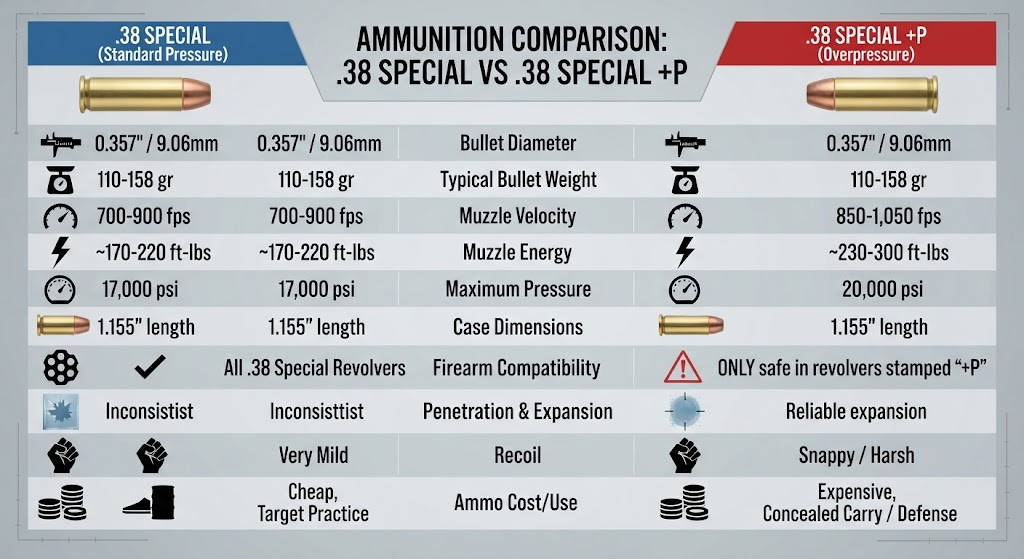
38 Special Vs 38 Special P Comparison
| Feature | 38 Special (Standard Pressure) | 38 Special P (+P Overpressure) |
| Bullet Diameter | 0.357 inches (9.06 mm) | 0.357 inches (9.06 mm) |
| Typical Bullet Weight | 110 gr to 158 gr (typically 130 or 158 gr) | 110 gr to 158 gr (typically 125 or 135 gr) |
| Muzzle Velocity | 700 to 900 fps (varies heavily by barrel) | 850 to 1,050 fps (varies heavily by barrel) |
| Muzzle Energy | ~170 to 220 ft-lbs | ~230 to 300 ft-lbs |
| Momentum | ~15 to ~18 lb-fps | ~18 to ~21 lb-fps |
| Maximum Pressure | 17,000 psi (SAAMI) | 20,000 psi (SAAMI) |
| Case Dimensions | Identical (1.155 inches length) | Identical (1.155 inches length) |
| Firearm Compatibility | Safe in all functional .38 Special revolvers | ONLY safe in revolvers explicitly stamped “+P” |
| Penetration | Deep (if non-expanding lead) / Shallow (if JHP fails) | Deep and reliable with modern hollow points |
| Expansion | Often fails to expand from 2-inch barrels | Reliable expansion from 2-inch snub-nose barrels |
| Recoil | Very Mild | Snappy to Harsh (in lightweight revolvers) |
| Effective Range | 25 to 50 yards | 25 to 50 yards |
| Ammo Availability | Extremely High (Target and practice rounds) | Extremely High (Premium defensive rounds) |
| Ammo Cost | Cheap ($0.40 to $0.60/rd) | Expensive ($1.00 to $1.50/rd) |
| Best Use | Target practice, vintage revolvers, plinking | Modern concealed carry, law enforcement, home defense |
The table above illustrates the most critical fact regarding these two cartridges: they are physically identical on the outside. A standard 38 Special and a 38 Special P cartridge share the exact same case dimensions and bullet diameter. The only difference is the amount and type of gunpowder loaded inside.
Because they are physically identical, a high-pressure +P cartridge will easily chamber inside a vintage or weakly constructed revolver that was only designed for standard pressure (17,000 psi). Firing 20,000 psi +P ammunition in an older firearm not rated for it can cause accelerated frame stretching, timing issues, or catastrophic cylinder failure. You must verify that your revolver’s barrel is stamped “38 Special +P” before firing overpressure ammunition.
38 Special Vs 38 Special P Ballistics
To objectively evaluate the ballistic capabilities, we must examine real-world ammunition fired from the most common platform for this caliber: the 2-inch snub-nose concealed carry revolver. (Note: Velocities drop significantly in 2-inch barrels compared to 4-inch test barrels).
- Load A (Standard Pressure Target): Winchester 130-grain Full Metal Jacket (FMJ). Tested from a 2-inch barrel. Muzzle velocity is roughly 720 feet per second. Muzzle energy is 150 foot-pounds.
- Load B (Standard Pressure Defense): Federal Premium 110-grain Hydra-Shok JHP. Tested from a 2-inch barrel. Muzzle velocity is roughly 840 feet per second. Muzzle energy is 172 foot-pounds.
- Load C (+P Defensive Hollow Point): Speer Gold Dot 135-grain +P JHP (Short Barrel). Tested from a 2-inch barrel. Muzzle velocity is roughly 860 feet per second. Muzzle energy is 222 foot-pounds.
- Load D (+P Heavy Defense): Remington 158-grain +P Lead Semi-Wadcutter Hollow Point (The “FBI Load”). Tested from a 2-inch barrel. Muzzle velocity is roughly 800 feet per second. Muzzle energy is 224 foot-pounds.
38 Special Vs 38 Special P Velocity
Velocity is the entire reason the +P designation exists. Revolver cartridges lose a massive amount of velocity when fired from 2-inch snub-nose barrels because the powder does not have enough time to burn completely before the bullet exits the muzzle.
Standard pressure loads often leave a 2-inch barrel traveling at a sluggish 700 to 750 feet per second. This is generally too slow to force a modern hollow-point bullet to expand upon impact.
The +P (overpressure) loading utilizes extra powder to squeeze an additional 100 to 150 feet per second out of the short barrel. This pushes the bullet past the critical 800 to 850 fps velocity threshold required to reliably open up a jacketed hollow point.
38 Special Vs 38 Special P Muzzle Energy
Muzzle energy represents the raw kinetic work capacity of a projectile.
Standard pressure loads generate a modest 150 to 200 foot-pounds of energy. While this is lethal, it is on the lower end of the modern self-defense spectrum, falling well behind standard 9mm ammunition.
The +P loads generate between 230 and 300 foot-pounds of energy (and even higher from 4-inch barrels). This 20% to 30% increase in kinetic energy allows the bullet to hit harder, penetrate deeper, and force violent terminal expansion, elevating the revolver back into highly capable defensive territory.
38 Special Vs 38 Special P Momentum
Momentum calculates mass in motion, which dictates a bullet’s ability to drive through heavy clothing and dense tissue without being deflected.
Because both loads can fire identical bullet weights (e.g., 135 grains or 158 grains), the momentum advantage goes entirely to the faster +P load. The extra velocity provides the heavy lead bullet with the linear driving force necessary to reach vital organs reliably from sub-optimal angles.
38 Special Vs 38 Special P Recoil
Recoil management highlights the primary trade-off of overpressure ammunition, especially when fired from modern “airweight” aluminum or scandium-framed revolvers weighing 15 ounces or less.
Standard pressure ammunition produces very mild, highly manageable recoil. It is comfortable to shoot for extended range sessions and allows for rapid, accurate follow-up shots under stress.
The +P ammunition produces a very snappy, harsh recoil impulse in lightweight snub-nose revolvers. The muzzle flip is significant, and the blast can cause physical pain to the shooter’s hand after just a few cylinders. This increased recoil can induce flinching in inexperienced shooters, making accurate follow-up shots much more difficult.
38 Special Vs 38 Special P Penetration & Expansion
This is the most critical difference for self-defense.
When a standard pressure hollow point is fired from a 2-inch barrel, it often strikes the target too slowly to expand. The hollow cavity plugs with clothing, and the bullet acts like a solid piece of lead, over-penetrating straight through the target and endangering bystanders behind the threat.
Modern +P ammunition is specifically engineered for short barrels. Because it achieves the necessary velocity threshold, the hollow point will peel back reliably, expanding to 0.50+ inches in diameter. This expansion acts like a parachute, dumping all the kinetic energy inside the target and preventing dangerous over-penetration.
38 Special Vs 38 Special P Self Defense & Concealed Carry
For modern concealed carry, the +P is universally recommended by law enforcement and defensive instructors, provided your revolver is rated for it. It maximizes the ballistic potential of the 5 or 6 rounds you have available in the cylinder, ensuring reliable terminal performance.
Standard pressure should be reserved for individuals who are highly sensitive to recoil, or for those who carry vintage steel revolvers (like early Smith & Wesson Model 10s or Colt Detective Specials) that cannot safely handle +P pressures.
Which Has More Stopping Power: 38 Special Vs 38 Special P?
The +P variant possesses significantly more stopping power. It delivers 20% to 30% more kinetic energy and guarantees much more reliable bullet expansion, creating a wider, more devastating permanent wound channel.
Which Is More Powerful: 38 Special Vs 38 Special P?
Based on raw internal pressure, velocity, and kinetic energy, the +P variant is objectively more powerful.
38 Special Pros And Cons
Pros
- Extremely mild recoil allows for fast, accurate follow-up shots
- Safe to fire in virtually all vintage and modern .38-caliber revolvers
- Massive availability of cheap full metal jacket (FMJ) ammunition for target practice
- Excellent for teaching new or recoil-sensitive shooters the fundamentals of marksmanship
Cons
- Frequently fails to expand when fired from short 2-inch barrels
- Generates relatively low kinetic energy compared to modern defensive calibers
- Risk of over-penetration if non-expanding bullets pass straight through the target
38 Special P Pros And Cons
Pros
- Provides the extra velocity necessary to force hollow points to expand reliably
- Delivers a 20% to 30% increase in kinetic energy and stopping power
- Maximizes the defensive capability of 5-shot snub-nose concealed carry revolvers
- Supported by premium, highly engineered defensive ammunition (e.g., Speer Gold Dot, Federal HST)
Cons
- Generates harsh, snappy recoil in lightweight concealed carry revolvers
- Accelerates wear and tear on the firearm’s lockup and timing over high round counts
- Dangerous to fire in older firearms that are not explicitly rated for overpressure ammunition
Final Comparison
| Category | Winner | Reason |
| Velocity | 38 Special P | Higher internal pressure limits yield 100 to 150 fps more speed |
| Muzzle Energy | 38 Special P | Extra velocity generates 20% to 30% more kinetic stopping power |
| Momentum | 38 Special P | Drives identical bullet weights with greater linear mass-in-motion |
| Penetration | 38 Special P | Reliable expansion prevents over-penetration while ensuring vital depth |
| Expansion | 38 Special P | Reaches the critical velocity thresholds required for modern hollow points |
| Recoil Control | 38 Special | Standard pressure is vastly softer and more pleasant to shoot |
| Firearm Safety | 38 Special | Universally safe in any functional .38 revolver, vintage or modern |
| Self Defense | 38 Special P | Significantly better terminal ballistics from short concealed carry barrels |
| Concealed Carry | 38 Special P | Maximizes the limited capacity of sub-compact revolvers |
| Ammo Cost | 38 Special | Standard target FMJ ammunition is cheap and widely produced |
| Ammo Availability | Tie | Both standard target loads and premium +P defensive loads are ubiquitous |
| Overall Performance | 38 Special P | The definitive upgrade required to make the caliber viable for modern defense |
38 Special Vs 38 Special P: Which Should You Choose?
Selecting between the two depends entirely on your firearm’s safety rating and whether you are at the shooting range or carrying for personal protection.
Choose the 38 Special (Standard Pressure) for target practice, plinking, and training. It is cheap, easy on the hands, and causes minimal wear on your firearm. It is also the only choice if you are shooting a vintage revolver (pre-1990s) that is not explicitly stamped as +P rated.
Choose the 38 Special P (+P) for concealed carry, home defense, and personal protection. When your life is on the line, you need ammunition that hits hard and expands reliably to stop a threat quickly. The +P load transforms the snub-nose revolver from a marginal backup gun into a highly capable primary defensive weapon.
FAQs
Is 38 Special P more powerful than standard 38 Special?
Yes, the +P variant is significantly more powerful. It is loaded to a maximum pressure of 20,000 psi (compared to 17,000 psi), resulting in higher velocities and 20% to 30% more muzzle energy.
Can any .38 revolver shoot +P ammunition?
No. You must check your firearm’s barrel or the manufacturer’s manual. Only revolvers explicitly stamped “.38 Special +P” (or modern .357 Magnum revolvers) are built with the steel strength required to safely contain the increased pressure.
What happens if I shoot +P in a standard pressure revolver?
Firing +P ammunition in a firearm not rated for it can cause the frame to stretch, the timing to degrade (causing the cylinder to fall out of alignment), or in extreme cases, the cylinder can catastrophically rupture and explode in your hands.
Which has more recoil?
The +P ammunition generates significantly more recoil and muzzle blast. In lightweight “airweight” revolvers, the recoil of a +P round can be harsh and uncomfortable, requiring practice to master.
Can a .357 Magnum shoot both?
Yes. A revolver chambered in .357 Magnum is built to withstand massive pressures (35,000 psi). It can safely fire .357 Magnum, standard pressure .38 Special, and .38 Special +P ammunition interchangeably.
Which is better for self-defense?
The +P is vastly superior for self-defense, particularly out of short 2-inch barrels, because the extra velocity guarantees that modern hollow points will expand reliably upon impact.
Which should you choose?
Choose standard pressure for cheap target practice and vintage revolvers. Choose +P for carrying in modern, +P rated concealed carry revolvers to maximize your stopping power.