The main difference between the cartridges is that the .277 Fury is a modern short-action military cartridge utilizing a high-pressure hybrid case design to achieve extreme velocities from compact sixteen-inch barrels, whereas the .270 Winchester is a century-old traditional long-action sporting cartridge that relies on a large internal powder capacity and twenty-four-inch barrels to achieve nearly identical downrange ballistic performance.
277 Fury vs 270 Win Comparison
| Feature | .277 Fury (6.8x51mm) | .270 Winchester |
| Bullet Diameter | 0.277 inches (7.04 mm) | 0.277 inches (7.04 mm) |
| Typical Bullet Weight | 135 gr to 150 gr (typically 135 gr or 150 gr) | 130 gr to 150 gr (typically 130 gr or 150 gr) |
| Muzzle Velocity | 2,750 to 3,000 fps (16-inch barrel) | 2,850 to 3,060 fps (24-inch barrel) |
| Muzzle Energy | 2,260 to 2,700 ft-lbs | 2,650 to 2,800 ft-lbs |
| Momentum | ~53 to ~60 lb-fps (depending on load) | ~56 to ~61 lb-fps (depending on load) |
| Maximum Pressure | 80,000 psi (Hybrid) / 65,000 psi (Brass) | 65,000 psi (SAAMI) |
| Ballistic Coefficient | Moderate to High (~0.475 to 0.500) | Moderate to High (~0.430 to 0.536) |
| Penetration | 18 to 22 inches (Gelatin) | 18 to 24 inches (Gelatin) |
| Expansion | 0.50 to 0.65 inches | 0.50 to 0.65 inches |
| Trajectory | Flat out to 300 yards, moderate drop beyond | Extremely flat out to 300 yards, predictable drop beyond |
| Recoil | Moderate (~16 to 18 ft-lbs in a standard rifle) | Moderate (~17 ft-lbs in an 8-pound rifle) |
| Effective Range | 400 to 600 yards (Hunting) | 400 to 600 yards (Hunting) |
| Ammo Availability | Low (Military priority, limited commercial runs) | Extremely High (Global hunting standard) |
| Ammo Cost | Very Expensive ($1.50 to $4.00+ per round) | Moderate ($1.00 to $2.50 per round) |
| Best Use | Short-barrel tactical applications, military duty | General plains game hunting, long-range deer hunting |
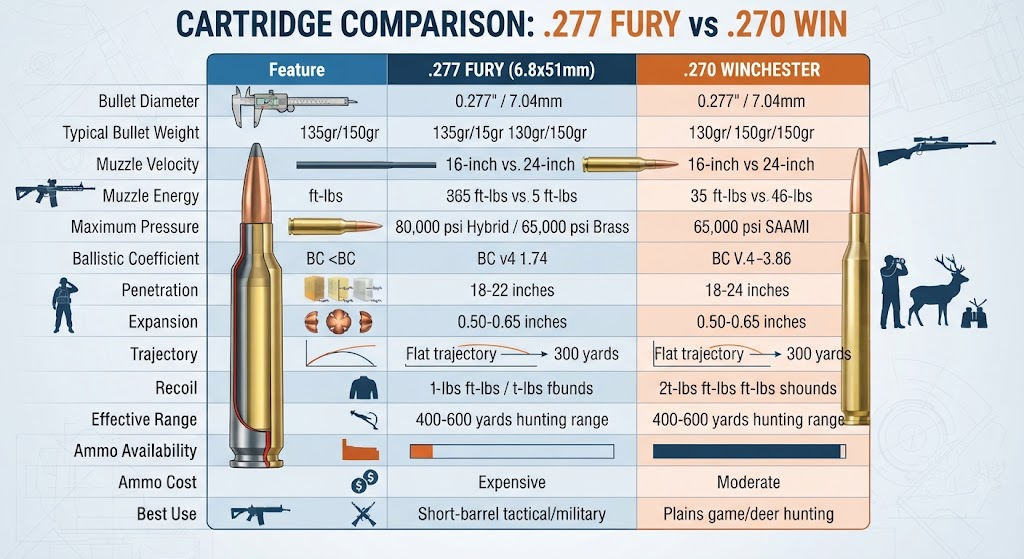
The table above outlines the foundational differences between a cutting-edge military combat cartridge and one of the most prolific big game hunting cartridges in American history. While both cartridges fire the exact same 0.277-inch diameter projectiles, their internal mechanics, case designs, and intended firearm platforms could not be more different.
277 Fury vs 270 Win Ballistics
To understand the ballistic profiles of these two calibers, one must examine the history and engineering constraints that dictated their designs.
The .270 Winchester is a piece of living firearms history. Introduced in 1925 by the Winchester Repeating Arms Company, it was created by necking down the .30-03 Springfield cartridge case to accept a smaller 0.277-inch bullet. Fostered into legendary status by the writings of hunting author Jack O’Connor, the .270 Winchester was designed to operate at a maximum pressure of 65,000 psi. Because it utilizes a long-action receiver and a case with massive internal powder capacity, it requires a long 24-inch barrel to burn all of its slow-burning powder and achieve its maximum velocity.
The .277 Fury (commercially adopted by SAAMI, but known in the military as the 6.8x51mm) was developed by SIG Sauer in 2019 to win the United States Army Next Generation Squad Weapon program. The military required a cartridge that could defeat modern Level IV body armor at extended distances, outperforming the 5.56 NATO and 7.62 NATO rounds, but it had to be fired from a compact 16-inch barrel to remain maneuverable in urban combat.
To achieve long-action, 24-inch barrel velocities from a short-action, 16-inch barrel, SIG Sauer had to drastically increase the chamber pressure. A standard brass cartridge case will catastrophically rupture at pressures exceeding 65,000 psi.To solve this, SIG Sauer designed a hybrid case consisting of a stainless steel base connected to a brass body by an aluminum locking washer.This stainless steel head allows the .277 Fury to safely operate at an astonishing 80,000 psi.It should be noted that commercial .277 Fury “practice” ammunition is manufactured using standard brass cases and is safely downloaded to normal 65,000 psi pressures, resulting in significantly slower velocities.
To objectively evaluate these calibers, we examine real-world factory ammunition across their most common applications. For a completely fair comparison reflecting their intended use cases, the .277 Fury loads are recorded from 16-inch barrels, while the .270 Winchester loads are recorded from 24-inch barrels.
- Load A (.277 Fury Hybrid Hunting): SIG Sauer 150-grain Hybrid Hunter (Stainless Steel Base). Tested from a 16-inch barrel. Muzzle velocity is 2,830 feet per second. Muzzle energy is 2,667 foot-pounds. Ballistic Coefficient is 0.500.
- Load B (.277 Fury Standard Brass): SIG Sauer 135-grain Elite Match Grade FMJ (Standard Brass). Tested from a 16-inch barrel. Muzzle velocity is 2,750 feet per second. Muzzle energy is 2,267 foot-pounds.Ballistic Coefficient is 0.475.
- Load C (.270 Winchester Hunting): Federal Premium 150-grain Nosler Partition. Tested from a 24-inch barrel. Muzzle velocity is 2,850 feet per second. Muzzle energy is 2,705 foot-pounds.
- Load D (.270 Winchester Standard): Hornady 130-grain Superformance SST. Tested from a 24-inch barrel. Muzzle velocity is 3,050 feet per second. Muzzle energy is 2,685 foot-pounds.
Manufacturer-rated data provides a standardized baseline, but independent testing frequently shows minor variations based on gas system length, chamber tolerances, and barrel wear.
277 Fury vs 270 Win Velocity
Velocity is a critical metric for rifle ammunition because it dictates how flat a projectile shoots across long distances and how effectively expanding bullets open upon impacting soft tissue.
When analyzing velocity, the barrel length discrepancy is the entire focal point of the comparison. The .270 Winchester is famous for its extreme velocity. A standard 130-grain bullet easily exceeds 3,060 feet per second from a 24-inch barrel. When loaded with heavier 150-grain bullets suitable for elk or moose, the .270 Winchester maintains an impressive 2,850 feet per second.
However, rifle cartridges lose velocity when fired from shorter barrels because the powder does not have enough time to fully burn and push the bullet before it exits the muzzle. If a hunter were to cut a .270 Winchester barrel down to 16 inches, the velocity of that 150-grain bullet would drop drastically, likely falling closer to 2,500 feet per second and creating an enormous fireball of unburnt powder.
The .277 Fury defies traditional barrel length rules by utilizing extreme 80,000 psi chamber pressures. From a compact 16-inch barrel, the .277 Fury pushes a 150-grain bullet at 2,830 feet per second.This means the short-action, 16-inch .277 Fury perfectly replicates the velocity of a long-action, 24-inch .270 Winchester.If a shooter decides to fire standard brass-cased .277 Fury ammunition, the velocity of a 135-grain bullet drops to a modest 2,750 feet per second, which is perfectly adequate for target practice but significantly slower than a standard .270 Winchester load.
277 Fury vs 270 Win Muzzle Energy
Muzzle energy represents the kinetic work capacity of a projectile. The kinetic energy generated by a cartridge is a direct reflection of both the speed of the bullet and its physical mass. Because both cartridges fire projectiles of identical diameters and highly similar weights at nearly identical velocities, their kinetic energy outputs are virtually indistinguishable.
A standard 130-grain .270 Winchester hunting load produces roughly 2,685 to 2,705 foot-pounds of energy at the muzzle. When utilizing heavier 150-grain bullets, the energy remains remarkably consistent, hovering around 2,705 foot-pounds. This is an exceptional amount of energy that has been proven capable of humanely harvesting every species of big game in North America for the last century.
The .277 Fury, when utilizing its high-pressure hybrid stainless steel cases, generates an astonishing 2,667 foot-pounds of energy from a 150-grain bullet fired out of a 16-inch barrel. The 135-grain hybrid match load can even reach 2,694 foot-pounds of energy at 3,000 feet per second. The engineering achievement here cannot be overstated. Delivering traditional magnum rifle energy from a compact carbine platform gives military personnel and modern hunters an unprecedented combination of maneuverability and raw stopping power.
277 Fury vs 270 Win Momentum
Momentum is a linear measurement calculating mass in motion. In terminal ballistics, high momentum correlates closely with the ability of a bullet to crush through dense bone, heavy winter clothing, and intermediate barriers without being deflected or stopping prematurely inside the target.
Because momentum relies equally on bullet weight and velocity, and both cartridges share identical specifications in these areas, their momentum profiles are identical.
A 150-grain bullet traveling at 2,850 feet per second (representing the .270 Winchester) yields approximately 61 pound-feet per second of linear momentum.
A 150-grain bullet traveling at 2,830 feet per second (representing the .277 Fury Hybrid load) yields approximately 60.5 pound-feet per second of linear momentum.
Both cartridges provide excellent momentum for medium to large game hunting. They will reliably punch through the heavy shoulder bones of elk or feral hogs and maintain a straight track through vital organs.
277 Fury vs 270 Win Trajectory
Understanding external ballistics and bullet drop is critical for any shooter attempting to hit targets beyond 200 yards. The trajectory of a bullet is dictated by its initial velocity, gravity, and the aerodynamic efficiency of the projectile as it cuts through the atmosphere. The aerodynamic efficiency is measured as a Ballistic Coefficient.
The calculations below assume a standard optic height of 1.5 inches above the bore and a clearly stated zero distance of 200 yards, which is the standard zero for modern centerfire hunting rifles. We will compare a 150-grain .277 Fury Hybrid load against a 150-grain .270 Winchester hunting load to demonstrate their nearly identical flight paths.
| Distance | .277 Fury (150 gr Hybrid at 2,830 fps) Drop | .270 Win (150 gr Soft Point at 2,850 fps) Drop |
| Muzzle | -1.5 inches | -1.5 inches |
| 100 Yards | +1.8 inches | +1.8 inches |
| 200 Yards | 0.0 inches (Zero) | 0.0 inches (Zero) |
| 300 Yards | -7.5 inches | -7.4 inches |
| 400 Yards | -21.8 inches | -21.5 inches |
| 500 Yards | -44.2 inches | -43.8 inches |
The data confirms that the trajectory of the high-pressure .277 Fury is functionally identical to the classic .270 Winchester. At 500 yards, the difference in bullet drop is less than half an inch, which is entirely imperceptible in real-world shooting conditions. Both cartridges shoot incredibly flat, allowing hunters to hold their crosshairs directly behind the shoulder of a deer out to 300 yards without needing to dial complex elevation adjustments on their rifle scopes.
277 Fury vs 270 Win Recoil
Recoil management is a major factor in rapid and accurate shooting. The physical recoil generated by a firearm is governed by the conservation of momentum and is heavily influenced by the weight of the rifle, the mass of the powder charge, and the weight of the bullet.
The .270 Winchester is globally recognized as a manageable but authoritative hunting cartridge. Fired from a standard 8-pound bolt-action hunting rifle, a typical 130-grain or 150-grain load generates roughly 17 to 18 foot-pounds of free recoil energy. This is a very comfortable level of recoil that most adult shooters can tolerate for moderate range sessions without developing a severe flinch.
The .277 Fury generates a very similar amount of total recoil energy due to matching velocities and bullet weights. However, the perceived felt recoil can vary drastically based on the firearm platform. The .277 Fury was designed primarily for the SIG Sauer MCX Spear (adopted as the M7 rifle), which is a gas-operated semi-automatic platform weighing roughly 8.4 pounds unloaded. The semi-automatic gas system and buffer springs absorb a significant portion of the rearward energy, making the felt recoil impulse surprisingly smooth. Conversely, if a shooter fires a full-power 80,000 psi .277 Fury hybrid load from a lightweight 6-pound bolt-action mountain rifle (such as the SIG Cross), the recoil will be sharp and punishing.
277 Fury vs 270 Win Penetration
Terminal penetration is rigorously evaluated to ensure the ethical harvesting of game animals and the effective neutralization of threats in tactical environments. A bullet must penetrate deep enough into soft tissue to reach critical cardiovascular structures regardless of the angle the target presents.
Because both cartridges utilize identical 0.277-inch diameter projectiles traveling at identical velocities, their penetration depth is dictated entirely by the specific bullet construction chosen by the shooter.
When utilizing premium bonded hunting bullets (such as the Nosler AccuBond) or solid copper monolithic projectiles (such as the Barnes TTSX), both cartridges will reliably penetrate 18 to 24 inches in ballistic gelatin. This deep penetration is perfect for quartering shots on large mule deer or broadside shots on elk. If a shooter opts for thin-jacketed target bullets or rapid-expanding polymer-tipped bullets, penetration will be shallower (typically 12 to 16 inches) due to the extreme velocity causing the bullet to fragment rapidly upon impact.
277 Fury vs 270 Win Expansion
Bullet expansion dictates the diameter of the permanent wound channel inside the target. Wide expansion increases the likelihood of severing major arteries and causing rapid incapacitation through catastrophic blood loss.
Just like penetration, the expansion profiles of the .277 Fury and the .270 Winchester are identical when utilizing the same style of projectile. Striking a target at roughly 2,800 feet per second generates immense hydraulic pressure on the nose of a hollow point or soft point bullet. This intense pressure forces the lead and copper jacket to peel back violently into a classic mushroom shape.
A standard 130-grain to 150-grain expanding bullet fired from either cartridge will typically open to roughly 0.50 to 0.65 inches in diameter, which is more than double the original caliber size. This massive expansion creates a devastating temporary stretch cavity inside fluid-filled tissue, resulting in massive central nervous system shock and extremely rapid ethical kills on game animals.
277 Fury vs 270 Win Effective Range
The effective range of a cartridge is determined by the intersection of velocity retention, bullet drop predictability, and the mechanical accuracy of the rifle platform. Both cartridges are highly accurate long-range tools.
For general plains game hunting and deer harvesting, both cartridges maintain enough kinetic energy (usually a minimum of 1,000 foot-pounds) and velocity (usually a minimum of 1,800 feet per second for reliable expansion) to be highly effective out to 500 or 600 yards.
For tactical applications and military engagements, the .277 Fury has a distinct advantage regarding effective range simply because it is chambered in modern semi-automatic weapon systems paired with advanced ballistic fire control optics. While a civilian hunter using a bolt-action .270 Winchester can certainly hit targets at 800 yards, the military operator using a .277 Fury can deliver rapid, highly accurate suppressive fire at the same distance, fulfilling the military requirement for extended-range lethality over traditional 5.56 NATO platforms.
277 Fury vs 270 Win Self Defense
When discussing self defense with high-powered centerfire rifle cartridges, the conversation revolves around tactical applications and the inherent risks of over-penetration in residential environments.
The .270 Winchester is a legendary hunting cartridge, but it is highly suboptimal for home defense. Almost every rifle chambered in .270 Winchester is a long, heavy bolt-action hunting rifle featuring a 24-inch barrel and an internal magazine holding only three to five rounds. Maneuvering a 44-inch long hunting rifle through tight hallways in the dark is incredibly difficult, and the slow bolt-action cycling speed puts the defender at a severe disadvantage against multiple threats.
The .277 Fury was purpose-built for military combat and self defense. Chambered in compact 16-inch or 13-inch semi-automatic carbines holding 20 or more rounds in detachable box magazines, it is an exceptionally lethal close-quarters weapon. However, any civilian using a .277 Fury for urban home defense must be acutely aware of over-penetration risks. A 150-grain bullet traveling at 2,800 feet per second will effortlessly pass through multiple interior walls, household appliances, and exterior siding, presenting a severe danger to neighbors and bystanders.
277 Fury vs 270 Win Concealed Carry
Concealed carry with either the .277 Fury or the .270 Winchester is impossible and entirely impractical. Both of these cartridges are massive centerfire rifle cartridges measuring over 2.8 inches in overall length. They require long receiver actions and substantial barrel lengths to safely contain their operating pressures. There are no practical handguns manufactured that can chamber these rounds for concealed carry. Their appropriate transport method involves a dedicated rifle bag, a vehicle rack, or a tactical sling.
Which Has More Stopping Power: 277 Fury or 270 Win?
Stopping power is a non-scientific term generally used to describe the ability of a cartridge to quickly incapacitate a biological target without requiring long tracking jobs.
Because the .277 Fury and the .270 Winchester fire identical bullets at identical velocities, their physical stopping power on a target is exactly the same. Both deliver around 2,700 foot-pounds of energy and induce massive hydrostatic shock capable of anchoring the largest deer and elk in North America.
The only practical difference in stopping power relates to the firearm platform. If an initial shot fails to hit a vital organ, a shooter using a semi-automatic .277 Fury can deliver a second shot much faster than a shooter manually cycling a bolt-action .270 Winchester.
Which Is More Powerful: 277 Fury or 270 Win?
Power is defined quantitatively by kinetic energy and linear momentum. Based on the laws of physics and the raw data, the .277 Fury and the .270 Winchester are equally powerful.
Both cartridges generate roughly 2,650 to 2,800 foot-pounds of muzzle energy depending on the specific load selected. Both cartridges generate roughly 60 pound-feet per second of linear momentum. While the .270 Winchester achieves this power through a large powder volume in a long barrel, the .277 Fury achieves this power through extreme 80,000 psi chamber pressures in a short barrel. The mechanical path to generating the power is vastly different, but the final power output striking the target is identical.
277 Fury Pros and Cons
Pros
- Revolutionary hybrid stainless steel case design allows for extreme 80,000 psi chamber pressures
- Achieves traditional long-action magnum performance from a short-action receiver and a compact 16-inch barrel
- Fits perfectly into modern semi-automatic tactical platforms like the SIG Sauer MCX Spear
- Offers immense stopping power and long-range ballistic superiority for military and tactical applications
Cons
- Full-power hybrid ammunition is incredibly expensive and extremely difficult to find on local retail shelves
- Firing 80,000 psi loads accelerates throat erosion and shortens the overall barrel life of the firearm
- Standard brass-cased practice ammunition is significantly weaker, losing the velocity advantage the caliber is known for
- Extremely high pressures produce a deafening muzzle blast and massive fireball when fired from short barrels without a suppressor
270 Win Pros and Cons
Pros
- The undisputed global gold standard for long-range plains game and deer hunting for over a century
- Extremely flat trajectory requires minimal holdover calculations out to 300 yards
- Ubiquitous ammunition availability ensures hunters can find affordable loads in any hardware or sporting goods store worldwide
- Operates at standard 65,000 psi pressures, resulting in incredibly long barrel life and proven mechanical reliability
Cons
- Requires a heavy long-action receiver and a long 24-inch barrel to achieve maximum advertised velocities
- If the barrel is chopped down to 16 or 18 inches for maneuverability, velocity and energy drop drastically
- Almost exclusively chambered in bolt-action sporting rifles, limiting its utility for high-capacity tactical applications
- Does not handle the absolute heaviest 0.277-caliber bullets as efficiently as modern fast-twist cartridges
Final Comparison
| Category | Winner | Reason |
| Velocity | Tie | Both achieve 2,800 to 3,000 fps (Fury uses 16-inch barrel, 270 uses 24-inch barrel) |
| Muzzle Energy | Tie | Both generate roughly 2,650 to 2,800 ft-lbs of kinetic energy |
| Momentum | Tie | Identical bullet weights at identical velocities yield identical linear momentum |
| Penetration | Tie | Bullet construction dictates penetration, not the cartridge name |
| Expansion | Tie | High-velocity impacts force massive expansion for both calibers |
| Trajectory | Tie | Bullet drop is virtually indistinguishable out to 500 yards |
| Recoil Control | Depends on Rifle | Semi-auto 277 Fury absorbs recoil better; Bolt-action 270 Win has softer pressure curves |
| Effective Range | Tie | Both comfortably reach 500 to 600 yards for ethical hunting |
| Self Defense | .277 Fury | Chambered in compact, high-capacity semi-automatic modern sporting rifles |
| Concealed Carry | Neither | Both are centerfire rifle cartridges completely unsuitable for concealment |
| Ammo Cost | .270 Winchester | A century of global mass production guarantees much cheaper price tags |
| Ammo Availability | .270 Winchester | Found in massive quantities in every sporting goods store globally |
| Overall Performance | Depends on Application | .277 Fury for short-barrel combat power; .270 Win for traditional long-range hunting |
277 Fury vs 270 Win: Which Should You Choose?
Selecting between the .277 Fury and the .270 Winchester requires a practical assessment of your intended shooting platform, your barrel length requirements, and your ammunition budget.
Choose the .277 Fury if your primary goal is building or purchasing a compact tactical rifle with a 16-inch barrel that can deliver full-size magnum rifle ballistics. The engineering behind the high-pressure hybrid case is genuinely revolutionary, allowing you to carry a highly maneuverable short-action rifle that hits with the authority of a long-action sniper platform. You must be willing to pay a massive premium for specialty ammunition to harness this performance.
Choose the .270 Winchester if you prioritize traditional hunting versatility, proven reliability, and economical high-volume shooting. It fits perfectly into classic long-action hunting rifles, features a trajectory flat enough to confidently take targets at 400 yards, and allows you to buy cheap ammunition in bulk anywhere in the world. It is objectively the more practical and cost-effective choice for a civilian hunter who does not mind carrying a longer 24-inch barrel in the field.
FAQs
Is 277 Fury more powerful than 270 Win?
No, the .277 Fury and the .270 Winchester are equally powerful when comparing full-power loads. Both cartridges generate roughly 2,650 to 2,800 foot-pounds of muzzle energy depending on the exact bullet weight selected.
Which has more muzzle energy?
They have identical muzzle energy capabilities. Both easily exceed 2,600 foot-pounds of energy with standard 130-grain to 150-grain projectiles.
Which has more stopping power?
Because they fire the exact same diameter bullets at the exact same velocities, their physiological stopping power on a game animal is identical.
Which has more recoil?
Recoil is very similar for both cartridges, generally hovering around 16 to 18 foot-pounds of free recoil energy in a standard weight rifle. The perceived felt recoil will depend entirely on whether you are shooting a gas-operated semi-automatic or a manual bolt-action rifle.
Which has better penetration?
Penetration is identical and depends entirely on the specific bullet construction. Solid copper or heavy bonded bullets will penetrate deeply for both calibers, while thin-jacketed target bullets will fragment quickly.
Which expands more?
Both cartridges expand incredibly well when utilizing modern jacketed hollow points or polymer-tipped bullets. Striking a target at over 2,800 feet per second forces massive, violent expansion for both rounds.
Which has a flatter trajectory?
The trajectory is functionally identical. When zeroed at 200 yards, both cartridges will drop roughly 44 inches at 500 yards when firing a 150-grain bullet.
Which is better for self defense?
The .277 Fury is superior for tactical self defense because it is chambered in compact, high-capacity semi-automatic rifles. The .270 Winchester is generally restricted to long, low-capacity bolt-action hunting rifles.
Which is better for concealed carry?
Neither. Both are large centerfire rifle cartridges fired from long, heavy rifles.
Is 277 Fury faster than 270 Win?
No, their velocities are nearly identical. A .277 Fury pushes a 150-grain bullet at 2,830 fps from a 16-inch barrel. A .270 Winchester pushes a 150-grain bullet at 2,850 fps from a 24-inch barrel.
Is 277 Fury stronger than 270 Win?
Yes, the .277 Fury operates at a much higher chamber pressure. Its stainless steel hybrid case safely withstands 80,000 psi, while the traditional brass case of the .270 Winchester is limited to 65,000 psi.
Which is cheaper to shoot?
The .270 Winchester is vastly cheaper and easier to shoot due to a century of global production. The .277 Fury hybrid ammunition is currently a high-cost specialty military item.
Which has better ballistics?
Their external ballistics are identical. The .277 Fury simply achieves these ballistics much more efficiently by utilizing a shorter case and a shorter barrel operating at extreme pressures.
Which is easier to shoot?
Both are considered manageable, moderate-recoiling centerfire rifle cartridges that most adult shooters can handle comfortably.
Which should you choose?
Choose the .277 Fury for short-barrel tactical applications and modern semi-automatic platforms. Choose the .270 Winchester for traditional long-range bolt-action hunting and cheap, globally available ammunition.