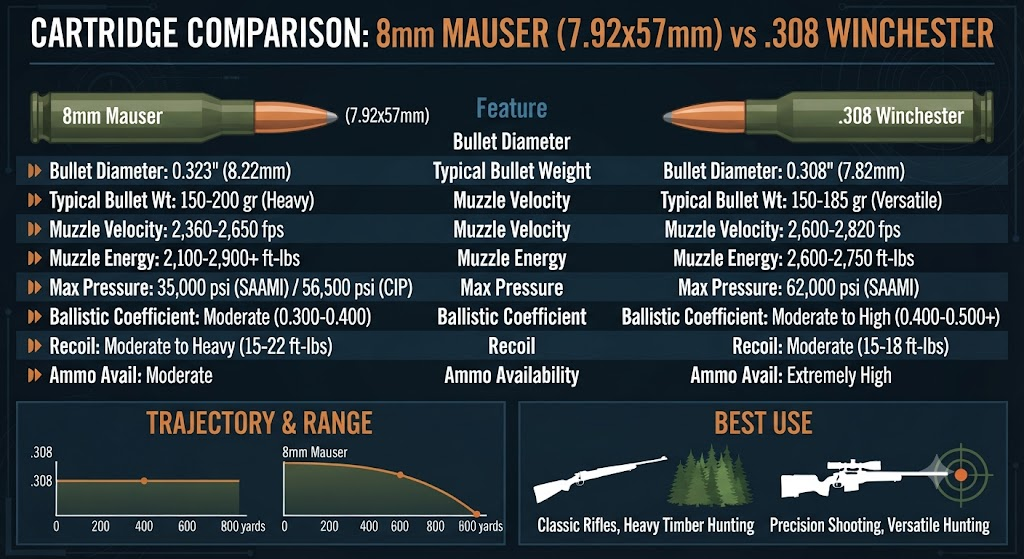
The main difference between the cartridges is that the 8mm Mauser is a historic military cartridge designed for standard long-action rifles that utilizes heavier projectiles to achieve deep penetration on large targets, whereas the .308 Winchester is a highly efficient modern cartridge designed to replicate classic military performance in a shorter, lighter, short-action platform utilizing lighter bullets with higher ballistic coefficients.
8mm Mauser vs 308 Comparison
| Feature | 8mm Mauser (7.92x57mm) | .308 Winchester |
| Bullet Diameter | 0.323 inches (8.22 mm) | 0.308 inches (7.82 mm) |
| Typical Bullet Weight | 150 gr to 200 gr (typically 170 gr or 196 gr) | 150 gr to 185 gr (typically 150 gr or 168 gr) |
| Muzzle Velocity | 2,360 to 2,650 fps (24-inch barrel) | 2,600 to 2,820 fps (24-inch barrel) |
| Muzzle Energy | 2,100 to 2,900+ ft-lbs (US vs Euro loads) | 2,600 to 2,750 ft-lbs |
| Momentum | ~57 to ~71 lb-fps (depending on load origin) | ~60 to ~64 lb-fps (depending on load) |
| Maximum Pressure | 35,000 psi (SAAMI) / 56,500 psi (CIP) | 62,000 psi (SAAMI) |
| Ballistic Coefficient | Moderate (typically 0.300 to 0.400) | Moderate to High (typically 0.400 to 0.500+) |
| Penetration | 20 to 28 inches (Gelatin with heavy hunting loads) | 18 to 24 inches (Gelatin with hunting loads) |
| Expansion | 0.60 to 0.75 inches | 0.60 to 0.70 inches |
| Trajectory | Noticeable drop past 300 yards | Flatter arc with predictable drop to 800 yards |
| Recoil | Moderate to Heavy (15 to 22 ft-lbs) | Moderate (15 to 18 ft-lbs) |
| Effective Range | 400 to 500 yards (Hunting) | 500 to 800+ yards (Target and Hunting) |
| Ammo Availability | Moderate (Seasonal or imported) | Extremely High (Global standard) |
| Ammo Cost | Moderate to Expensive ($1.50 to $3.00 per round) | Moderate ($0.80 to $2.50 per round) |
| Best Use | Classic military rifles, heavy timber hunting | Precision target shooting, versatile big game hunting |
The table above outlines the foundational differences between a late 19th-century European military powerhouse and a mid-20th-century American ballistic standard. Understanding the 8mm Mauser requires a brief dive into its complicated history. Originally adopted by the German Empire in 1888 for the Commission Rifle, it utilized a 0.318-inch diameter bullet (the “J” bore). In 1905, the German military updated the cartridge to fire a lighter, faster spitzer bullet measuring 0.323 inches in diameter (the “JS” or “IS” bore). This creates a massive ballistic duality today. American ammunition manufacturers, fearing liability from a shooter firing a modern 0.323-inch bullet through an antique 0.318-inch barrel, deliberately underload all domestic 8mm Mauser ammunition to a very weak maximum pressure of 35,000 psi. European manufacturers load the cartridge to its true potential at over 56,000 psi.
The .308 Winchester has no such historical baggage. Introduced to the civilian market by Winchester in 1952 just prior to its military adoption as the 7.62x51mm NATO, it was engineered with modern smokeless powder efficiency in mind. By utilizing a shorter case than the classic .30-06 Springfield, the .308 Winchester allows hunters and military snipers to use a stiffer, lighter short-action receiver while delivering nearly identical downrange performance out to 500 yards. It operates safely at 62,000 psi across the board.
8mm Mauser vs 308 Ballistics
To objectively evaluate the ballistic capabilities of the 8mm Mauser against the .308 Winchester, we must examine real-world factory ammunition across their most common applications. Because of the massive discrepancy in 8mm Mauser ammunition between continents, we will include both an American underloaded standard and a European full-power standard.
For this comparison, we will examine premium hunting and target loads fired from standard 24-inch test barrels. Manufacturer-rated data is generally captured under controlled atmospheric conditions using standardized universal receiver barrels. Real-world velocities will vary slightly depending on your specific firearm chamber tolerances and barrel wear.
- Load A (American 8mm Mauser): Remington Core-Lokt 170-grain Soft Point. Tested from a 24-inch barrel: Muzzle Velocity = 2,360 fps, Muzzle Energy = 2,102 ft-lbs, Ballistic Coefficient (G1) = 0.326.
- Load B (European 8mm Mauser): Prvi Partizan (PPU) 198-grain Full Metal Jacket (FMJ). Tested from a 24-inch barrel: Muzzle Velocity = 2,425 fps, Muzzle Energy = 2,586 ft-lbs, Ballistic Coefficient (G1) = 0.440.
- Load C (.308 Winchester): Federal Premium 150-grain Nosler Partition. Tested from a 24-inch barrel: Muzzle Velocity = 2,820 fps, Muzzle Energy = 2,648 ft-lbs, Ballistic Coefficient (G1) = 0.387.
- Load D (.308 Winchester): Hornady 168-grain ELD Match. Tested from a 24-inch barrel: Muzzle Velocity = 2,700 fps, Muzzle Energy = 2,719 ft-lbs, Ballistic Coefficient (G1) = 0.523.
The data reveals that American 8mm Mauser ammunition is ballistically inferior to the .308 Winchester in every metric. However, when loaded to full European CIP specifications, the 8mm Mauser pushes heavy 198-grain bullets at formidable velocities, closing the kinetic energy gap entirely while offering heavier bullet weight.
8mm Mauser vs 308 Velocity
Velocity determines how flat a projectile shoots and influences how quickly expanding bullets open upon impacting soft tissue. High velocity also dictates the amount of wind deflection a bullet will suffer over a long distance.
The .308 Winchester holds a distinct velocity advantage over the 8mm Mauser when comparing standard hunting weights. A standard 150-grain .308 Winchester load easily exceeds 2,800 feet per second. This high initial velocity ensures that the bullet reaches its target quickly, minimizing the time gravity and crosswinds have to act upon the projectile. Even when stepping up to heavier 168-grain bullets, the .308 Winchester maintains a highly respectable 2,700 feet per second.
The 8mm Mauser was fundamentally designed around heavier projectiles. Even in its modern European configuration, a 196-grain or 198-grain bullet will typically exit a 24-inch barrel at roughly 2,400 to 2,500 feet per second. While this is exceptionally lethal, it is significantly slower than the .308 Winchester. The American loads are even slower, pushing light 170-grain bullets at barely 2,360 feet per second. The lower velocity of the 8mm Mauser makes hitting targets at unknown distances more challenging due to a steeper trajectory curve.
8mm Mauser vs 308 Muzzle Energy
Muzzle energy represents the kinetic work capacity of a projectile. Because velocity plays a disproportionately large role in generating kinetic energy, the faster .308 Winchester generates highly consistent and impressive energy figures across all commercially available bullet weights.
A standard 150-grain .308 Winchester hunting load produces roughly 2,650 foot-pounds of energy at the muzzle. This is more than enough kinetic energy to humanely harvest any game animal in North America, including elk and moose, provided the hunter selects an appropriate bullet construction and keeps their shots within ethical distances.
The 8mm Mauser muzzle energy is entirely dependent on where the ammunition was manufactured. American factory loads generate a meager 2,100 foot-pounds of energy, putting it on par with the venerable .30-30 Winchester lever-action cartridge. This is vastly underpowered for the size of the cartridge case. Conversely, full-power European loads from manufacturers like Sellier & Bellot or Norma push heavy bullets fast enough to generate 2,600 to 2,900 foot-pounds of energy. When utilizing full-power European ammunition, the 8mm Mauser is a slightly more powerful cartridge than the .308 Winchester at the muzzle.
8mm Mauser vs 308 Momentum
Momentum measures the mass of an object in motion. In terminal ballistics, high momentum correlates closely with the bullet ability to crush through dense bone, heavy winter clothing, and intermediate brush without being deflected or stopping prematurely.
The .308 Winchester relies on a balance of speed and moderate mass. A 168-grain bullet traveling at 2,700 fps yields roughly 64 lb-fps of linear momentum. This is highly effective and represents the standard benchmark for modern medium-bore hunting cartridges.
The 8mm Mauser, when loaded to European specifications, dominates the momentum category. By pushing a massive 198-grain bullet at 2,425 fps, it yields roughly 68 lb-fps of linear momentum. A custom handload pushing a 200-grain bullet at 2,500 fps pushes this figure over 71 lb-fps. This heavy momentum is the exact reason the 8mm Mauser is still highly favored in Europe for driven hunts where large boars and stags are shot at running speeds in heavy timber. The massive bullet crushes straight through heavy shoulder bones and vital organs with immense authority.
8mm Mauser vs 308 Trajectory
Because both cartridges are utilized for hunting and target shooting, understanding external ballistics and bullet drop is critical. Calculations below assume a standard scope sight height of 1.5 inches above the bore and a clearly stated zero distance of 200 yards, which is the standard zero for modern centerfire rifle hunting.
| Distance | 8mm Mauser (198 gr PPU at 2,425 fps) Drop | .308 Win (168 gr ELD at 2,700 fps) Drop |
| Muzzle | -1.5 inches | -1.5 inches |
| 100 Yards | +2.7 inches | +1.9 inches |
| 200 Yards | 0.0 inches (Zero) | 0.0 inches (Zero) |
| 300 Yards | -10.5 inches | -7.9 inches |
| 400 Yards | -30.2 inches | -22.4 inches |
| 500 Yards | -60.8 inches | -44.5 inches |
The .308 Winchester features a noticeably flatter trajectory. By the time both bullets reach the 500-yard mark, the slower, heavier 8mm Mauser bullet has dropped a full 16 inches more than the highly aerodynamic .308 Winchester bullet. For a hunter or precision shooter attempting to ring steel or hit a vital zone at a half-mile, the .308 Winchester is drastically easier to calculate holdovers for. The high ballistic coefficients available in 0.308-caliber bullets also ensure they resist wind deflection far better than the older 0.323-caliber bullet designs.
8mm Mauser vs 308 Recoil
Recoil management is a significant factor in rapid, accurate shooting. Recoil is governed by the conservation of momentum and is heavily influenced by the weight of the rifle, the mass of the powder charge, and the weight of the bullet.
The .308 Winchester is globally recognized as a mild-recoiling short-action cartridge. Fired from a standard 8-pound hunting rifle, a typical 150-grain hunting load generates roughly 15.5 foot-pounds of free recoil energy. This is a very comfortable level of recoil that most shooters, including youths and beginners, can tolerate for long range sessions without developing a severe flinch.
The 8mm Mauser generates varying levels of recoil depending on the ammunition. Fired from a classic 9-pound military surplus Mauser K98k rifle, an underloaded American 170-grain round generates a very soft 14 foot-pounds of recoil. However, when firing full-power 196-grain or 198-grain European ammunition from an 8-pound sporting rifle, the recoil jumps to approximately 21 foot-pounds of free recoil energy. While not punishing like a magnum cartridge, this is a heavy, stout shove that will bruise a shoulder during an extended shooting session from a bench rest.
8mm Mauser vs 308 Penetration
Terminal penetration is rigorously evaluated to ensure ethical harvesting of game animals. The bullet must penetrate deep enough to reach critical cardiovascular structures regardless of the angle the animal is standing at.
The .308 Winchester provides excellent penetration across a wide variety of North American big game. Utilizing a premium bonded bullet or a solid copper projectile (like the Barnes TSX) weighing 150 to 165 grains, the .308 will easily penetrate 18 to 24 inches of tissue, often resulting in a complete pass-through on broadside shots on deer and elk.
The 8mm Mauser, when utilizing heavy 196-grain soft point bullets, is a penetration monster. The combination of heavy bullet mass, moderate velocity, and a high sectional density ensures the bullet tracks straight through heavy muscle and thick bone. European hunters routinely use the 8mm Mauser for large, tough game because the bullet retains its weight and drives incredibly deep, often penetrating 20 to 28 inches in soft tissue even after impacting a heavy shoulder blade.
8mm Mauser vs 308 Expansion
Bullet expansion dictates the diameter of the permanent wound channel, increasing the likelihood of severing major arteries and causing rapid incapacitation through blood loss.
Starting with a slightly wider diameter of 0.323 inches, the 8mm Mauser soft point bullets expand beautifully at standard European velocities. A typical 196-grain soft point will peel back to a massive 0.65 to 0.75 inches in diameter, creating a devastating crush cavity that leads to very short tracking jobs.
The .308 Winchester starts at 0.308 inches in diameter. Because it travels faster, the hydraulic pressure exerted on the nose of a hollow point or polymer-tipped bullet is more intense, causing very rapid and violent expansion. A standard 150-grain expanding bullet will typically open to roughly 0.60 to 0.70 inches. Both cartridges provide more than enough tissue disruption to humanely take any appropriate game animal.
8mm Mauser vs 308 Effective Range
The effective range of a cartridge is determined by the intersection of three factors which include velocity retention, bullet drop, and mechanical accuracy.
The .308 Winchester is a legendary long-range cartridge. With modern high-BC match bullets, precision shooters routinely engage targets at 800 to 1,000 yards. For hunting applications, the .308 Winchester maintains enough velocity to guarantee proper bullet expansion (usually requiring a minimum of 1,800 fps) out to roughly 500 yards.
The 8mm Mauser is highly effective but possesses a much shorter practical range. Because it fires heavier, blunter bullets at slower initial velocities, its trajectory becomes very steep past 300 yards. Furthermore, the bullet sheds velocity quickly. Most heavy 8mm Mauser hunting bullets will drop below the 1,800 fps expansion threshold around 350 to 400 yards. It is best utilized as a short to medium-range thumper in heavy timber environments.
8mm Mauser vs 308 Self Defense
When discussing self defense with high-powered centerfire rifle cartridges, the conversation typically revolves around rural property defense or wilderness survival rather than urban home defense.
For urban home defense against human threats, both cartridges are heavily overpowered. The extreme kinetic energy and mass of these bullets present a severe over-penetration risk, easily passing through an intruder, multiple interior walls, and potentially exiting the structure entirely into neighboring properties.
If pressed into a defensive role in a rural environment, the .308 Winchester is vastly superior strictly due to the firearm platforms available. The .308 Winchester is chambered in modern, lightweight, semi-automatic platforms like the AR-10, Springfield M1A, and FN SCAR. These platforms offer 20-round magazines, optics mounting solutions, and rapid follow-up shots.
The 8mm Mauser is almost exclusively found in historical bolt-action military surplus rifles or expensive European sporting bolt-action rifles. While a Mauser K98k was a formidable battle implement in 1940, a bolt-action rifle with a 5-round internal magazine is vastly outclassed by modern semi-automatic rifles for defensive purposes today.
8mm Mauser vs 308 Concealed Carry
Concealed carry with either the 8mm Mauser or the .308 Winchester is impossible and entirely impractical. Both of these cartridges are strictly centerfire rifle cartridges measuring over 2.8 inches in overall length. They require long, heavy rifle actions to safely contain their operating pressures. There are no handguns manufactured that can chamber these rounds for concealed carry. Their appropriate carry method involves a rifle sling over a shoulder in the backcountry or a dedicated rifle case.
Which Has More Stopping Power: 8mm Mauser or 308?
Stopping power is an ambiguous term often used to describe a cartridge ability to quickly incapacitate a biological target without requiring long tracking jobs.
When comparing full-power European 8mm Mauser against the .308 Winchester, the 8mm Mauser holds a slight edge in stopping power on massive, heavy-boned animals. The ability to launch 196-grain to 200-grain bullets provides a level of bone-shattering momentum and deep penetration that lighter .308 bullets sometimes lack when taking quartering-away shots on animals like moose or large bears.
On medium game such as whitetail deer or pronghorn antelope, the .308 Winchester often provides more dramatic instantaneous stopping power. The higher velocity of the .308 Winchester creates a larger temporary stretch cavity within the fluid-filled tissue of the animal, often resulting in massive central nervous system shock that drops the animal in its tracks.
Which Is More Powerful: 8mm Mauser or 308?
Power is defined quantitatively by kinetic energy and linear momentum.
If you are shooting American factory ammunition, the .308 Winchester is vastly more powerful, generating roughly 2,650 foot-pounds of energy compared to the heavily restricted 2,100 foot-pounds of the domestic 8mm Mauser.
If you are shooting full-specification European ammunition or custom handloads, the 8mm Mauser is more powerful. A fully loaded 8mm Mauser can exceed 2,900 foot-pounds of muzzle energy and generates significantly higher momentum due to its heavier bullet mass.
8mm Mauser Pros and Cons
Pros
- Exceptional performance on large, tough game when using full-power European ammunition
- Massive historical significance makes shooting surplus military rifles a highly enjoyable collector experience
- Heavy bullet weights provide reliable straight-line penetration through dense brush and heavy bone
- Can be handloaded to surpass .308 Winchester power levels safely in modern strong-action rifles
Cons
- American factory ammunition is severely underloaded and performs poorly on large game
- Requires a standard long-action receiver, making rifles heavier and longer than short-action alternatives
- Ammunition and reloading components (specifically 0.323-caliber bullets) are much harder to find in local sporting goods stores
- Steeper trajectory makes long-range precision shooting difficult compared to modern calibers
308 Winchester Pros and Cons
Pros
- The global gold standard for short-action efficiency, fitting into lightweight, compact hunting rifles
- Universally available ammunition ranging from cheap military surplus FMJ to premium match-grade target loads
- Extremely flat trajectory and high inherent accuracy make it highly effective out to 800 yards
- Mild recoil allows for comfortable extended range sessions and better accuracy from novice shooters
Cons
- Lacks the heavy bullet mass (200+ grains) preferred by some hunters for the absolute largest North American game
- Extremely common, which lacks the unique historical nostalgia that comes with shooting antique military calibers
- Performance drops significantly if barrel lengths are reduced below 16 inches in tactical platforms
Final Comparison
| Category | Winner | Reason |
| Velocity | .308 Winchester | Efficient powder column and lighter bullets easily exceed 2,700 fps |
| Muzzle Energy | Depends on Load | .308 wins over US 8mm; Euro 8mm wins over .308 |
| Momentum | 8mm Mauser | Heavy 198-grain bullets carry immense linear driving mass |
| Penetration | 8mm Mauser | High mass and sectional density shatter heavy shoulder bones easily |
| Expansion | Tie | Both expand massively depending on modern bullet selection |
| Trajectory | .308 Winchester | Higher velocity creates a significantly flatter arc out to 500 yards |
| Recoil Control | .308 Winchester | Generates noticeably less free recoil energy than full-power 8mm loads |
| Effective Range | .308 Winchester | Flatter trajectory confidently extends ethical shots and target shooting |
| Self Defense | .308 Winchester | Chambered in modern semi-automatic platforms with high capacity |
| Concealed Carry | Neither | Both are massive centerfire rifle cartridges unsuitable for concealment |
| Ammo Cost | .308 Winchester | Extreme popularity has lowered relative cost and increased bulk options |
| Ammo Availability | .308 Winchester | Found in almost every gun shop globally due to military and civilian use |
| Overall Performance | .308 Winchester | Superior ballistics, lighter rifles, and unmatched logistical support |
8mm Mauser vs 308: Which Should You Choose?
Selecting between the 8mm Mauser and the .308 Winchester requires an honest assessment of your hunting environment, your appreciation for history, and your local ammunition logistics.
Choose the 8mm Mauser if you are a collector of military surplus firearms, appreciate the rich history of the Mauser 98 action, or hunt in dense European or North American timber where heavy 200-grain bullets and deep penetration are more important than long-range flat trajectories. You must be willing to source full-power European ammunition or reload your own cartridges to see the true potential of this legendary caliber.
Choose the .308 Winchester if you prioritize efficiency, accuracy, and logistical convenience. It fits perfectly into lightweight short-action hunting rifles, features a trajectory flat enough to confidently take game at 400 yards, and allows you to buy extremely accurate ammunition at any hardware store in the country. It is objectively the more practical choice for a modern shooter who wants maximum versatility with minimum hassle.
FAQs
Is 8mm Mauser more powerful than 308?
It depends entirely on the ammunition. Standard American factory 8mm Mauser is severely underloaded and much weaker than a .308 Winchester. However, full-power European 8mm Mauser ammunition is slightly more powerful than the .308 Winchester in both energy and momentum.
Which has more muzzle energy?
A .308 Winchester generates roughly 2,650 ft-lbs of energy. American 8mm Mauser generates roughly 2,100 ft-lbs. European 8mm Mauser generates roughly 2,600 to 2,900 ft-lbs.
Which has more stopping power?
For deer and medium game, the .308 Winchester provides excellent stopping power via high-velocity hydrostatic shock. For heavily muscled animals like moose or large bears, the heavy 196-grain bullets of the full-power 8mm Mauser provide superior bone-shattering penetration.
Which has more recoil?
Full-power European 8mm Mauser ammunition fired from a standard-weight sporting rifle produces noticeably more recoil than a .308 Winchester. Underloaded American 8mm Mauser produces slightly less recoil.
Which has better penetration?
The 8mm Mauser has better penetration on heavy game. Its extreme bullet mass allows the projectiles to punch through dense muscle and thick bone without deflecting or losing critical momentum.
Which expands more?
Both cartridges expand incredibly well when utilizing modern jacketed hollow points or polymer-tipped bullets. Because the 8mm starts at a slightly larger diameter (0.323 versus 0.308 inches), it generally creates a marginally wider final expanded profile.
Which has a flatter trajectory?
The .308 Winchester has a significantly flatter trajectory. Because it fires more aerodynamic bullets at higher velocities, it drops much less over 300 to 500 yards, making long-range shots drastically easier to execute.
Which is better for self defense?
For rural property defense, the .308 Winchester is universally recognized as the superior choice because it is chambered in modern, high-capacity semi-automatic rifles like the AR-10.
Which is better for concealed carry?
Neither. Both are large centerfire rifle cartridges fired from long, heavy rifles.
Is 8mm Mauser faster than 308?
No. The .308 Winchester is faster. It typically drives a 150-grain bullet at over 2,800 fps, whereas modern full-power 8mm Mauser loads generally drive 196-grain bullets at 2,400 to 2,500 fps.
Is 308 stronger than 8mm Mauser?
The .308 Winchester operates at a much higher standard SAAMI pressure (62,000 psi) compared to the American SAAMI standard for 8mm Mauser (35,000 psi). However, the 8mm Mauser case is physically larger and holds more powder.
Which is cheaper to shoot?
The .308 Winchester is vastly cheaper and easier to shoot due to its massive global popularity. Major manufacturers produce cheap bulk FMJ lines of .308, while 8mm Mauser is often relegated to limited imported production runs.
Which has better ballistics?
The .308 Winchester features better aerodynamic external ballistics including a flatter trajectory and higher velocity. The 8mm Mauser features better terminal ballistics on heavy dangerous game due to deeper penetration and massive momentum.
Which is easier to shoot?
The .308 Winchester is easier to shoot due to its milder recoil impulse compared to fully loaded European 8mm Mauser ammunition.
Which should you choose?
Choose the 8mm Mauser for classic military surplus rifles, dense timber hunting, and historical nostalgia. Choose the .308 Winchester for a flatter trajectory, longer effective range, lightweight short-action rifles, and ubiquitous ammunition availability.