The main difference between .357 Magnum and .45 Colt is that the .357 Magnum generally produces much higher velocity and features a significantly flatter trajectory, while the .45 Colt uses a substantially heavier and larger diameter bullet. The .357 Magnum is widely celebrated for its blistering speed, deep penetration, and high pressure standard loadings that make it incredibly versatile. Conversely, the .45 Colt is a legendary cartridge initially built for black powder pressures, which means its standard factory loads are relatively mild in comparison. In this article, we will compare these differences using actual ballistic data, factory ammunition specifications, and reliable performance metrics to determine which revolver caliber makes the most sense for your specific needs.
.357 vs 45 Colt Comparison Table
When evaluating these two revolver cartridges, it is absolutely critical to separate the .45 Colt into two distinct categories, which include Standard Pressure and High Pressure loads.
| Cartridge | .357 Magnum | .45 Colt (Standard) | .45 Colt (+P Heavy) |
|---|---|---|---|
| Bullet Diameter | .357 inches | .451 to .452 inches | .451 to .452 inches |
| Case Length | 1.290 inches | 1.285 inches | 1.285 inches |
| Overall Cartridge Length | 1.590 inches | 1.600 inches | 1.600 inches |
| Typical Bullet Weights | 125gr, 158gr, 180gr | 200gr, 225gr, 255gr | 250gr, 300gr, 325gr |
| Typical Velocity | 1100 to 1450 fps | 725 to 1000 fps | 1200 to 1500 fps |
| Muzzle Energy | 450 to 780 ft lbs | 300 to 460 ft lbs | 800 to 1267 ft lbs |
| Maximum Pressure | 35000 PSI (SAAMI) | 14000 PSI (SAAMI) | 30000 PSI (Non SAAMI) |
| Momentum | Moderate | Moderate to High | Extremely High |
| Typical Trajectory | Flat | Arced | Moderate to Flat |
| Recoil | Sharp Snappy | Mild Pushing | Heavy Punishing |
| Effective Range | 75 to 100 yards | 50 yards | 75 to 100 yards |
| Penetration | Excellent | Good | Phenomenal |
| Expansion | Very Reliable | Reliable | Very Reliable |
| Ammunition Cost | Moderate | Expensive | Very Expensive |
| Ammo Availability | Widespread | Moderate | Specialty Limited |
| Best Uses | Self defense, medium game | Target shooting | Big game hunting |
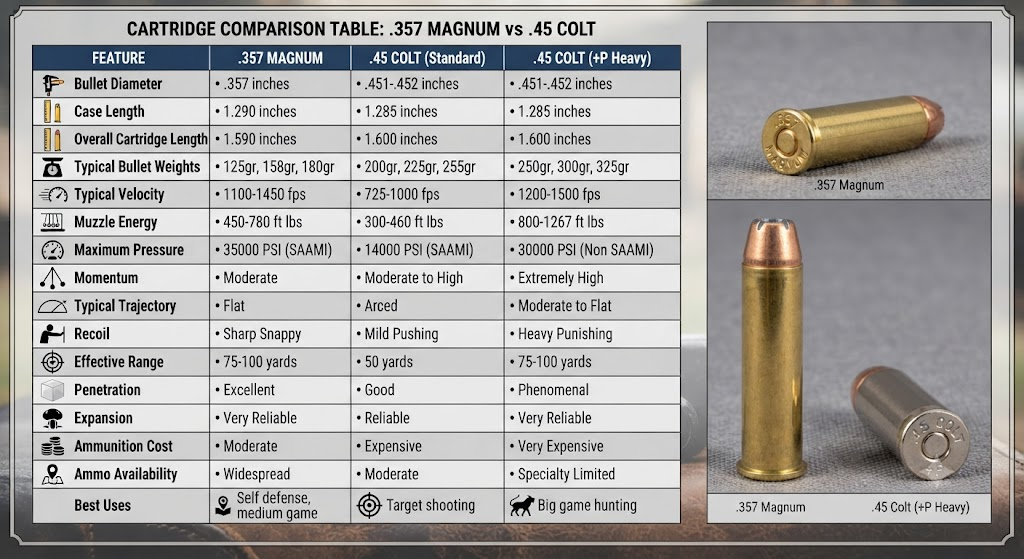
The data reveals that the .357 Magnum operates at vastly higher pressures than standard .45 Colt ammunition, utilizing 35000 PSI compared to the modest 14000 PSI limit maintained for the older cartridge. This pressure discrepancy translates directly to the .357 Magnum pushing lighter bullets at significantly higher velocities. However, when you step up to heavy .45 Colt loads produced by specialty manufacturers like Buffalo Bore or Underwood Ammo, the dynamic changes entirely. These heavy loads push massive 300 grain and 325 grain bullets at velocities that rival or beat the .357 Magnum, producing tremendous kinetic energy and momentum. The trade off is punishing recoil and the strict requirement to only use specific heavy framed firearms like the Ruger Blackhawk or Freedom Arms Model 83.
.357 vs .45 Colt Ballistics
To truly understand how these cartridges behave, we must evaluate their external and terminal ballistics using real world factory loads. We will compare standard, widely available ammunition that a consumer can purchase off the shelf.
The .357 Magnum achieves its renowned performance through speed. Originally developed in 1935 by essentially lengthening the .38 Special case, the .357 uses large charges of smokeless powder to propel 125 grain to 158 grain bullets at blistering speeds. The .45 Colt, introduced in 1873, relies on mass. Its massive case capacity was originally designed for black powder. Modern standard pressure .45 Colt loads use smokeless powder but are kept intentionally mild to prevent catastrophic failures in older antique revolvers.
.357 vs .45 Colt Velocity
Velocity is the primary advantage of the .357 Magnum over standard .45 Colt loads. A faster bullet shoots flatter, expands more violently upon impact, and reduces the amount of lead required on moving targets.
Here is a comparison of representative factory loads fired from typical revolver barrel lengths of four to five inches:
Representative .357 Magnum Velocities:
- Federal Premium 125gr JHP: 1440 fps
- Winchester Super X 158gr JHP: 1235 fps
- Federal Power Shok 180gr JHP: 1080 fps
- Buffalo Bore 180gr Hard Cast: 1400 fps
Representative .45 Colt Velocities (Standard Pressure):
- Blazer 200gr JHP: 1000 fps
- Hornady 225gr FTX: 920 fps
- Double Tap 255gr SWC HC: 900 fps
Representative .45 Colt Velocities (+P Heavy):
- Buffalo Bore 225gr Barnes XPB: 1500 fps
- Double Tap 255gr SWC HC: 1450 fps
- Cor Bon 300gr JSP: 1300 fps
- Buffalo Bore 325gr LFN: 1325 fps
Winner: .357 Magnum against standard loads. The .357 Magnum easily outpaces standard pressure .45 Colt ammunition. However, if using heavy Ruger only loads, the .45 Colt can match or exceed the velocity of heavy .357 loads while pushing a bullet that is twice as heavy.
.357 vs .45 Colt Muzzle Energy
Muzzle energy represents the destructive potential or kinetic energy of the bullet as it leaves the barrel. Because velocity carries an exponentially higher weight in kinetic energy calculations than bullet mass, speed has a disproportionate impact on total power. This explains why the lighter, faster .357 Magnum often hits harder than the heavier, slower standard .45 Colt.
| Cartridge Load | Bullet Weight | Velocity | Muzzle Energy |
|---|---|---|---|
| .45 Colt (Federal SWCHP) | 225 gr | 830 fps | 344 ft lbs |
| .45 Colt (Blazer JHP) | 200 gr | 1000 fps | 444 ft lbs |
| .357 Magnum (Federal 180gr) | 180 gr | 1080 fps | 466 ft lbs |
| .357 Magnum (Winchester 158gr) | 158 gr | 1235 fps | 535 ft lbs |
| .357 Magnum (Federal 125gr) | 125 gr | 1440 fps | 576 ft lbs |
| .45 Colt +P (Cor Bon 300gr) | 300 gr | 1300 fps | 1126 ft lbs |
| .45 Colt +P (Buffalo Bore 325gr) | 325 gr | 1325 fps | 1267 ft lbs |
Winner: .357 Magnum (Standard Ammo) and .45 Colt (Heavy Ammo).
If you buy off the shelf ammunition at a big box store, the .357 Magnum hits significantly harder. A standard 125 grain .357 Magnum generates roughly 576 ft lbs of energy, while standard 200 to 225 grain .45 Colt loads hover in the 340 to 450 ft lbs range. However, heavy .45 Colt loads completely rewrite the rules, easily surpassing 1100 ft lbs of muzzle energy to generate nearly double the power of the hottest .357 Magnum rounds.
.357 vs .45 Colt Bullet Diameter
Bullet diameter plays a critical role in creating a permanent wound channel and determining the frontal surface area of the projectile.
- .357 Magnum: True to its name, it utilizes a bullet measuring .357 inches in diameter.
- .45 Colt: Uses a substantially wider bullet measuring .451 to .452 inches in diameter.
The larger diameter of the .45 Colt provides an immediate terminal ballistic advantage. Even if a .45 Colt bullet fails to expand whatsoever, it is already wider than a .357 Magnum bullet that has perfectly expanded by 25 percent. A wider bullet crushes more tissue as it penetrates.
Winner: .45 Colt. The .45 Colt has a roughly 26 percent larger diameter, significantly increasing its frontal surface area.
.357 vs .45 Colt Momentum
While kinetic energy favors velocity, momentum strongly favors bullet weight. Hunters often prefer momentum over kinetic energy as a predictor of deep penetration, especially when breaking heavy bone. Momentum evaluates the sheer force of mass in motion.
Let us evaluate the momentum of common factory loads:
- .357 Magnum 125gr at 1440 fps: 0.80 lbs sec
- .357 Magnum 158gr at 1235 fps: 0.87 lbs sec
- .357 Magnum 180gr at 1400 fps: 1.12 lbs sec
- .45 Colt Standard 225gr at 920 fps: 0.92 lbs sec
- .45 Colt Standard 255gr at 900 fps: 1.02 lbs sec
- .45 Colt +P 325gr at 1325 fps: 1.91 lbs sec
Winner: .45 Colt. Even in its standard pressure iterations, the massive 255 grain .45 Colt bullet generates greater momentum than common 125 grain and 158 grain .357 Magnum loads. When moving to the 325 grain heavy loads, the .45 Colt produces a staggering 1.91 lbs sec of momentum, absolutely dwarfing the ability of the .357 Magnum to crush through thick hide.
.357 vs .45 Colt Trajectory
Trajectory dictates how far a bullet drops over distance due to gravity. A flatter trajectory makes it easier to hit a target at unknown ranges because the shooter does not have to heavily adjust their point of aim.
Because standard .45 Colt bullets are heavy and relatively slow, their trajectory arcs significantly. The high velocity .357 Magnum flies remarkably flat in comparison.
When evaluating bullet drop using a 50 yard zero:
- .357 Magnum 125gr JHP: Drops roughly 5 inches at 100 yards.
- .45 Colt Standard 255gr SWC: Drops approximately 10 to 12 inches at 100 yards depending on barrel length.
Even when zeroed perfectly, the .45 Colt shooter must aim significantly higher to strike a target at 100 yards. The .357 Magnum requires only minimal hold over at the same distance, making it far superior for longer range handgun shooting.
Winner: .357 Magnum. Its higher velocity provides a much flatter trajectory, allowing for confident hits out to 100 yards without aggressive sight adjustments.
.357 vs .45 Colt Recoil
Felt recoil is subjective, but recoil energy can be mathematically calculated using bullet weight, powder charge, velocity, and firearm weight.
- .45 Colt Standard: Standard pressure loads typically generate around 8 ft lbs of recoil energy in a heavy steel revolver. Because the velocity is low, the recoil feels like a slow, deliberate push backwards.
- .357 Magnum: Typically generates about 9 ft lbs of recoil energy in similarly weighted guns. Because of the high pressures and high velocities, the recoil is notoriously sharp and snappy, accompanied by significant muzzle blast.
- .45 Colt +P Heavy: These loads are vicious. Firing a 325 grain bullet at 1325 fps from a handgun produces severe, punishing recoil that easily exceeds 20 ft lbs, requiring serious grip strength and experience to control.
Winner: .45 Colt (Standard Pressure). For recreational shooting and standard applications, standard pressure .45 Colt loads provide a very pleasant, smooth recoil impulse. The .357 Magnum is substantially louder and snappier, though it remains controllable in heavy revolvers.
.357 vs .45 Colt Penetration
Penetration is the single most vital metric for taking down large game or dealing with heavy boned predators.
- .357 Magnum: Standard 158 grain jacketed soft point bullets or 180 grain hard cast bullets provide exceptionally deep penetration, often passing completely through medium sized game like deer. The high sectional density allows the bullet to track straight and deep.
- .45 Colt Standard: Standard 255 grain lead semi wadcutters penetrate quite well due to their high momentum, but their lower velocity limits their absolute depth in highly dense mediums compared to the .357 Magnum.
- .45 Colt +P: Heavy 300 grain to 335 grain hard cast bullets fired from a Ruger only .45 Colt load offer some of the deepest penetration of any handgun cartridge in existence. These bullets will reliably smash through both shoulders of a grizzly bear or an elk.
Winner: Depends on Load. With standard off the shelf hunting ammo, the .357 Magnum generally penetrates deeper on medium game. If using heavy hard cast ammunition, the .45 Colt is drastically superior for deep penetration on massive animals.
.357 vs .45 Colt Expansion
Expansion relies primarily on velocity and bullet design. As a bullet expands, it sheds velocity faster but creates a significantly wider permanent wound cavity, leading to rapid blood loss.
The high velocity of the .357 Magnum, which often exceeds 1400 fps with 125 grain loads, forces modern jacketed hollow points to expand violently and reliably. It is rare for a quality .357 Magnum bullet to fail to expand in soft tissue.
Standard .45 Colt loads traveling 800 to 950 fps are right on the edge of the velocity threshold required for reliable jacketed hollow point expansion. Ammunition manufacturers often have to use incredibly soft lead or wide hollow point cavities to guarantee expansion at these lower speeds.
Winner: .357 Magnum. Its higher velocity virtually guarantees reliable, dramatic bullet expansion, whereas standard .45 Colt ammunition can sometimes fail to expand if it encounters heavy clothing at lower speeds.
.357 vs .45 Colt Stopping Power
Stopping power is not a scientifically precise metric, but rather an amalgamation of penetration, expansion, kinetic energy, and permanent wound cavity size. However, decades of law enforcement data heavily favor one cartridge in this discussion.
The .357 Magnum, specifically the 125 grain Jacketed Hollow Point load, is widely considered the gold standard for handgun stopping power against human threats. Its combination of high velocity, violent expansion, and adequate penetration creates a devastating terminal effect.
The .45 Colt is no slouch because a 255 grain chunk of lead tearing through tissue leaves a massive hole. However, because its standard loads lack the sheer hydrostatic shock and violent expansion of the .357 Magnum, it is generally considered slightly less instantaneous in its effects against two legged threats.
Winner: .357 Magnum. For defensive stopping power, the 125 grain .357 Magnum load remains one of the most proven cartridges in handgun history.
.357 vs .45 Colt Hunting
Both cartridges are exceptional hunting rounds, but they excel in entirely different environments.
- .357 Magnum: Excellent for hunting medium sized game like whitetail deer, coyotes, and wild hogs at close to medium ranges. It provides a flat enough trajectory to ethically take game out to 100 yards. In a lever action rifle, the .357 Magnum gains significant velocity and becomes a superb deer cartridge.
- .45 Colt: With standard pressure ammunition, it is viable for deer hunting at close ranges under 50 yards. However, when loaded with heavy 300 grain bullets, the .45 Colt becomes entirely capable of ethically harvesting elk, moose, and black bear.
Winner: Depends on the Game. For deer and hogs, the flatter trajectory of the .357 Magnum makes it the superior choice. For elk, moose, or large bear, the .45 Colt is vastly superior provided you have a firearm that can handle high pressure loads.
.357 vs .45 Colt For Self Defense
For urban self defense and concealed carry, the .357 Magnum holds a substantial edge.
- Firearm Size: The .357 Magnum can be chambered in small, concealable snubbies like the Smith and Wesson J Frame or Ruger LCR. The .45 Colt requires a massive cylinder, meaning .45 Colt revolvers are large, heavy, and difficult to conceal.
- Ammunition: Premium defensive ammunition like Federal HST, Speer Gold Dot, or Hornady Critical Defense is vastly more abundant in .357 Magnum.
- Versatility: A .357 Magnum revolver can safely fire mild, low recoil .38 Special ammunition, making practice much cheaper and more accessible.
Winner: .357 Magnum. The .357 Magnum is undeniably better suited for modern self defense due to firearm concealability and the availability of proven defensive hollow points.
.357 vs .45 Colt For Woods Carry
Woods carry requires a firearm capable of defending against predatory threats, which in North America primarily means black bears, grizzly bears, or mountain lions.
If you are carrying a standard pressure .45 Colt, you are carrying a cartridge with impressive momentum but relatively low kinetic energy. A standard .357 Magnum loaded with 180 grain hard cast bullets provides superior penetration and energy for this application.
However, if you are carrying a Ruger Blackhawk or Redhawk loaded with Buffalo Bore 325 grain Heavy loads, you are carrying a true bear stopper. These loads hit with over 1200 ft lbs of energy and will break grizzly shoulders with ease.
Winner: .45 Colt (If using heavy ammunition). If restricted to standard factory ammo, the .357 Magnum is better. If high pressure loads and heavy revolvers are on the table, the .45 Colt reigns supreme in the deep woods.
.357 vs .45 Colt Ammunition Cost
The price of ammunition heavily dictates how often a shooter can realistically practice.
- .357 Magnum: Because of its immense popularity, mass produced practice ammunition is relatively affordable, often priced between 60 to 80 cents per round. Furthermore, the ability to practice with .38 Special ammunition reduces costs even further.
- .45 Colt: Once widely cheap, .45 Colt is now considered a boutique caliber. Standard practice ammunition often exceeds one dollar per round. Heavy hunting loads from Buffalo Bore or Underwood can cost between two and three dollars per round.
Winner: .357 Magnum. It is drastically cheaper to shoot and much easier to find in local sporting goods stores.
.357 vs .45 Colt Effective Range
The effective range of a handgun cartridge is limited by its trajectory, remaining kinetic energy, and the ability of the shooter to aim precisely.
Because the .357 Magnum pushes bullets much faster, it naturally has a flatter trajectory. A 158 grain .357 Magnum bullet will drop significantly less at 100 yards than a 255 grain .45 Colt bullet traveling 900 fps. Additionally, the .357 Magnum retains enough kinetic energy and velocity at 100 yards to ensure reliable expansion.
The .45 Colt drops precipitously past 75 yards. While experienced shooters can ring steel at 100 yards by holding over the target, it is not an ideal long range hunting trajectory.
Winner: .357 Magnum.
Which Is More Powerful: .357 or .45 Colt?
The answer to this question entirely depends on the ammunition you use.
If comparing standard factory ammunition, the .357 Magnum is significantly more powerful. A standard 158 grain .357 Magnum produces over 530 ft lbs of muzzle energy, while standard 250 grain .45 Colt loads struggle to break 400 ft lbs.
If comparing high pressure ammunition, the .45 Colt absolutely destroys the .357 Magnum in sheer power. A 300 grain or 325 grain heavy .45 Colt load can produce upwards of 1200 ft lbs of muzzle energy, nearly doubling the output of the absolute hottest .357 Magnum loads.
Pros and Cons
.357 Magnum
Pros:
- Drastically higher velocity often exceeding 1400 fps.
- Flatter trajectory for better medium range accuracy.
- Incredible, proven track record for self defense and stopping power.
- Ammunition is significantly cheaper and more widely available.
- Can shoot inexpensive .38 Special ammunition for practice.
- Chambered in small, concealable revolvers suitable for everyday carry.
Cons:
- Lighter bullets cannot match the bone crushing momentum of big bore rounds.
- Produces sharp, snappy recoil and severe muzzle blast.
- Less optimal for large dangerous game like grizzly bears.
.45 Colt
Pros:
- Massive .452 inch bullet creates a wider initial wound channel.
- Standard loads feature a very mild, pleasant push recoil impulse.
- Heavy loads provide unprecedented momentum and penetration for massive game.
- Historical pedigree makes it a joy for classic firearms enthusiasts and Cowboy Action shooters.
Cons:
- Standard loads are slow and produce relatively low kinetic energy.
- Ammunition is highly expensive and harder to find.
- Heavy loads require specific heavy framed revolvers to avoid catastrophic firearm failure.
- Arced trajectory severely limits effective range.
Decision Table
| Category | Winner | Reason |
|---|---|---|
| Velocity | .357 Magnum | Blistering speeds ranging from 1200 to 1450 fps. |
| Muzzle Energy | Depends on Load | .357 wins in standard ammo while .45 Colt wins in heavy ammo. |
| Bullet Weight | .45 Colt | Pushes massive 250gr to 335gr projectiles. |
| Bullet Diameter | .45 Colt | Wider .452 inch diameter results in a wider permanent wound channel. |
| Momentum | .45 Colt | The sheer weight of the bullet guarantees immense forward momentum. |
| Trajectory | .357 Magnum | High velocity creates a flat shooting flight path. |
| Recoil | .45 Colt Standard | Standard loads offer a mild smooth push compared to .357 sharp snap. |
| Penetration | Depends on Load | .357 wins for standard ammo while .45 Colt hard cast wins overall. |
| Self Defense | .357 Magnum | Superior modern hollow points and concealable firearms. |
| Hunting | Depends on Game | .357 for deer and hogs while .45 Colt is best for elk and bear. |
| Woods Carry | Depends on Load | Heavy .45 Colt ammunition is the ultimate bear defense round. |
| Concealed Carry | .357 Magnum | .45 Colt revolvers are simply too large for practical concealment. |
| Ammunition Cost | .357 Magnum | Far cheaper to purchase, plus the ability to shoot .38 Special. |
| Effective Range | .357 Magnum | Flatter trajectory pushes ethical hunting range to 100 yards. |
.357 vs .45 Colt: Which Should You Choose?
The decision between .357 Magnum and .45 Colt ultimately comes down to whether you prioritize versatility and speed or brute mass and specialty applications.
You should choose the .357 Magnum if you want a highly versatile handgun capable of self defense, target shooting, and medium game hunting. It is ideal if you want the ability to conceal carry your revolver and practice economically by shooting .38 Special ammunition. It is also the clear winner if you prioritize a flat trajectory and reliable hollow point expansion at extended handgun ranges.
You should choose the .45 Colt if you are hunting massive, heavy boned game like elk, moose, or bear and intend to use a strong revolver capable of handling heavy 300 grain loads. It is also an excellent choice if you are an enthusiast of historic firearms, single action revolvers, or Cowboy Action Shooting. Furthermore, it works well if you are recoil sensitive and want a large bore revolver that offers a smooth, pleasant push when using standard pressure ammunition.
For the vast majority of modern shooters, the .357 Magnum is the more practical and economical choice. However, for big game handgun hunters who understand the ballistic requirements of heavy boned animals, the high pressure .45 Colt remains a legendary powerhouse.
FAQ
Is .357 Magnum more powerful than .45 Colt?
Yes, if comparing standard off the shelf ammunition. The .357 Magnum produces over 500 ft lbs of energy, while standard .45 Colt yields around 400 ft lbs. However, heavy .45 Colt loads far exceed the power of the .357 Magnum.
Is .45 Colt stronger than .357 Magnum?
Only if loaded to heavy, maximum pressures for strong revolvers. These 300 grain loads produce tremendous energy and momentum that the .357 Magnum cannot match.
Which has more stopping power?
For self defense against human threats, the .357 Magnum is generally considered superior due to its high velocity and violent expansion.
Which has more muzzle energy?
Standard .357 Magnum generates roughly 530 to 580 ft lbs. Standard .45 Colt generates 350 to 450 ft lbs. Heavy .45 Colt ammunition can generate over 1200 ft lbs.
Which has more recoil?
Standard .45 Colt has a mild, pushing recoil. .357 Magnum has a snappy, sharp recoil with significant blast. Heavy .45 Colt has punishing, heavy recoil.
Which has a larger bullet?
The .45 Colt uses a .451 to .452 inch diameter bullet, which is substantially wider than the .357 inch bullet used by the .357 Magnum.
Which has better penetration?
Standard .357 Magnum hard cast bullets penetrate deeper than standard .45 Colt loads. However, heavy 300 grain .45 Colt loads penetrate deeper than any .357 Magnum load.
Which has better expansion?
The .357 Magnum. Its higher velocity ensures that jacketed hollow points open up violently and consistently. Standard .45 Colt bullets travel slower and occasionally struggle to expand reliably.
Which has a flatter trajectory?
The .357 Magnum shoots significantly flatter due to its velocity often exceeding 1200 to 1400 fps, dropping only about 5 inches at 100 yards.
Which is better for hunting?
The .357 Magnum is better for deer and hogs. The .45 Colt is better for elk, moose, and large bears when using heavy loads.
Which is better for self defense?
The .357 Magnum is widely preferred for self defense. Ammunition is abundant, hollow points perform perfectly, and the firearms are much easier to conceal.
Which is better for bear defense?
If using standard ammunition, the .357 Magnum 180 grain hard cast. If your revolver can handle high pressure, the .45 Colt 325 grain load is drastically superior for bear defense.
Is .45 Colt more powerful than .357 Magnum in a revolver?
Standard pressure .45 Colt is weaker than .357 Magnum. High pressure Ruger only .45 Colt is nearly twice as powerful as .357 Magnum.
Does high pressure .45 Colt beat .357 Magnum?
Yes. A 300 grain .45 Colt traveling at 1300 fps generates 1126 ft lbs of energy, utterly dominating the .357 Magnum in energy, momentum, and tissue destruction.
Which is cheaper to shoot?
The .357 Magnum is considerably cheaper. Furthermore, .357 Magnum revolvers can safely fire widely available and highly affordable .38 Special ammunition for practice.