The main difference between the .22 Hornet and the .22 Mag is that the .22 Hornet is a reloadable centerfire cartridge that operates at much higher pressures to deliver vastly superior velocity, kinetic energy, and effective range for dedicated varmint hunters, whereas the .22 Mag is a mass-produced rimfire cartridge that offers excellent short-range pest control with the ultimate convenience of cheap, universally available ammunition.
.22 Hornet vs .22 Mag Comparison Table
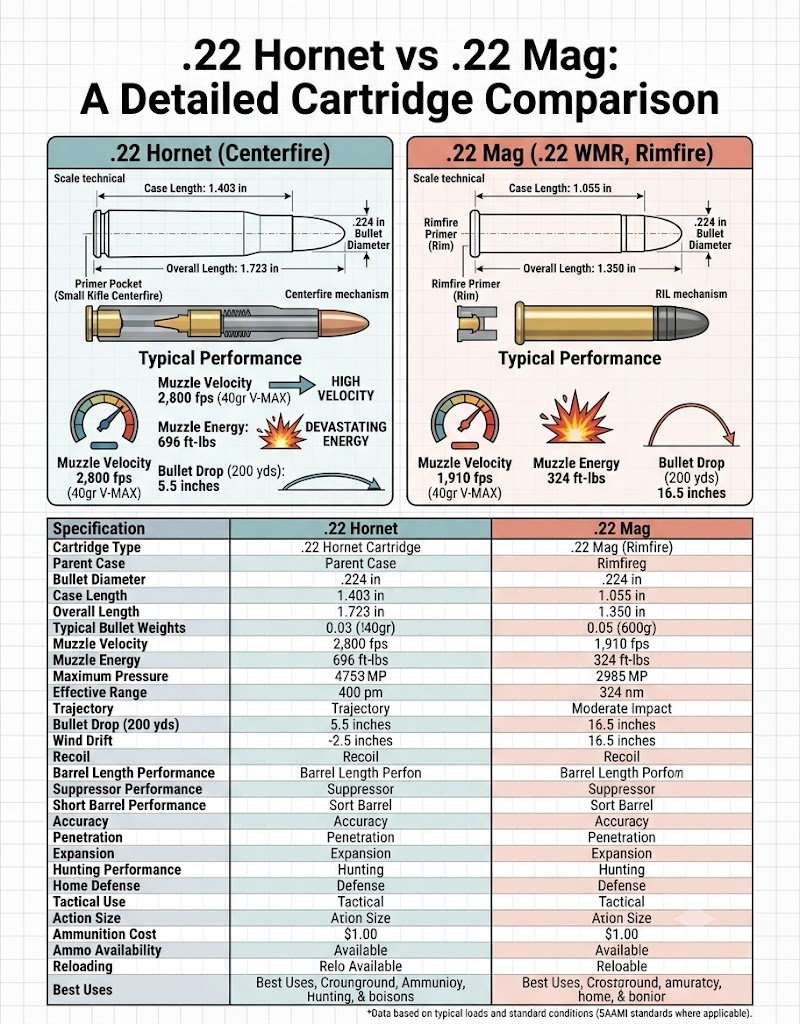
To accurately compare these two varmint cartridges, we must examine their physical dimensions and baseline ballistic performance. The data below represents standard premium factory loads, comparing a 40-grain V-MAX load for the .22 Hornet against a 40-grain V-MAX load for the .22 Mag fired from standard rifle barrels.
| Specification | .22 Hornet | .22 Mag |
| Cartridge Type | Centerfire Rifle | Rimfire Rifle |
| Parent Case | Original Design (1930) | .22 WRF (Lengthened, 1959) |
| Bullet Diameter | .224 inches | .224 inches |
| Case Length | 1.403 inches | 1.055 inches |
| Overall Length | 1.723 inches | 1.350 inches |
| Typical Bullet Weights | 35 grains to 45 grains | 30 grains to 40 grains |
| Muzzle Velocity (Rifle bbl) | 2,800 fps (40gr V-MAX) | 1,910 fps (40gr V-MAX) |
| Muzzle Energy (Rifle bbl) | 696 foot-pounds | 324 foot-pounds |
| Maximum Pressure | 43,000 CUP (SAAMI) | 24,000 psi (SAAMI) |
| Effective Range | 200 to 250 yards | 100 to 125 yards |
| Trajectory | Flat | Arced |
| Bullet Drop (200 yds) | Approx. 5.5 inches | Approx. 16.5 inches |
| Wind Drift | Moderate | High (Slower-moving bullet) |
| Recoil | Very Mild (Approx. 1.5 foot-pounds) | Practically Zero |
| Barrel Length Performance | Excels in 20 to 24-inch barrels | Excels in 18 to 20-inch barrels |
| Suppressor Performance | Good | Good |
| Short Barrel Performance | Rare in handguns | Excellent in revolvers |
| Accuracy | High (Centerfire consistency) | Good (Rimfire consistency) |
| Penetration | Moderate (Explosive fragmentation) | Moderate |
| Expansion | Devastating | Reliable |
| Hunting Performance | Elite (Coyotes, foxes, woodchucks) | Excellent (Raccoons, squirrels, close coyotes) |
| Home Defense | Not Recommended | Not Recommended |
| Tactical Use | None | None |
| Action Size | Micro Short Action | Rimfire Action |
| Ammunition Cost | High | Low |
| Ammo Availability | Specialty / Online | Ubiquitous |
| Reloading | Yes (Highly popular) | No (Rimfire cannot be reloaded) |
| Best Uses | Reloading, precision varmint hunting | Budget pest control, companion revolvers |
Understanding the Numbers
The technical differences between these cartridges are rooted entirely in their ignition systems and operating pressures.
The .22 Mag was introduced in 1959. It is a rimfire cartridge, meaning the priming compound is spun into the hollow rim of the thin brass case. Because rimfire cases must be thin enough for the firing pin to crush them, the .22 Mag is strictly limited to a maximum pressure of roughly 24,000 psi. Once fired, the case cannot be reloaded.
The .22 Hornet was introduced in 1930 and is widely considered one of the first dedicated modern varmint cartridges. It is a centerfire cartridge, utilizing a thick brass web and a replaceable Boxer primer. This robust construction allows the .22 Hornet to safely contain 43,000 CUP of pressure. This massive pressure advantage allows the Hornet to burn more powder and push identical bullet weights significantly faster than any rimfire cartridge ever could.
Velocity Comparison
Velocity dictates the trajectory flatness and the kinetic energy delivered to the target.
When pushing identical 40-grain bullets, the .22 Hornet is an absolute speed demon compared to the rimfire magnum. The .22 Hornet pushes a 40-grain V-MAX bullet at approximately 2,800 feet per second. The .22 Mag pushes that exact same 40-grain bullet weight at only 1,910 feet per second.
The .22 Hornet achieves nearly 900 feet per second more velocity simply because its centerfire case holds significantly more smokeless powder and operates at a much higher pressure threshold.
Muzzle Energy Comparison
Muzzle energy measures the absolute kinetic force transferred to a target upon impact.
Because kinetic energy relies heavily on velocity squared, the .22 Hornet completely eclipses the .22 Mag. A 40-grain .22 Hornet bullet generates a staggering 696 foot-pounds of energy at the muzzle.
The .22 Mag generates roughly 324 foot-pounds of energy. While this is more than adequate for taking a raccoon or a close-range coyote, it possesses less than half the raw kinetic power of the mighty centerfire Hornet.
Trajectory Comparison
A flat trajectory minimizes the margin of error when estimating range in the field.
Because the .22 Hornet drives its bullets much faster, it shoots significantly flatter than the .22 Mag. A hunter using a 40-grain .22 Hornet can hold the crosshairs directly on the vitals of a coyote out to 150 yards. The .22 Mag arches noticeably more and requires careful holdover estimation past 100 yards.
Bullet Drop Comparison
Assuming a 100-yard zero for both rifles, the mathematical bullet drop at 200 yards illustrates the trajectory differences clearly.
The .22 Hornet will drop approximately 5.5 inches at 200 yards. The .22 Mag will drop a massive 16.5 inches at the exact same distance. The .22 Mag sheds its velocity so rapidly that ethical hits on small targets become incredibly difficult past 125 yards.
Wind Drift Comparison
Wind deflection is mitigated by a bullet’s velocity and its aerodynamic profile.
Because both cartridges fire lightweight .22 caliber bullets, they are highly susceptible to wind drift. However, because the .22 Hornet reaches the target nearly a full second faster at extended ranges, it spends far less time exposed to crosswinds. At 150 yards, the .22 Hornet will drift noticeably less than the slow-moving .22 Mag, resulting in a much higher hit probability in open fields.
Recoil Comparison
Recoil dictates a shooter’s ability to spot their own impacts through a rifle scope.
Both of these cartridges are famous for practically non-existent recoil. The .22 Mag generates roughly 0.2 foot-pounds of recoil, while the .22 Hornet generates roughly 1.5 foot-pounds. Both feel like a very light, gentle tap against the shoulder. They are absolute joys to shoot and are perfect for young beginners.
Stopping Power Comparison
For varmint hunting, stopping power refers to explosive fragmentation and instant energy transfer.
The .22 Mag delivers excellent stopping power on small game and pests. The bullets expand reliably and cause rapid blood loss.
The .22 Hornet relies on high-velocity hydrostatic shock. When a 40-grain .22 Hornet bullet strikes a coyote at 2,800 feet per second, the massive energy transfer and violent expansion cause catastrophic tissue damage, anchoring the predator instantly. The .22 Mag simply cannot match the explosive terminal ballistics of the centerfire Hornet.
Accuracy Comparison
Both cartridges are capable of excellent accuracy, but the .22 Hornet holds a distinct mechanical advantage.
Rimfire ammunition is mass-produced, and the priming compound is spun into the rim of the case, which can occasionally lead to slight inconsistencies in ignition. The .22 Hornet is a centerfire cartridge. Centerfire primers provide highly consistent ignition, and the brass cases can be precision-manufactured to tighter tolerances. While a good .22 Mag rifle is highly accurate, a quality .22 Hornet bolt-action will routinely shoot tighter groups.
Effective Range Comparison
The .22 Hornet is a highly effective 200 to 250-yard hunting cartridge in the hands of a skilled marksman. It retains plenty of kinetic energy and velocity to ethically harvest coyotes at that distance.
The .22 Mag is a dedicated short-range rimfire. Its steep trajectory and rapidly decreasing velocity limit its ethical effective hunting range on predators to roughly 100 to 125 yards.
Suppressor Performance Comparison
Suppressors are highly recommended for both of these cartridges to mitigate their loud muzzle blast.
Both cartridges are entirely supersonic and push expanding gas. They perform identically well when suppressed. Adding a quality suppressor will tame the acoustic signature of both cartridges beautifully, though the supersonic crack of the bullet breaking the sound barrier will always remain.
Short Barrel Performance Comparison
This category highlights a massive difference in modern application.
The .22 Mag is incredibly popular in handguns. Revolvers like the Ruger Single-Six or high-capacity pistols like the Kel-Tec PMR30 chambered in .22 Mag are fantastic trail guns. While the cartridge loses significant velocity in a handgun barrel, it still produces a massive, loud fireball and remains highly lethal at close ranges.
The .22 Hornet is strictly a rifle cartridge. While specialty single-shot pistols like the Thompson/Center Contender were once chambered in it, you will never find a modern production revolver or semi-automatic handgun chambered in .22 Hornet.
Home Defense Comparison
Neither cartridge should be relied upon for primary home defense. While both are lethal, they fire tiny, lightweight bullets that lack the necessary mass and kinetic energy to reliably stop a determined human threat instantly. A dedicated 9mm pistol or a 12-gauge shotgun is vastly superior for home defense.
Hunting Comparison
These cartridges were built specifically for pest control, but they belong in different environments.
The .22 Mag is arguably the ultimate farm and ranch cartridge. It is light, fast-handling, and utterly devastating on raccoons, skunks, and armadillos inside 75 yards.
The .22 Hornet is the superior choice for dedicated predator hunters. The massive kinetic energy and flat trajectory ensure you can ethically harvest a coyote or fox across a wide pasture where the rimfire cartridge would fall severely short.
Tactical and Duty Use Comparison
Neither cartridge has any application in modern law enforcement or military roles. They are dedicated varmint hunting cartridges.
Action Length and Rifle Compatibility
The .22 Mag fits perfectly into incredibly small, lightweight, and affordable rimfire bolt-action and lever-action rifles.
The .22 Hornet requires a slightly longer micro short-action centerfire receiver. Rifles chambered in .22 Hornet are typically slightly heavier and significantly more expensive to manufacture than simple rimfire actions.
Ammo Cost Comparison
To become proficient with a hunting rifle, you must practice frequently.
The .22 Mag is highly affordable. Because it is a mass-produced rimfire cartridge, you can buy boxes of 50 rounds for a fraction of the cost of centerfire ammunition.
The .22 Hornet is a premium, specialty centerfire round. Boxes of 20 or 50 rounds typically cost three to four times the price of .22 Mag ammunition. Because it is a specialty item, manufacturers only load it in seasonal batches, driving the cost up significantly.
Ammo Availability Comparison
Walk into any gun store, rural hardware store, or big box sporting goods retailer in North America, and you will find .22 Mag ammunition sitting on the shelf.
The .22 Hornet is incredibly difficult to find locally. You will almost certainly have to order .22 Hornet ammunition online, and during ammunition shortages, it completely disappears from the market.
Reloading Comparison
This is a fundamental divide between the two cartridges.
The .22 Mag is a rimfire cartridge. It is permanently destroyed upon firing and absolutely cannot be reloaded.
The .22 Hornet is an absolute favorite in the reloading community. Because factory ammunition is so expensive, reloading is practically mandatory for high-volume shooters. A handloader can carefully tune their powder charges to achieve extreme precision, making the .22 Hornet highly economical to shoot if you save your brass.
Pros and Cons
.22 Hornet
Pros
- Generates double the kinetic energy of the .22 Mag.
- Shoots significantly flatter for long-range varmint hunting.
- Centerfire primers offer superior ignition consistency.
- Highly economical to reload with tiny powder charges.
- Elite stopping power on coyotes and foxes.
Cons
- Ammunition is incredibly expensive and very difficult to find.
- Modern rifle manufacturers rarely chamber new guns in this caliber.
- Cannot be used in standard high-capacity handguns.
.22 Mag
Pros
- Ammunition is highly affordable and universally available.
- Perfect ballistic profile for hunting small pests inside 100 yards.
- Chambered in countless affordable rifles and high-capacity handguns.
- Practically zero recoil impulse.
- No need to save brass or buy reloading equipment.
Cons
- Trajectory drops significantly past 125 yards.
- Cannot be reloaded.
- Lacks the kinetic energy for long shots on coyotes.
Final Verdict
Choosing between the .22 Hornet and the .22 Mag comes down entirely to the distance of your shots and your willingness to reload your own ammunition.
- For the Dedicated Predator Hunter: Choose the .22 Hornet. It provides the massive kinetic energy and flat trajectory necessary to anchor coyotes at 200 yards, which the rimfire simply cannot do ethically.
- For the Farm and Ranch Owner: Choose the .22 Mag. A lightweight rimfire rifle is fast-handling, produces zero recoil, and uses incredibly cheap ammunition that will easily dispatch pests inside 100 yards.
- For the Handloader: Choose the .22 Hornet. The ability to meticulously craft your own precision centerfire ammunition makes it a highly rewarding and economical cartridge to reload at home.
- For the Budget-Conscious Shooter: Choose the .22 Mag. If you do not own reloading equipment, buying factory .22 Hornet ammunition for high-volume shooting is completely cost-prohibitive.
FAQ
Is the .22 Hornet more powerful than the .22 Mag?
Yes. Because it is a high-pressure centerfire cartridge, the .22 Hornet pushes identical bullet weights roughly 900 feet per second faster, generating more than double the kinetic energy of the .22 Mag.
Can a .22 Mag kill a coyote?
Yes. The .22 Mag is highly effective on coyotes at close ranges (inside 75 yards) with perfect shot placement. However, for hunting coyotes at extended distances, the much more powerful .22 Hornet is strongly recommended.
Can I shoot .22 Mag in a .22 LR rifle?
Absolutely not. The .22 Mag uses a longer and slightly wider brass case than the standard .22 Long Rifle. Attempting to force a .22 Mag cartridge into a .22 LR chamber will result in a failure to chamber or a catastrophic firearm failure.
Is the .22 Hornet obsolete?
Commercially, it is definitely a niche cartridge. Very few new rifles are chambered in it today. However, ballistically it remains a highly effective varmint cartridge, and its loyal following of reloaders ensures it will never completely disappear.
Can I shoot .22 LR in a .22 Mag revolver?
No. The chamber dimensions are different. If you fire a .22 LR cartridge in a .22 Mag cylinder, the brass case will split and rupture, venting hot gases back toward the shooter. Some revolvers come with two interchangeable cylinders so you can safely shoot both calibers.