The main difference between the .357 Maximum and the .357 Magnum is that the .357 Maximum utilizes a significantly longer cartridge case and a higher pressure threshold to drive heavy bullets at extreme velocities for long distance metallic silhouette shooting and hunting, while the .357 Magnum is a shorter cartridge optimized for standard revolvers that provides ubiquitous ammunition availability and proven terminal performance for personal defense.
.357 Maximum vs .357 Magnum Comparison Table
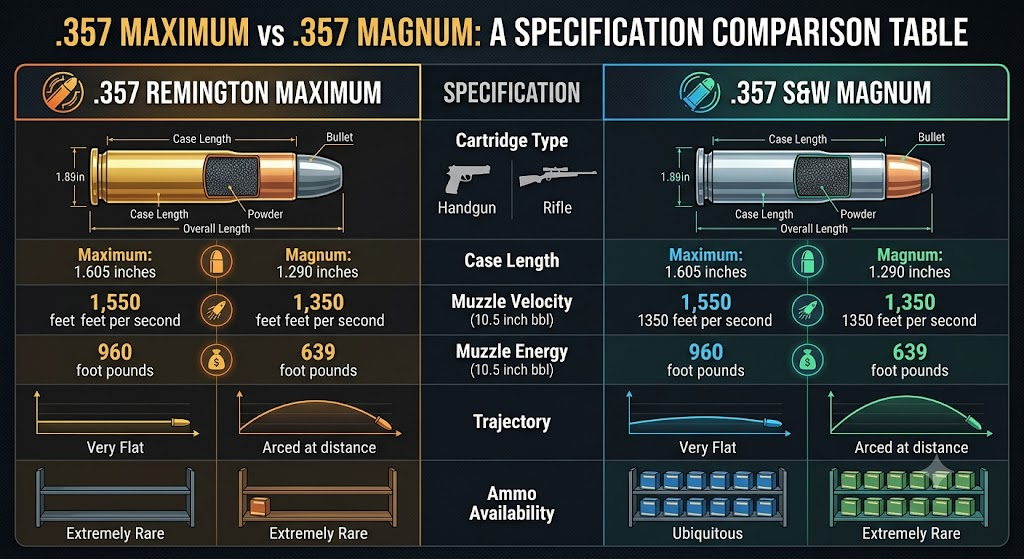
To accurately compare these two powerhouse revolver cartridges, we must examine their physical dimensions, pressure limits, and baseline ballistic performance. The data below represents standard premium factory loads. For the .357 Magnum, we reference standard 158 grain loads. For the .357 Maximum, we reference the traditional 180 grain loads originally designed by Remington and Elgin Gates, fired from 10.5 inch test barrels to reflect the typical single shot pistols used for this caliber.
| Specification | .357 Remington Maximum | .357 S&W Magnum |
| Cartridge Type | Centerfire Handgun and Rifle | Centerfire Handgun and Rifle |
| Parent Case | .357 Magnum (Lengthened) | .38 Special (Lengthened) |
| Bullet Diameter | .357 inches (9.07 mm) | .357 inches (9.07 mm) |
| Case Length | 1.605 inches | 1.290 inches |
| Overall Length | 1.990 inches | 1.590 inches |
| Typical Bullet Weights | 158 grains to 200 grains | 110 grains to 180 grains |
| Muzzle Velocity (10.5 inch bbl) | 1,550 feet per second (180gr JHP) | 1,350 feet per second (158gr JSP) |
| Muzzle Energy (10.5 inch bbl) | 960 foot pounds | 639 foot pounds |
| Maximum Pressure | 40,000 psi (SAAMI Specification) | 35,000 psi (SAAMI Specification) |
| Effective Range | 150 to 200 yards | 50 to 100 yards |
| Trajectory | Very Flat | Arced at distance |
| Bullet Drop (100 yards) | Approximately 1.5 inches | Approximately 3.5 inches |
| Wind Drift | Moderate (Heavy bullets resist drift) | High at extended ranges |
| Recoil | Heavy and sharp | Moderate to Heavy |
| Barrel Length Performance | Excels in 10 to 18 inch barrels | Excels in 4 to 6 inch barrels |
| Suppressor Performance | Poor in revolvers | Poor in revolvers |
| Short Barrel Performance | Terrible (Massive unburnt powder flash) | Poor (Significant velocity loss) |
| Accuracy | Extremely High (Match grade potential) | Extremely High |
| Penetration | Extreme (Deep penetration on large game) | Deep |
| Expansion | Devastating | Devastating |
| Hunting Performance | Elite (Deer, hogs, black bear) | Excellent at close ranges |
| Home Defense | Not Recommended (Extreme over penetration) | Elite (Proven stopping power) |
| Tactical Use | None | Historical Police Standard |
| Magazine Compatibility | Tubular magazines in custom lever actions | Fits 6 to 8 round revolver cylinders |
| Ammunition Cost | Astronomical | Moderate |
| Ammo Availability | Extremely Rare | Ubiquitous |
| Best Uses | Silhouette competition, straight wall hunting | Concealed carry, general woods defense |
Understanding the Dimensions and History
The technical differences between these cartridges represent a fascinating chapter in firearms history. The .357 Magnum was introduced in 1934 by lengthening the .38 Special case by 0.135 inches. This prevented the new high pressure magnum cartridge from being accidentally loaded into older, weaker .38 Special revolvers. The .357 Magnum quickly became the gold standard for law enforcement and civilian defense.
In 1983, a collaboration between Remington Arms and Ruger, heavily influenced by metallic silhouette shooting pioneer Elgin Gates, resulted in the .357 Remington Maximum. They took the .357 Magnum case and lengthened it by a massive 0.315 inches. The goal was to create a cartridge capable of knocking down 50 pound steel ram targets at 200 meters. The .357 Maximum operates at a staggering 40,000 psi. Just as a .357 Magnum revolver can safely fire .38 Special ammunition, a firearm chambered in .357 Maximum can safely fire both .357 Magnum and .38 Special ammunition, making it incredibly versatile.
Velocity Comparison
Velocity is the driving force behind the long range capabilities of the .357 Maximum.
When examining standard factory loads fired from a 10.5 inch test barrel, the .357 Maximum possesses a massive speed advantage. A standard 158 grain .357 Magnum bullet will leave a 10.5 inch barrel at roughly 1,400 feet per second. The .357 Maximum, utilizing its massive powder capacity, will push that exact same 158 grain bullet to over 1,825 feet per second.
When loaded with heavier 180 grain bullets specifically designed to carry momentum over long distances, the .357 Maximum still achieves an impressive 1,550 feet per second. The .357 Magnum struggles to push a 180 grain bullet past 1,150 feet per second in comparable handguns.
Winner: .357 Maximum
Muzzle Energy Comparison
Muzzle energy measures the absolute kinetic force transferred to the target upon impact. It provides a mathematical representation of raw knock down power.
Because the .357 Maximum drives significantly heavier bullets at much higher velocities, it drastically outperforms the .357 Magnum. A 180 grain .357 Maximum bullet traveling at 1,550 feet per second generates approximately 960 foot pounds of energy at the muzzle. A heavy 158 grain .357 Magnum bullet traveling at 1,350 feet per second generates roughly 639 foot pounds of energy.
The .357 Maximum delivers nearly 50 percent more kinetic energy. This massive increase in force places the .357 Maximum squarely in the same power category as the legendary .44 Magnum, despite utilizing a smaller diameter .357 caliber bullet.
Winner: .357 Maximum
Trajectory Comparison
A flat trajectory ensures the bullet point of impact matches the point of aim without requiring the shooter to calculate complex vertical holdover adjustments at extended distances.
The .357 Maximum was engineered specifically to shoot flat over a 200 meter distance for silhouette competition. Because it launches its bullets hundreds of feet per second faster than the .357 Magnum, it shoots a noticeably flatter trajectory. The bullet reaches the steel target much faster, giving gravity less time to pull the projectile toward the earth. The .357 Magnum drops rapidly past 75 yards, requiring significant elevation adjustments.
Winner: .357 Maximum
Bullet Drop Comparison
Assuming a standard 50 yard zero for both handguns equipped with optics, the mathematical bullet drop at extended distances illustrates the trajectory difference clearly.
At 100 yards, a standard 158 grain .357 Magnum bullet will drop approximately 3.5 inches. At the exact same distance of 100 yards, a 180 grain .357 Maximum bullet will drop less than 1.5 inches.
If pushed to 200 yards, the .357 Magnum drops a massive 24 inches, making ethical hits on game or steel targets extremely difficult. The .357 Maximum drops roughly 12 inches at 200 yards, allowing a skilled marksman to make reliable hits with minimal holdover.
Winner: .357 Maximum
Wind Drift Comparison
Wind deflection is mitigated by a bullet’s velocity and its aerodynamic efficiency.
Handgun bullets are typically short and blunt, giving them terrible aerodynamic profiles compared to modern rifle bullets. However, the .357 Maximum has two distinct advantages in the wind. First, it pushes the bullet faster, minimizing the time the bullet is exposed to crosswinds. Second, the elongated case allows reloaders to seat heavier, longer 180 grain and 200 grain bullets that inherently possess higher ballistic coefficients. In a heavy 10 mph crosswind at 150 yards, the .357 Maximum will drift noticeably less than a standard 158 grain .357 Magnum.
Winner: .357 Maximum
Recoil Comparison
Recoil directly dictates a shooter’s ability to fire rapid and accurate follow up shots.
The .357 Magnum generates a sharp, snappy recoil impulse that is entirely manageable in a heavy, full size steel revolver like the Smith and Wesson 686. Most shooters can master the recoil of the .357 Magnum with adequate practice.
The .357 Maximum generates severe recoil. Because it operates at 40,000 psi and burns a massive column of slow burning magnum powder, it produces a violent rearward thrust and a massive concussive blast. Firing the .357 Maximum from a revolver or a lightweight single shot pistol requires strong grip fundamentals and a high tolerance for physical punishment.
Winner: .357 Magnum
Stopping Power Comparison
Stopping power against a threat or game animal requires a combination of adequate penetration, rapid energy transfer, and wide bullet expansion to cause rapid blood loss and disrupt the central nervous system.
The .357 Magnum is universally recognized as one of the greatest defensive handgun cartridges ever designed. The 125 grain jacketed hollow point load developed a legendary reputation in law enforcement for stopping threats with a single shot.
The .357 Maximum possesses vastly more kinetic energy, but this extra power does not necessarily equate to better defensive stopping power. The extreme velocity of the .357 Maximum can actually cause standard .357 caliber pistol bullets to fragment prematurely on impact before reaching vital organs. To harness the true stopping power of the .357 Maximum, hunters must use specialized, heavily jacketed bullets designed to withstand 1,800 feet per second impact velocities. When loaded with these premium bullets, the .357 Maximum delivers absolute devastation on large game.
Winner: .357 Maximum (For Hunting) / .357 Magnum (For Defense)
Penetration Comparison
Penetration is the absolute most critical metric for any hunting cartridge, ensuring the bullet can reach vital organs from quartering angles.
The .357 Magnum provides excellent penetration on human targets and medium game like whitetail deer. A 158 grain soft point bullet will easily punch through the ribcage of a deer at 50 yards.
The .357 Maximum operates in a different league. When loaded with a 180 grain or 200 grain hard cast lead bullet or a bonded core hunting bullet, the .357 Maximum will easily penetrate both shoulders of a large wild boar or a black bear. The extra velocity and heavier bullet mass guarantee deep, straight line penetration that the .357 Magnum simply cannot match.
Winner: .357 Maximum
Expansion Comparison
To accurately test bullet expansion, the ballistics industry relies on calibrated ordinance gel.
A premium .357 Magnum hollow point starts at .357 inches in diameter. When it hits tissue at 1,350 feet per second, the fluid pressure forces the copper jacket to peel back, violently mushrooming the bullet to over .60 inches.
The .357 Maximum drives those exact same bullets significantly faster. This guarantees violent expansion, but as previously mentioned, pushing a standard pistol bullet past its design velocity limits can cause the lead core to separate from the copper jacket. Shooters must be extremely careful to select bullets constructed specifically for the extreme velocities of the .357 Maximum to ensure the bullet expands reliably without disintegrating.
Winner: Tie (Dependent on bullet construction)
Accuracy Comparison
Both cartridges are capable of elite mechanical accuracy, but they excel in different platforms.
The .357 Magnum is phenomenally accurate in standard double action revolvers and lever action rifles. It is a legendary target cartridge that has won countless bullseye competitions.
The .357 Maximum is renowned for its extreme precision in single shot pistols, specifically the Thompson/Center Contender and the specialized Dan Wesson revolvers. The ability to seat long, aerodynamic bullets allows handloaders to tune the .357 Maximum to shoot sub minute of angle groups at 100 yards, which is virtually unheard of for standard straight walled pistol cartridges.
Winner: .357 Maximum
Effective Range Comparison
The effective range of a handgun is severely limited by its sight radius and rapidly decreasing bullet energy.
Because the .357 Magnum sheds its velocity quickly, its practical effective hunting range is generally limited to 75 yards for the average shooter, or perhaps 100 yards with a magnified optic.
The .357 Maximum was purposefully built to knock down 50 pound steel targets at 200 meters. It retains enough kinetic energy and flies flat enough to be a highly ethical 150 yard to 200 yard hunting cartridge in the hands of a skilled marksman equipped with a pistol scope.
Winner: .357 Maximum
Suppressor Performance Comparison
Suppressing a personal defense weapon or hunting pistol helps protect the shooter’s hearing, but neither of these cartridges performs well with silencers in their traditional platforms.
Suppressing a revolver is almost entirely ineffective due to the cylinder gap. This is the small physical space between the front of the rotating cylinder and the rear of the barrel. When either of these cartridges fires, high pressure gases and a deafening acoustic pop escape through this cylinder gap before the sound ever reaches the silencer attached to the muzzle.
If fired from a sealed single shot pistol or a lever action rifle, both cartridges can be suppressed. However, because both are inherently supersonic cartridges, the loud ballistic crack of the bullet breaking the sound barrier will always remain.
Winner: Tie
Short Barrel Performance Comparison
Modern concealed carry requires highly concealable firearms, meaning barrels are frequently chopped down to microscopic lengths.
The .357 Magnum suffers massive performance degradation in short 2 inch snub nose barrels. The bullet exits the muzzle before the powder has time to fully combust, creating a blinding muzzle flash, a deafening roar, and a severe loss of velocity.
The .357 Maximum should absolutely never be fired from a short barrel. It utilizes a massive column of very slow burning magnum powder. If you were to fire a .357 Maximum from a short barrel, it would act more like a flamethrower than a firearm. The cartridge requires a minimum of 10 inches of barrel length to achieve efficient powder combustion.
Winner: .357 Magnum
Carbine and Single Shot Rifle Performance
Both cartridges benefit immensely from the increased barrel length of a rifle.
The .357 Magnum performs absolutely brilliantly in lever action carbines. The sealed breech and 16 inch barrel allow the powder to fully combust. A standard 158 grain .357 Magnum bullet gains hundreds of feet per second in velocity, transforming it into a highly capable 100 yard deer rifle.
The .357 Maximum is a legendary straight wall rifle cartridge. Because several Midwestern states restrict deer hunting to straight walled cartridges only, custom gunsmiths frequently chamber single shot rifles and custom lever actions in .357 Maximum. Out of an 18 inch rifle barrel, the .357 Maximum can push a 180 grain bullet past 2,100 feet per second, yielding over 1,700 foot pounds of energy. This rivals the performance of the venerable .30-30 Winchester while remaining completely legal for straight wall hunting zones.
Winner: .357 Maximum
Home Defense Comparison
Inside the home, a defender must balance stopping power against over penetration and auditory safety.
The .357 Magnum is a proven home defense cartridge, though the concussive indoor blast is severe. Many homeowners prefer to load their .357 Magnum revolvers with .38 Special Plus P ammunition to mitigate the noise and flash while still providing excellent stopping power.
The .357 Maximum is a terrible choice for home defense. The 40,000 psi operating pressure will cause immediate and permanent hearing damage if fired indoors without ear protection. Furthermore, the extreme velocity and heavy bullet mass guarantee that the projectile will over penetrate through multiple interior walls, endangering innocent bystanders and family members in adjacent rooms.
Winner: .357 Magnum
Hunting Comparison
These cartridges are both highly effective in the hunting woods, but they operate in different ranges.
The .357 Magnum is a perfectly adequate brush gun cartridge. When fired from a revolver, it will ethically harvest deer and feral hogs inside 50 yards. When fired from a lever action rifle, that ethical range extends to roughly 100 yards.
The .357 Maximum is a dedicated, elite hunting cartridge. It provides the deep penetration necessary to take down black bears and massive feral hogs. The flat trajectory and high retained energy make it a phenomenal 200 yard deer cartridge in single shot pistols or custom rifles.
Winner: .357 Maximum
Tactical and Duty Use Comparison
The .357 Magnum was the undisputed king of American law enforcement from the 1950s through the late 1980s. Highway patrolmen favored the .357 Magnum because the high velocity 125 grain bullets could easily penetrate the heavy steel car doors of the era. It has a proven and extensive tactical pedigree.
The .357 Maximum has never been utilized by any military or law enforcement agency. It was designed purely as a civilian sporting cartridge for silhouette competition and hunting.
Winner: .357 Magnum
Firearm Platform Compatibility
This category highlights the tragic downfall of the .357 Maximum in the commercial market.
The .357 Magnum is universally supported. You can buy double action revolvers, single action revolvers, lever action rifles, pump action rifles, and even semi automatic pistols chambered in .357 Magnum from dozens of different manufacturers.
The .357 Maximum suffered a massive commercial failure shortly after its release. Ruger initially chambered their Blackhawk revolver in .357 Maximum. However, shooters quickly discovered that the extreme pressure and high volume of burning powder escaping the cylinder gap acted like a plasma torch. This high pressure gas physically cut into the steel frame above the cylinder, a phenomenon known as top strap cutting. The top strap cutting and severe erosion of the forcing cone forced Ruger to completely discontinue the revolver. Today, you can practically only find the .357 Maximum chambered in single shot pistols like the Thompson/Center Contender, single shot rifles, or extremely expensive custom revolvers built to withstand the pressure.
Winner: .357 Magnum
Ammo Cost and Availability
To become proficient with a firearm, you must practice frequently.
The .357 Magnum is universally available. You can walk into any sporting goods store in the world and find .357 Magnum ammunition sitting on the shelf. Furthermore, you can practice with cheap, abundant .38 Special ammunition to save money.
The .357 Maximum is commercially obsolete. Major ammunition manufacturers rarely produce it. If you want to shoot a .357 Maximum, you must scour the internet for specialty boutique ammunition manufacturers who charge an absolute premium for custom loaded boxes, often exceeding three or four dollars per trigger pull.
Winner: .357 Magnum
Reloading Comparison
Because factory ammunition is so rare, reloading is practically mandatory for the .357 Maximum.
The .357 Magnum is incredibly easy to reload. Brass is cheap, components are everywhere, and load data is infinite.
The .357 Maximum is an absolute dream for experienced handloaders. It is a straight walled cartridge that sizes easily in standard carbide dies. The massive case capacity allows handloaders to experiment with heavy 180 grain, 200 grain, and even 220 grain bullets that would never fit inside a standard .357 Magnum case. Handloading is the only way to truly unlock the long range potential of the .357 Maximum.
Winner: Tie (Both are excellent, but mandatory for the Maximum)
Pros and Cons
.357 Maximum
Pros
- Generates massive kinetic energy, rivaling the .44 Magnum.
- Incredible flat trajectory for 200 yard target engagements.
- An elite straight walled cartridge for deer hunting states.
- Handloaders can utilize extremely heavy, aerodynamic bullets.
- Firearms chambered in Maximum can also safely fire .357 Magnum and .38 Special.
Cons
- Commercially obsolete, making factory ammunition nearly impossible to find.
- High pressure gas cutting destroyed its viability in standard revolvers.
- Generates punishing recoil and severe muzzle blast.
- Extremely limited selection of compatible firearms.
.357 Magnum
Pros
- Unmatched velocity and stopping power for personal defense.
- Ammunition is universally available and highly affordable.
- Massive ecosystem of revolvers and lever action rifles available globally.
- Allows you to shoot cheap, abundant .38 Special ammunition for practice.
- Proven track record in law enforcement and hunting.
Cons
- Generates a sharp, painful recoil impulse compared to standard pistol calibers.
- Blinding muzzle flash when fired from short barrel snub nose revolvers.
- Heavy bullet drop limits ethical hunting range to 100 yards.
- Lacks the case capacity to efficiently push bullets heavier than 158 grains.
Final Verdict
Choosing between the .357 Maximum and the .357 Magnum comes down to deciding between a rare, high performance specialist cartridge and a universally supported everyday classic.
- For Concealed Carry and Home Defense: Choose the .357 Magnum. It offers superior availability, modern expanding defensive ammunition, and a massive variety of reliable double action revolvers perfect for personal protection.
- For Straight Wall Deer Hunting: Choose the .357 Maximum. If you live in a state that restricts rifle hunting to straight walled cartridges, a single shot rifle chambered in .357 Maximum provides the velocity and trajectory needed to ethically harvest deer at 200 yards.
- For Metallic Silhouette Competition: Choose the .357 Maximum. Elgin Gates designed the cartridge for this exact purpose. The heavy bullets and high velocity guarantee reliable knockdown power on heavy steel rams at 200 meters.
- For Budget Conscious Shooters: Choose the .357 Magnum. The ability to practice with cheap .38 Special ammunition will save you a fortune over the lifespan of the firearm.
- For Handloaders Seeking Extreme Performance: Choose the .357 Maximum. The massive case capacity allows experienced handloaders to push .357 caliber bullets to their absolute ballistic limits in strong single shot platforms.
FAQ
Is the .357 Maximum more powerful than the .357 Magnum?
Yes. The .357 Maximum features a case that is 0.315 inches longer than the .357 Magnum. This massive increase in powder capacity allows the .357 Maximum to generate roughly 50 percent more kinetic energy and achieve significantly higher velocities than standard .357 Magnum ammunition.
Can I shoot .357 Magnum in a .357 Maximum firearm?
Yes. Because the .357 Maximum is simply a lengthened .357 Magnum, any firearm chambered in .357 Maximum can safely chamber and fire .357 Magnum ammunition, as well as .38 Special ammunition. However, you cannot fire a .357 Maximum cartridge in a .357 Magnum firearm.
Why did the .357 Maximum fail commercially?
The .357 Maximum failed primarily due to a phenomenon called top strap cutting. When fired from early Ruger revolvers, the extreme pressure and high volume of burning powder escaping the cylinder gap acted like a plasma torch, physically cutting into the steel frame above the cylinder and eroding the forcing cone. This forced manufacturers to stop producing revolvers in this caliber.
Can you still buy .357 Maximum ammo?
Yes, but it is extremely difficult to find. Major ammunition manufacturers rarely produce it. Shooters typically have to purchase custom loaded ammunition from small boutique manufacturers online, or they rely on reloading their own spent brass cases.
Is the .357 Maximum good for deer hunting?
It is exceptional for deer hunting. When fired from a single shot pistol or a custom rifle, the .357 Maximum provides the flat trajectory and deep penetration necessary to ethically harvest large whitetail deer at distances up to 200 yards.
Does the .357 Maximum kick hard?
Yes. Burning a massive column of slow burning magnum powder generates a severe recoil impulse and a massive concussive blast. Managing the recoil of a .357 Maximum requires strong grip fundamentals and physical stamina, especially when fired from a handgun.