The main difference between the .17 WSM and the .17 Hornet is that the .17 WSM is a highly affordable rimfire cartridge that maxes out around 3,000 feet per second for close to medium range varmint control, while the .17 Hornet is a reloadable centerfire cartridge that pushes the exact same bullet weights over 3,650 feet per second to deliver superior trajectory, kinetic energy, and effective range.
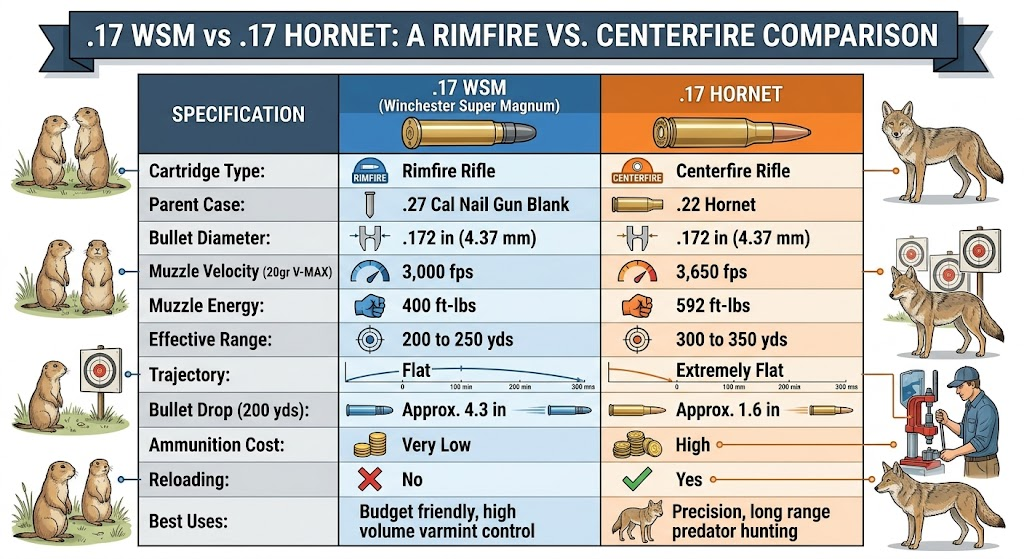
.17 WSM vs .17 Hornet Comparison Table
To accurately compare these two sub caliber varmint cartridges, we must examine their physical dimensions and baseline ballistic performance. The data below represents standard premium factory loads from Hornady, firing the exact same 20 grain V-MAX polymer tipped bullet to ensure a perfectly fair ballistic comparison.
| Specification | .17 WSM (Winchester Super Magnum) | .17 Hornet |
| Cartridge Type | Rimfire Rifle | Centerfire Rifle |
| Parent Case | .27 Caliber Nail Gun Blank | .22 Hornet |
| Bullet Diameter | .172 in (4.37 mm) | .172 in (4.37 mm) |
| Case Length | 1.190 in | 1.340 in |
| Overall Length | 1.590 in | 1.720 in |
| Typical Bullet Weights | 15 gr to 25 gr | 15 gr to 25 gr |
| Muzzle Velocity (20gr V-MAX) | 3,000 fps | 3,650 fps |
| Muzzle Energy (20gr V-MAX) | 400 ft-lbs | 592 ft-lbs |
| Maximum Pressure | 33,000 psi (SAAMI) | 50,000 psi (SAAMI) |
| Effective Range | 200 to 250 yds | 300 to 350 yds |
| Trajectory | Flat | Extremely Flat |
| Bullet Drop (200 yds) | Approx. 4.3 inches | Approx. 1.6 inches |
| Wind Drift (200 yds) | High (Lightweight bullet) | Moderate (Higher velocity mitigates drift) |
| Recoil | Practically Zero | Practically Zero |
| Barrel Length Performance | Excels in 20 to 24 inch barrels | Excels in 24 inch barrels |
| Suppressor Performance | Good (Remains supersonic) | Good (Remains supersonic) |
| Accuracy | High | Extremely High (Match capable) |
| Penetration | Low (Designed for rapid fragmentation) | Low (Explosive fragmentation) |
| Hunting Performance | Excellent (Prairie dogs, groundhogs, foxes) | Elite (Coyotes, prairie dogs, bobcats) |
| Home Defense | Not Recommended | Not Recommended |
| Tactical Use | None | None |
| Action Type | Bolt Action, Semi Automatic | Bolt Action, Single Shot |
| Ammunition Cost | Very Low | High |
| Ammo Availability | Moderate to Good | Moderate (Often seasonal) |
| Reloading | No (Rimfire cases cannot be reloaded) | Yes (Highly popular for handloaders) |
| Best Uses | Budget friendly, high volume varmint control | Precision, long range predator hunting |
Understanding the Numbers
The technical differences between these cartridges are rooted entirely in their ignition systems. The .17 WSM (Winchester Super Magnum) was introduced in 2013. Winchester engineers took a heavy duty .27 caliber industrial nail gun blank, necked it down to accept a .17 caliber bullet, and created the fastest, most powerful rimfire cartridge in the world. However, because it is a rimfire cartridge, it is limited to 33,000 psi of pressure and cannot be reloaded once fired.
The .17 Hornet is a centerfire cartridge originally wildcatted by P.O. Ackley in the 1950s and officially standardized by Hornady in 2012. It is based on the classic .22 Hornet case necked down to .17 caliber. Because it utilizes a centerfire primer and a thicker brass web, it safely operates at a much higher 50,000 psi. This pressure difference allows the .17 Hornet to generate significantly more power while offering handloaders the ability to reuse the brass cases.
Velocity Comparison
Velocity is the primary mechanism that allows these tiny lightweight bullets to perform effectively on small game.
Using the exact same Hornady 20 grain V-MAX bullet out of a 24 inch barrel:
- .17 WSM: 3,000 fps
- .17 Hornet: 3,650 fps
The .17 Hornet is a blistering fast cartridge. By utilizing higher chamber pressures and a slightly larger powder column, the centerfire Hornet drives the 20 grain bullet 650 feet per second faster than the rimfire WSM. This extreme speed causes the tiny polymer tipped bullets to explode violently upon impact, completely transferring all of their energy into the target without exiting.
Muzzle Energy Comparison
Muzzle energy dictates the kinetic force the bullet strikes with upon impact.
- .17 WSM (20gr V-MAX): 400 ft-lbs
- .17 Hornet (20gr V-MAX): 592 ft-lbs
The .17 Hornet generates nearly 50 percent more kinetic energy at the muzzle than the .17 WSM. While 400 foot pounds is perfectly adequate for prairie dogs and groundhogs, the nearly 600 foot pounds generated by the .17 Hornet makes it a much more ethical and reliable choice for anchoring larger predators like coyotes or bobcats at extended ranges.
Trajectory Comparison
A flat trajectory minimizes the need for drastic holdover adjustments in the field, which is critical when shooting at very small targets like ground squirrels.
Because the .17 Hornet drives the exact same .172 caliber bullets significantly faster than the WSM, it shoots noticeably flatter. The Hornet reaches the target much faster, giving gravity less time to pull the projectile toward the earth. This makes the Hornet a much more forgiving cartridge if your range estimation is off by a few yards.
Bullet Drop Comparison
Assuming a standard 100 yard zero and firing the 20 grain V-MAX bullet, the mathematical drop out to 300 yards illustrates the centerfire advantage.
| Distance | .17 WSM (20gr V-MAX) | .17 Hornet (20gr V-MAX) |
| 100 Yards | 0 inches | 0 inches |
| 150 Yards | -1.2 inches | -0.5 inches |
| 200 Yards | -4.3 inches | -1.6 inches |
| 250 Yards | -9.8 inches | -4.0 inches |
| 300 Yards | -18.2 inches | -7.8 inches |
At 200 yards, the rimfire .17 WSM drops nearly three inches more than the .17 Hornet. By the time the bullets reach 300 yards, the .17 WSM is dropping drastically, requiring a full 18 inches of holdover. The .17 Hornet only drops 7.8 inches at 300 yards, allowing a hunter to hold near the top edge of a coyote’s vitals and still score a clean hit.
Wind Drift Comparison
Wind deflection is the absolute greatest enemy of the .17 caliber bullet. Because these projectiles weigh only 15 to 25 grains, a moderate crosswind will easily blow them completely off a small target.
Since both cartridges can be loaded with the exact same aerodynamic bullets, velocity is the only determining factor for mitigating wind drift. Because the .17 Hornet reaches the target 650 feet per second faster, it spends less time exposed to crosswinds. At 200 yards in a 10 mph crosswind, the Hornet will drift noticeably less than the WSM, resulting in a higher hit probability in open country.
Recoil Comparison
Recoil is practically non existent for both cartridges.
Whether you are shooting the rimfire WSM or the centerfire Hornet, the recoil impulse is so light that you can easily watch your bullet impact the target through the rifle scope. This makes both cartridges phenomenal training tools for young or recoil sensitive shooters, and it allows varmint hunters to instantly verify their hits without losing the sight picture.
Stopping Power Comparison
For varmint hunting, stopping power refers to explosive fragmentation rather than deep penetration.
Both cartridges utilize highly frangible bullets designed to rapidly expand and fragment upon impact. This prevents the bullet from exiting the animal and ricocheting across the landscape. The .17 WSM performs beautifully on small pests. However, because the .17 Hornet strikes with significantly higher velocity and nearly 200 additional foot pounds of energy, it delivers a much more violent hydrostatic shock, making it vastly superior for larger predators like coyotes.
Accuracy Comparison
Both cartridges are capable of excellent accuracy, but the .17 Hornet holds a distinct mechanical advantage.
Rimfire ammunition is mass produced, and the priming compound is spun into the rim of the case, which can occasionally lead to slight inconsistencies in ignition. The .17 Hornet is a centerfire cartridge. Centerfire primers provide highly consistent ignition, and the brass cases can be precision manufactured to tighter tolerances. While a good .17 WSM rifle will shoot 1 MOA groups, a quality .17 Hornet bolt action will routinely shoot sub half MOA groups with premium ammunition.
Effective Range Comparison
The effective range of a sub caliber varmint rifle is dictated by bullet drop, wind drift, and retained energy.
The .17 WSM is widely considered a highly effective 200 yard cartridge. Beyond 200 yards, the velocity bleeds off rapidly, making wind calls incredibly difficult and reducing terminal fragmentation.
The .17 Hornet stretches the ethical hunting range out to 300 or even 350 yards on calm days. The extra velocity keeps the bullet flying flat and ensures it retains enough energy to explosively dispatch rodents at a quarter mile.
Ammo Cost Comparison
This is the primary reason the .17 WSM is so popular.
Because the .17 WSM is a rimfire cartridge, the manufacturing process is significantly cheaper. You can typically purchase a box of 50 rounds of .17 WSM for a fraction of the cost of centerfire ammunition, making it highly affordable for high volume prairie dog shoots where you might fire hundreds of rounds in a single afternoon.
The .17 Hornet is a centerfire cartridge requiring thicker brass and a dedicated Boxer primer. Factory boxes of 25 rounds are quite expensive, often costing triple the price per round compared to the rimfire WSM.
Ammo Availability Comparison
The .17 WSM is generally easier to find on the shelves of big box sporting goods stores and rural hardware stores. Rimfire ammunition is produced in massive quantities year round.
The .17 Hornet is a specialty varmint cartridge. Major manufacturers usually only produce it in seasonal batches leading up to the spring and summer varmint hunting seasons. During the off season, factory loaded .17 Hornet can be difficult to find locally.
Reloading Comparison
This category represents a fundamental divide between the two cartridges.
The .17 WSM is a rimfire cartridge. Once the firing pin crushes the rim to ignite the primer, the brass case is permanently destroyed and cannot be reloaded. You must rely entirely on factory produced ammunition.
The .17 Hornet is a centerfire cartridge that utilizes standard small rifle primers. It is highly popular among handloaders. By saving the spent brass cases, shooters can reload their own .17 Hornet ammunition for roughly the same price as buying factory .17 WSM rimfire rounds. Furthermore, reloading allows you to perfectly tune the powder charge to your specific rifle barrel for absolute pinpoint accuracy.
Final Verdict
Choosing between the .17 WSM and the .17 Hornet comes down to your budget, your willingness to reload, and the specific distances you intend to shoot.
- For High Volume Prairie Dog Shooters: Choose the .17 WSM. The incredibly low cost of rimfire factory ammunition allows you to shoot hundreds of rounds a day without breaking the bank, and it performs beautifully inside 200 yards.
- For Coyote and Predator Hunters: Choose the .17 Hornet. Coyotes require more kinetic energy for ethical, one shot kills. The Hornet delivers the necessary 600 foot pounds of energy and superior terminal performance.
- For Handloaders Seeking Precision: Choose the .17 Hornet. The centerfire case allows you to craft custom, sub MOA match ammunition tailored perfectly to your rifle, completely negating the high cost of factory centerfire ammunition.
- For Long Range Varminting: Choose the .17 Hornet. The extra 650 feet per second provides a drastically flatter trajectory and less wind drift, extending your effective range past 300 yards.
- For Budget Conscious Non Reloaders: Choose the .17 WSM. If you do not own reloading equipment, buying factory .17 Hornet ammunition for high volume shooting is cost prohibitive. The .17 WSM offers the best rimfire ballistics on the market at a highly affordable price.
FAQ
Is the .17 Hornet more powerful than the .17 WSM?
Yes. Because the .17 Hornet is a centerfire cartridge that safely operates at 50,000 psi, it drives the exact same 20 grain bullet roughly 650 feet per second faster than the rimfire .17 WSM, resulting in nearly 50 percent more kinetic energy at the muzzle.
Can I reload .17 WSM?
No. The .17 Winchester Super Magnum is a rimfire cartridge. The priming compound is spun directly into the rim of the brass case, which is permanently crushed by the firing pin upon ignition. It cannot be safely reprimed or reloaded.
Can I shoot .17 HMR in a .17 WSM rifle?
Absolutely not. The .17 WSM uses a significantly larger and thicker parent case based on a .27 caliber nail gun blank. The chamber dimensions are completely different, and attempting to fire a smaller .17 HMR cartridge in a .17 WSM rifle will result in a dangerous case rupture.
Which cartridge is better for coyotes?
The .17 Hornet is vastly superior for coyotes. While the .17 WSM can kill a coyote at very close range with perfect shot placement, the .17 Hornet provides the necessary kinetic energy and deep hydrostatic shock to ethically anchor large predators out to 200 yards.
Does the .17 WSM have recoil?
The recoil of the .17 WSM is practically non existent. It generates less than one foot pound of free recoil, making it completely comfortable for young children and new shooters, and allowing hunters to easily watch their bullets impact through the rifle scope.
Why is .17 Hornet ammo so expensive?
The .17 Hornet is a centerfire cartridge that requires precision manufactured thick brass cases, separate Boxer primers, and careful powder metering. Because it is a niche varmint cartridge rather than a mass produced military caliber, the economies of scale dictate a higher retail price for factory ammunition.