A 44 Mag Trajectory Chart is a technical reference guide that outlines the flight path and vertical drop of 44 Remington Magnum ammunition when fired from rifle length barrels across distances of 50 to 200 yards. Because this cartridge is widely used in lever action rifles for deer hunting and timber shooting, understanding its rapid bullet drop is essential for accurate shot placement. This resource uses verified factory data to illustrate how heavy, blunt projectiles interact with gravity at ranges where the cartridge remains effective. By utilizing this information, shooters can confidently determine the necessary holdover adjustments required for consistent performance in the field.
44 Mag Trajectory Chart
| Manufacturer | Load Name | Weight (gr) | Type | BC | MV (fps) | 50y Drop | 100y Drop | 150y Drop | 200y Drop | Zero (y) |
| Hornady | LEVERevolution | 225 | FTX | 0.190 | 1850 | +0.4 | 0.0 | -6.8 | -19.4 | 100 |
| Remington | HTP Copper | 210 | HP | 0.170 | 1750 | +0.5 | 0.0 | -7.8 | -22.5 | 100 |
| Federal | Power-Shok | 240 | JSP | 0.166 | 1760 | +0.5 | 0.0 | -7.9 | -22.8 | 100 |
| Winchester | Super-X | 240 | JSP | 0.166 | 1760 | +0.5 | 0.0 | -7.9 | -22.8 | 100 |
| Buffalo Bore | Heavy | 270 | JFN | 0.198 | 1700 | +0.6 | 0.0 | -8.2 | -23.5 | 100 |
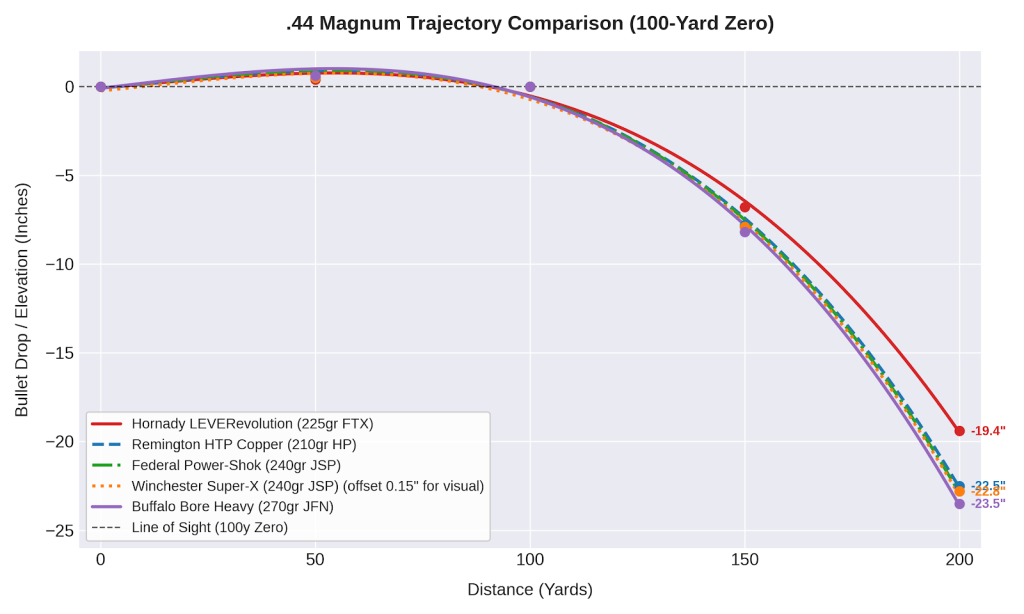
To use this trajectory chart correctly, identify the specific factory load and bullet weight currently in your rifle. With a 100 yard zero established, the table provides the vertical deviation in inches at each interval. For example, the Hornady FTX load drops 6.8 inches at 150 yards, while the heavier 240 grain JSP loads drop 7.9 inches at that same distance. Understanding these values is crucial for successful hunting, as the 44 Magnum experiences significant drop beyond the 100 yard mark.
Understanding The 44 Mag Trajectory Chart
The values in this table are sourced from standard 18 to 20 inch rifle barrels. These metrics demonstrate the physical reality of shooting a large diameter, medium velocity handgun caliber through a rifle platform.
Trajectory Analysis
The trajectory of the 44 Magnum is steep due to the low ballistic coefficients of the bullets required for tube-fed lever action rifles. Comparing the 225 grain Hornady FTX to the 240 grain Federal JSP, the FTX load is flatter, dropping 19.4 inches at 200 yards compared to the 22.8 inches of the heavier JSP. This illustrates that optimizing for a better BC with the FTX profile offers a measurable advantage in range.
Velocity Analysis
Muzzle velocity for the 44 Magnum typically ranges between 1700 and 1850 fps. The Hornady LEVERevolution is the fastest listed at 1850 fps, which assists in keeping the bullet path higher for longer. The slower, heavier loads like the 270 grain Buffalo Bore start at 1700 fps, requiring more aggressive holdover as the distance increases to 200 yards.
Ballistic Coefficient Analysis
Ballistic coefficient is the limiting factor for 44 Magnum ballistics. Traditional JSP bullets have a BC near 0.166, which is quite low by modern standards, causing them to shed speed rapidly. The Hornady FTX improves this with a 0.190 BC, allowing it to maintain energy and trajectory better than standard flat-point designs.
Best Factory Loads Based On The Chart
For general deer hunting at ranges up to 150 yards, the Hornady 225 grain FTX is the top choice because it provides the flattest trajectory and efficient energy transfer. For hunters who prioritize maximum penetration on larger animals within 100 yards, the Buffalo Bore 270 grain JFN is highly effective. The standard 240 grain JSP loads remain the best value for general practice and short range timber hunting.
Key Takeaways From The Chart
The Hornady 225 grain FTX is the flattest shooting factory load in our table. The 100 yard zero is the industry standard for this cartridge, providing a predictable flight path that remains within a few inches of point-of-aim for the majority of standard hunting scenarios. Any shot taken beyond 150 yards requires significant holdover, emphasizing the cartridge’s role as a short to medium range tool.
Common 44 Mag Bullet Weights
210 Grain
These lighter bullets provide high velocity and a slightly flatter trajectory than the standard 240 grain loads. They are well-suited for deer hunting but may lack the deep penetration desired for larger, tougher game animals.
225 Grain
The 225 grain weight, often found in polymer-tipped designs, is the best balance of speed and ballistic efficiency. It is the preferred weight for those looking to maximize the effective range of their 44 Magnum lever action rifles.
240 Grain
This is the classic weight for the 44 Magnum. It is highly effective for short range work and provides a proven balance of expansion and penetration on medium game. It is arguably the most common and versatile bullet weight available.
270+ Grain
Heavy bullets over 270 grains provide significant terminal power and penetration. While they have the most pronounced trajectory drop, they are the best choice for hunting larger game where terminal energy is more critical than flat flight.
Effective Range
Deer Hunting
The 44 Magnum is effectively a 100 to 150 yard cartridge for deer. The trajectory data shows that drop becomes a significant factor beyond this, making clean, ethical shots harder to achieve.
Timber and Brush Hunting
In thick brush, the 44 Magnum is an excellent choice. At ranges under 100 yards, the heavy bullet remains accurate and is not easily deflected by small twigs or leaves compared to high-velocity rifle rounds.
Target Shooting
The 44 Magnum can be used for target shooting out to 200 yards, but it is not a precision long range cartridge. The drop is substantial, and accuracy is better suited for hunting-sized targets rather than small bullseyes.
Factors That Affect 44 Mag Trajectory
Bullet Profile
The flat or hollow point design of 44 caliber bullets creates high drag. This is the primary reason the trajectory drops so sharply compared to rifle-specific cartridges.
Barrel Length
Because the 44 Magnum is a handgun-derived cartridge, bullet velocity is highly dependent on the rifle’s barrel length. A 20 inch barrel will produce significantly more speed—and therefore a flatter trajectory—than a short-barreled carbine.
Zero Distance
The 100 yard zero is the best setup for this cartridge. Attempting to stretch the zero to 150 yards will cause the bullet to strike high at 50 yards, which may lead to misses on small target zones.
Wind
Due to the relatively low velocity and blunt bullet shape, the 44 Magnum is sensitive to wind drift. At 150+ yards, a crosswind will push the bullet significantly, necessitating careful observation.
Frequently Asked Questions
What is the effective range of the 44 Magnum?
The 44 Magnum is effectively a 150 yard cartridge for deer hunting.
Why does the 44 Magnum drop so much?
It uses heavy, blunt bullets and moderate velocity, which results in high aerodynamic drag and a steep ballistic arc.
Is the 44 Magnum good for deer?
Yes, it is highly effective for deer hunting in timber and brush environments where shots are usually under 100 yards.
What is the best zero for 44 Magnum?
A 100 yard zero is the standard and most practical setting for all hunting applications.
Can I shoot 44 Magnum at 200 yards?
You can, but the drop is nearly 20 inches, making it a very difficult shot to place accurately on game.
Does barrel length matter?
Yes, longer barrels (18-20 inches) significantly increase velocity and improve the trajectory compared to short-barreled firearms.
Are polymer tipped loads better?
Yes, loads like the Hornady FTX improve the ballistic coefficient, providing a flatter flight path and better energy retention.
Is the 44 Magnum accurate?
In a good rifle, it is very accurate for hunting purposes out to 100-150 yards.
Does the 44 Magnum recoil heavily?
Recoil is moderate; most shooters find it very manageable, especially in a rifle-length platform.
What bullet weight is best for hunting?
240 grains is the classic standard, though 225 grain FTX loads offer superior trajectory.
How would you like to proceed with your ballistics website development, or is there another cartridge trajectory chart you would like me to generate for your database?