A 220 Swift Trajectory Chart is a technical reference guide that illustrates the predictable flight path and vertical drop of various factory ammunition loads for the 220 Swift cartridge across distances ranging from 100 to 600 yards. By utilizing this data, shooters can determine the precise holdover required to compensate for gravity and environmental factors when engaging targets at extended ranges. This essential resource relies on variables like muzzle velocity and ballistic coefficients to provide a standardized expectation of how different bullet weights perform in the field. Mastering this chart allows for significantly improved accuracy and consistent shot placement in varmint hunting or target applications.
220 Swift Trajectory Chart
| Manufacturer | Load Name | Weight (gr) | Type | BC | MV (fps) | 100y Drop | 200y Drop | 300y Drop | 400y Drop | 500y Drop | 600y Drop | Zero (y) |
| Hornady | Varmint Express | 55 | V-MAX | 0.255 | 3680 | 0.0 | -1.8 | -6.2 | -13.5 | -24.1 | -38.6 | 200 |
| Hornady | Superformance | 50 | V-MAX | 0.242 | 3975 | 0.0 | -1.5 | -5.2 | -11.5 | -20.8 | -33.9 | 200 |
| Federal | Premium | 40 | BT | 0.200 | 4250 | 0.0 | -1.3 | -4.6 | -10.4 | -19.2 | -31.8 | 200 |
| Winchester | Varmint X | 40 | Polymer | 0.200 | 4200 | 0.0 | -1.4 | -4.8 | -10.8 | -19.8 | -32.8 | 200 |
| Remington | High Perf | 50 | PSP | 0.175 | 3780 | 0.0 | -1.7 | -5.8 | -12.7 | -22.9 | -37.2 | 200 |
| Hornady | Custom | 60 | HP | 0.230 | 3600 | 0.0 | -1.9 | -6.6 | -14.4 | -25.8 | -41.4 | 200 |
| Winchester | Super-X | 50 | PP | 0.190 | 3870 | 0.0 | -1.6 | -5.5 | -12.1 | -21.8 | -35.5 | 200 |
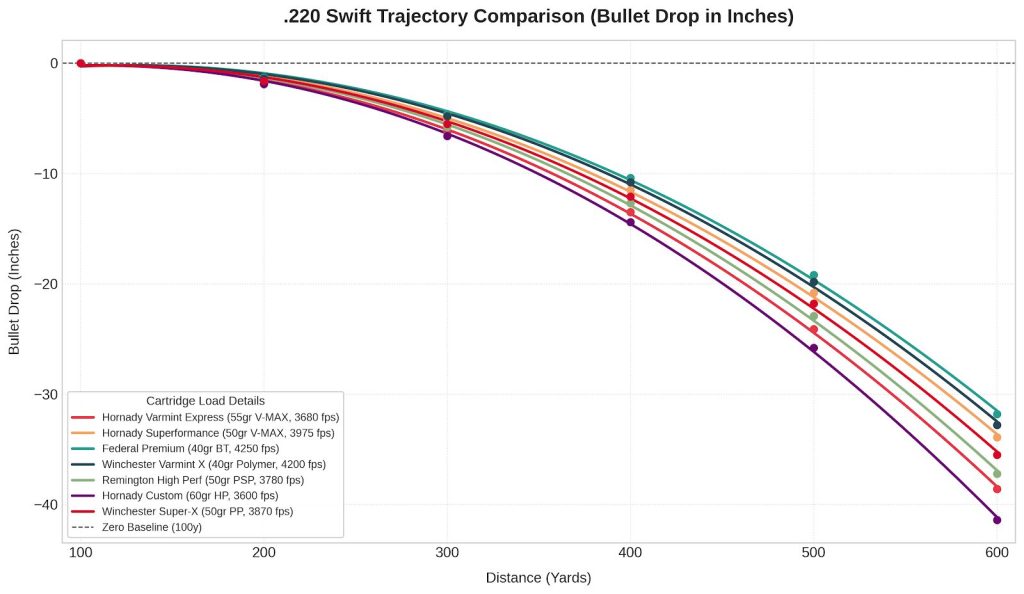
Readers should use this trajectory chart by first identifying their specific ammunition load and verifying the muzzle velocity matches their barrel performance. By selecting the recommended 200 yard zero, you can easily calculate the necessary elevation adjustments for various distances by observing the drop values listed in inches. Always cross reference your rangefinder readings with these drop figures to ensure your point of aim compensates correctly for the bullet arc.
Understanding The 220 Swift Trajectory Chart
The data provided in the table serves as the foundation for your ballistic calculations in the field. Understanding these values helps you anticipate how different bullet weights react to gravity as they travel downrange.
Trajectory Analysis
Comparing the 55 grain Hornady V-MAX against the 60 grain Hornady HP shows a clear distinction in long range performance. At 500 yards, the 55 grain load drops approximately 24.1 inches, whereas the heavier 60 grain load drops significantly more at 25.8 inches. This demonstrates that lighter bullets, like the 40 grain offerings from Federal, maintain a flatter flight path, dropping only 19.2 inches at that same 500 yard distance.
Velocity Analysis
Muzzle velocity is the primary driver of the 220 Swift’s flat trajectory. The Federal Premium 40 grain load hits an impressive 4250 fps, which results in the least amount of drop across all distances measured in our table. In contrast, the 60 grain load at 3600 fps exhibits a steeper arc, requiring more precise compensation as the distance increases toward 600 yards.
Ballistic Coefficient Analysis
The ballistic coefficient (BC) is a measure of a bullet’s ability to overcome air resistance. The 55 grain V-MAX boasts a BC of 0.255, which helps it retain energy and fight drag more effectively than the 50 grain Remington PSP, which has a lower BC of 0.175. Even though the Remington starts fast at 3780 fps, the superior BC of the V-MAX load allows it to maintain its velocity and trajectory profile better at distances beyond 300 yards.
Best Factory Loads Based On The Chart
For varmint hunting at mid ranges, the Hornady 50 grain Superformance load is an excellent choice, combining high velocity with a balanced drop profile. Predator hunters often prefer the 55 grain V-MAX due to its higher BC, which offers more stability against wind compared to the lighter 40 grain loads. For long range target shooting, the 60 grain load provides the most consistent performance, as the added weight helps buck wind deflection more effectively than the lighter options.
Key Takeaways From The Chart
The 40 grain Federal Premium load is the fastest factory offering in our table at 4250 fps, resulting in the flattest trajectory. The 55 grain Hornady V-MAX maintains the highest ballistic coefficient at 0.255, making it the most efficient load for retaining velocity downrange. The 60 grain load, while having the most drop, is the most robust option for long range work where wind conditions are a significant factor.
Common 220 Swift Bullet Weights
The 220 Swift is most effective when loaded with specific bullet weights designed for high velocity, typically ranging from 40 to 60 grains.
40 Grain
These bullets are the speed demons of the 220 Swift world, often exceeding 4200 fps. Their primary advantage is an extremely flat trajectory, making them ideal for short to mid range varmint hunting. The downside is that their low mass and low BC cause them to lose velocity rapidly and drift significantly in crosswinds beyond 300 yards.
45 Grain
The 45 grain weight offers a middle ground between the explosive nature of the 40 grain and the stability of the 50 grain. It is often favored by shooters who want a flatter trajectory than the 50 grain offers, but with slightly more resilience to light wind. It is an excellent all around load for small varmint nuisance control.
50 Grain
This is arguably the most versatile bullet weight for the 220 Swift. It balances high muzzle velocity, often around 3800 fps, with sufficient ballistic performance to remain useful out to 400 yards. It is the gold standard for many factory loads and provides a good compromise for hunters who occasionally encounter longer range shots.
55 Grain
The 55 grain bullet is favored for its higher ballistic coefficient and better performance in windy conditions. While it starts at a lower velocity than the 40 grain, its ability to retain that speed makes it more predictable at distances between 300 and 500 yards. This is a top recommendation for hunters who prioritize downrange precision.
60 Grain
The 60 grain load represents the heavier end of the factory standard for the 220 Swift. While it produces the most drop of the common weights, it provides the best sectional density and wind resistance. It is often chosen for target work or when hunting larger varmints where terminal energy retention at 400+ yards is a priority.
Effective Range
Varmint Hunting
For small varmints, the 220 Swift is effectively a 400 yard cartridge when using the 50 or 55 grain loads. The trajectory data confirms that drop remains manageable within this range, allowing for minimal holdover adjustments on targets the size of a groundhog.
Predator Hunting
When hunting predators like coyotes, the effective range is extended to roughly 500 yards, provided the shooter accounts for the ~20 to 25 inch drop shown in our chart. Beyond this distance, bullet energy may begin to drop below the threshold for clean, ethical kills on larger animals.
Target Shooting
The 220 Swift can be used for target shooting out to 600 yards. At this distance, the trajectory requires significant elevation compensation, but the inherent accuracy of the cartridge makes it quite capable if the shooter understands their specific drop values.
Long Range Shooting
Long range shooting beyond 600 yards is possible with the 220 Swift, but it requires precise ballistic software and consistent ammunition. The rapid velocity loss of .224 caliber bullets means that environmental variables like wind and humidity have a much greater impact at these distances compared to 6mm or 6.5mm alternatives.
Factors That Affect 220 Swift Trajectory
Bullet Weight
Lighter bullets accelerate faster but lose energy and velocity more quickly. Heavier bullets retain energy better and are less affected by crosswinds, as seen in the comparison between the 40 and 60 grain loads in our table.
Muzzle Velocity
Higher muzzle velocity directly correlates to a flatter flight path. Every increase in velocity reduces the time of flight, which leaves gravity with less time to pull the bullet down before it hits the target.
Barrel Length
Factory data is often based on 24 or 26 inch barrels. If your rifle features a shorter barrel, you will likely see a reduction in muzzle velocity, which will require you to adjust your zero or holdover data to compensate for a slightly steeper drop.
Ballistic Coefficient
A higher BC allows a bullet to cut through the air more efficiently. As shown in our analysis of the 55 grain V-MAX, a higher BC leads to less velocity loss over distance, which ultimately results in less vertical drop at long ranges.
Wind
The 220 Swift’s high velocity helps mitigate wind drift, but it does not eliminate it. Even with a fast 40 grain bullet, a strong crosswind will push the bullet off course, making high BC bullets like the 55 or 60 grain options preferable on windy days.
Temperature
Extreme temperature changes can affect both the powder’s burn rate and the air density. Higher temperatures can lead to higher muzzle velocities, while lower temperatures increase air density, causing more drag and a slightly lower point of impact.
Altitude
Higher altitudes mean thinner air, which creates less drag on the bullet. If you are shooting at high elevations, your bullets will fly flatter and hit higher than the trajectory chart would suggest based on sea level data.
Zero Distance
Selecting a 200 yard zero is the industry standard for the 220 Swift, as it creates a manageable arc that stays relatively close to the line of sight from 100 to 300 yards. Changing this to 100 yards would require significantly more elevation correction for any shot past 200 yards.
Best Zero Distance
100 Yard Zero
A 100 yard zero is perfect for dedicated short range precision. However, it results in more significant holdover requirements once you extend your range, making it less convenient for the long range capabilities of the 220 Swift.
200 Yard Zero
This is the most recommended zero for the 220 Swift. It aligns perfectly with the flat trajectory of the cartridge, allowing the shooter to aim point blank for most hunting scenarios out to roughly 250 yards without complex adjustments.
250 Yard Zero
Zeroing at 250 yards stretches the point blank range even further, allowing for deeper engagement into the 300 yard territory. This is ideal for open field hunting where the target size is large enough that a slightly higher mid range trajectory will not cause a miss.
220 Swift Compared To Similar Cartridges
| Cartridge | Trajectory | Velocity | BC | Effective Range | Wind Drift | Recoil |
| 220 Swift | Very Flat | Extreme | Moderate | 500y+ | Low | Very Low |
| 22-250 Rem | Flat | Very High | Moderate | 450y+ | Low | Very Low |
| 223 Rem | Moderate | High | Moderate | 300y+ | Medium | Minimal |
| 204 Ruger | Very Flat | Very High | Low | 400y+ | Low | Low |
| 224 Valkyrie | Flat | High | High | 600y+ | Very Low | Low |
The 220 Swift remains one of the fastest cartridges available, typically outpacing the 22-250 Remington by 100-200 fps. While the 223 Remington is much more common and easier to find, it cannot match the extreme velocity or flat trajectory of the Swift. The 204 Ruger offers similar speed but lacks the bullet weight diversity, while the 224 Valkyrie is designed specifically for long range efficiency with much higher BC bullets, even if it does not match the raw muzzle velocity of the classic 220 Swift.
Frequently Asked Questions
Is the 220 Swift still a good round for long range?
Yes, the 220 Swift remains an excellent long range varmint round due to its extreme velocity and flat trajectory, though it requires precise load selection to maximize consistency.
What is the best bullet weight for 220 Swift?
For most hunters, the 50 to 55 grain bullet range is considered the sweet spot, offering the best balance between high velocity and ballistic stability.
Does the 220 Swift burn out barrels faster than other 22 centerfires?
The 220 Swift has a reputation for being a “barrel burner” due to its extreme powder capacity and high velocity, though modern barrel metallurgy has significantly improved its lifespan compared to the original rifles from the 1930s.
Can I use 223 Remington data for my 220 Swift?
No, you should never use ballistic or load data from a 223 Remington for a 220 Swift, as the pressure levels and case capacities are completely different.
What is the effective range of the 220 Swift on coyotes?
With proper shot placement, the 220 Swift is highly effective on coyotes out to 500 yards.
Why do my 220 Swift shots drop more than the chart says?
If your shots are dropping more than expected, check your barrel length against the manufacturer’s test barrel length, as a shorter barrel will result in lower muzzle velocity.
Is the 220 Swift considered a match grade cartridge?
While not traditionally designed for precision matches, the 220 Swift’s inherent accuracy makes it very popular for benchrest and specialized long range varmint competitions.
Does wind affect the 220 Swift more than the 22-250?
No, due to the 220 Swift’s higher muzzle velocity, it generally drifts slightly less than the 22-250 when firing similar bullet weights.
What zero distance should I use for general varmint hunting?
A 200 yard zero is widely considered the best setup for general varmint hunting, providing the most versatile point blank range.
Are there any factory match loads available for the 220 Swift?
Yes, several manufacturers offer high quality loads, such as the Hornady V-MAX or Federal Premium lines, which provide excellent consistency for precision shooters.