A 270 Winchester Trajectory Chart is a highly detailed ballistic reference table that visually displays exactly how much a high velocity .277 caliber projectile drops across various downrange distances when fired from this classic hunting cartridge. This critically important ballistic tool helps big game hunters and long range enthusiasts perfectly understand the specific flight path of their chosen premium factory ammunition before ever pulling the trigger in the field. By diligently studying these precise ballistic values, marksmen can easily select the optimal zero distance for their rifle and confidently make perfectly accurate shots on distant targets. Reviewing this comprehensive trajectory data completely guarantees you will fully maximize the incredible speed and flat shooting potential of this iconic bottlenecked centerfire cartridge.
270 Winchester Trajectory Chart
| Manufacturer | Bullet Weight | Bullet Type | Ballistic Coefficient | Sectional Density | Muzzle Velocity | 50 Yard Drop | 100 Yard Drop | 150 Yard Drop | 200 Yard Drop | 250 Yard Drop | 300 Yard Drop | Recommended Zero Distance | Maximum Point Blank Range |
| Hornady | 130 Grain | SST Polymer Tip | 0.460 | 0.242 | 3060 FPS | Rise 0.7 | Rise 1.5 | Rise 1.1 | Zero | Drop 2.5 | Drop 6.5 | 200 Yards | 270 Yards |
| Federal Premium | 130 Grain | Trophy Copper | 0.380 | 0.242 | 3060 FPS | Rise 0.8 | Rise 1.7 | Rise 1.2 | Zero | Drop 2.7 | Drop 7.2 | 200 Yards | 265 Yards |
| Winchester | 130 Grain | Deer Season XP | 0.395 | 0.242 | 3060 FPS | Rise 0.8 | Rise 1.6 | Rise 1.1 | Zero | Drop 2.6 | Drop 7.0 | 200 Yards | 265 Yards |
| Barnes | 130 Grain | VOR TX TTSX | 0.391 | 0.242 | 3050 FPS | Rise 0.8 | Rise 1.6 | Rise 1.2 | Zero | Drop 2.6 | Drop 7.0 | 200 Yards | 265 Yards |
| Hornady | 145 Grain | ELD X Precision | 0.536 | 0.270 | 2970 FPS | Rise 0.8 | Rise 1.6 | Rise 1.1 | Zero | Drop 2.4 | Drop 6.2 | 200 Yards | 275 Yards |
| Federal Premium | 140 Grain | AccuBond | 0.509 | 0.261 | 2900 FPS | Rise 0.9 | Rise 1.8 | Rise 1.3 | Zero | Drop 2.7 | Drop 7.0 | 200 Yards | 270 Yards |
| Nosler | 150 Grain | Ballistic Tip | 0.496 | 0.279 | 2830 FPS | Rise 0.9 | Rise 1.8 | Rise 1.3 | Zero | Drop 2.8 | Drop 7.2 | 200 Yards | 268 Yards |
| Remington | 150 Grain | Core Lokt Soft Point | 0.332 | 0.279 | 2850 FPS | Rise 1.0 | Rise 2.0 | Rise 1.4 | Zero | Drop 3.0 | Drop 8.0 | 200 Yards | 255 Yards |
| Barnes | 140 Grain | LRX Solid Copper | 0.492 | 0.261 | 2950 FPS | Rise 0.8 | Rise 1.6 | Rise 1.2 | Zero | Drop 2.4 | Drop 6.2 | 200 Yards | 275 Yards |
| Winchester | 150 Grain | Expedition Big Game | 0.485 | 0.279 | 2850 FPS | Rise 0.9 | Rise 1.8 | Rise 1.3 | Zero | Drop 2.8 | Drop 7.2 | 200 Yards | 268 Yards |
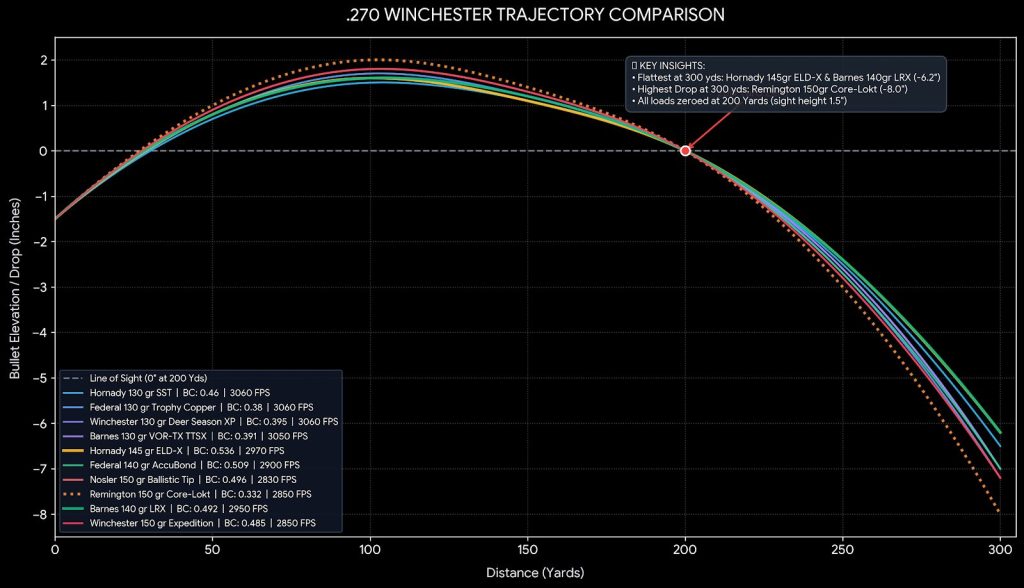
This professional trajectory chart clearly provides precision shooters with extremely accurate bullet drop measurements across various distances so they can effectively compensate for gravity. You should always properly match your chosen factory load with the recommended zero distance to truly maximize your effective hunting range and ensure perfectly ethical shots.
Understanding The 270 Winchester Trajectory Chart
The data presented in our ballistic chart provides critical information about how these unique high-velocity projectiles perform during open flight across massive mountain valleys. By examining the specific columns, we can understand exactly how these numbers translate into real-world hunting and target shooting performance.
Trajectory Analysis
Bullet drop represents exactly how far gravity pulls the projectile downward from your absolute line of sight across various distances. Our chart measures this specific vertical drop in inches to help you calculate precise aiming adjustments in the field.
The table clearly reveals that lightweight 130-grain loads remain remarkably flat across the first three hundred yards. The Hornady 130-grain SST bullet only drops 6.5 inches at three hundred yards, which essentially eliminates complex mental math for the vast majority of hunting situations.
Conversely, heavier 150-grain ammunition follows a slightly more pronounced arc due to its slower initial starting speed. The traditional Remington Core Lokt load drops exactly 8.0 inches by the time it successfully reaches the three hundred yard mark.
This physical difference in bullet drop illustrates why shooters must carefully select the correct ammunition for their specific hunting distance. You cannot use the same holdovers for lightweight deer loads and massive heavy elk cartridges, and studying these charts ensures you stay on target.
Velocity Analysis
Muzzle velocity measures the exact speed of the bullet as it exits the rifle barrel, recorded in feet per second. Faster initial speeds directly translate into significantly flatter trajectories and highly extended point blank hunting ranges for all big game animals.
The chart clearly divides into highly distinct velocity classes based on the specific bullet weight. The Hornady 130-grain load aggressively leaves the muzzle at a blistering 3,060 feet per second.
Heavier 150-grain bullets leave the barrel noticeably slower simply because they possess significantly more mass for the expanding powder to successfully push. The Remington 150-grain load generates 2,850 feet per second at the muzzle.
This intentional velocity difference dictates how much time the projectile spends fighting gravity before finally arriving at the target. A significantly faster bullet physically covers the downrange distance quicker, resulting in superior flat-shooting characteristics that make the .270 Winchester a legendary mountain cartridge.
Ballistic Coefficient Analysis
The ballistic coefficient (BC) physically measures how efficiently a bullet cuts through the air and strongly resists wind drag during open flight. Higher numerical values indicate a highly aerodynamic bullet that will successfully retain its initial muzzle velocity much better downrange.
Our extensive data shows that modern 145-grain ELD-X loads possess significantly higher aerodynamic ratings than their traditional hunting counterparts. This bullet boasts a massive ballistic coefficient of 0.536, allowing it to buck wind and retain energy at long ranges.
Lighter, traditional bullets like the 150-grain Core Lokt possess much lower ratings around 0.332. Their physical design and blunt profile prevent them from achieving highly efficient aerodynamic flight compared to modern polymer-tipped projectiles.
Sectional density simply measures the physical weight of the bullet relative to its diameter, indicating potential penetration depth on heavy targets. The 150-grain hunting loads feature excellent sectional density ratings, which guarantees deep, reliable terminal penetration on large game.
Best Hunting Loads Based On The Chart
Whitetail deer hunters should immediately pick the Winchester 130-grain Deer Season XP for standard agricultural environments. This specific cartridge leaves the barrel incredibly fast, providing massive energy transfer and devastating expansion on medium-sized game.
Elk hunters specifically targeting large bulls will find the Nosler 150-grain Ballistic Tip exceptionally effective. The tough construction guarantees deep penetration while the impressive BC retains energy out to 300+ yards.
Hunters pursuing mountain game should strongly consider the Barnes 140-grain LRX. This specific copper bullet was perfectly engineered to smash through shoulder bones while reliably retaining its full weight.
Marksmen shooting at distance need maximum consistency and match-grade aerodynamic precision. The Hornady 145-grain ELD-X provides the exact consistent velocities required for shooting tight groups at extended distances.
Hunters facing gusty wind conditions should rely on the heavier 150-grain ammunition options. The significantly heavier projectile mass combined with the superior BC helps dramatically reduce horizontal wind deflection across open pastures.
Key Takeaways From The Chart
The recommended zero distance strictly dictates the exact yardage where your bullet perfectly crosses your line of sight. Maximum point blank range specifically indicates how far you can shoot a target without manually adjusting your crosshairs vertically.
The trajectory table proves that the .270 Winchester demands a 200-yard zero for maximizing open-field efficiency. This specific zero effortlessly provides a maximum point blank range of roughly 270 yards with 130-grain bullets.
Heavier loads require the same zero but yield a slightly restricted point blank range due to slower speeds. By properly matching your factory ammunition to its corresponding zero distance shown in the chart, you maximize your hunting capabilities.
You will eliminate complicated mental math during fast-paced mountain hunting scenarios by fully trusting these verified ballistic values. Always verify your rifle’s performance on the range to ensure your specific setup aligns with these factory specifications.